0

Kia Seltos Earns a 5-Star Crash-Test Rating: A Big Win for Safety

Kia Seltos Earns a 5-Star

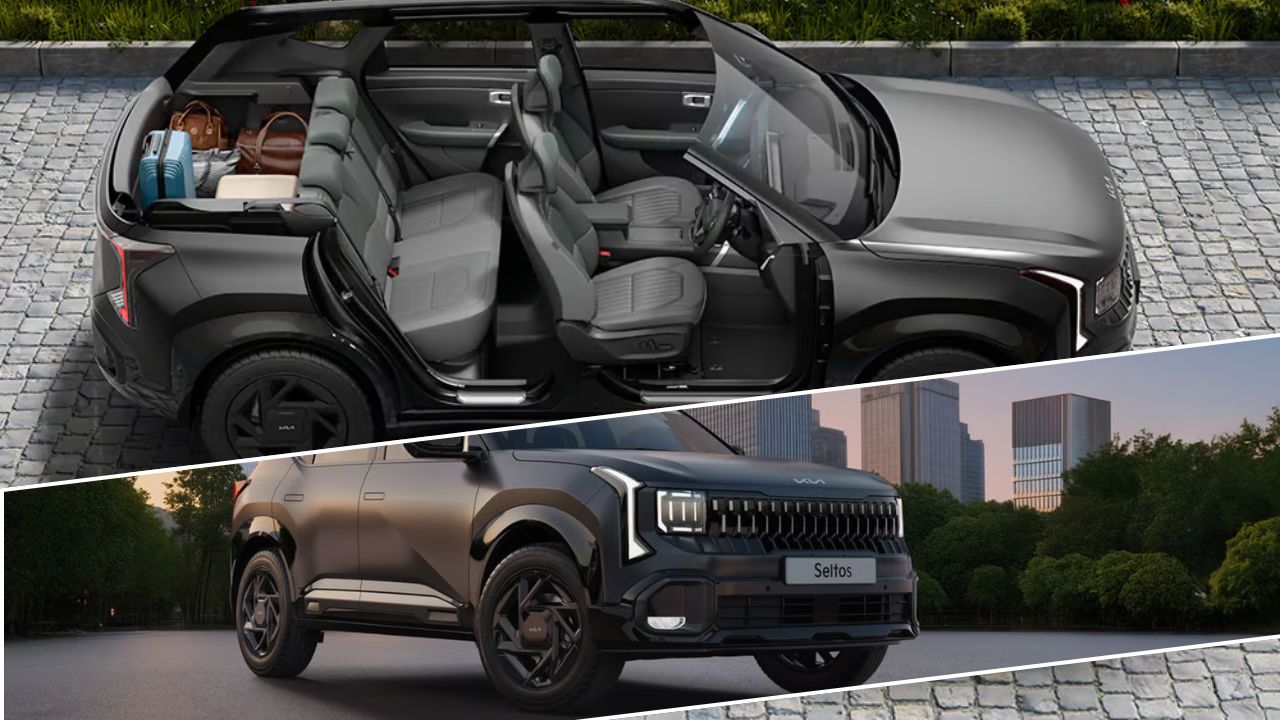
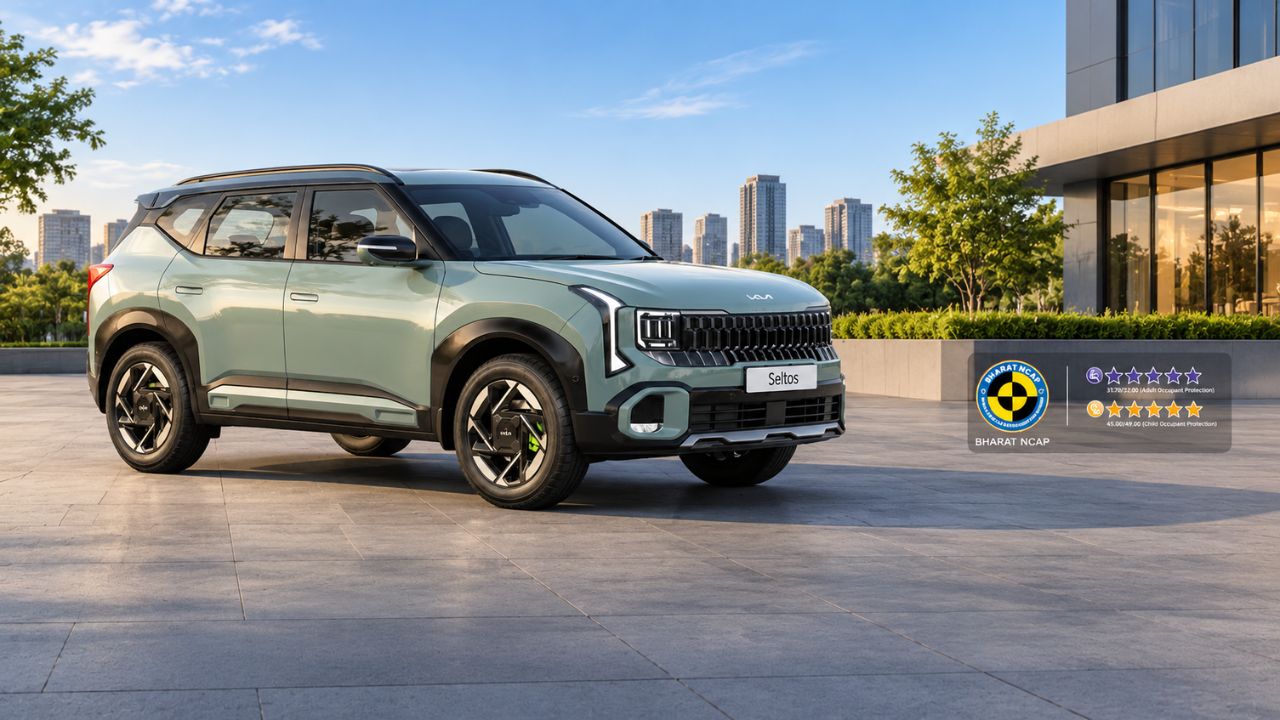
Kia Seltos Earns a 5-Star Rating from crash tests, providing another compelling reason for buyers to think about it. It got 31.70 out of 32 for adult occupant safety, and 45 out of 49 for child occupant safety in the new round of Bharat NCAP tests. You will be surprised by what these numbers say when you’re in search of an SUV for family. 

How Kia Seltos Earns a 5-Star in Bharat NCAP Crash Tests

Bharat NCAP tested the diesel-automatic HTE (O) and GTX trims. The agency says the rating applies to every variant in the range.

Adult protection came in at 31.70 out of 32. The frontal offset test earned 15.70 of 16, and the side barrier test earned a full 16 of 16. Child protection scored 45 out of 49, helped by full marks for the dynamic test and for child seat installation.

5-Star in Bharat NCAP

Kia says this is the highest adult score among petrol and diesel cars tested under the programme so far. That is Kia’s claim, so check the Bharat NCAP site for the current leaderboard. It’s also only the second Kia in India to earn five stars, after the Syros.

Why the Seltos’ Five-Star Safety Rating Matters for Buyers

Crash-test ratings are often overlooked when people choose a car. Many buyers focus on design, features, mileage, or price—but safety should always come first, especially for families.

This also demonstrates that the Seltos has demonstrated superior durability and restraint system performance in a controlled collision test, which means it turns out to be fair to its passengers that the interior cabin has been built with safety as its primary consideration in case of collision. 

The fact that the Seltos has got a high adult protection rating means that not only the driver but the front passenger also is protected very well.

Safety Features That Support the Rating

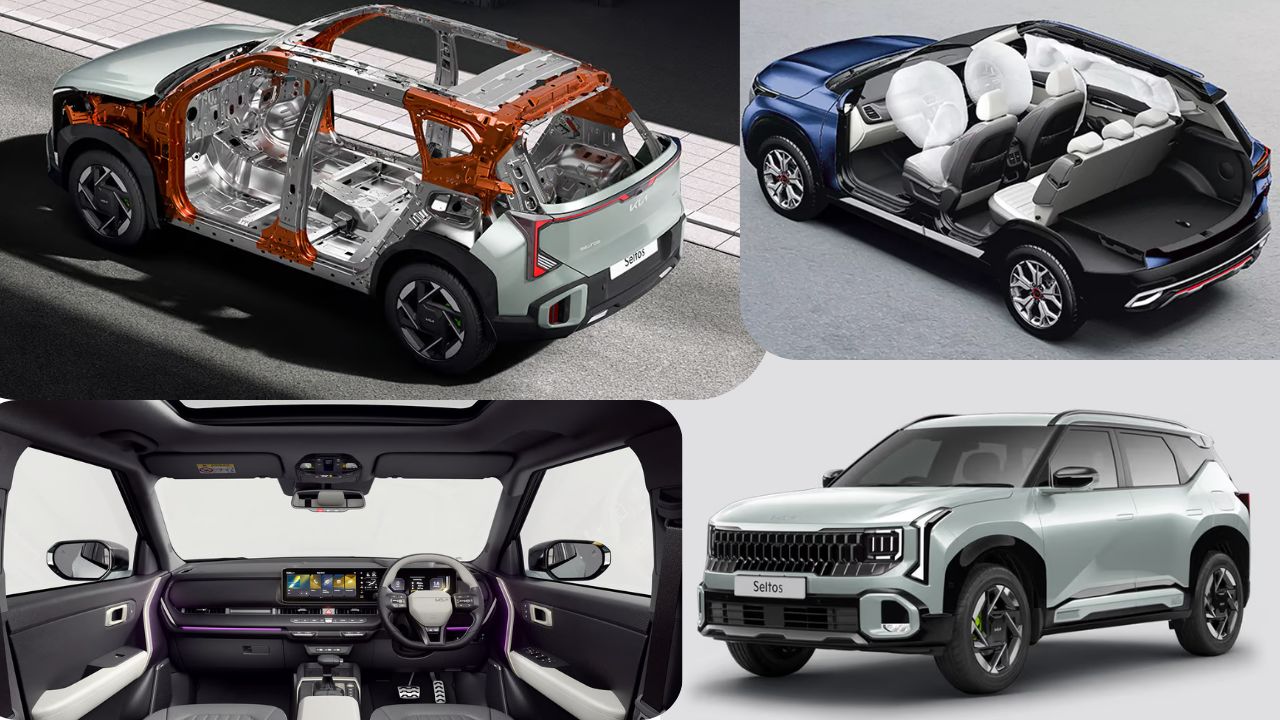
The Seltos comes with a comprehensive safety package that helps support its crash-test performance. Standard equipment includes six airbags, electronic stability control, ABS with EBD, and tyre-pressure monitoring.

These features work together in different ways:

  • Airbags help reduce impact forces during a collision.
  • ESC helps the driver maintain control during sudden manoeuvres or slippery conditions.
  • ABS and EBD improve braking stability.
  • Tyre-pressure monitoring helps prevent tyre-related risks before they become dangerous.

The Seltos also offers advanced driver-assistance features in higher variants, adding another layer of protection for everyday driving.

A Major Improvement for Kia

Kia Seltos Earns a 5-Star and it is especially important because the previous-generation Seltos had faced criticism for its Global NCAP performance. The new five-star Bharat NCAP result signals a clear shift in Kia’s approach to safety and structural engineering.

Kia Seltos Earns

This is a comforting move for the Indian buyers because Seltos has always been known to be popular due to its style, comfort, features, and presence on the roads. According to the official statement by Kia India, the Seltos achieved the maximum adult occupant protection rating among the internal combustion engine cars tested under the Bharat NCAP, as well as one of the maximum child protection ratings.

What This Means for Buyers

If you are planning on buying a midsize SUV, the Seltos is now known not just as a car loaded with features and style, but as a car that also puts safety first. The Kia Seltos Earns a 5-Star rating assures parents that their car has been independently tested for safety of its occupants.

Yet, there is no rating that will be able to replace safe driving. The use of seat belts, child safety seats, correct seating posture, and attentive driving is still crucial. Safe cars offer protection, but responsible driving avoids many accidents.

Explore👉 Tesla Cybercab: How Much Will the Driverless Robotaxi Cost?

Conclusion

The Kia Seltos Earns a 5-Star Rating from a crash test. With an adult safety score of 31.70 out 32 and a 45 out of 49 for child safety, it proves that not only is this a great looking vehicle but it is a great family vehicle with great safety features.

For buyers who want style, comfort, technology, and safety in one package, the new Seltos has made a very strong case for itself.

Bipin Sharma

Bipin Sharma is a seasoned automotive content writer with over 10 years of hands-on experience in the world of cars. From the latest car news and reviews to in-depth maintenance tips and expert buying guides, Bipin covers everything that drives the automotive world. Writing about cars isn’t just his profession — it’s his passion. His deep industry knowledge and love for automobiles fuel every blog he creates, helping readers make informed decisions and stay updated on the fast-evolving auto landscape.

Leave a Reply

Your email address will not be published. Required fields are marked *

1

4 Best Renault Cars to Buy in India: Kwid, Triber, Kiger and Duster

Published Nov 10, 2026, 2:00 PM
Last Updated Nov 16, 2026, 3:31 PM

Best Renault Cars

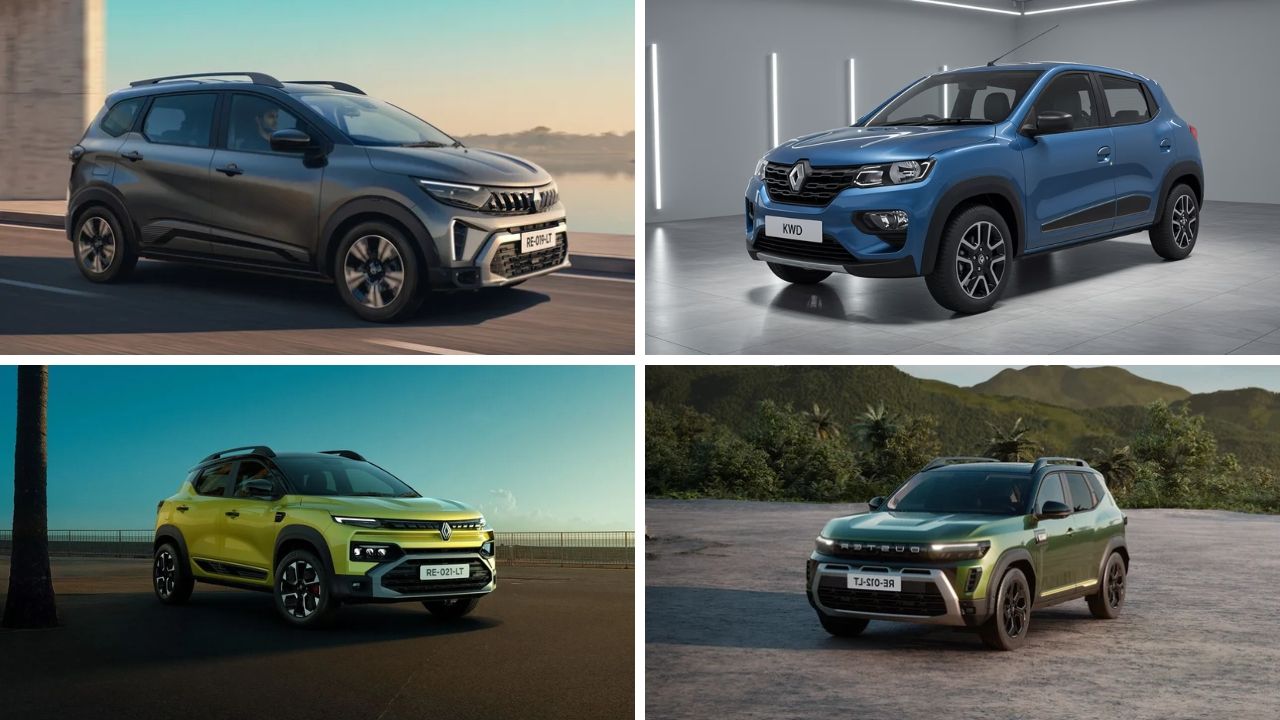
Most people who walk into a Renault showroom already know their budget but not their car. If you are trying to work out which of the Best Renault Cars to buy, the answer depends less on specs and more on who sits in your back seat. Kwid, Triber, Kiger, and Duster stack up in a worth buying list.

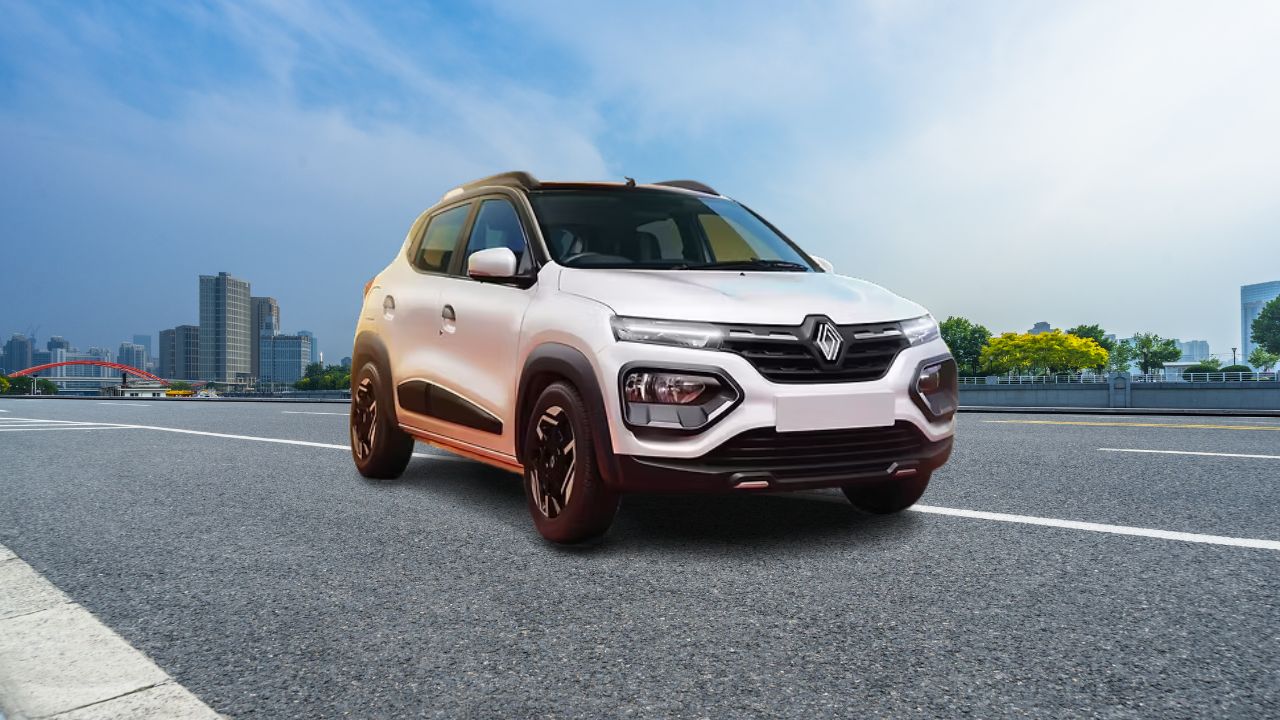
1. Renault Kwid: the city car that looks bigger than it is

The Renault Kwid is priced at ₹4.30-4.53 lakh ex-showroom price. This is the entry level price which offers a 1.0L petrol engine with a manual transmission. The price goes higher with AMT gearbox or advanced features variant.

Renault Kwid

The mileage is about 21 kmpl with SUV styling design which gives it a more substantial look than an entry-level hatchback. At higher speeds, you may find the engine is working too hard on the road, which gives you a slightly stiffer ride on the highway.

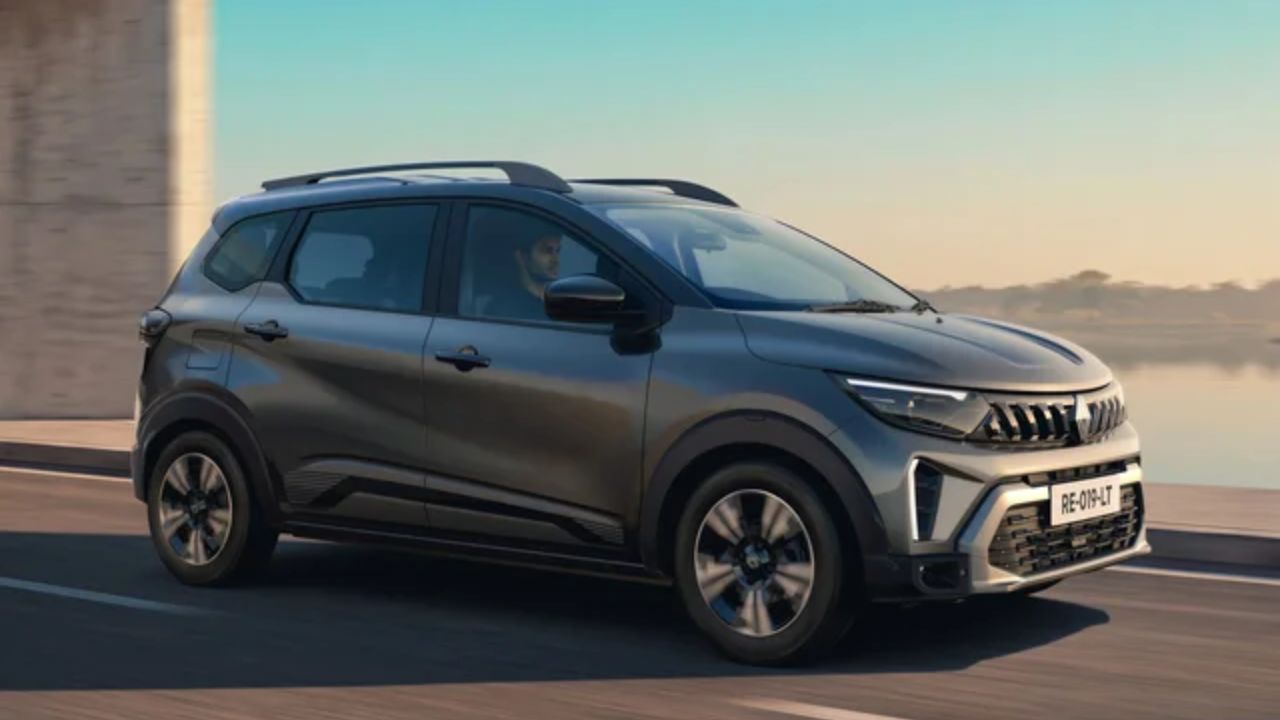
2. Renault Triber: a seven-seater under four metres

The Triber is the odd one out in a good way. The refreshed 2026 model starts at ₹5.80 lakh and pairs a 1.0-litre petrol with a five-speed manual or an Easy-R AMT on the top trim.

Renault Triber

Few cars at this price give a family of five or six this much flexibility, and the removable third row is what you are paying for. The catch is that with all seven seats up, boot space nearly disappears, and the engine is not built for loaded hill roads. Against the Nissan Gravite, which sits in a similar bracket, the Triber has the longer track record. If your budget stretches, the Maruti Ertiga starts around ₹8.80 lakh and is the more relaxed long-distance option. Best for: joint families and occasional airport runs.

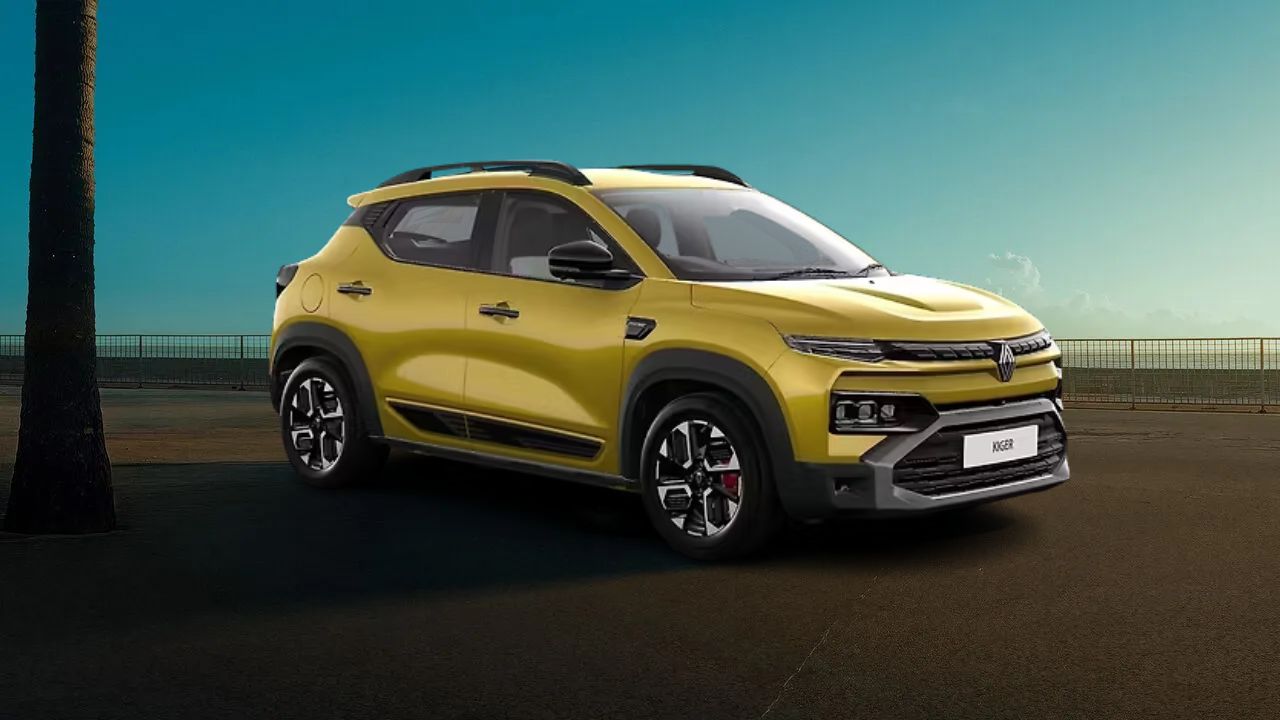
3. Renault Kiger: the one that does the most with the least

The Renault Kiger is priced at ₹5.81 lakh. This is the starting price which can go higher up to roughly ₹10.34 lakh for higher variants. The car offers a 1.0L petrol turbo engine which produces about 100 PS, with manual and automatic options.

Renault Kiger

Kiger offers a natural aspiration turbo so it is the one worth buying. It gives the overtaking experience relaxed rather than other naturally aspirated versions. The Kiger rear-seat space is slightly tight which makes taller people uncomfortable. 

Renault Kiger rivals Nissan Magnite priced at ₹5.65-10.96 lakh. It became a rival because they share the same structure so the real difference is brand name and service network.

Best for: couples and small families who want SUV looks on a sensible budget.

4. Renault Duster: the comeback car

The third-generation Duster launched this year at ₹10.49 lakh. The price goes up with more features and comfort up to ₹18.49-18.69 lakh. It gives a 1.0 L turbo makes 100 PS of power and a 1.3-litre turbo making roughly 160 PS with manual and DCT options, and it earned a five-star Bharat NCAP rating in April 2026.

It remarkably secured its position at safety with a strong engine. But the higher variant cost is equal to Creta which makes it question the buyer. Hyundai Creta becomes the biggest rival. 

One caution: the strong-hybrid version is reportedly sold out for 2026 and expected later, so do not wait for it without confirming a date with your dealer. 

Best for: buyers who want a proper family SUV and will keep the car for years.

Conclusion 

The Best Renault Cars you should buy in India depends on what you need it for and how much you can afford. It is wise to buy the Kwid for affordable metropolitan use. An ideal choice for newbies is the Triber, the back seat, if you need seven seats for the family, and the Kiger, which looks and performs like an SUV. 

0

Top 10 Most Fuel-Efficient Cars in India Under ₹10 Lakhs You Must See in 2025

Published Oct 3, 2025, 9:23 AM
Last Updated Apr 24, 2026, 11:19 AM

The 2025 Indian sub-₹10 Lakh automotive market is driven by ultra-low running costs, making CNG cars being the most popular option as they cost 50-60 percent less on fuel compared to petrol. Maruti Suzuki Celerio (34.43 km/kg) and Wagon R (34.05 km/kg) are two such models that set the efficiency benchmark.

Good hybrids (Grand Vitara, Urban Cruiser Hyryder) provide great mileage however are beyond this price range as they are priced above ₹10 Lakh.

Value shoppers must choose between:

  • Most Mileage Cars (Celerio, WagonR, AltoK10) Are Economical But Have Poor Safety Ratings (0–2 Stars).
  • Safer modern alternatives (Maruti Dzire – 5 star, Tata Tiago – 4 star) are a bit costlier, but they offer vital occupant safety.

Fuel Efficiency is Shaped By Two Key Realities:

ARAI vs Real-World Mileage

Since ARAI certified figures are laboratory tested and are doubtful.

City mileage in real life is relatively up to 47% lesser (Wagon R CNG claims 34 km/kg, but its real life mileage is 22 to 26 km/kg).

Efficiency needs to be calculated a little differently: km per litre for petrol/diesel, km per kg for CNG and the true financial metric is Cost per km (CpK) – and in terms of CpK, CNG comes out as the winner for the fuel is dirt-cheap.

Market Barrier for Hybrid Technology in India

Decent hybrids (like Grand Vitara, Urban Cruiser Hyryder) may come close to high mileage (28 kmpl) but still are out of reach in this segment, with prices commencing well over ₹10 Lakh (generally ₹17 Lakh+ on-road).

So, in the sub ₹10 Lakh buyers have to bank on CNG to get significant savings, with sophisticated hybrid efficiency being available only at the upper end of the cost spectrum. 

For the value-conscious consumer CNG is still the only viable option to really achieve Total Cost of Ownership (TCO) savings though that can really cash in only if consumers temper their expectations to the reality in real world mileage and not inflated ARAI figures. 

The Top 10 Fuel Efficiency Cars (Under ₹10 Lakhs)

Factory-fitted CNG variants, which come with the highest certified mileage figures, take the top spot in the the conclusive list of the most fuel-efficient cars under ₹10 Lakhs. The list below has been prepared on the basis of highest ARAI-certified efficiency figure of a single variant in all the cars available under the price cap of ₹10 Lakhs Ex Showroom for major metros.

Model/Variant Fuel Type ARAI Certified FE (km/unit) Ex-Showroom Price (₹ Lakhs)
Maruti Suzuki Celerio CNG 34.43 km/kg ₹ 6.65 – 8.64 Lakhs
Maruti Suzuki Wagon R CNG 34.05 km/kg ₹ 6.80 – 8.96 Lakhs
Maruti Suzuki Dzire Tour S  CNG 34.3 km/kg ₹ 7.19 – 9.00 Lakhs
Tata Tigor CNG 33.1 km/kg ₹ 6.49 – 8.90 Lakhs
Maruti Suzuki Alto K10 CNG 31.59 km/kg ₹ 5.50 – 7.18 Lakhs
Maruti Suzuki Baleno CNG 30.61 km/kg ₹ 7.70 – 9.10 Lakhs
Hyundai Aura  / Grand i10 Nios  CNG 28.0 km/kg ₹ 8.00 – 9.00 Lakhs
Tata Tiago  CNG 26.49 km/kg ₹ 6.15 – 8.00 Lakhs
Maruti Suzuki Swift Petrol 25.75 kmpl ₹ 6.49 – 9.64 Lakhs
Honda Amaze Petrol 25.0 kmpl ₹ 7.92 – 9.50 Lakhs

The clearest feature of this list is the undeniable dominance of Maruti Suzuki: it takes 7 places out of the top 10. This widespread presence especially in the top CNG high-efficiency slots cements Maruti’s strategy of Efficiency as Core value Proposition. The company holds an edge to this day in its unique engineering of small displacement, highly tuned engines and integrated factory fitted CNG solutions.

The final two spots are taken by none other than Maruti Suzuki Swift and Honda Amaze. It shows that even a highly tuned petrol engine cannot objectively compete with the volumetric efficiency, cost efficiency and performance offered by MCNG. Pure petrol variants are becoming a second option to mileage-conscious buyers and more for those living in areas that are not that well connected with CNG refilling infrastructure. 

Read More:- EV vs Petrol vs Hybrid: Which Car Type Is Perfect for You in 2025?

In-Depth Profiles of the Top Cost-Efficiency Leaders

Maruti Suzuki Celerio

The Maruti Suzuki Celerio is a good hatchback in the Maruti range and has been one of the highest selling from the segment largely due to its fuel-efficient engines, especially the CNG version. It offers 1.0-litre three cylinder petrol engine paired with 5-speed manual or AMT gearbox, power steering, front power windows, keyless entry and a 7-inch touchscreen infotainment system.

Image credit: MarutiSuzuki

It provides maximum cabin space, while the size of the exterior is kept to a minimum. Dual front airbags are offered along with ABS with EBD, rear parking sensors and more.

Maruti Suzuki Wagon R

The Maruti Suzuki Wagon R is a tallboy hatchback which is known for its spacious cabin and tall roofline. It has two powertrain options: 1.0-litre and 1.2-litre petrol engines, both with the choice of manual and AMT transmission. It is also available in a factory fitted CNG variant for more mileage efficiency.

Image credit: MarutiSuzuki

It comes with provisions such as 7-inch touchscreen, steering-mounted audio controls, power adjustable mirrors, rear seats that split-fold. Standard safety provisions on the hatchback include two airbags, ABS with EBD, rear parking sensors and it is well poised to attract new car buyers in the urban Indian market.

Maruti Suzuki Dzire Tour S

The Dzire Tour S is focused on commercial and taxi purposes. It comes with a 1.2-liter petrol engine with CNG and petrol variants and a 5-speed manual gearbox. The sedan is also appreciated for having a large boot (378 liters) and for its economy, more so when running on CNG.
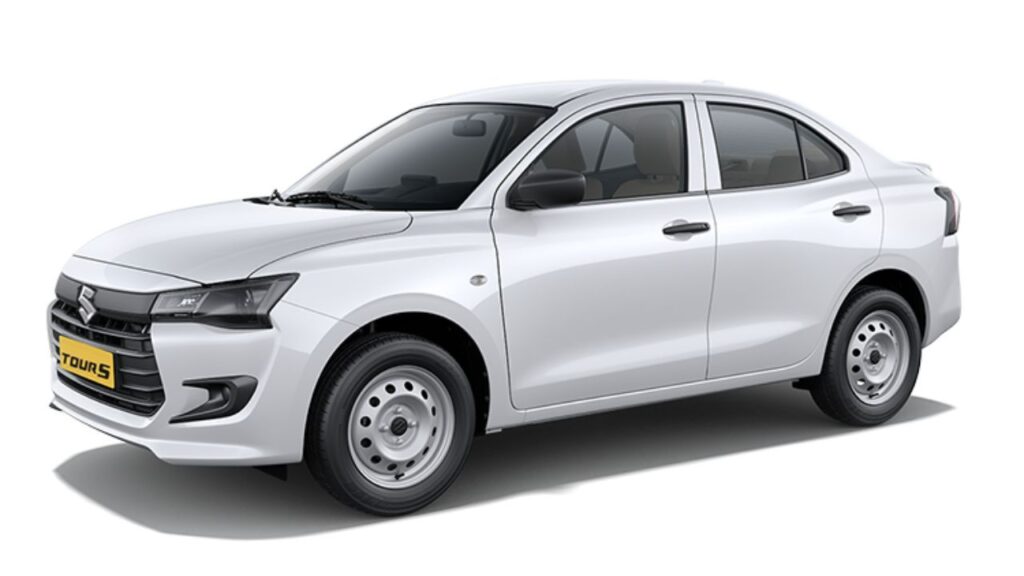
Image credit: MarutiSuzuki

The most important specifications are front power windows, central locking, manual air conditioning, 2 airbags with ABS. Its rear seat is road-trip viable and it continues to be a preferred selection among fleet purchasers.

Tata Tigor

The Tata Tigor is a small sedan that runs a 1.2-litre three-cylinder petrol engine, it competes in CNG and petrol variants. “It boasts with being a coupe-like styled vehicle, 419-liter boot capacity, has safety with 4-star GNCAP crash rating.

Image credit: TataMotors

Includes – touchscreen infotainment system with Android Auto and Apple CarPlay, climate control, projector headlamps, rear parking camera. Tigor pays focus on structural safety and cabin comfort, so it’s safe for your family and strong enough for your day to day.

Maruti Suzuki Alto K10

Alto K10 is one of India’s bestselling entry-level hatchbacks. It is powered by a 1.0-liter three-cylinder petrol engine and is also offered with a factory-fitted CNG kit.

Image credit: MarutiSuzuki

Basic power steering, front power windows, manual air conditioner and a rudimentary infotainment system on the higher variants are the key features. There are dual airbags but safety is minimal. Alto K10 is light and nimble making it a great city car for new car buyers and daily users.

Maruti Suzuki Baleno

The Baleno is a premium hatchback from Maruti Suzuki and is powered by 1.2-litre petrol engine and comes with an optional CNG kit. Transmission options include a manual and an AMT automatic. Highlights of the specifications: 9-inch SmartPlay Pro+ infotainment, LED projector headlamps, 360-degree camera, cruise control.
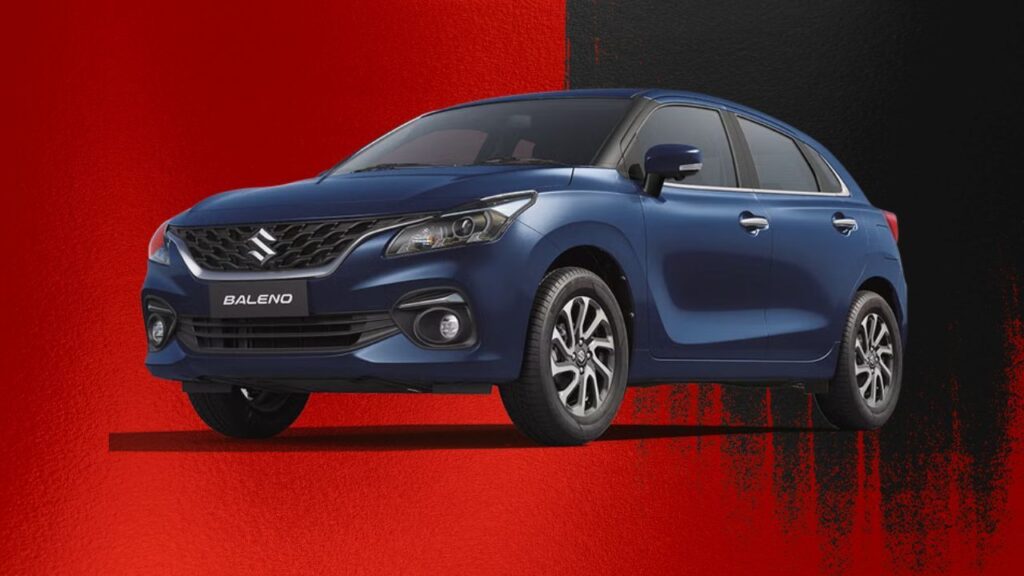
Image credit: MarutiSuzuki

Six airbags in top models, ESP, hill hold assist, and rear parking sensors all come as standard safety features. The Baleno is also revered for its spacious cabin and refined ride quality and is very popular among small families.

Hyundai Aura  / Grand i10 Nios 

The Hyundai Aura is small sedan and the Grand i10 Nios is a hatchback, however both vehicles share the same platform and 1.2 liter engine in petrol, CNG and diesel forms. The highlight features include an infotainment touchscreen with smartphone connectivity, automatic climate control, wireless charger, and rear AC vents.

Image credit: Hyundai

Both are good for comfortable riding and they also provide practical boot space for a hatchback and compact sedan respectively. Safety consists of dual front airbags, ABS with EBD, and stability control on the higher variants, making it a value-for-money choice for those looking for practical needs.

Tata Tiago 

Tata Tiago, a compact hatchback, is equipped with a 1.2 liter three-cylinder petrol engine and the variants on offer are petrol and CNG. It boats robust build quality with 4 star GNCAP safety rating. Additional features are an infotainment touchscreen, dual zone climate control, 8-speaker Harman audio, reverse parking sensors and two airbags.

Image credit: TataMotors

The Tiago is lauded for its fun-to-drive dynamics, safety and youthful design, making it a great choice for small families and city runs.

Maruti Suzuki Swift

The sporty Maruti Suzuki Swift hatchback comes with a 1.2-liter petrol engine and AMT option. Highlights of the car are LED headlamps, 7-inch touchscreen, automatic climate control, and push-button start.

Image credit: MarutiSuzuki

It manages to be fuel efficient yet delivers peppy performance and is equipped with dual airbags, ABS, and ISOFIX mounts for safety. The Swift is known to add a youthful and energetic charm to the general object of its ownership.

Honda Amaze

Honda Amaze is a petrol-powered compact sedan with a 1.2-litre engine and CVT automatic now available as an option. It’s all about comfortable seating and sensible space, with a 420-litre boot.

Image credit: Honda

Highlights of the vehicle are its 7-inch infotainment system with Android Auto/Apple CarPlay, dual-zone climate control, cruise control, and rear camera.Safety kit Standard a – dual airbags, ABS with EBD and rear parking sensors. Its refined engine and smooth ride make it the best family sedan in India.

Conclusion

Maximizing ROI in 2025 The Best Financially Prudent Option In 2025 For High Usage Indian Consumers With A Budget Of Under ₹10 Lakh Is A Stock CNG Car. The difference in running costs is so great that the initial extra outlay is quickly recovered. Now for the discerning customer would be when choosing the contemporary, structurally safe CNG options (Dzire, Baleno, Tiago/Tigor) that blend best in class operational efficiency with high safety standards to deliver end to end maximum value for money and protection in the long run.

0

Hyundai Venue vs Kia Sonet: Which Compact SUV Wins the Battle?

Published Aug 18, 2025, 10:19 AM
Last Updated Apr 11, 2026, 11:11 AM

The compact SUV has emerged as a first choice between petrol and electric models. As the market looks to 2025, Hyundai Venue vs Kia Sonet offer a blend of fuel efficiency, performance, and advanced features that make them increasingly attractive for any SUV buyer. In the early Q1 of 2024 & 2025 hybrid electric vehicles have increased their sales more than other electric or plug-in hybrid vehicles. The increasing growth of these SUVs makes them a strong contender. People’s preferences have shown for these new hybrid electric models of Hyundai and Kia.

Let’s look into the details of these compact SUVs such as price, performance, fuel economy, safety features, and what makes them a strong contender in 2025 SUVs. 

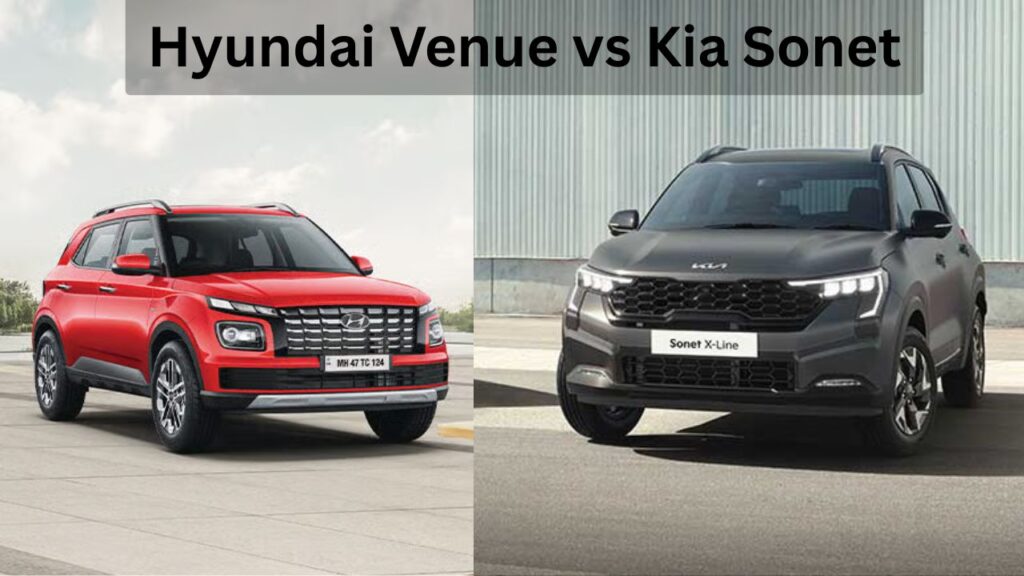
Hyundai Venue vs Kia Sonet: The 2025 Best Compact SUVs 

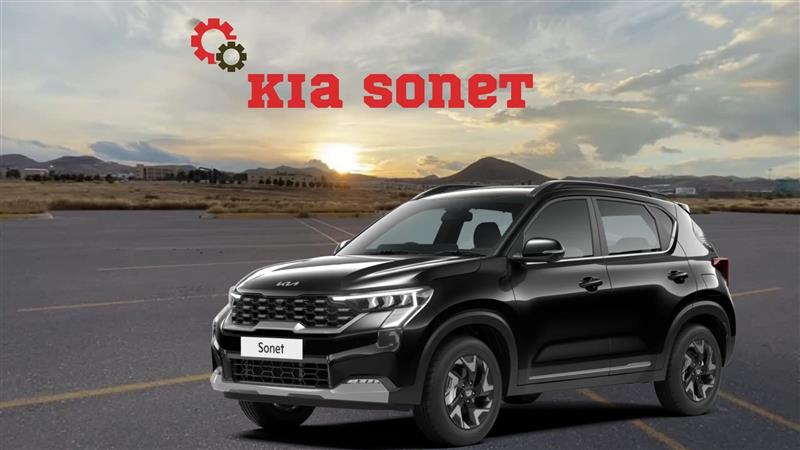
Kia Sonet

The Kia Sonet is on the top consistently due to its powerful performance and other key points which attract the most is industry-leading reliability and future-rich interior making it a strong contender in its segment. It offers a perfect balance of fuel efficiency and practicality. 

The 2025 model comes with a mileage of up to 18.4 kmpl for petrol and 24.1 kmpl for diesel variant. A 1.2L petrol engine with 5-speed manual transmission, 1.0L turbo-petrol with 7-speed DCT, and 1.5L diesel engine with 6-speed manual transmission.

The Kia Sonet starting price is around $9,600 to $10,000. It offers the best safety features to keep the passenger safe during the crash with multiple airbags, ABS safety function, dynamic cruise control, lane assist, and pedestrian detection.

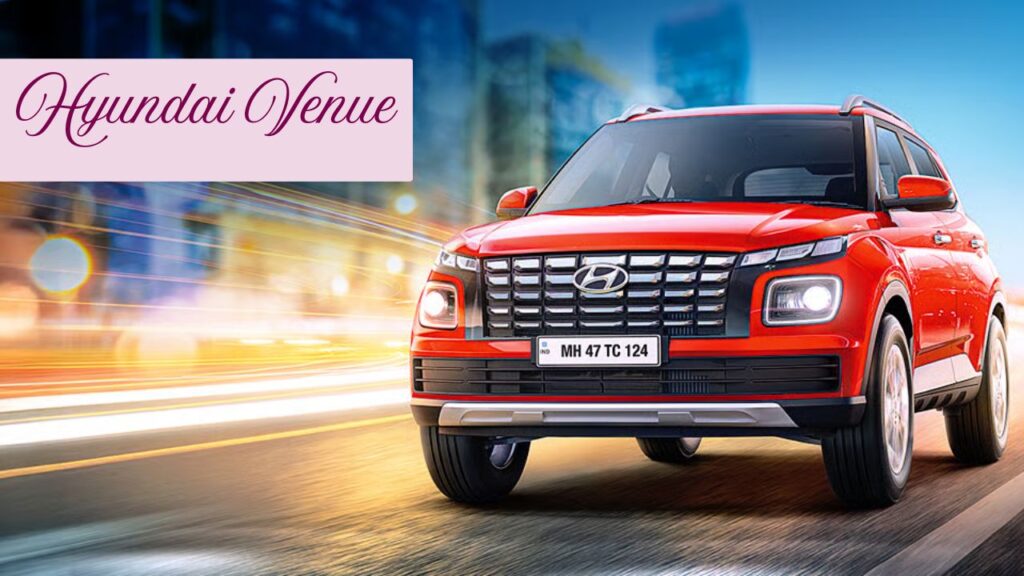
Hyundai Venue

The Hyundai Venue brings new design in both exterior and interior. The Hyundai Venue 2025 is a significantly popular model in many international markets and offers high-premium features for comfortable trips that includes leatherate seats and fuel efficiency. 

The starting price of Hyundai Venue is around $20,200. This highly powerful model is delivering 1.2-litre naturally aspirated petrol engine without automatic transmission, but DCT is available in the 1.0-litre turbo petrol engine. 

Its impressive features include safety functions – drive assist, collision warning, and lane departure detection. Its angular design looks inspired by other Hyundai SUVs like the Alcazar, the sleek impression with its new front is remarkable. 

Hyundai Venue vs Kia Sonet: Same DNA, Different Flavors

While there is comparison between powerful compact SUVs which offer impressive looks, it is hard to decide which one is more strong and reliable. Both Hyundai Venue and Kia Sonet are built on K2 small car architecture offering the same structural parts that lead to similar driving dynamics and safety fundamentals.

Engines Both SUVs Share

The 1.2-litre naturally aspirated petrol engines are not very quick but almost reliable and fuel efficient to deliver 5-speed manual ride and 83 PS power. The 1.0-litre twin turbo engine produces 120 horsepower and 172 lb-ft of torque which delivers fast speed with 6-speed iMT clutchless manual or 7-speed dual clutch automatic for smoother gear switching.

Kia Sonet’s Extra Power Options

For those buyers who want more power, a 1.5L petrol engine offers incredible power. Sonet’s 1.5L diesel engine delivers 6-speed manual and automatic power that delivers better fuel efficiency and high torque for rush and highways. 

Venue no longer offers these features including automatic mode in diesel, it makes Sonet a best choice.

Read More 👉  Tata Nexon vs Hyundai Creta: Which 2025 SUV Will Rule the Roads?

Comfort & Interiors: Which SUV Feels More Premium?

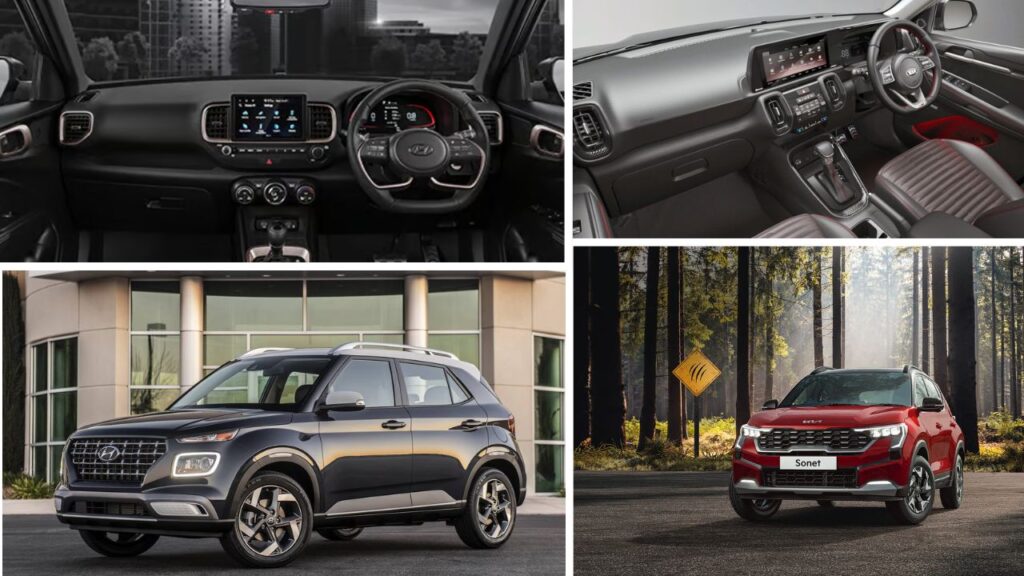
The 2025 Hyundai Venue offers softer seats with original material, 4-way adjustable feature and 2-step reclining gives comfortable rides to its passengers. It offers 5 passenger seating, its modern and user-friendly cabin is the major selling point of Venue. The high quality material giving a premium look with various colour options might set an amazing impression.

The 2025 Kia Sonet is offering a premium look with more cabin space and cargo space for passengers. Long trips can no longer be hard with its comfortable ventilated seats that deliver power-adjustable to hot weather. Electric sunroof and automatic climate control is more attractive to the buyer who wants an SUV for longer trips without compromising their comfort.

Category Venue 2025 Sonet 2025
Starting Price  $34,050 $36,100
Engine Options 1.2L & 1.5L  1.2L & 1.5L 
Max Power 113bhp  114bhp 
Max Torque 250Nm  250Nm 
Transmission Options 6-speed MT 6-speed MT
Mileage (ARAI) Up to 24.2 km/l  Up to 24.1 km/l 
Boot Space 350 litres 385 litres
Fuel Tank Capacity 45 litres 45 litres
Ground Clearance 190 mm 205 mm
Safety Features 6 Airbags, ABS, EBD, Rear Parking Camera 6 Airbags, ABS, Rear Parking Camera, ADAS, 360° Camera
Modern Tech  360° Camera, Wireless Charging, Sunroof  ADAS, Digital Driver Display, Powered Driver Seat, Ventilated Seats, Sunroof

Final Verdict

With the modern design and advanced features Hyundai Venue vs Kia Sonet compact SUVs are hitting at the top rank consistently. The high demand for these is rising due to their safety functions, impressive look and most importantly they are hybrid models. As the world evolves in the automotive landscape, the SUV has more demand in the market. 

Which one should you buy? It is totally up to your priorities and budget, choose the right vehicle for your convenience because both offer somewhat same engines, design with little difference in their interior and budget. Overall, both are best and get positive reviews from consumers.

0

Inside Daniel Craig’s Garage: A Breathtaking Collection of High-End Automobiles

Published Oct 13, 2025, 6:33 AM
Last Updated Apr 9, 2026, 11:21 AM

Daniel Craig's Garage

Look inside Daniel Craig’s garage and know what astonishing cars he has, it looked like ripped right from a James Bond film. Daniel Craig the handsome British star known for his role as James Bond has made a lot of his fortune estimated at $160 million. Along with the amazing net worth, Craig has a luxury car collection that is worth approximately $625,000. Instead of many celebrities who show off their luxurious lifestyles via social media, Craig keeps the low-profile and private, which makes his car collection a little mysterious. Fans are left to wonder what fat cats he might have tucked away in his garage. Whether a classic Aston Martin or something less expected, Craig’s desire to keep his personal life under wraps makes his choice of wheels that much more interesting.  

The Aston Martin Vantage Roadster: A British Icon Reborn

The crown jewel of Craig’s car collection must be the Aston Martin Vantage Roadster, a sleek beauty with $194,500 price tag. This convertible supercar shouts James Bond vibes, ticking all of the boxes for the classy style Craig exuded on screen. Under the bonnet it’s got a monstrous 6.0-litre V12 delivering 510 bhp and 420 lb ft. This car is engineered for some serious fun, with its seven-speed automated manual transmission.

Aston Martin Vantage Roadster

And it’s no slouch either—0 to 60 miles per hour in 3.5 seconds, 190 miles per hour top speed. Let’s be honest, this isn’t your everyday grocery-getter — it’s a ride for someone who adores speed and elegance. The execution is equally exhilarating, boasting the British marque’s signature ‘Z-fold’ convertible system, which they describe as not only faster to retract but lighter than conventional systems. It’s the ideal combination of power, performance and style, and ready to turn heads wherever it goes. 

This two-seater offered the best of British automotive engineering, stunning speed matched with open-air refinement that gave Craig access to the entire soundscape of the V12. 

Audi R8: Precision Redefined

Craig’s Audi R8 brings German engineering to the forefront, a supercar known for combining performance with everyday usability. This thing has a 5.2-liter V10 engine that produces 562 horsepower, which allows it to sprint from zero to sixty in a little more than three seconds.

Audi R8

The R8’s fluid bodywork and technology-packed interior demonstrate that it loves driving purity. From Craig navigating London traffic to Hill driving mountain roads, this Audi delivers thrill and assurance in a sleek, under-stated modern face. 

A Touch of Nostalgia: Aston Martin Vanquish and DBS

Other than Daniel Craig on-screen performance with Aston Martin Vanquish but he once had this beautiful car in his own garage. While the car has been sold, rumors say Craig had a soft spot for the 5.9-liter V12 beast. Once the Vanquish was bespoke as a Centenary Edition for Craig as the highest grossing actor for Aston Martin, it achieved a mind blowing $468,500 at auction.

Aston Martin Vanquish

The collection also boasts the stunning Aston Martin DBS, which starred in “Casino Royale” – making Craig one of the rare Bond actors who has owned his character’s signature car off the big screen. 

Jaguar XJ: British Luxury With Attitude

A bond collection is nothing without a Jaguar, and Craig’s Jaguar XJ is suave and strong. Included in Skyfall, this sedan packs a 5.0-liter V8 and can take Craig from zero to sixty in a bit more than four seconds.

Jaguar XJ

With its plush seating and cockpit that’s as high-tech as the XJ’s comes, it’s the perfect chariot for city-slicking with serene regality. 

Range Rover Sport: Utility Meets Style

Amid the supercars and saloons, Craig’s Range Rover Sport injects flexibility and rugged appeal into his stable of vehicles. It’s not a display vehicle, this $81,100 Sport is engineered to take a beating on rugged country roads as well as city streets.

Range Rover Sport

With a turbocharged, inline-six engine, off-road systems and luxury features, the Range Rover allows Craig to travel in comfort, regardless of the location. 

Reliving Bond’s Legacy: Aston Martin DB5

The legendary Aston Martin DB5 is particularly close to Craig’s heart. Although it’s unclear whether it has any Q-style gadgetry, the car itself is worth $3,195,000, it gets higher depending on condition.

Aston Martin DB5

The DB5’s classic British lines and straight-six engine remind us all why it’s the most iconic Bond car of all time. 

The Everyday Choice: Ford Mondeo

Bond also owns a Ford Mondeo – the same vehicle he drove in “Casino Royale.” The Mondeo gave Craig a way to fly under the radar, with its practicality and 2.5-litre engine.

Ford Mondeo

This saloon serves to remind us that not every day is spent in the thick of high-octane action – a bit of anonymity is sometimes just what the secret agent needs. 

Car Model Engine / Power 0-60 mph Top Speed Key Features Price (USD)
Aston Martin Vantage Roadster 6.0L V12, 510 hp, 420 lb-ft 3.5 seconds 190 mph Z-fold roof, 7-spd automated manual, British style $194,500 ​
Audi R8 5.2L V10, 562 hp, 406 lb-ft 3.2 seconds 205 mph 7-spd auto, quattro AWD, modern design $161,395 ​
Aston Martin Vanquish 5.9L V12, 565 hp, 457 lb-ft 4 seconds 183 mph Lux interior, 6-spd auto manual, rare model $450,000 ​
Jaguar XJ 5.0L V8, 385 hp, 460 lb-ft 4 seconds 115 mph Lux sedan, plush interior, 6-spd auto $76,000 ​
Range Rover Sport 3.0L Turbo I6, 355 hp, 365 lb-ft 6 seconds 130 mph Premium SUV, tech features, 8-spd auto $81,100 ​
Aston Martin DBS V12, manual, (Bond film) 4 seconds 190+ mph Bond car, gifted after Casino Royale $300,000+ ​
Aston Martin DB5 4.0L inline-6, 282 hp 7.1 seconds 142 mph Classic Bond car, legendary design $3,195,000+ ​
Ford Mondeo 2.5L, 220 hp 7.3 seconds 152 mph Practical, HMI display, Bond “Casino Royale” car $30,000-$55,000

Read More :-  The 2025 Toyota Camry: Performance, Features, and Safety

Conclusion

Craig’s cars aren’t just costlier but they’re selected for emotional value and connection to his legacy as Bond. Although a few of the vehicles were provided as gifts from movie deals, the majority represent a true love of craftsmanship, performance and style. He’s a leading man who actually drove many of the cars that audiences saw him commandeer as 007, straddling the line between “Bond” fantasy and automotive actuality. 

What makes Daniel Craig’s garage so incredible is not just the price (an estimated $625,000 all in) but it’s the story behind each vehicle, the mix of cinematic history and personal taste. To Craig, cars are not simply things. They’re memories, milestones and homages to the driving experience. 

0

Toyota Urban Cruiser BEV Teased in India: Launch Timeline, Range, Features & Price

Published Jan 7, 2026, 12:48 PM
Last Updated Apr 10, 2026, 7:19 AM

Toyota Urban Cruiser BEV

If you are among those waiting for a right-sized, family-friendly electric SUV from Toyota for India — now the wait just got a whole lot more exciting. Toyota has now officially teased the Toyota Urban Cruiser BEV (Battery Electric Vehicle) for India for the very first time, hinting that the launch is just around the corner. This is not just some other concept or a long-term promise- this is a near-production electric SUV ready for India and it will hit showrooms soon.

​In this blog, let’s check predicted features, design, battery choices, and what makes the Urban Cruiser BEV very likely to be one of the most buzz-worthy EVs in the Indian market. 

First Clear Glimpse Of Toyota’s India-Spec EV

New teaser unveiling Urban Cruiser BEV front and side views provides a solid glimpse at Toyota’s design language for its first electric SUV in India.

  • The SUV features slim LED headlamps with eyebrow-style DRLs and are connected by a light strip, lending it a contemporary look. 
  • As one would expect on an EV, the grille is closed and rendered in body colour or piano black, hiding the front behind clean, futuristic-looking material. 
  • The bonnet is sculpted and the aggressive bumper stance is tough enough for an SUV.
  • On the side, you also see the ‘BEV’ badge right behind the charging port, confirming this is a full electric vehicle. 

The overall India-spec Urban Cruiser BEV appears very near to the concept. It’s production-ready and stylish but not particularly flashy or experimental. 

Shared DNA With Maruti e Vitara – But With Toyota Flavour

Toyota Urban Cruiser BEV is based on the Maruti Suzuki e Vitara platform. Both electric SUVs will be produced at Maruti Suzuki’s Gujarat plant and are built on the same EV underpinnings.

Toyota Urban Cruiser BEV

In other words, it’s Toyota’s take on Maruti’s first electric SUV – same base, different design. They are expected to be close in size, measuring about 4.2-4.3 meters long with a 2,700 mm wheelbase, which would position them in the midsize SUV category. You’ll also find the same EV platform, flat floor, battery configuration, and similar powertrain and range options.

The difference is in the design and branding behind which Toyota is well known. The Urban Cruiser BEV has Toyota-specific design features and details of lighting, alloy wheels and trims and includes Toyota’s global design language and brand reliability. 

Toyota Urban Cruiser BEV Expected Features & Interior

Although Toyota has not shown the inside of the India-spec Urban Cruiser BEV as of yet, thanks to the global car and e Vitara, we know what will be on offer:  ​  

Two-spoke steering wheel with a chunky, modern design – similar to recent Maruti/Toyota models. A 10.25-inch touchscreen infotainment system with connected car technology, navigation, smartphone connectivity, and may be some built-in apps. A 10.1-inch fully digital instrument cluster that displays EV-related details such as range, battery status, energy flow, drive modes and regen levels.  

Premium options are expected to be: 

  • Heated Auto climate control
  • Electronic Park Brake with Auto Hold
  • Wireless charging
  • JBL sound system (high spec models)
  • Panoramic or single-pane sunroof (variant dependent).

Speaking of practicality, the overseas Urban Cruiser EV and e Vitara feature sliding rear seats that slide forwards and backwards to offer flexibility between rear legroom and boot space.This is a very user-friendly feature for Indian families who often juggle airport runs, city commutes, and highway trips in one car»rdquo; 

Safety Kit will also likely be robust:

  • 6 airbags as standard
  • Level 2 ADAS suite including adaptive cruise control, lane-keep assist, lane departure warning, pre-collision warning.
  • ​A 360-degree camera, TPMS, ESC, front and rear parking sensors.

All in all, the Urban Cruiser BEV appears to be a comfortable, technology-laden, and safety-centric EV SUV — not just a “born-electric experiment.” 

Urban Cruiser BEV Battery Options and Range

There will be two battery options for the Urban Cruiser BEV and range is left to be one of its biggest “excitement” factors.

Urban Cruiser BEV battery options & range

Battery: Toyota will probably provide a 49 kWh battery and a bigger 61 kWh battery. The smaller pack is estimated to output around 143–144 PS, while the bigger one could pump out about 173–174 PS. 

Powertrain: Both are likely to be front wheel drive secures. A global version with AWD is available, but whether it will be released in India is still unknown.

Range: The 61 kWh battery claims to give more than 500 km ARAI cycle range which is similar to that of the Maruti eVitara with a claim of 543 km. On a practical standpoint, the range is probably good for 350–400 km, which is plenty for daily commuting in addition to weekend jaunts.

Charging information has yet to be announced, but DC fast charging and a home AC wall charger should be available. 

Launch Timeline & Expected Price In India

The Toyota Urban Cruiser BEV is anticipated to bring its India debut in the coming days. After its full disclosure, some reports suggest that 19 January may be the date of the launch.

Launch Timeline & Expected Price In India

As for the price, it is likely to be priced in the range of ₹16 lakh to ₹22 lakh (ex-showroom) approximately depending upon the variant and battery pack. 

Conclusion

The Toyota Urban Cruiser BEV is poised to be a very good and value-for-money guess of this new segment in India’s electric SUV market. It is a familiar, family-based SUV model, but with contemporary EV technology, long-range claims, and Toyota reliability. sharing underpinnings with the Maruti e Vitara, buyers get a proven platform, while Toyota adds its own styling, tuning, and brand value.

If priced right, the Toyota Urban Cruiser BEV will be a fine compromise of pragmatism, performance, features, and safety. Indian families who want to move away from petrol or diesel SUVs but don’t want to take that dangerous jump to going electric, this is quite possibly one of the most well-rounded, and confidence-inspiring, EV options you’ll find.