
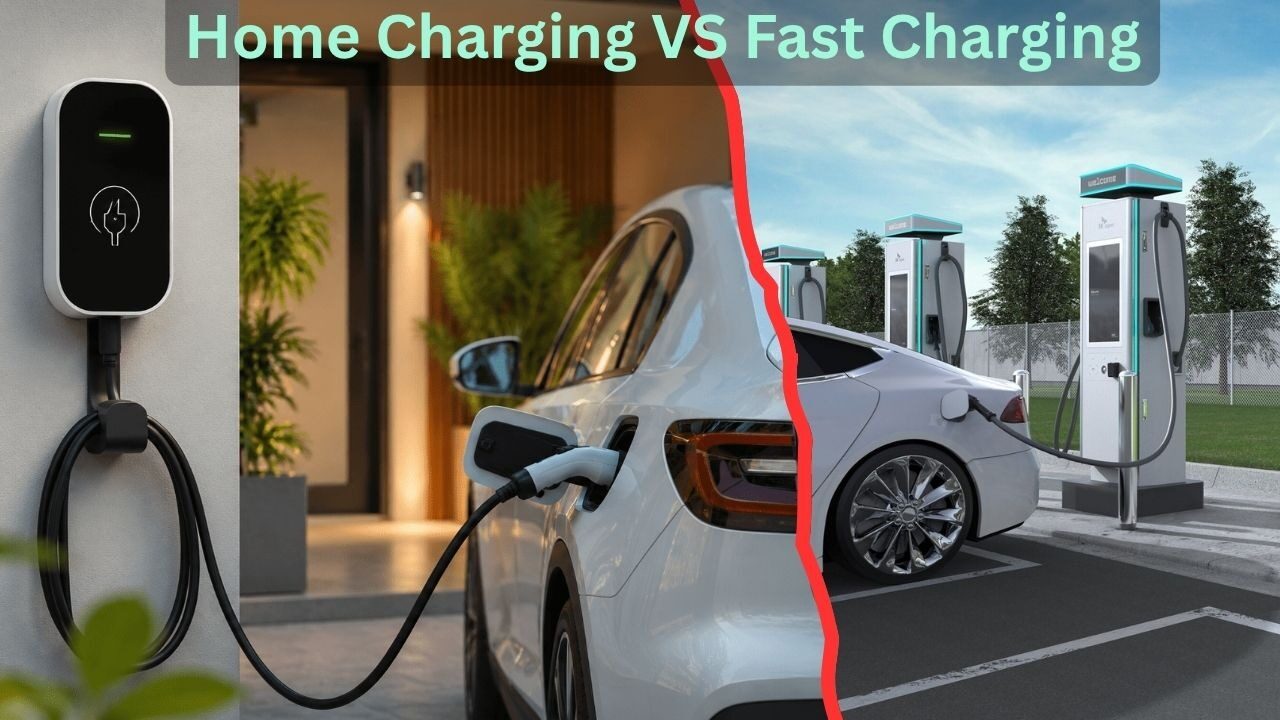
Buying an EV is not as hard as choosing a charging method that matches with your lifestyle, expense, and daily convenience. Fast Charging vs Home Charging is not a debate in which one can win, there are different answers from EV car owners themselves. But if you are going to buy an EV car and are confused about the charging method then this blog will make you understand how these two charging methods work.
1. Home Charging: The Reliable Anchor
Home charging usually means an AC charger — either the basic 15A plug that comes with most EVs or a dedicated wall box installed by the manufacturer or a third-party installer. It’s slow by design. A typical home setup adds roughly 8 to 15 km of range per hour, depending on your car’s onboard charger and your home’s power supply.
For most owners, this means plugging in overnight and waking up to a full battery, every single day, without ever visiting a charging station.
The Advantages
- Massive Cost Savings: Home electricity tariffs—especially off-peak or night-rate smart tariffs are incredibly cheap. You’re paying your domestic electricity tariff, not a premium station rate.
- Increases Battery Lifeline: Slow AC charging produces less heat and stress on lithium-ion cells which increase the battery health. It means your EVs battery won’t be damaged in early years as they experience low average battery degradation of only 1.5% per year, according to large-scale telematics data.
- Convenient for City commuters: You don’t have to stand in the line for hours at the station so this home charging method becomes handy. Once you plug in at night, you will get a fully charged vehicle in the morning.
The Disadvantages
- Slow Speed: If you need range back in an hour, home charging won’t deliver it since it almost takes from 6 to 12 hours to fully charge a depleted battery.
- Installation cost and Wiring Upgrades: You have to purchase and install a proper wall box plus wiring upgrade as recent data highlights that nearly 45% of older residential homes or apartment blocks require a minor electrical grid to handle the load that costs you real money.
- The Apartment or Rentals problem: If you live in an apartment without assigned parking or society approval for a wall box then home charging isn’t an option for you. Even renters and people in shared housing are cut off from this option as they don’t own the parking.
Who It Fits Best
It fits if you live in an independent house or an apartment with assigned covered parking, your daily driving is mostly within city limits, and you can plug in every night without a second thought. This covers a large chunk of EV buyers in Tier 1 and Tier 2 Indian cities who bought an EV specifically to cut down on daily commute costs.
Cars That Require It Most
Compact or Mid-size EVs and Plug-in Hybrid are required for home charging most. Some reliable EVs such as MG Comet, Tata Tiago EV don’t need high-powered DC fast charging as their batteries are small. If you can afford overnight charging at home then these cars are the best options to buy. And home charging is the cheapest and most convenient way to keep them running.
2. DC Fast Charging: The Road Trip Fuel
Fast charging refers to DC charging stations — the ones you find at highway plazas, malls, and dedicated charging hubs from networks like Tata Power, Statiq, or ChargeZone. These can take a battery from near-empty to 80% in anywhere from 20 minutes to an hour, depending on the car’s charging capability and the station’s output.
The Advantages
- Incredible Speed: Fast charging can boost the battery from 20 to 80 percent in as little as 20 to 40 minutes.
- Enables Long-Distance Travel: That’s the only practical choice for highway travel, it effectively erases range anxiety on highways, making hundred-mile cross-country road trips feasible.
- Growing Network: Car manufacturers and the government are working to increase the charging stations. They are rapidly growing as car owners are shifting from petrol to EV cars.
- People who don’t own parking spots: Perfect for apartment dwellers, renters now buy an EV for city commute. Similar to a fuel station visit.
The Disadvantages
- Premium Pricing: Public fast chargers are businesses with high operational overhead. You will pay 2 to 3 times more per kilowatt-hour (kWh) here than you would on your home utility bill.
- Slightly Higher Battery Wear: Pushing massive amounts of current creates internal heat. Fleet tracking data shows that vehicles relying exclusively on high-power DC fast charging experience an average annual degradation of up to 3.0%.
- The Taper Effect: Fast chargers slow down significantly after hitting 80% to protect the battery cells from overheating, meaning the final 20% takes frustratingly long.
Who It Fits Best
If you live in a rented flat or a society without charging approval, you regularly drive between cities, or your job involves long daily distances that a single overnight charge can’t cover. It also fits anyone whose EV is a second car used mainly for longer, less predictable trips rather than a fixed daily commute.
Cars That Require It Most
In Premium & high-range EVs, the advanced 800V battery is fixed to run the engine for many kilometers. Big range EVs like Hyundai Ioniq 5, Kia EV6, or Porsche Taycan are equipped with this battery. These vehicles are specifically engineered to gulp down 250+ kW of power, allowing them to extract maximum utility from ultra-fast public networks.
Read More :- Mercedes Benz CLA 250+ Real-World Range Tested
The Fair Comparison of Fast Charging vs Home Charging
| Factor | Home Charging | Fast Charging |
| Speed | 8–15 km/hour (slow, overnight) | 0–80% in 20–60 minutes |
| Cost per charge | Lowest — domestic tariff | Higher — commercial station rate |
| Battery health impact | Minimal stress, better long-term health | More heat, faster degradation if overused |
| Convenience | High, if you own your parking | High, but requires a trip to a station |
| Upfront cost | Wall box + installation charges | None — pay per use |
| Best for | Daily commuting, city driving | Highway travel, no home parking, urgent top-ups |
| Availability | Depends on your housing situation | Depends on your city/route infrastructure |
The Car Matters More Than People Admit
A city-focused compact EV with a smaller battery — the kind bought mainly for daily office commutes leans almost entirely on home charging, since the battery is rarely drained enough to need a fast-charge stop. Premium EVs built on big batteries to give longer range are particularly bought for highway trips. They depend on a strong fast-charging network, because home charging alone can’t refill a large battery overnight for back-to-back long drives.
In short: Compact everyday EVs are designed to run on home charging, meanwhile long-range and luxury EVs are designed to run highways with fast-charging availability.
Your Car’s Battery Chemistry (LFP vs. NMC) That EV Buyers Often Forget
Lithium Iron Phosphate (LFP) — The LFP battery is known for being long lasting. They handle aggressive fast charging with close to zero additional degradation, and they can be charged to 100% every day, safely.
Nickel Manganese Cobalt (NMC) — NMC batteries are more susceptible to heat and high voltage. If you’ve got a vehicle with an NMC battery, it thrives on slow charging at home, and you’d best think of DC fast chargers as something you need just for occasional road trips.
Read More :- Best Automatic Cars in India Under 10 Lakhs – Easy Driving Options
Why This Comparison Actually Matters for EV Buyers
Most people cross-shop EVs by comparing range and price, and treat charging as an afterthought they’ll figure out later. That’s backwards. Your charging setup determines your real-world cost of ownership, how fast your battery degrades over five to eight years, and whether owning an EV is even convenient for your specific living situation.
Two people can buy the identical car and have completely different ownership experiences — one because they have a private garage and never touch a public charger, the other because they’re queuing at a mall charger three times a week. The charging question isn’t a footnote. It’s arguably more important than the range number on the brochure.
Why Buyers Should Plan for Both
The most realistic approach isn’t picking one — it’s building a routine where home charging handles 80-90% of your needs, and fast charging exists as a backup for the days that don’t fit the routine: a road trip, a forgotten overnight charge, an unexpectedly long day of driving.
Buyers who plan around both, rather than betting on one exclusively, tend to get the best of both worlds — low daily running costs from home charging, and the flexibility to never be stranded, thanks to fast charging when it’s genuinely needed.
Crucial Factors EV Buyers Often Forget
- Check your onboard charger’s AC limit before buying a wall box. Some EVs cap AC charging speed regardless of how powerful your home charger is — paying for a high-output wall box in that case is wasted money.
- Society approval can take longer than expected. If you live in an apartment, start the RWA approval process for a charging point well before your car is delivered.
- Fast charging isn’t available at the same speed everywhere. Not all “fast chargers” are equal — output varies station to station, so your actual charging time on the road can differ a lot from the advertised number.
- Battery warranties usually still apply regardless of charging method, but manufacturers often quietly recommend limiting fast charging to occasional use rather than a daily habit, for exactly the degradation reasons mentioned above.
Read More :- The Future of Electric Vehicles: What Drivers Need to Know
Conclusion
Home charging wins on cost and battery health. Fast charging wins on speed and flexibility. Neither one replaces the other — they solve different problems. The right question isn’t “which is better in Fast Charging vs Home Charging,” it’s “how much of my driving is predictable daily commuting versus unpredictable long-distance travel,” because that answer decides how much you’ll actually lean on each option.
