

Advanced Driver Assistance System is a friend of driver in new cars as safety tech to prevent the crash. That vagueness is the problem. ADAS isn’t one feature. It’s a bundle of separate systems, each doing a very specific job, and understanding them individually is the only way to actually judge whether a car’s ADAS package is worth paying for — or whether it’s mostly a marketing sticker.
ADAS features fall into three buckets — ones that warn you (FCW, LDW, BSM), ones that act for you (AEB, LKA, ACC), and ones that inform you (TSR, TPMS, parking cameras). A car with a long feature list might lean heavily on the “inform” bucket, which sounds impressive but does less heavy lifting than one solid AEB system.
So let’s break it down properly, one system at a time.
What Does ADAS Actually Stand For?
ADAS stands for Advanced Driver Assistance Systems. The keyword there is assistance — not automation. Every ADAS feature is built to support the driver, not replace them. When you drive a car with an ADAS system, it watches the road through cameras, radar, and sensors, to detect any object or something so it intervenes with a warning or a slight correction that driver might miss.
The car suddenly braking up front, a vehicle slowly drifting into your lane, a pedestrian emerging from between parked cars. Think of it less like autopilot and more like a very alert co-passenger who’s looking at the rearview mirrors and road behind you at the same time you’re looking at the road in front of you, and who taps you on the Shoulder or takes the wheel for half a second when something feels off.
How ADAS Actually Works Behind the Scenes
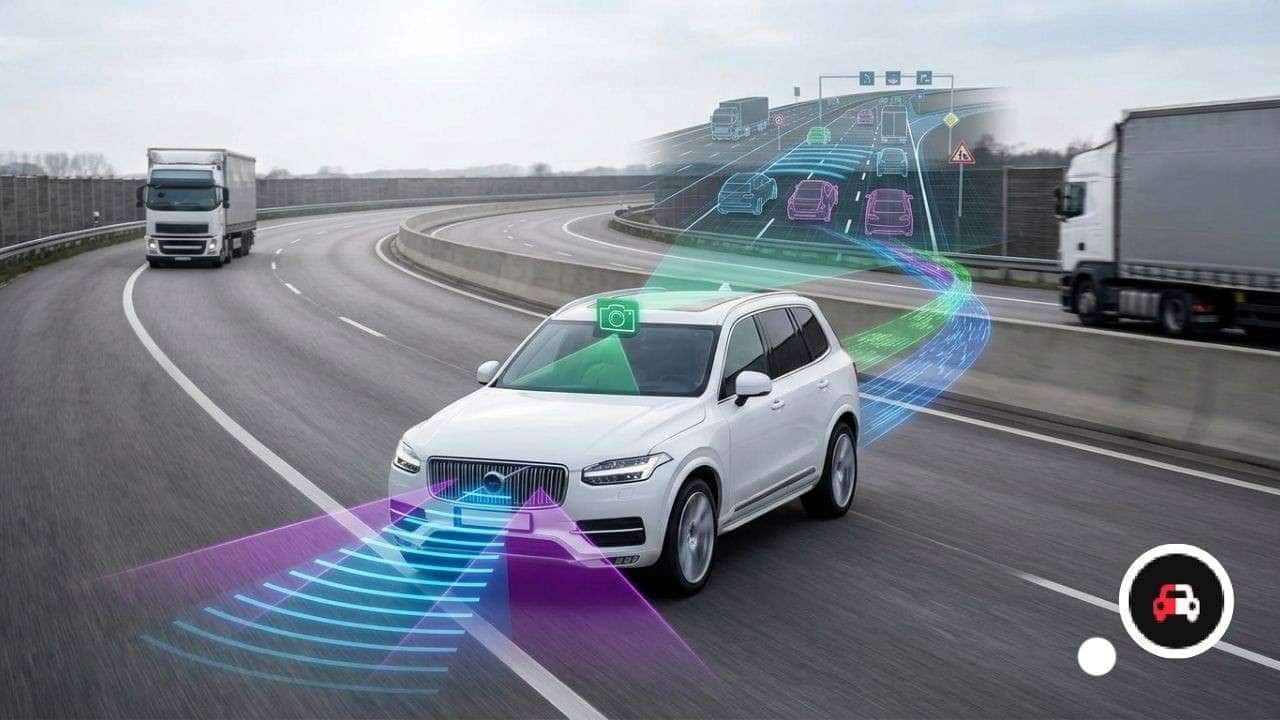
Every ADAS feature runs on the same basic loop, even though the end result looks different each time. It helps to understand this loop before getting into individual features, because it explains why some systems work brilliantly on Indian highways and struggle in city traffic.
Step 1: Sensing
The car continuously gathers information from a combination of hardware — typically a forward-facing camera located near the rearview mirror, radar sensors embedded in the front bumper, ultrasonic sensors distributed around the body for close-range detection, and in some cases LiDAR on more advanced platforms. They’re all looking at the world in a different way: radar is good at measuring distance and speed in the rain or fog, while cameras get a better look at lane markings, traffic signs, and what an object, well, actually is.
Step 2: Processing
All that raw information is sent to an onboard computer that runs it through algorithms trained to identify patterns — a pedestrian outline, a motorised two-wheeler darting through lanes, brake lights ahead. This needs to be done in a matter of milliseconds because when you’re driving on the highway, half a second lag means you’ve travelled several car-lengths of road.
Step 3: Decision
Using this information, the system decides if the situation warrants a warning like a beep, alert on the dashboard, or seat vibration or intervention by braking, trimming the steering, or limiting the power of the engine.
Step 4: Action
The car either alerts you or acts automatically applying brakes, correcting steering input, or adjusting speed, depending on which specific ADAS feature has triggered.
Once you understand this four-step loop, every individual ADAS feature is just a variation of “sense something specific, process it, decide, act.”
The Core ADAS Features, Explained One by One
1. Adaptive Cruise Control (ACC)
Standard cruise control maintains a constant speed. Adaptive cruise control takes this a step further – it travels at a set speed, but will also slow down and speed up to maintain a preset gap between your car and the one in front of you, using radar to keep tabs on that vehicle. In Indian highways like the Yamuna Expressway or Mumbai-Pune, this is actually helpful as it does away with the endless pressing on the accelerator and brake pedals in the moving traffic.
2. Autonomous Emergency Braking (AEB)
This is arguably the most safety-critical feature in the whole ADAS suite. AEB watches the road ahead and, if it detects an imminent collision that the driver hasn’t reacted to, applies the brakes on its own — sometimes fully, sometimes partially to reduce impact speed. It’s designed as a last line of defence, not a substitute for paying attention.
3. Lane Keep Assist (LKA) and Lane Departure Warning (LDW)
These two often get bundled together but do slightly different jobs. Lane Departure Warning simply alerts you — a beep or a steering wheel vibration — if you drift out of your lane without indicating. Lane Keep Assist goes further and gently steers the car back into the lane. On Indian roads where lane discipline is, let’s be honest, inconsistent at best, this feature can be a bit of a mixed bag — it works well on marked highways but can get confused on roads with faded or missing lane paint.
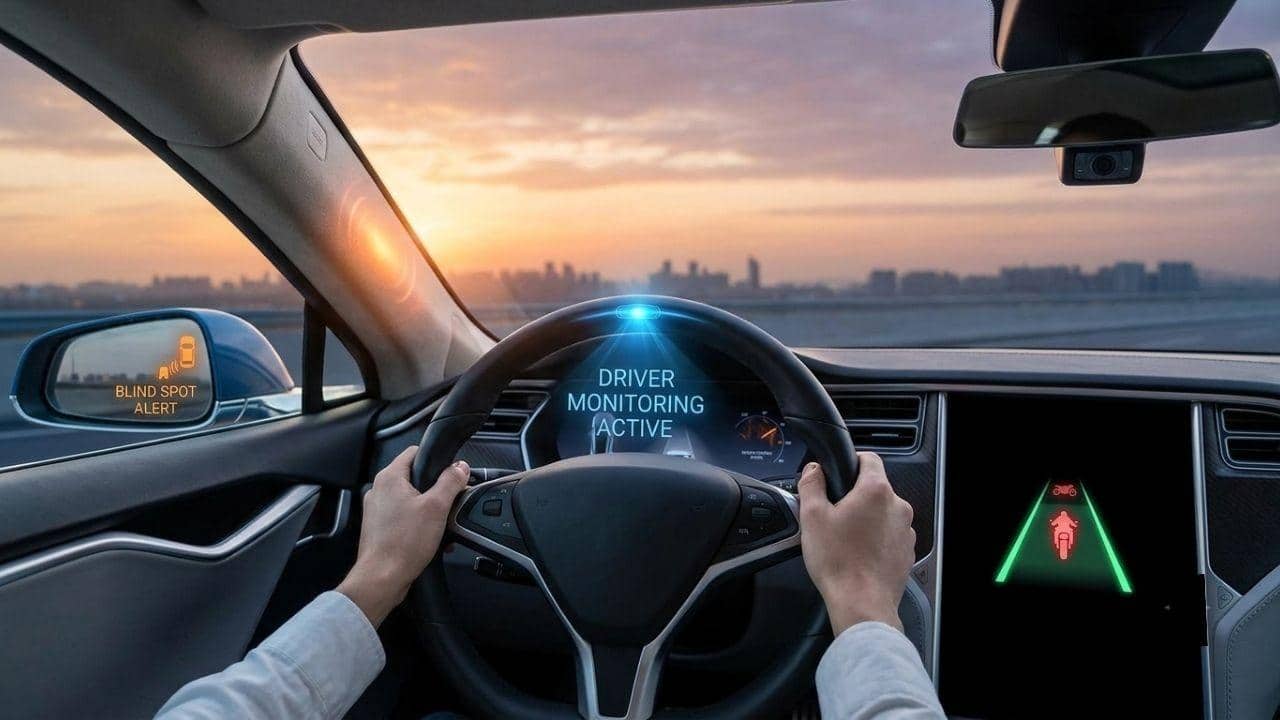
4. Blind Spot Monitoring (BSM)
Sensors placed on the back corners of the car keep an eye on your blind spots for adjacent vehicles like cars, motorcycles, and more. If an object is detected, a warning light appears on the corresponding side mirror and many systems also emit an audible alert if you signal to change lanes. It is quite handy in Indian traffic where two-wheelers and auto-rickshaws tend to criss-cross in the blind spots quite easily.
5. Forward Collision Warning (FCW)
This feature is a warning system and does not perform the function of an intervention. If it detects that you are closing in on the car ahead too quickly, it will activate visual and audible alerts, allowing you to brake or steer away to avoid a collision.
6. Parking Assist and Surround View / 360-Degree Camera
Multiple cameras and ultrasonic sensors are combined to generate a top-down view of the vehicle, which takes the stress out of parallel parking or driving through tight residential gates. Certain systems are now equipped with semi-automated parking, with the car manoeuvring into a space while you control the brake.
7. Traffic Sign Recognition (TSR)
Based on the feed from a forward-facing camera, the system recognizes speed limit, no-entry, other traffic signs, and shows them on the instrument cluster or on the screen of the infotainment system. So you can keep track of the road rules, even if you do accidentally drive past a sign.
8. Driver Attention/Fatigue Monitoring
Using either steering pattern analysis or an in-cabin camera, this system tracks signs of drowsy or distracted driving — inconsistent steering corrections, prolonged eye closure — and prompts you to take a break. Extremely relevant for long highway drives, which is a big part of Indian road travel culture.
9. Tyre Pressure Monitoring System (TPMS)
While TPMS isn’t always considered an ADAS, it certainly falls under the umbrella of vehicle safety tech systems. It constantly monitors the tyre pressure and notifies you if it goes below the recommended level, saving you from trouble of poor handling, decreased fuel efficiency or even a tyre blowout.
The Levels of Driving Automation — Where Does ADAS Fit?
Much of the confusion around ADAS happened due to being confused with self-driving vehicles. There are six levels of driving automation as defined by the Society of Automotive Engineers (SAE), and it’s helpful to understand where ADAS fits on that spectrum.
| Level | Name | What It Means |
| Level 0 | No Automation | Driver does everything; car may just have basic warnings. |
| Level 1 | Driver Assistance | One system helps, like cruise control OR lane keeping — not both together. |
| Level 2 | Partial Automation | Car controls steering and speed together, but driver must stay fully alert. Most ADAS cars sold in India today sit here. |
| Level 3 | Conditional Automation | Car handles most driving in specific conditions; driver can look away briefly but must be ready to take over. |
| Level 4 | High Automation | Car drives itself fully within a defined area or condition, no driver needed in that zone. |
| Level 5 | Full Automation | No steering wheel needed at all, under any condition. Still not commercially available anywhere. |
Almost all cars that are sold in India with “ADAS” slapped on as a feature — the Mahindra XUV700 and Scorpio-N, Tata Curvv, Hyundai Creta, MG Astor, and a bunch of Toyota and Honda models, are all Level 1 or Level 2. That means the car is helping, not driving. Taking your hands off the wheel because the car has ADAS is the exact kind of assumption that gets people killed.
Why ADAS Matters More in India Than the Marketing Suggests
It’s easy to dismiss ADAS as a Western safety obsession bolted onto Indian cars for export-market compliance. But the argument in favour of it in Indian conditions is perhaps stronger, not weaker. Indian traffic is dense, heterogeneous, and chaotic — two-wheelers darting across lanes, pedestrians jaywalking, sudden braking on tailgated city traffic, and long monotonous stretches of highways where drowsiness easily sets in. These are precisely the situations where AEB, FCW, and driver fatigue monitoring earn their keep.
That’s also a fair point on the other side of the argument. Features like Lane Keep Assist require crisp lane markings, which are still a rarity on many Indian roads. The better question isn’t just “does this car have ADAS,” but “what ADAS features does it have, and do those features correspond to the roads and conditions I deal with, day-in and day-out?”
Is ADAS Worth Paying Extra For?
If the choice is between a base variant and one with AEB, forward collision warning, and blind spot monitoring, the safety case is strong enough that it’s hard to argue against it, especially for anyone doing regular highway driving. Features like fully automated lane keeping or advanced parking assist fall more into the comfort category — genuinely nice to have, but not something to stretch your budget for if money’s tight.
A useful way to assess ADAS is to weigh more the functions that can intervene to avoid accidents, such as Automatic Emergency Braking (AEB) and Adaptive Cruise Control (ACC), compared to those that are more informative, such as Traffic Sign Recognition (TSR) or a 360° camera. Active intervention systems have a more direct impact on safety, informational features are mostly aimed at convenience and driver awareness.
Conclusion
ADAS is really a collection of safety features, not just one. Every system helps with a different part of driving, from alerting you to potential dangers to actively working to prevent a crash. Understanding the capabilities and limitations of these features can help you select the right vehicle and the safety systems that you can best take advantage of on the road.
