
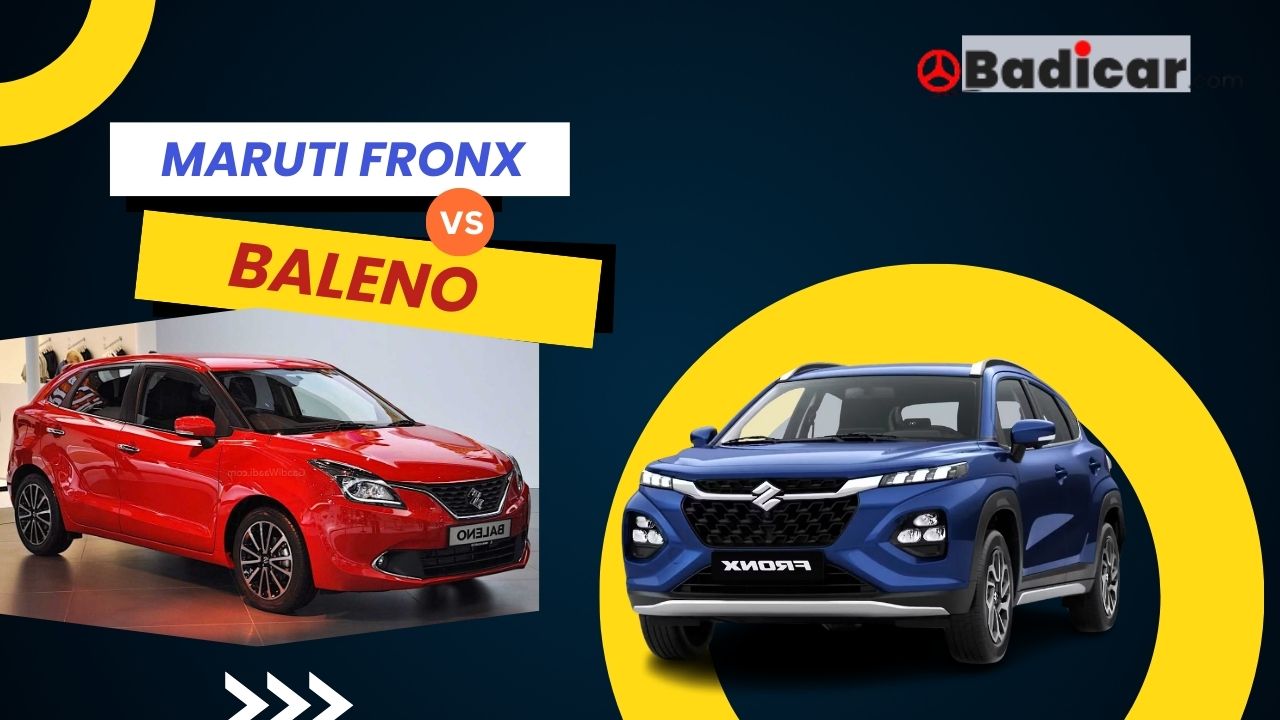
Let’s just be honest. Walking into a Maruti Suzuki showroom these days seems less about buying a car and more about placing an order for coffee at some third-wave café—there are simply too many variants that look and sound almost identical, but have really subtle taste-based differences.
Half-way through this menu is the ultimate dilemma for modern buyers: the Maruti Fronx and the Maruti Baleno. On the one hand, there’s the Baleno: the uncontested monarch of the premium hatchback space. It’s the car that’s probably been sitting in your neighbour’s driveway for ages. And then there’s the Fronx is the new entrant, the “compact SUV” that has created a sensation with its robust looks.
But here’s the real question: Given that they have the same engines, platform, and even the same showroom, if you’re really going to own just one, does it make more sense to go for the utilitarian hatchback or the evo-styled SUV? I have gone through a bit of research and here is my blunt, plain talk comparing price, mileage and features to help you pick up where you might want to invest your money.
| Aspect | Maruti Baleno | Maruti Fronx |
| Starting Price | ₹6.61 lakh (base petrol) | ₹7.51 lakh (base petrol) |
| Top-End Price | ~₹10 lakh (Alpha Auto) | ~₹13 lakh (Turbo Auto) |
| Engines | 1.2L DualJet petrol (89 bhp) | 1.2L DualJet (89 bhp) + 1.0L Turbo (100 bhp) |
| Transmission | 5MT / 6AT | 5MT / 6AT |
| Mileage (Petrol MT) | 21-22 km/l (city/highway) | 21-22 km/l (1.2L); 18-19 km/l (Turbo) |
| Key Features | 9″ Smartplay Pro+ (wireless AA/CP), HUD (top), sleek interior | Sunroof (mid variants), raised SUV stance, same infotainment |
| Safety | 6 airbags, ESP, hill-hold (AT) | Same as Baleno |
| Style/Vibe | Premium hatchback, refined city drive | SUV coupe, bold presence, adventure feel |
| Best For | Value, efficiency, daily urban use | Style, turbo punch, road presence |
The Vibe Check: Style vs. Substance

Before the numbers, we have to talk feelings. Because really, most of us buy cars with our hearts and only use our brains to justify the purchase.
The Baleno is sleek and premium, wide-bodied with a sporty slanting roofline. It is polished and refined, making it perfect for daily drives and the monotony of city living.
The Fronx is, however, a completely different animal. It adopts the “SUV coupe” shape, that is reminiscent of its larger sibling the Grand Vitara. It sits up higher, has cladded wheel wells and a front grille that seems like it’s glaring at you. It’s made for the young (or the young at heart). If you imagine yourself hitting the open road on the weekends, when the highway might not be in quite such good shape, the Fronx appeals to that sense of adventure.
The Money Talk: Prices
So what does this cost you? Both vehicles are similar enough that you’re not necessarily paying a boatload of money just for the “SUV” name.
The Maruti Baleno’s starting price is slightly lower, at around the ₹6.61 lakh (ex-Showroom) for the base petrol, getting close to ₹10 lakh on the higher side for the top-end Alpha Automatic.
Maruti Fronx, the all-new SUV from Maruti Suzuki, is priced at around ₹7.51 lakh (ex-showroom) in India. But the high-end models actually come at prices that are quite similar to the Baleno’s, just short of the ₹13 lakh mark in case you get the Turbo Automatic.
The Baleno wins if you’re counting pennies or just need the cheapest entrance point. But the difference in price is almost imperceptible if you’re looking at the mid-to-high end models (that’s what most of us buy). Two very different personalities and you are essentially paying the same money.
Mileage and Performance: The Engine Room
This is a closely-guarded secret that Maruti doesn’t reveal on billboards: under the skin, these two are almost siblings.
- Both car models come with the 1.2-litre DualJet petrol unit that makes around 89 bhp.
- Options for transmission are the same as well, with a 5-speed manual or a 6-speed torque-converter automatic.
- Used in the same mechanicals, the fuel economy figures are surprisingly close. City and highway fuel economy for the petrol manual is 21-22 km/l. Less for you but negligible for us With the automatic variants you get slightly less, but this is negligible difference for us.

But there is a twist: The Fronx also offers something the Baleno doesn’t have (at least, not yet in the same form): The 1.0L Turbo Boosterjet engine. This is a pellet, isn’t it? bhp and takes you on a burst of torque that makes moving out on highways a cakewalk. The trade off: mileage takes a hit, down to around 18-19 km/l, and high-speed petrol is needed (we recommend 91 octane).
If you’re a sedentary driver who wants to just sip fuel, stick to the conventional 1.2L engine in either car. Fronx Turbo: For all the enthusiasts who like a bit of punch when they floor the accelerators, this is your only winner here.
Feature Fight: Tech vs. Comfort

Step inside, the arrangement of the dashboard, the steering wheel and gear stick in both models are the same. But it’s the details that count.
The Baleno is all about “smart tech.” You get the sleek 9-inch Smartplay Pro+ infotainment system that offers wireless Android Auto and Apple CarPlay support – a feature we all crave secretly to avoid entangled cables. The top model also gets a heads up display (HUD), which is pretty futuristic.
Then there’s the Fronx, which, as SUVs go, puts a premium on a somewhat different experience. Although it doesn’t get the HUD in the lower variants as the Baleno does, it makes up for it with a sunroof in the mid-variant — a feature that can be a deal-breaker for many consumers in India.
The Fronx also has a slightly raised stance, putting you at a ”commanding view of the road,” while the Baleno feels more like you’re driving inside it rather than on it. both cars come brimming with safety features- including 6 airbags, ESP and a hill-hold assist (automatic only), so you’re not compromising on safety whichever is your pick.
Conclusion
When all is said and done, the Fronx vs Baleno is not a competition of spec sheets and mileage charts – it is a reflection of who you are as a driver.
If you’re big on predictable daily-driving, tight city parking and low running costs, and are looking for a car that’s well-judged and quietly premium, then the Maruti Baleno still holds more water. It’s more tolerable, a bit easier on the bank balance, a little more fuel-efficient, and seems like the kind of car that’s already worked life out. It doesn’t strain—-and that’s what makes it charming.
The Baleno is aimed at the more conservative buyers, while the Maruti Fronx is for those who want it to make a statement. You get the SUV-like stance, an elevated driving position, optional turbo-petrol thrill, plus lifestyle additions like a sunroof that have more emotional value than rational. You aren’t paying too much more — you’re paying for attitude, presence, that little bit of an “upgrade” every time you walk up to it.
- Go for the Baleno if you want the most value, refinement and hassle-free ownership.
- Pick the Fronx if you want style, road presence and a ride that feels a bit more special – even if the daily grind is the same.
Same engine options. Same showroom. Same reliability.
Different personalities. Take your pick and find the one that feels right for you.
