0

Mahindra XUV700 Facelift 2026 – New Features, Design Updates & Latest Details

Mahindra XUV700 Facelift 2026

The Mahindra XUV700 has been the undisputed leader in the Indian SUV space ever since its launch in 2021. Now it’s time for the company to prepare a thrilling new edition to keep that trend very much alive and well. The 2026 refresh is set to include such an impressive array of updates that it’s expected to entice even more buyers. So, let’s take a look at what’s new, what’s changed and why this facelift is worth the wait. 

What’s the Big Deal with the Facelift?

A “facelift” in terms of cars, is when a vehicle is given a bit of a design and feature refresh to keep it looking up to date and competitive. The XUV700 facelift 2026 is not a mere patchwork-up. It brings massive changes on the outside and inside the SUV. Facelift is all set to keep Mahindra ahead in the war marred mid-size SUV segment which is their bread and butter where it faces competition from Tata Safari, MG Hector Plus, Hyundai Alcazar.

The good news is the update will make the XUV700 even more capable while still being the XUV700 that owners already love. The upcoming model is expected to debut in 2026, and judging from the spy shots of the prototype, we now have a peek at what is coming. 

Design Updates

The body of 2026 XUV700 facelift remains same but gets an all new front end- which will be a huge change in the new model. Here’s what’s changing:

Front Fascia: The circular headlights are disappearing to give way to dual-pod LED projector headlights which look much sharper and modern. The new lamps will have a new design for the C-shaped LED DRLs, appearing more futuristic and aggressive

Grille: The grille at the front has been redesigned. It’s more upright and has more slats, which gives the XUV700 a new identity that is more premium and unique. The restyled design was inspired by Mahindra’s new electric SUVs such as the BE 6 and XEV 9e.

Bumper Design: The lower part of the front bumper is restyled with a more streamlined air dam and a new lower lip on the bumper that gives a more refined finished look. The rear bumper gets revisions too in line with the new design language. 

Alloy Wheels: There will be new alloy wheel designs that match the contemporary exterior style.​

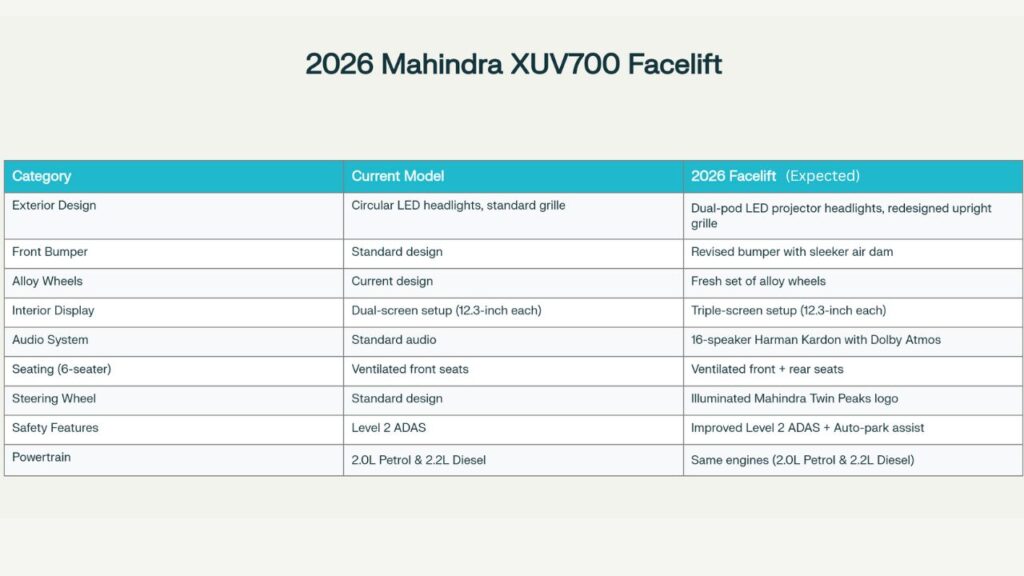
Mahindra XUV700 Facelift 2026 vs Current Model

Mahindra XUV700 Facelift 2026 vs Current Model – (Expected) Key Updates Comparison

Rear End : The rear receives minor changes that includes a new LED lightbar and restyled bumper. The dual tail light set up with vertical extensions mounted on both sides is also said to modernize its looks. 

Interior Features

It’s the interior of the new XUV700 that truly sizzles. Mahindra is bringing certain features from its electric SUVs to enhance the premium feel of the cabin and make it more tech-forward.

Triple Screen Setup: The transformed triple-screen dashboard setup, inspired by the Mahindra XEV 9e, is the most significant change in the interior. The instrument cluster, the infotainment screen, and the co-passenger entertainment screen – all three are 12.3 inches in size. This is the kind of arrangement you usually find in far more expensive SUVs, and it just adds to the value of the XUV700.​

Premium Audio System: The existing unit already a treat to ears but the 2026 gets premium 16-speaker Harman Kardon audio system with Dolby Atmos. This is the same audio system available in Mahindra’s EVs and will give you film-quality audio inside your SUV.​

Comfort Features: The 6-seater model would now receive rear ventilated seats in the second row, ideal for Indian summers. The revised version also introduces an auto-dimming internal rear-view mirror in the XUV700. You will also find one more wireless phone charger, so as you and your partner keep your phones charged on road trips. 

Steering Wheel: The steering wheel now sports an illuminated Mahindra Twin Peaks logo for a premium feel when you get in at night.​

Advanced Safety Tech: Among the most-discussed features is the auto-park assist feature, which can park the car itself in a tight spot —a high-end luxury car feature until now. 

Technology & Safety

Apart from the screens and the sound system, the facelift also makes the XUV700 smarter. The Level 2 ADAS (Advanced Driver Assistance System) will be enhanced with more functions and better performance. A digital key feature will enable you to unlock and start your car from your smartphone.​

Other anticipated technology upgrades include upgraded connected car features and a refreshed infotainment system with more touchscreen-based controls. Rear sun blinds and ambient lighting throughout the cabin which help to create a more premium feeling. 

Same Powerful Engines

Here’s the thing about the facelift — the engines remain the same because they’re already great. The XUV700 will get two power options.​

The 2.0-litre turbo Petrol engine is capable of producing 197 bhp @ 5,000 rpm and 380 Nm of torque between 1,750 and 3,000 rpm. Then there’s the 2.2-litre diesel, which delivers an economical punch for the purists. 

Either a 6-speed manual or 6-speed automatic gearbox can be had for both engines. So no mechanical changes just the engines that have been excellent in terms of reliability and performance. 

What Stays the Same?

The XUV700 facelift is packed with the features that already have you hooked. This includes the panoramic roof, 360-degree camera, ventilated front seats, dual-zone air conditioning, electronic parking brake and tire pressure monitoring system. You can still opt between the 6-seater and 7-seater variants

When Can You Buy It?

The update is said to come in 2026. Although the release date has not been confirmed, Mahindra is already shuttling the vehicle on roads in India, meaning that an official unveiling is drawing nearer. 

Conclusion

The Mahindra XUV700 facelift 2026 is turning out to be an impressive midcycle update that the manufacturer planned to bring to the buyers, including more features, better tech and an all-new look. It’s not an all-new design, which is good news, because customers already love the shape of the current XUV700’s body. Instead, it’s a smart refresh that transfers features from luxury cars and electric vehicles to this beloved SUV.

If you’re in the market for a mid-size SUV and can hold on a few months, wait for the 2026 refresh. Mahindra has undoubtedly heard the customers desires and has brought forth an update that emanates an improved comfort, more tech, a more premium feel—all with the same reliable engines and practical design that made the XUV700 such a hit. 

Sharey Khan

Sharey Khan is an IT entrepreneur and petrol head & a car enthusiast. With a special focus on car-related content, he combines his deep passion for vehicles with a talent for crafting informative, engaging, and easy-to-understand content. His writing is driven by a genuine love for cars and he is committed to providing readers with accurate, up-to-date, and trustworthy information that empowers smarter driving decisions. 

Leave a Reply

Your email address will not be published. Required fields are marked *

Tesla vs Ford Electric Cars : Who’s Winning the 2025 EV Race?

Tesla vs Ford Electric Cars 2025

The year is 2025, and electric cars are gaining popularity. The preference for cars that are clean, fast and easy to use, is increasing rapidly. There are two companies main players making big strides in this new paradigm. They are Tesla and Ford. In some ways, they are racing against each other for best electric vehicle technology leadership. Therefore, we will compare Tesla vs Ford electric cars, and explain who is winning the race in 2025. We will address; their cars, prices, technology, range and more. By the end of this post, you will be able to understand buyers that hold brand loyalty, and help you decide which brand is better for your needs.

Why Tesla and Ford Are Competing in the EV Space?

Though Tesla and Ford are very different companies, they do have a fact in common; they are both making large efforts to lead the charge into the electric vehicle world. Tesla is well known for making only electric cars, and actually entered the EV space from the get-go. Ford is an older company that was first created to make gas cars, but now is spending tremendous amounts of money towards building electric vehicles; this will allow Ford to leapfrog into the EV space and become a significant competitor to Tesla. When comparing Tesla vs Ford electric cars, we are talking about two major players that are driving the future of driving.

Tesla Electric Cars in 2025

Tesla is now well-known everywhere as a leader in intelligent, environmentally friendly, high-performance battery electric vehicles (BEV). Tesla also offers several BEV models in 2025 to fit various requirements. Ideal for daily trips, the Tesla Model 3 is a reasonably priced battery electric vehicle with an approximately 358-mile range. With enough of room for families, the Tesla Model Y is a small SUV having approximately 330 miles range.

Tesla Electric Cars in 2025

Image Credit: Tesla.com

With more than 370 miles of range and amazing speed, the Tesla Model S provides a more upscale experience acting as a luxury sedan. A full-size SUV, the Tesla Model X boasts upward-opening doors, lots of loading space, and great comfort. Every Tesla electric vehicle has smart features like Autopilot, with software upgrades that regularly enhance the car without physically bringing it into the service center.

Ford Electric Vehicles for 2025

Over the last several years, Ford has gotten more electric vehicle commitment. Ford has assembled a number of models enjoying positive note in 2025. Sporty electric SUV with a 312-mile range, the Ford Mustang Mach-E has appealing design. Among the most often sold Ford electric vehicles is the Ford Mustang Mach-E. For truck enthusiasts, the Ford F-150 Lightning is a significant event.

Ford Electric Vehicles for 2025

Image Credit: Ford.com

Dependent on the model, this electric variant of America’s best-selling truck has a range of roughly 240 to 320 miles. Ford is also introducing the Ford Explorer EV in 2025. With a maximum of 374 miles, this family SUV is quite outstanding. Ford is also introducing intelligent driving technologies like BlueCruise, which lets some roads drivers go hands-free.

Sales comparisons between Ford and Tesla

Tesla is definitely ahead when we consider sales figures. Tesla sold roughly 128,000 electric vehicles in the United States during January through March of 2025. Ford sold roughly 22,500 electric vehicles during that period. These figures demonstrate Tesla’s continued leadership in the electric vehicle sector. Ford, meanwhile, is expanding fast and introducing additional designs each year. Additionally expanding factories and battery enhancements is Ford. Thus, while Tesla is currently leading, Ford is really working to close the gap.

Tesla vs. Ford Electric Vehicle Battery Range

Battery range is the distance a car can cover on a single full charge. When purchasing an electric vehicle, people consider this among the most crucial factors. Tesla has always been strong in this area. One charge of the Tesla Model S might take it more than 370 miles. Though the Model Y offers roughly 330 miles, the Tesla Model 3 delivers around 358 miles. Ford is also enhancing its battery range. The 312-mile range of the Mustang Mach-E The F-150 Lightning offers 320 miles maximum. With an expected range of up to 374 miles, the new Ford Explorer EV would be somewhat more thanTesla’s top model. This indicates that in terms of range, Ford electric vehicles are developing and providing fierce rivalry for Tesla electric cars.

Network of Charging and Convenience

One of the main components of owning an electric vehicle is charging. Tesla has a sizable worldwide Supercharger network. Fast and simple to use, these charging docks Approximately 30 minutes will allow Tesla drivers to charge their vehicles to 80%. Tesla boasts more than 50,000 Superchargers by 2025. This simplifies Tesla drivers’ travel. Ford collaborates with public chargers like Electrify America; she does not have her own charging network. Also available to Ford drivers are some Tesla Superchargers. Tesla still has the advantage in network size and charging speed.

Technology and Feature Comparison

Tesla vs Ford Electric Cars

Tesla is famous for its sophisticated technology features. It provides Autopilot, a self-driving capability. Tesla vehicles have entertaining features like Dog Mode, which keeps your pet cool while you artist. Like your smartphone, the vehicles receive updates over the air. These revisions enhance the car and introduce new features. Additionally including intelligent capabilities is Ford. Ford’s version of self-driving, BlueCruise, runs on several main routes. Ford trucks provide features like built-in power outlets for running lights or tools. Although Ford is rapidly catching up and providing practical tools for everyday use, Tesla still sets the standard in technology.

Tesla and Ford electric vehicle price comparison

When people purchase cars, price is a major consideration. Tesla provides a decent price range. Starting prices for the Model 3 are about $40,000, among the most affordable electric vehicles available. Starting price for the Model Y is roughly $47,000. Starting around $90,000 for high-end consumers, the Model S and Model X exceed $100,000. Prices for Ford vehicles are somewhat higher or comparable. Starting price for the Mustang Mach-E is approximately $45,000. Starting price for the F-150 Lightning is $55,000. The expected price range for the new Explorer EV is $50,000 to $60,000. Tesla might provide more value in certain categories, but Ford is aiming at consumers who want tough SUVs and trucks.

Service to Customers and Ownership Experience

While some users complain about build quality and service delays, Tesla cars are enjoyable, high-tech. Tesla sells cars directly, therefore there are no nearby dealers to assist rapidly in many locations. Conversely, Ford has been around for a long and has a sizable dealership network. This means that if something goes wrong, one may more easily look for assistance. Ford’s service arrangement still appeals to many consumers. New electric vehicle users depend a lot on a supportive service team, and Ford has the edge here.

Read Also : Top 10 Mistakes to Avoid When Buying a Car

The Future of Tesla and Ford in Electric Vehicles

Tesla is not slowing down. It is working on new projects like the Cybertruck and a low-cost electric car. These models could help Tesla grow even faster. Ford is also building more EV plants, making new batteries, and hiring thousands of workers to build electric cars. The company plans to make millions of electric vehicles in the next few years. Both companies are focused on cleaner energy and want to help the world switch to electric cars. While Tesla electric cars are still leading today, Ford electric cars are getting stronger and more competitive every year.

Final Thoughts

When we look at everything — sales, battery range, price, charging, features, and service — Tesla is still ahead in most areas. It sells more cars, offers better tech, and has the best charging network. But Ford is making big moves. Its cars now offer good range, smart features, and better service. So, in the race of Tesla vs Ford electric cars, Tesla wins in 2025. But Ford is catching up fast. In a few years, it may become a close fight.


Sharey Khan

Sharey Khan is an IT entrepreneur and petrol head & a car enthusiast. With a special focus on car-related content, he combines his deep passion for vehicles with a talent for crafting informative, engaging, and easy-to-understand content. His writing is driven by a genuine love for cars and he is committed to providing readers with accurate, up-to-date, and trustworthy information that empowers smarter driving decisions. 

Leave a Reply

Your email address will not be published. Required fields are marked *

Hyundai Elantra 2025 Review: Price, Trims, Hybrid & N Line Features Revealed!

The Hyundai Elantra 2025 is strategically positioned among the most competitive compact sedan market, as it depends on the aggressive pricing, the unique aesthetic styling, as well as the best-in-class safety features. Having the lowest entry barrier, the base price being launched at $22,125 MSRP, the Elantra gets attention fast compared to the most important competitors. Its sporty, aggressive exterior styling so that the car doesn’t fade into obscurity, appeals first of all to the younger generation, as well as those who pay much attention to the styling factor.

Other than looks, Hyundai bases the value appeal of the Elantra on safety and durability. The car has scored the ultimate commendations from independent evaluation agencies, including the IIHS Top Safety Pick+ awfully and the NHTSA-provided 5-Star Overall Safety Rating. This body integrity as well as this extensive complement of standard driver assist technologies gives the ultimate trust factor that is the key market advantage.

This price increase is dialed in to motivate the purchase of the skipped entry-grade so that buyers do get access to essential features that rev up the car experience, including the digital instrument cluster, 10.25-inch infotainment display, power sunroof, and heated seats.

Delineation among Powertrain Families: Standard, Turbo, and Hybrid

To achieve ultimate breadth across the compact segment, the 2025 Elantra provides three separate powertrain families designed to support varying buyer priorities— the frugal 2.0L normally aspirated inline four-cylinder engine for standard friskiness, the big-output 1.6L Turbo GDI engine for high-performance enthusiasts (N Line), and the highest-efficiency 1.6L GDI Hybrid system for high-mileage users. This triad engineering strategy holds the Elantra competitive across ranges as diverse as price to ultimate dynamic capability as well as ultimate fuel economy.

Exterior and Interior Volume Measures

It is 185.4 inches long and has a long 107.1-inch wheelbase. It has a decent 14.2 cubic feet of cargo space with all seats occupied. Crucially, the car has an EPA interior volume of 113.6 cubic feet.

The Standard Drivetrain: 2.0L I4 and Smartstream

Elantra comes in different trims including SE, SEL Sport, SEL Convenience, and Limited. Its standard variant offers a 2.0L inline four-cylinder engine. This solid engine gives powerful 147 horsepower at 6,200 rpm and 132 lb-ft of torque at 4,500 rpm, making it perfect for smooth performance. Its exclusive Hyundai’s Smartstream Intelligent Variable Transmission comes in standard trim to deliver an opulent experience to buyers.

Fuel economy is slightly different depending on the trim’s equipment level. Based SE trim provides the best fuel efficiency, which is 36 combined MPG (32 city / 41 highway). However, the SEL Sport, the SEL Convenience, as well as the Limited, trim log the combined 34 MPG (30 city / 39 highway). This 2 MPG combined deficit directly results from the feature upgrade. Higher trim levels come as part of higher equipment loading, including the digital screens as well as the dual-zone climate control, and they ride on larger, heavier 17-inch alloy wheels.

The Performance Peak: N Line

For enthusiasts who prioritize dynamic response, the N Line trim is loaded with exclusive mechanical upgrades. Highlights include a front performance damper, electronically controlled suspension, and an N-Performance exhaust system with PTU cooling. The N Line delivers an impressive 201 horsepower with 1.6L Turbo solid engine. Its amazing 195 lb-ft of torque is available over a wide range, from 1,500 to 4,500 rpm.

Now, the most extreme mode of the N Line is sporty 7-speed Dual Clutch Transmission with a good EPA estimated of 31 MPG combined, challenging a better fuel economy rivals. Its SHIFTRONIC paddle makes a ride more thrilling that drives you crazy.

Efficient Commuter: Hybrid System

The hybrid model is perfect for city commutes as it offers top-tier fuel efficiency. It combines a 1.6L GDI engine with an electric motor, delivering 139 horsepower with 195 lb-ft of torque. The Elantra Hybrid gives smooth ride, conventional shifts, and amazing experience with a 6-speed EcoShift Dual Clutch Transmission (DCT). Efficiency is outstanding, it is powered with 54 MPG combined and its limited versions get upgraded features including luxury and 50 MPG combined.

Full Trim Lineup and Pricing Strategy

The 2025 Hyundai Elantra is available in five gasoline trims—SE, SEL Sport, SEL Convenience, Limited, and N Line. In 2 Hybrid Variants Hybrid Blue and Hybrid Limited are available in 2025. The price for each variant varies along their features, from starting price of base models to luxury hybrid models with expensive price offering.

SE Trim

Base price starts at $22,125.

The Hyundai Elantra offers 2.0L four-cylinder engine in its base model which has 36 MPG combined. Key safety features cover four-wheel ABS brakes, emergency brake system for secondary collision, and alarm for remote-theft. It also provides a good infotainment system with an 8-inch screen and seamless connectivity.

SEL Sport Trim

Starting MSRP: $23,250.

The SEL Sport builds on the SE trim that delivers a solid 2.0L engine with 34 MPG combined. Buyers can achieve good comfort and smoother rides with 17-inch alloy wheels and automatic climatic control functions. It comes with leather-wrapped, push-button start, and wireless charging support.

Convenience Trim

Starting MSRP: $25,825.

This model introduces premium technology like dual 10.25-inch setup, blends with digital instrument cluster and comfort upgrades including power tilt-and-slide sunroof and heated front seats. It is powered with a 2.0L engine (34 MPG combined), giving the vibes of an upgraded luxurious ride.

Limited Trim

Starting MSRP: $26,775.

The Limited trim sits at the top of the standard 2.0L lineup, delivering the most advanced functions. It helps you hands-free cruising on highways consistently with a powerful Highway Driving Assist feature. It comes with advanced driver-assistance systems (ADAS), H-Tex leatherette seating, and premium Bose audio system.

N Line Trim

Starting MSRP: $28,975.

The N Line is crafted with performance in mind. It comes with a 1.6L turbo engine that delivers outstanding performance. It offers a 7-speed DCT to challenge the road, and a multi-link independent rear suspension. This combination makes it perfect for beast riding race lovers. Its unique styling includes 18-inch alloy wheels, exclusive N Line bumpers, and sport seats that support your desires. Most importantly, its chrome dual exhaust tips that scream fun.

Hybrid Trims

Two hybrid versions are offered. The Hybrid Blue focuses on efficiency, delivering up to 54 MPG combined, while the Hybrid Limited sacrifices a little efficiency (50 MPG combined) to add premium features like a Bose audio system and larger wheels. Pricing for the Hybrid Blue is expected to start around $25,450.

Digital Interface Designs and Cabin Aesthetics

The cabin environment is equipped with a widescreen infotainment console, especially in the higher trims, and it uplifts the environment for the buyer. The console integrates a 10.25-inch gauge cluster and a 10.25-inch navigation display into a seamless and, visually, a cohesive entity. This sleek design is a factor to the “nearly luxury experience.” This is the compact class. Multiple USB ports and wireless charging are available to enhance the connected experience for the occupants.

Interior Comfort and Material Assessment

Even with the impressive design and focus on technology, elements in the interior cabin of the Elantra, specifically, the negative comments are aimed at the “hard plastic materials” found on surfaces.

Safety Profile and Driver Assistance Systems (ADAS)

Safety is one of the Elantra’s strongest selling points, shown by its IIHS Top Safety Pick+ and NHTSA 5-Star Overall Safety Rating. That performance comes from a high-strength body structure combined with a broad, effective set of driver-assist systems.

Hyundai SmartSense:  Hyundai basic tools include Forward Collision-Avoidance Assist with Pedestrian Detection, Blind-Spot Collision-Avoidance Assist, Lane Keeping Assist, and Lane Following Assist, and Driver Attention Warning are available in every Hyundai trims.

Read More :- Maruti Suzuki Top Variant Cars 2025: Luxury, Hybrids & EV Revolution Revealed

Advanced Systems and Highway Driving Assist

Higher trim comes with more advanced technology for assistance, including Adaptive Cruise Control with stop-and-go. The top-tier Limited trim gives more features like Highway Driving Assist, this can help you with highway driving by enabling Level 2 hands-on, semi-autonomous driving.

The 2025 Hyundai Elantra firmly establishes itself as a tech- and design-forward leader in the compact sedan class. It pairs top safety scores from IIHS, NHTSA also gives 5-Star. It offers class-leading efficiency options up to 54 combined MPG.

Conclusion

The Hyundai Elantra 2025 available in various trims which is elegantly improved with its design and higher level trims offer fantastic features that can drive you crazy. For the next-level riding experience with the powerful speed of hybrid trim that ensures your safety along with smooth rides.

These trims come in different ranges of prices from entry-level model $23,250 to N Line trims $28,975, and all trims come with Hyundai SmartSense feature. It ensures the safety of the passengers and offers practicality. Whether you buy an entry-level model or higher trims that are available, buyers can get the best advanced features inside these trims.

Sharey Khan

Sharey Khan is an IT entrepreneur and petrol head & a car enthusiast. With a special focus on car-related content, he combines his deep passion for vehicles with a talent for crafting informative, engaging, and easy-to-understand content. His writing is driven by a genuine love for cars and he is committed to providing readers with accurate, up-to-date, and trustworthy information that empowers smarter driving decisions. 

Leave a Reply

Your email address will not be published. Required fields are marked *

Lexus RX 350h Exquisite Grade: Price, Features & Specifications

Lexus RX 350h price in India

Lexus has introduced a new RX 350h Exquisite Grade model which is aimed at providing an easy access into the premium hybrid range. The model is being offered in India at Rs. 89.99 lakh (ex-showroom), which is a premium yet balanced way to combine luxury with performance. It gives customers the opportunity to enjoy the brand’ renowned quality and innovation, without having to make concessions on must-have features. 

A Smart Price for New RX 350h  Premium Expectations

Here is where Exquisite Grade starts to get interesting. This new variant makes way for the existing Luxury trim as the entry level offering, and is priced Rs 89 lakh, the Luxury trim. For Indian buyers who want finer things in life but do not have (unlimited) budgets, this is big news. 

You get all the features that made the now outgoing Luxury trim so desirable, but at a price that’s a little easier to swallow. If you want the optional Mark Levinson premium audio system than that takes the price to Rs 92.02 lakh. Whichever way you slice it, you’re getting a truly opulent hybrid SUV without breaking the bank. 

Read More :- BYD Sealion 7 Prices in India: Expected Cost, Features & Launch Updates

The Hybrid Powertrain in RX 350h

The RX 350h Exquisite can only be had with a refined 2.5-litre hybrid system—and frankly, that’s all you’d want. This naturally aspirated four-cylinder engine pairs excellently with a self-charging electric motor, making for a total combined output of 246 horsepower and 238 Nm of torque. Don’t be intimidated by the numbers; this hybrid arrangement is surprisingly quick. The car accelerates from 0-100 km/h in only 7.9 seconds, so it’s fast enough for daily use without the guilt of chugging gas like a 20-year-old SUV. 

The Hybrid Powertrain in RX 350h

The efficiency is the star feature here. Due to Lexus’ well established hybrid technology and said electric motor integration, the RX 350h manages to achieve a remarkable 18.6 kilometers per liter (WLTP certified) – a number that really makes a difference when running the numbers for long-term ownership costs. Combined with an eCVT automatic transmission designed for smooth, effortless shifting, this powertrain makes driving a luxurious SUV responsibly a new experience. 

Refine Interior That Meets Modern Technology

Step inside Lexus, and you can tell right away that the brand gets the fact that luxury isn’t just about the price of the materials—it’s about the design details. The interior is dominated by a 14-inch touchscreen infotainment system, which is one of the largest in its class and sits within the driver-centric ‘Tazuna’ cockpit layout. Now, you’re spending less time wrestling with menus and more time driving. 

Refine Interior That Meets Modern Technology

What constitutes comfort is different for everyone, which is why the Exquisite comes with 10-way power front seats with memory functions. They remember your preferred seating position, so each time you sit down the car is adjusted to your liking. Add heating and ventilation – front and rear – and you end up with a cabin that can cater to your physical well-being all 12 months of the year, whether you’re baking in the summer sun or freezing your knuckles off come winter. Power recline on the rear seats means your passengers get pampering too. 

Lexus RX That Meets Modern Technology

The ambiance is important, and that’s what makes the ambient lighting system so welcoming. Set your mood with adjustable lights and all of a sudden, that night road trip becomes therapy. The three-zone climate system allows you, your co-driver and the rear-seat travellers to each have their own preferred temperatures. No more fighting over it being too hot or too cold! 

Technology & Safety Provide by New RX 350h

What truly sets the RX 350h apart is the serious level of safety Lexus delivers. The Elegant Grade features Level 2 ADAS (Advanced Driver Assistance Systems), which actively assists in driving safety. There is also a 360-degree camera that provides a bird’s-eye view when parking or driving in confined spaces.

Technology & Safety Provide by New RX 350h

The pre-collision system, lane departure alert and blind spot monitoring all team up to be your invisible co-pilot, imparting gentle guidance away from potential hazards.​ Connected car technology lets you stay connected to your car even when you are not in it. An optional smartphone app allows you to remotely perform select functions—such as starting the air conditioning on a hot day before you get to your car. 

Practical Dimensions & Cargo Space

With 192.5 inches in overall length and 112.2 inches in wheelbase, the RX 350h Exquisite delivers a bold presence on the road, yet does not feel cumbersome. The 29.6 cu. ft. of cargo space with the rear seats up expands to a massive 46.2 cu. ft when you fold them down — ideal for weekend escapes or a run for emergency supplies. Ground clearance is a sonorous 8.2 inches, so you’re not grinding undercarriage on every speed bump.

Read More :- Best Sedan Under 20 Lakhs: Luxury Buys with Premium Features

Conclusion

The Lexus RX 350h Exquisite Grade is an intelligent combination of luxury, efficiency and value. It’s not attempting to be all things to all people, but rather recognizes that consumers are more discerning and want greatness without bells and whistles. Whether you’re attracted by its smooth hybrid powertrain, ease-of-use interior technology or surprisingly affordable price, this SUV lives up to the promise of luxury living — one planned kilometer at a time.  

Sharey Khan

Sharey Khan is an IT entrepreneur and petrol head & a car enthusiast. With a special focus on car-related content, he combines his deep passion for vehicles with a talent for crafting informative, engaging, and easy-to-understand content. His writing is driven by a genuine love for cars and he is committed to providing readers with accurate, up-to-date, and trustworthy information that empowers smarter driving decisions. 

Leave a Reply

Your email address will not be published. Required fields are marked *

BYD Sealion 7 Prices in India: Expected Cost, Features & Launch Updates

BYD Sealion 7

The Indian electric SUV market is getting competitive and BYD is going all out. If you have been watching the high-end EV scene, you may have come across the buzz about the BYD Sealion 7 and for good reason. The latest release of this Chinese automaker had already captured the attention of Indian car enthusiasts with its stylish appearance, outstanding technology and most affordable price. But here’s a crucial thing you need to know right now: starting January 2026, the prices will be increasing, so if you’re planning on getting one, your time might be running out. 

The Price Story: Lock in Now or Pay More Later

Currently, the BYD Sealion 7 is available in two variants with the following ex-showroom prices: The Premium variant is priced at Rs 48.90 lakh, and the Performance variant comes at Rs 54.90 lakh. Here is the important update — the prices are valid for customers who book the vehicle on or before 31 December 2025, as per an official statement from BYD. From 1 January 2026, the prices will be going up, but the exact amount of increase is unknown. If you are in the market for the SUV then you could save some money by booking before year-end. 

What is surprising? The Sealion 7 has already seen more than 2,000 units sold since the launch in February 2025, showing that Indian consumers are true fans of the BYD products. 

Understanding the Two Variants

It’s not only the price that you have to pay for the Premium over the Performance options. The Premium model runs on a rear-wheel-drive platform with a single electric motor which produces 313 PS and 380 Nm of torque. That equals 0-62 mph (100 km/h) from a standstill in 6.7 seconds and a claimed range of up to 567 km on one charge – ideal for long commutes without endless charging concerns. 

Understanding the Two Variants

The Performance model, however, is significantly more powerful with two motors and all-wheel drive. It packs 530 PS of power and 690 Nm of torque, and does the 0-100 km/h run in 4.5 seconds. The sacrifice? 542 km of range is just a little less – but really for most city-based driving that’s more than sufficient.​

Both models come with a common power source in the 82.56 kWh Blade Battery which BYD uses as its own patented lithium iron phosphate (LFP) technology. This battery allows for ultra-fast DC charging at a rate of 230 kW, leading to a charge from 10 to 80 percent in 32 minutes. Just think about it — squeezing in enough charge for the rest of your day in the time it takes to get a coffee! 

Features That Make You Go “Wow”

Inside, it is the BYD Sealion 7 that sits at the top to show BYD’s technology prowess. The 15.6-inch rotating touchscreen is undoubtedly the main attraction — yes, it really rotates and a 10.25-inch digital instrument cluster acts as the cocoon. This rotating display is a great conversation piece and adds to turning the menus into genuinely fun rather than frustrating. 

Features That Make You Go Wow

Outside the screen, you get premium touches like a panoramic sunroof, 12-speaker Dynaudio audio system, head-up display and wireless phone charging. Front seats are heated and ventilated to offer a degree of comfort in boiling summers and freezing winters. There’s even a 500-litre boot that grows to 1,789 litres with the rear seats down — ideal for weekend breaks or moving house calamities.  

Safety and Technology

BYD is not stingy when it comes to safety features. The Sealion 7 is equipped with 11 airbags as standard along with a 360-degree camera, adaptive cruise control and a full Level 2 ADAS package that also integrates lane departure warning, automatic emergency braking, and blind-spot detection. It also earned a 5-star Euro NCAP rating, which says a lot about its crash test results. 

Launch and Delivery Timeline

The Sealion 7 was out on the date of 17 February 2025 and the first 70 units began deliveries on 7 March 2025. Bookings are open at BYD dealers in India, and a token of Rs 70,000 is all that is needed to book your unit.

Launch and Delivery Timeline

The good news? BYD is providing a 7-year/1.5 lakh km warranty and a free 7 kW home charger for the first 70 buyers

Who Are Sealion 7 Rivals?

The Sealion 7 takes on the likes of the Hyundai Ioniq 5, Kia EV6, Tesla Model Y, and BMW iX1 in the territory of premium EVs. All in all, it’s a compelling value at that price point for its tech and performance creds.​

Read More:-  Best Sedan Under 20 Lakhs: Luxury Buys with Premium Features

Conclusion

BYD’s big move to strengthen its position in the premium EV segment in India The BYD Sealion 7 is a major leap forward for BYD in India. Impressive range, fast charging, rich features and a good safety record make it a well-rounded offering for anyone poised to make the jump to electric. However, with an impending price increase from January 2026, it is a purchase that comes at the right time. It’s a great time to buy if you’ve been sitting on the sidelines, head down to your nearest BYD showroom, take a test drive and lock in the current prices before they jump up. 

Sharey Khan

Sharey Khan is an IT entrepreneur and petrol head & a car enthusiast. With a special focus on car-related content, he combines his deep passion for vehicles with a talent for crafting informative, engaging, and easy-to-understand content. His writing is driven by a genuine love for cars and he is committed to providing readers with accurate, up-to-date, and trustworthy information that empowers smarter driving decisions. 

Leave a Reply

Your email address will not be published. Required fields are marked *

EV vs Petrol vs Hybrid: Which Car Type Is Perfect for You in 2025?

The 2025 car market is unrecognizable compared to just a few years ago. Between that and gas prices rising and EV charging networks growing and brands doubling down on hybrids, there’s now an embarrassment of options for buyers. But more options can make things confusing— EV vs Petrol vs Hybrid, do you go with a petrol car you know and trust, get a full electric vehicle, or take the middle ground in a hybrid? They all have their strengths, costs and suitability to one’s lifestyle. In this guide we’ve distilled the key differences — in running costs, convenience and the newest models — to help you decide which type of car really fits your life in 2025. 

Comparison At A Glance

Choose an EV if most of your daily driving is city/commute (≤100–200 km/day), you can charge at home/work, and you want the lowest running costs and least hassle. Opt for a Petrol car if you frequently do high mileage where chargers are sparse, need quickest refuel and lowest initial outlay, or biggest model/network. Get a Hybrid if you desire much more fuel economy than petrol, far less range-anxiety than a full EV, and you travel a lot on combined city/highways runs. 

Factors That Define Which Car Type is Perfect For You in 2025

Upfront price Value for EVs, Petrol, & Hybrid Cars

  • Mainstream EVs in India in 2025 start at around mid-₹7–12 lakh for city-centric models and extend to ₹20 lakh+ for full-sized SUVs and premium cars. (dealer listings reveal plenty of choice throughout the price spectrum).
  • Petrol cars are the cheapest to begin with – good small hatchbacks are available for much less than ₹7 lakh.
  • Hybrids (mild/strong/plug-in forms) are priced between petrol and EVs; popular models (Maruti, Toyota, MG) tend to start ₹8–12 lakh. 

Running Cost for EVs, Petrol, & Hybrid Cars

EV home charging is usually in the range of ₹6–₹10 per kWh, which in the case of regular hatchbacks or small SUVs works out to about ₹0.8–₹1.5/km – still a lot less than what petrol costs. 

Cost of petrol per litre for running cost. For city driving (15–18 km/L) that works out to around ₹5–8 per km per km – but it depends on the model and the city. 

EVs are miles ahead on running costs per km if you have dependable home charging or cheap, electric-friendly, off-peak tariffs.

Convenience & everyday life: charging refuelling

Refuelling petrol: 3-5 min at any petrol station. They are all spaced evenly everywhere. 

Charging EVs: home charging overnight is most convenient (adds minimal friction). While public fast chargers are becoming more numerous and reliable, they remain patchy; national and private initiatives are working to expand the networks. The IEA expects a significant rise in public chargers in the next few years.

EV convenience recedes significantly if you live in a flat with no assured parking/charger access and no workplace charging. 

Range for practical everyday use & long haul trips

Budget EV hatchbacks tend to have 200-450 km of usable range depending on the variant. For a few long journeys you can plan for charging breaks – slower than filling up on petrol, but it can be done.

Hybrids and petrol vehicles offer seamless, rapid long-distance travel without the need to stop and recharge — which is a significant advantage for highway users.

Government assistance & incentives (important if you are buying now)

Various central and state subsidies (through portals such as e-AMRIT, the FAME scheme details) exist albeit till date non-uniformed, the state EV policies — these can significantly reduce the cost of the EV or of the charging infrastructure. FAME II and related demand incentives have informed subsidies and procurement schemes. Refer to e-AMRIT/FAME pages and your state policy before purchasing.

(Practical advice: incentives are frequently models- and region-specific. All EVs don’t get the same perks, check with dealer + State EV policy). 

Read More:-  Hyundai Elantra 2025 Review: Price, Trims, Hybrid & N Line Features Revealed!

Maintenance, Resale and Dependability

EVs: Less moving parts → less scheduled maintenance (no oil changes, fewer brake jobs because of regen braking). The health of the battery is the biggest long-term concern; warranties on batteries are provided by manufacturers (usually for 8 years/1.6 lakh km or so on a number of models).

Petrol: Well established service network and cheap spare parts in India, high predictability.

Hybrid:The addition of a hybrid system (engine + electric components) brings complexity, but manufacturers like Toyota have decades of proven hybrid tech and solid service networks in India.

The resale value for EVs is stabilising, but it still depends on the model – stick to well-known, popular brands for reduced risk. 

Environment & Social Aspects

Lifecycle vehicle emissions of EVs are a function of the electricity mix, as they have no tailpipe emissions. India’s grid is greening and policy pushes gradually lower lifecycle emissions for EVs. Hybrids reduce emissions versus petrol, particularly in urban driving. 

Simple decision checklist: who should choose which option

Pick EV if:

You drive less than 300 km a day and most of your trips are within the city. If you can charge at home (private parking) or your office provides charging and desire to have the lowest running cost and lesser maintenance hassles. It’s best if you care about low tailpipe emissions and technology-enhanced features.

Pick Petrol if:

You do at least some long highway cruising, you travel out into the country, or you just live where EV chargers are hard to find. You want the lowest initial cost and refuel fastest and have access to the widest network.

Pick Hybrid if:

You’d like to get vastly superior fuel economy to petrol without having to depend on charging stations. You do both city and highway driving and want to move seamlessly through both without the need to plan your route around charging stops. You also like tried and tested reliable (Toyota/Maruti strong hybrids have a good track record in India).

Some Latest Models of EV / Hybrid / Petrol Cars

Type Model Key Specs
Electric Vehicles  Tata Harrier EV Launched mid-2025. Comes with AWD dual-motor option, very impressive real-range (up to ~627 km MIDC in best variant). Strong contender in the mid-size SUV EV space.
Hyundai Creta EV Scheduled early-2025. Multiple battery pack options. Expected range ~390-470 km depending on battery size. Features like DC fast charging, interior tech upgrades.
Maruti Suzuki e-Vitara To launch in mid/late 2025. Two battery options (≈49 kWh and ≈61 kWh), claimed range up to ~500 km in some trims. Will compete with Creta EV etc. 
Hybrids Toyota / Maruti / Suzuki strong or mild hybrids (Grand Vitara strong hybrid) Coming in H2 2025. Third-row / 7-seater version too. Strong hybrid (self-charging) gives the benefit of much better mileage than petrol alone. 
Toyota Fortuner Mild-Hybrid Neo Drive Already launched in 2025. Adds mild-hybrid tech to the Fortuner to improve stop-start behaviour, small torque assist etc. Good for those who drive big SUVs but want improved efficiency.
Hyundai Creta Hybrid Already launched in 2025. Adds mild-hybrid tech to the Fortuner to improve stop-start behaviour, small torque assist etc. Good for those who drive big SUVs but want improved efficiency.
Petrol Mahindra Thar / Bolero Updated models set to launch in Oct-2025. These are mature, rugged, proven petrol SUVs with facelifted features. Good for off-road / rural tasks or for those who like strong looks + robust service
Skoda Octavia RS For those looking for a more premium sedan with petrol performance and features. The RS version adds sportiness. May have higher maintenance costs but strong appeal if you want power + brand.

Conclusion

There’s no such thing as the “best” car for everyone, because EV vs Petrol vs Hybrid is a confusing debate but what works for one person depends on how they drive, where they live, and what kind of vehicle they find most useful. If you mostly drive in a city, and have reliable access to an outlet, an EV provides unparalleled running costs and a green driving experience. If highway and long road trips are the staple of your life and you want to fill up as quickly as possible—and as cheaply as possible up front—gas cars are still the prudent choice. And if you want to save fuel but don’t want to plug in, hybrids give us the best of both worlds. In the end, the ideal car for you in 2025 isn’t what’s the biggest hit of the day — it’s the vehicle that fits your everyday life and your plans for the future. 

Sharey Khan

Sharey Khan is an IT entrepreneur and petrol head & a car enthusiast. With a special focus on car-related content, he combines his deep passion for vehicles with a talent for crafting informative, engaging, and easy-to-understand content. His writing is driven by a genuine love for cars and he is committed to providing readers with accurate, up-to-date, and trustworthy information that empowers smarter driving decisions. 

Leave a Reply

Your email address will not be published. Required fields are marked *