
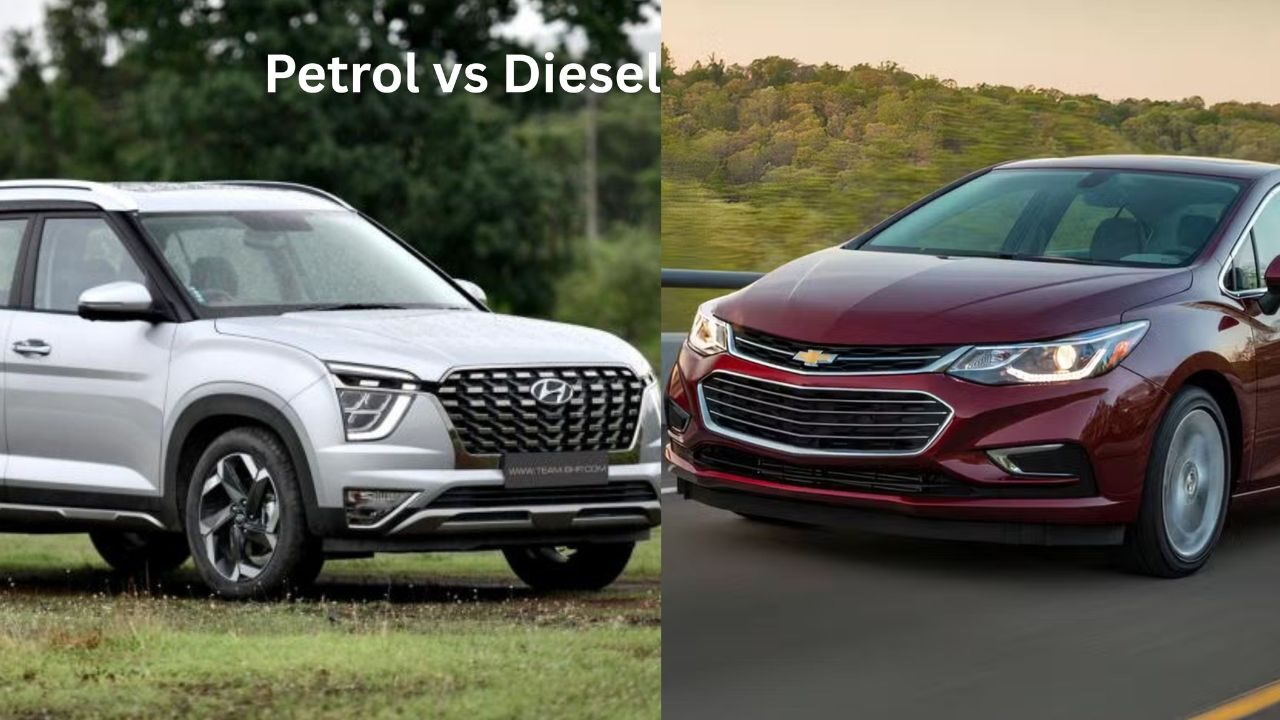
When you visit a showroom of Maruti, Honda, Tata or any brand, you probably get confused which car is best for you — Petrol vs Diesel Car? The generic answer is it depends on your usage and region but cars are also affected by many factors that make them different from each other. If you are not sure then continue reading to understand it properly.
Let’s Understand the Basics
A petrol engine uses spark plugs to ignite a mixture of air and fuel. It runs smoother, quickly picks high speed, and feels more responsive mostly at lower speeds. This makes petrol engine cars preferable for smaller distances, city driving.
A car built on a diesel engine uses compression (high pressure) to ignite the fuel, not a spark plug. It generates more torque (that pulling power you feel when you accelerate), runs at lower RPMs, and uses less fuel on longer distances.
That’s the core difference — and it explains almost everything else about how they behave on the road.
The Cost Factor: Upfront vs Long-Term
Most buyers end their discussion on Petrol vs Diesel Car when it comes to the money.
Same car but diesel variant cost around ₹1 lakh to ₹2 lakh which is more expensive petrol variant. Manufacturing cost drives the extra price of the car because diesel engines have more complex parts.
However, Diesel fuel is cheaper per litre than petrol in India (usually by ₹10–₹15 per litre). And that makes it more fuel-efficient — a diesel car might give you 20–25% better mileage than the petrol version of the same model.
So here’s the math that actually matters: the break-even point.
Driving in a city less than 10,000–12,000 km a year, it will take you 6–8 years to compensate for the extra cost you paid to the showroom owner for the diesel variant through fuel savings. By that time, you’re probably thinking about your next car anyway.
But if you’re clocking 20,000+ km a year — long highway runs, intercity travel, road trips — a diesel car will pay for itself in 2–3 years and save you a significant amount after that.
The simple rule: high mileage = diesel makes financial sense. Low to moderate mileage = petrol wins.
City Driving vs Highway Driving
City Commuting
If you use a car mostly for city trips then choose Petrol engines as they love city driving. They’re more responsive at low speeds, gear shifting is very light, and the engine doesn’t need to warm up as much. Start-stop traffic — which is basically the story of driving in any Indian metro — suits petrol engines far better.
In this traffic area, Diesel engines won’t cope up because they perform best at sustained speeds and consume less fuel. In city conditions, their fuel efficiency advantage largely disappears, and the engine can be reluctant at low revs.
On the Highway
The diesel engine wins here, that high torque means effortless overtaking, smooth cruising at 100+ km/h, and significantly better fuel economy over long stretches. A diesel car on the highway is a genuinely satisfying experience — particularly for long-distance drivers.
Petrol engines can also run on highways but for the run on higher speed they need more fuel to work harder.
Maintenance: The Hidden Cost Nobody Talks About
Diesel cars leave your wallet empty for maintenance as their parts are more complex. And diesel-specific components (like the fuel injectors and turbocharger) need time-to-time and attentive servicing.
Petrol cars are simpler under the hood. Routine servicing is cheaper, and mechanics are more familiar with petrol engines — particularly at smaller garages in Tier 2 and Tier 3 cities.
One important thing to understand is that diesel cars need to be driven regularly. If you left them in a garage like any showpiece, a diesel engine can develop issues. Petrol engines can sit without creating any problem for a long time, perfect if the car is a second vehicle or used only on weekends.
Environment and Emissions
Environmental considerations are increasingly playing a bigger role in the petrol vs diesel car debate. Diesel engines emit larger quantities of PM2.5 particles and nitrogen oxides (NOx), which are air pollutants that harm the environment and human health. Petrol engines produce more CO2 per kilometre, but they generate a fraction of the harmful particles.
India’s BS6 emission rules have brought diesel engines much cleaner than before — but the gap hasn’t fully closed. Several Indian cities have placed restrictions on older diesel vehicles, and there are ongoing policy discussions to set more regulations in pollution-heavy metros.
There are few cities like Delhi and Mumbai where pollution is rising day-by-day and so are emission concerns. It is worth knowing the resale value of your car.
Read more:- How to Calculate Average of Car With Explained Methods and Formula
Resale Value: A Tale of Two Markets
Diesel cars have long had better resale values because buyers thought they were more cost-effective to operate. That narrative has been shifting.
The prices are rising and rules are tightening on using diesel cars to prevent air pollution. Petrol cars are increasingly competitive in the used car market and in some segments (hatchbacks, small SUVs), they actually hold value better than diesel equivalents.
You can check any model resale value at the used car market. The segment matters a lot here.
So, Who Should Buy What?
Let’s make this as simple as possible.
Go petrol if:
- You drive mostly within the city
- Your annual mileage is under 12,000–15,000 km
- You want lower upfront cost and simpler maintenance
- The car will sit idle for days or weeks at a stretch
- You’re buying a small hatchback or entry-level sedan
Go diesel if:
- You regularly cover long distances — highway commutes, intercity travel
- Your annual mileage crosses 20,000 km comfortably
- You’re buying a larger vehicle (SUV, MUV, premium sedan) where diesel variants make more economic sense
- You want strong torque and highway cruising ability
A Quick Word on CNG and Electric
In 2026, you must understand that petrol vs diesel isn’t the only choice anymore. CNG has become a very practical third option for high-mileage city drivers. It gives more fuel efficiency than both Petrol or Diesel engines, and factory-fitted CNG kits in models like the Maruti Suzuki Alto K10 and Tata Tiago CNG are far more refined than they used to be.
Car manufacturers are making more Electric vehicles (EVs) as their demand is rapidly growing around the world. After petrol becomes more expensive, EVs seem to be the best option for you. Tata Nexon EV and MG Windsor making a compelling case for urban buyers.
But if you’re specifically choosing between petrol and diesel — the two questions to ask yourself are: how much do you drive, and where? The answers will almost always lead you to the right choice.
Conclusion
There’s no universally “better” fuel type. Petrol vs Diesel Car engines are optimised for different kinds of drivers and different kinds of roads.
If you spend around 800–1,000 km a month on the city roads, a petrol car will prove to be cheaper for you and involve fewer hassles. If you’re a long drive enthusiast, you regularly crisscross city limits – diesel will thank you for every kilometre you put on the odometer.
Know your driving habits honestly, do the break-even math for the specific car you’re buying, and you’ll make the right call.
