0

Discover the New Kia Telluride – Bold Design, Advanced Tech & Premium Comfort for 2025

New Kia Telluride

Image credit: Badicar

The 2025 Kia Telluride is a strong contender in the midsize three-row SUV class, offering a great balance of eye-catching exterior design, cutting-edge technology, and real luxury in comfort. This all-in-one guide will take you through what makes the Telluride one of the best SUVs on the market today. 

Bold Exterior Design That Commands Attention

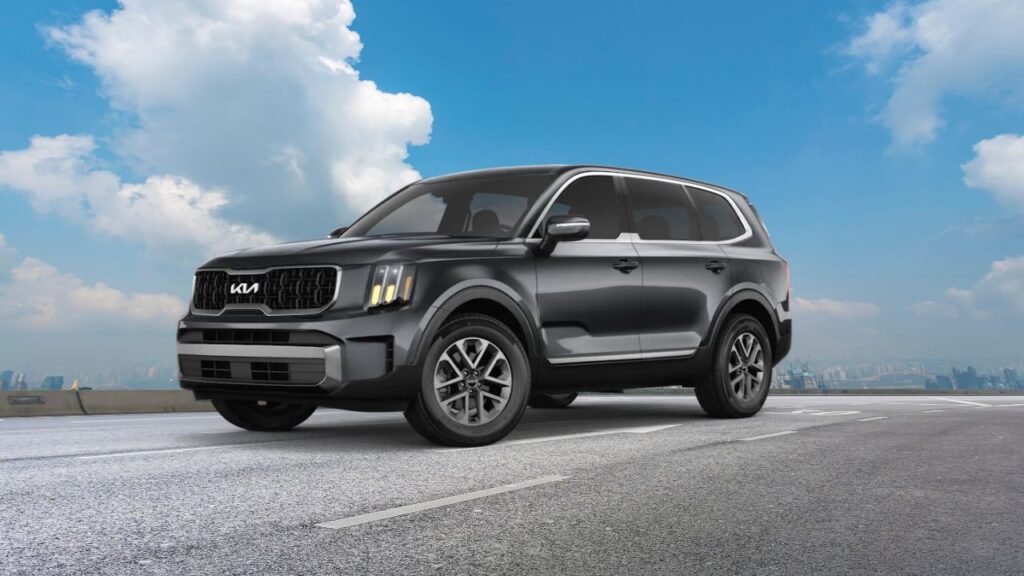
The 2025 Telluride strikes an unmistakable pose with a distinctive grille and an aggressive stance. The distinctive tiger-nose grille is now enhanced by a stronger and more sophisticated texture which enriches its premium feeling, flanked by elegant LED headlamps and optional fog lamps providing the optimum road visibility while keep up with the contemporary styling.  

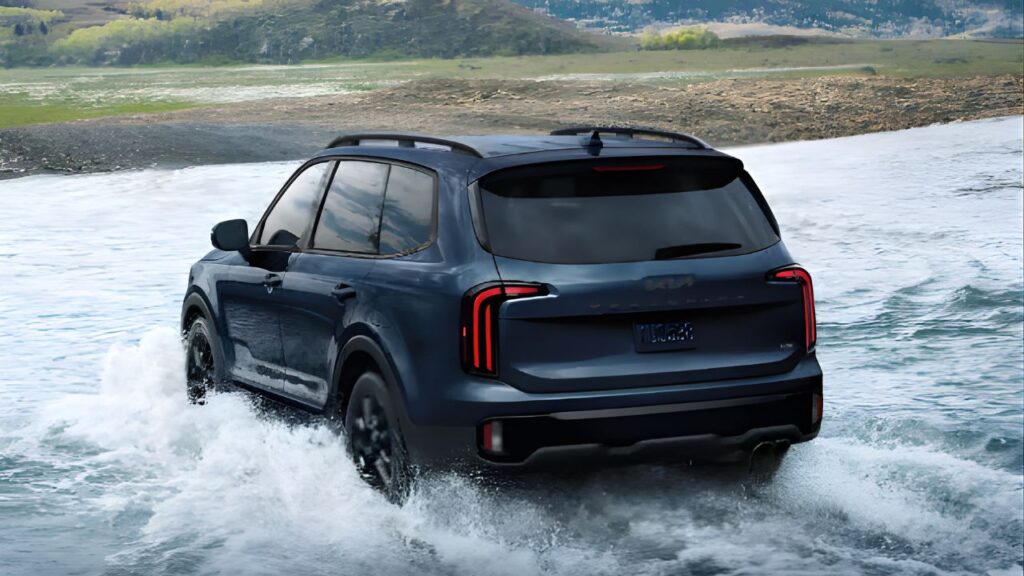
Sculpted body lines and an upright stance The vehicle’s muscular profile has armoured body lines and an upright stance that radiates rugged confidence, yet doesn’t hide away behind elegance. The 18-inch standard alloy wheels make for a tough foundation, while the optional 20-inch wheels in black finish – especially on the X-Line and X-Pro versions – bring a touch of sportiness. The unique 18-inch all-terrain tires exclusive to the X-Pro improve off-road performance and adventure-ready design. 

Functional design details like the roof rails, available hands-free power liftgate, and power-folding side mirrors are a great mix of form and function. The vehicle also has increased ground clearance, up to 8.4 inches (213 mm) on the X-Line and X-Pro models, which makes it really adept at off-road conditions. 
Bold Exterior Design

Image credit: Kia

The colors are especially stunning of Kia Telluride, and there are eight bold exterior colors to choose from to fit any taste – Panthera Metal, Midnight Lake Blue, Wolf Gray, Ebony Black, and Silver. 

Premium Interior Comfort and Spaciousness

Step inside the 2025 Kia Telluride and you’ll find a cabin crafted for real comfort and utility.The cabin is finished in high-grade materials with well thought-out ergonomics and offers different seating arrangements to suit the requirements of today’s family. 

Seating and Space

The Kia Telluride has a variety of seating options, including up to eight passengers (with bench seating) or seven passengers with available captain’s chairs. More impressively, more legroom is provided in the Kia Telluride’s second row than in the first, ensuring that adults in every row will be comfortable on long journeys.

Cargo flexibility is excellent, with 21 cubic feet behind the third row, 46 cubic feet behind the second row, and as much as 87 cubic feet with both rear rows folded. While testing brought four carry-on bags behind the third row with both back rows collapsed to this spacious configuration. 

Premium Materials and Finishes
Premium Materials and Finishes

Image credit: Kia

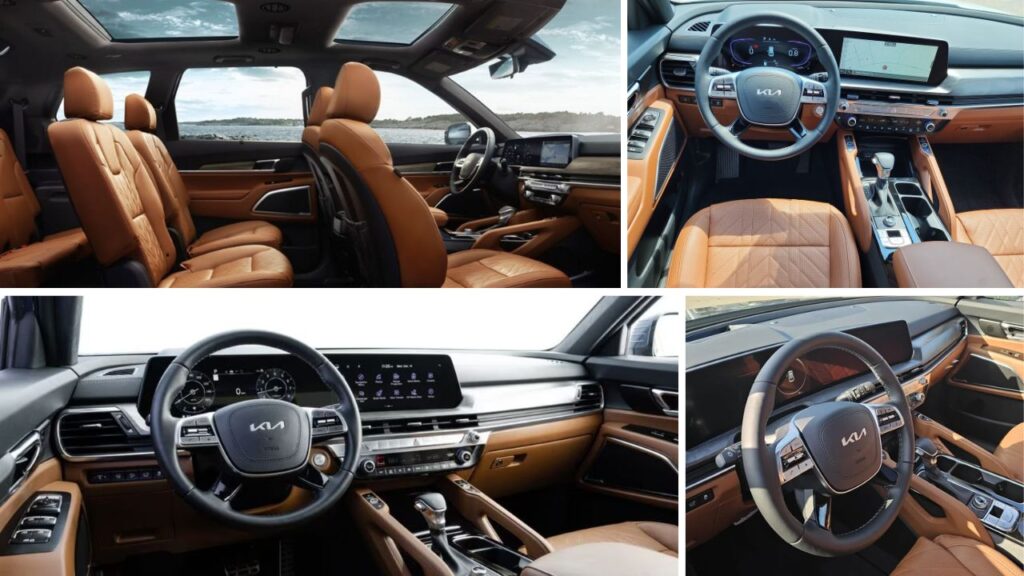
The upper level trims of Kia Telluride come with Nappa leather seats, real wood inlays, and suede-like materials on the headliner that bring the refinement up a notch. The available heated and ventilated second row captain’s chairs (with best-in-class legroom) guarantee comfort for passengers in the rear.Lower spec models have a good quality synthetic leather (SynTex) or leather substitute that still feels premium but without the luxury cost.

 Five sophisticated interior color options:​ Black, Gray, Gray & Navy, Mahogany, and Terracotta

Climate Control and Ambient Features

Standard Telluride models are equipped with dual-zone automatic climate control, and rear-seat climate control also comes with dedicated AC vents helping passengers in all three rows of seats remain comfortable. With the available 64-color customizable ambient interior lighting, drivers can personalize the cabin atmosphere while sound-absorbing windshield glass helps keep cabin noise to a minimum for a quiet driving experience. 

Advanced Technology and Connectivity

The 12.3-inch HD touchscreen is equipped with Wi-Fi hotspot, Apple CarPlay, Android Auto, and one controls integrated navigation. Panoramic 12.3in dual displays are available on higher trim levels. Concert-quality sound from the 10-speaker Harman Kardon premium audio system, available on 2.3T and 2.5T Limited models.

The standard 6-speaker audio system on base models. It also features Driver Talk, a function that lets drivers talk to rear-seat passengers without turning around by broadcasting the driver’s voice through the rear-row speakers. 

Every row is equipped with multiple USB-C fast charging ports to keep each passenger connected while on the road. A 110-volt household-style power inverter draws power from the vehicle’s battery to run standard electrical appliances (optional on upper trims). 

Performance and Driving Dynamics
New Kia Telluride Performance and Driving Dynamics

Image credit: Kia

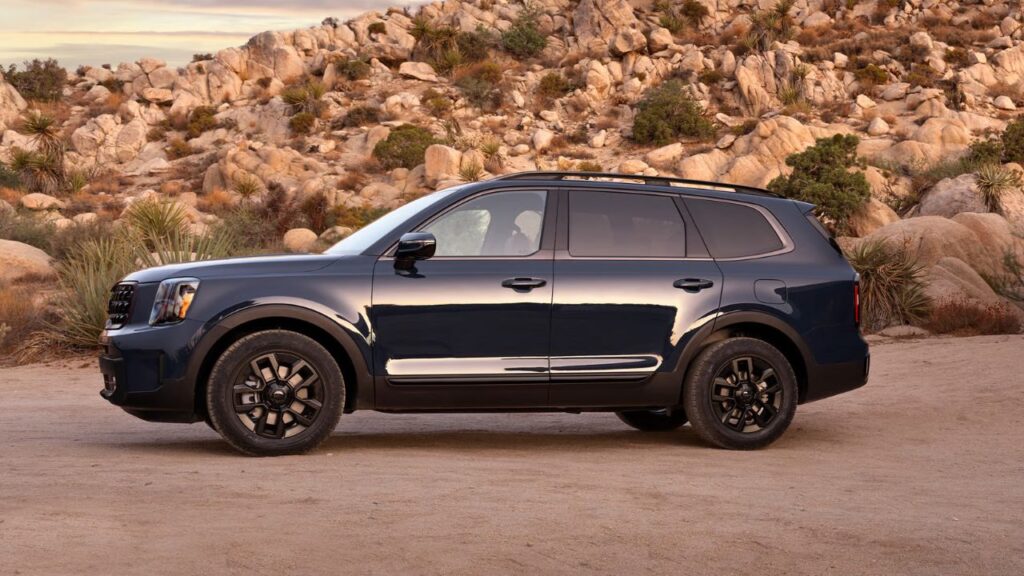
All 2025 Telluride models come standard with a 3.8-liter V6 engine that makes 291 horsepower and 262 pound-feet of torque. This combination gives you snappy acceleration plus fuel economy that’s not shabby — 20 MPG city and 26 MPG highway.

The eight-speed automatic transmission strikes just the right balance between fuel economy and responsiveness, the power delivery feeling as smooth as ever when you need it. Drive Mode Select offers the driver a choice of four driving modes including Comfort, Eco, Sport and Smart modes and an additional Snow mode for Audi all-wheel-drive versions. 

All but the base LX trim level have an all-wheel-drive option, which adds $2,000 to the price and provides better traction and stability in bad weather. X-Pro models really are ready for adventure, with a towing capacity that’s been boosted to 5,500 pounds (5,000 pounds on regular models) and suspension tuning that’s geared for the outdoors. 

Comprehensive Safety and Driver-Assistance Features

The 2025 Telluride’s excellent crash-avoidance and occupant protection capabilities result in a 5-Star NHTSA rating and the IIHS Top Safety Pick+ award. With over 17 standard driver-assistance features, included on every model, it sets the bar for this category.  

Passive Safety

The vehicle is outfitted with nine strategically located airbags (dual front, side curtain, second row side, and driver knee) to help protect all occupants. Anti-Lock Braking System, Electronic Stability Control, Vehicle Stability Management, Hill-Start Assist and Traction Control are a standard combo that helps you maintain control when the going gets tough. 

Active Safety and Driver Assistance

Blind Spot Collision Warning employs steering assist technology that nudges the vehicle back into its lane if the driver begins a lane change with an occupied blind spot. Forward Collision Warning with Pedestrian, Cyclist and Junction-Turning Detection monitors the traffic ahead, giving visual and audible alerts when the risk of collision increases.

AEB: Auto Emergency Braking – the system brakes automatically to prevent or reduce the severity of collision with vehicles, pedestrians or cyclists. Pedestrian Cyclist Lane Keeping and Following Assist: It keeps the vehicle in the lane and corrects the steering wheel in a mild way if the vehicle strays unintentionally from the lane. 

Navigation-Based Smart Cruise Control with Stop & Go lets the vehicle speed vary by curves on the road and navigation information, decelerating when approaching curves and accelerating after passing them up to the preset speed. Available Highway Driving Assist 2 employs cameras, radar and navigation information to keep safe following distances and perform lane changes by using the turn signal. 

Traffic sign recognition, intelligent speed limit assistance, driver attention monitoring and more are among the additional features. The 360-degree Surround View Monitor helps simplify parking and maneuvering at low speeds by displaying an aerial view around the vehicle. ​ 

Kia Telluride Price According To Trim Levels

Trim Starting Price Range (USD) Drivetrain Option
Base and Mid-Level Trims
LX (FWD only) $36,390 – $37,805 Front-Wheel Drive (FWD) only
S $39,390 – $41,390 Available with AWD option
EX $42,090 – $44,090 Available with AWD option
Premium Trims
SX $46,190 – $48,190 Available with AWD option
SX Prestige Starting at $51,390 Standard AWD
Adventure-Oriented Variants
EX X-Line Starting at $46,485 Standard AWD
EX X-Pro Starting at $47,385 Standard AWD
SX X-Line Starting at $49,885 Standard AWD
SX-Prestige X-Line Starting at $52,785 Standard AWD
SX-Prestige X-Pro Starting at $53,685 Standard AWD

Read More 👉 New Tata Sierra 2025 – Price, Features, Launch Date, and Electric SUV Details

Conclusion

The 2025 Kia Telluride offers authentic luxury positioning, but not luxury pricing. The roomy three-row SUV offers a refined interior, modern technology, and a long list of safety equipment at a price that’s far below rivals such as the Lexus GX or premium trims of segment competitors.​

With its bold design statement, genuine premium comfort for up to seven or eight passengers, unsurpassed cargo versatility plus a comprehensive suite of advanced driver-assistance technologies, the Telluride once again proves that it’s the benchmark for families and thrill-seekers in need of a truly capable, connected, and comfortable three-row SUV experience. 

Sharey Khan

Sharey Khan is an IT entrepreneur and petrol head & a car enthusiast. With a special focus on car-related content, he combines his deep passion for vehicles with a talent for crafting informative, engaging, and easy-to-understand content. His writing is driven by a genuine love for cars and he is committed to providing readers with accurate, up-to-date, and trustworthy information that empowers smarter driving decisions. 

Leave a Reply

Your email address will not be published. Required fields are marked *

The 2025 Toyota Camry: Performance, Features, and Safety

Toyota Camry 2025

The 2025 Toyota Camry is now on sale and it is shaking up the midsize sedan segment!Toyota is going all hybrid for the ninth-generation model – the traditional gas-only engines are being dropped. With four trims—LE, SE, XLE, and XSE—the Camry is melding efficiency with style and performance now more than ever. Loaded with all the latest technology and safety features and boasting a great design, the only question to answer is if you are an environmentally-friendly driver or just like a great ride. And with competitive starting prices, it’s obvious Toyota still wants the Camry to be a leader in its segment.  

Strategic Shift and Core Performance

What that means for 2025, that means the 10th-generation is available-standard as a hybrid powertrain. The fifth generation Toyota Camry is available only as a hybrid, utilizing the Toyota Hybrid System with a 2.5-liter 4-cylinder engine along with electric motors. This strategic shift dramatically elevates the baseline performance and results in exponential returns in efficiency. 

The default Front-Wheel Drive (FWD) setup has Rated Combined 225 horsepower output. For those who choose the Electronic On Demand All-Wheel Drive (AWD), which is optional, the system adds an additional rear electric motor and output rises to 232 net combined horsepower. Power is transmitted via an Electronically Controlled Continuously Variable Transmission (ECVT).  

The hybrid system requirement makes the 2025 Camry no less powerful and a whole lot more efficient than last stable’s base gasoline trim. With the instant torque of the electric motors, the car feels more lively around town and enables the sedan to deliver respectable 0-60 mph times between 6.8 and 7.7 seconds. 

Driving Dynamics and AWD Trade-Offs

The chassis received revised suspension and brake systems engineered to attain an ideal harmony of ride comfort and handling stability. Tighter body control in cornering is the result of sport-tuned independent front and multi-link rear suspensions on the SE and XSE trims, particularly the latter.

Toyota Camry Driving Dynamics and AWD Trade-Offs

Four different grades are available with the same AWD system engineered primarily for traction on diverse surfaces. It does come with a slight power increase of 7 horsepower over the FWD option, but it undoubtedly needs to be measured against the efficiency. Oil may be customers first choice in order to achieve the best fuel economy for maximum, but AWD models has a rather heavy penalty on mileage due to the extra weight and drag of the electronic AWD system so if your focus is absolute best fuel economy and you don’t want to drive in the snow, FWD is your better bet. 

Fuel Efficiency and Cost Analysis

The 2025 Camry is able to deliver best-in-class efficiency ratings with the standard THS 5 system equipped. The entry-level LE front wheel drive model sets the bar closer to the stars with a combined 51 MPG (53 city/50 highway) figure from the manufacturer. 

The standard THS 5 system allows the 2025 Camry to achieve best-in-class efficiency ratings. The base LE FWD model sets the bar higher with a manufacturer-estimated 51 combined mpg (53 city/50 highway). 

Table for Toyota Camry EPA-Estimated Fuel Economy

Trim  City MPG Highway MPG Combined MPG
LE FWD 53 50 51
LE AWD 51 49 50
SE FWD 48 47 47
SE AWD 46 46 46
XLE FWD 48 47 47
XLE AWD 46 46 46
XSE FWD 48 47 47
XSE AWD 44 43 44

Tech geeks will notice a flattening of fuel economy: the SE, XLE and XSE FWD models all have the same 47 combined MPG figure. That means when you go up the pack and up in wheel size and luxury amenities from the all-out efficiency focused base LE, you’re getting a 47 MPG ceiling on the FWD models. 

Pricing Structure and Standard Features

2025 Camry is pricier than the outgoing gas-only version, but it remains competitively priced, especially in light of the required advanced hybrid powertrain.

Toyota Camry Pricing Structure and Standard Features

The base LE model has a starting MSRP (Manufacturer’s Suggested Retail Price) of $28,400. All prices do not include the Dealer Processing and Handling Fee (DPH) of $1,095. 

Pricing by comfort and technology is clear:

LE: Begins at $28,400, delivering the most efficiency and the most robust standard features.

SE: Starting at $30,700, with sport styling, synthetic leather seating (SofTex), and 18-inch black-finished wheels. 

XLE: Begins at $33,400, opening the doors to luxury with rich materials and larger screens.  

XSE: Starting at $34,600, the top sport model comes with 19-inch smoked gray/black wheels.  

While it’s a bit pricier at the bottom end, the addition of the hybrid system and important standard tech makes it easy for the buyer to justify the expense. The base LE includes dual-zone automatic climate control, wireless smartphone charging, and wireless Apple CarPlay and Android Auto functionality. 

Interior Technology and Digital Segmentation

The cabin has been completely re-engineered for the ultimate comfort and latest technology. One of the levers in making the value proposition clear across the grades is the size of the digital displays. Its 8-inch Toyota Audio Multimedia screen is standard with LE and SE trims. 

However, the XLE and XSE models receive a significant upgrade: a massive 12.3-inch touchscreen that is flanked on the right by an identical size digital instrument cluster. This dramatic increase in digital real estate is one of the memorable tacit codes used to distinguish the mid/upper-trims. These luxury models also offer optional features including a 10-inch color Head Up Display (HUD) and heated and ventilated front seats. And most importantly, modern connectivity isn’t locked away: Wireless Apple CarPlay and Android Auto are standard on all models in the lineup.  

Read More 👉  The 2025 Volvo XC90 Review, Safety Ratings and Pricing in Detail — Best Trims for Families

Advanced Safety and Ratings

The commitment to high-level safety is evident in the availability of the all-new Toyota Safety Sense 3.0 (TSS 3.0) package as standard equipment across the entire 2025 Camry lineup. · Technology upgrades TSS 3.0 features upgrades like an upgraded forward-facing camera and radar sensor with wider field of view.   

Key features of TSS 3.0 Pre-Collision System with Pedestrian Detection Dynamic Radar Cruise Control (DDRC) Lane Tracing Assist (LTA) Proactive Driving Assist Spreading further safety You may also like. Plus two critical driver-assist tech — Blind Spot Monitor (BSM) and Rear Cross-Traffic Alert (RCTA) — are standard for every trim, including the base LE version.  

The 2025 Camry is built to be safest in class. The early international crash safety testing and the vehicle’s structural design suggest that it will pass the rigors of the IIHS Top Safety Pick+ award. Testing confirms strong performance including “Good” for the pedestrian auto frontal crash prevention system.  

One contributor to future vehicle durability is TSS 3.0 being Upgradable to Over The Air (OTA) Software Updates. This enables Toyota to roll out vital updates and additional advanced features to the ADAS suite post-purchase, maintaining the relevance and safety of the vehicle long-term, without ever needing the involvement of a dealer. 

Conclusion

The 2025 Toyota Camry deftly pivots from regular midsize sedan to technology-driven, full-hybrid vehicle. This ninth-generation model builds on the proven efficiency of THS 5 to offer a level of performance that is both competitive and class-leading in fuel economy, particularly in the base LE trim. With its range of essential safety and connectivity features (TSS 3.0, BSM, Wireless CarPlay) Toyota takes care of delivering good value for the all grades, while the large digital displays and luxury touches are reserved for the XLE and XSE grades.

Sharey Khan

Sharey Khan is an IT entrepreneur and petrol head & a car enthusiast. With a special focus on car-related content, he combines his deep passion for vehicles with a talent for crafting informative, engaging, and easy-to-understand content. His writing is driven by a genuine love for cars and he is committed to providing readers with accurate, up-to-date, and trustworthy information that empowers smarter driving decisions. 

Leave a Reply

Your email address will not be published. Required fields are marked *

Toyota LC FJ vs Toyota Fortuner: The Shared DNA That Makes Them Siblings

Toyota LC FJ vs Toyota Fortuner

The automotive world was recently electrified when Toyota brought back the Land Cruiser FJ, fondly known as the “Baby Land Cruiser.” What is so interesting about this announcement is that the LC FJ is built on the same basic engine and platform as the popular Toyota Fortuner – essentially making them automotive siblings with a different attitude. But there are some features that are different from each other that make them stand in a different perspective. Buyers can check every detail through this article before buying it.

The Common Foundation: More Than Just Shared Parts

The Toyota LC FJ and Fortuner connection is far deeper than just a parts-bin-sharing exercise. Both are based on Toyota’s tried and tested IMV (Innovative International Multipurpose Vehicle) platform, a hardy ladder-frame chassis that has underpinned Toyota’s global pickup and SUV strategy since 2004. This platform has already been proven with more than 5 million vehicles worldwide with not only the Fortuner, but also the Hilux pickup and Innova minivan. 

The LC FJ employs in particular a modified version of the IMV platform, known as IMV 0, that Toyota designed to produce cheaper but just as capable vehicles for developing markets. Preserving the shape and off-road capabilities of the original IMV platform, the IMV 0 version utilizes cost-effective materials and production techniques. 

The Heart of the Matter: The 2TR-FE Engine

Perhaps the biggest similarity between these two SUVs lies under the bonnet. The Toyota LC FJ and Fortuner petrol variant comes with the same 2TR-FE 2.7 litre four-cylinder naturally aspirated petrol engine. This is not just similar spec – it’s the same engine code, same displacement and same core architecture. 

The Heart of the Matter The 2TR-FE Engine

The 2TR-FE produces 163 PS (160 hp) at 5,200 rpm and 246 Nm of torque in the LC FJ while the Fortuner petrol version produces almost the same numbers: 163 PS at 5,220 rpm and 245 N⋅m at 4,020 rpm. This is the first Toyota engine to employ its Dual VVT-i (Variable Valve Timing with intelligence) technology on the intake and exhaust camshafts which enables the engine to achieve maximum performance at any engine speed. 

The 2TR-FE is based on a cast-iron block with an aluminum cylinder head and features double overhead camshafts (DOHC) with 16 valves. The engine uses a timing chain instead of a belt, which has added to its reputation for reliability and low maintenance. 

Platform Similarities

Both vehicles are built on the IMV platform with a ladder frame chassis, which ensures high levels of structural rigidity and makes them exceptionally capable off road. This body-on-frame construction has several advantages. 

Shared Structural Elements:

  • Two wishbone front suspension for handling and off-road articulation superiority with an articulating rear suspension
  • Multi-link rear suspension engineered to deliver the right balance of comfort and capability
  • Engines mounted in-line for best weight distribution
  • 4WD power, with part-time systems available on the two vehicles. 

The LC FJ can provide a wheelbase of 2,580 mm as against 2,745 mm for the Fortuner, but both the vehicles boast nearly identical ride qualities and off-road capabilities. 

Read More :- What’s The Safest Family Car You Should Buy

Where They Diverge: Different Missions, Different Personalities

Yet, there are two entirely different markets and purposes for the LC FJ versus the Fortuner. 

Where They Diverge Different Missions, Different Personalities

Size and Dimension

The first big gap is the size difference. The Toyota LC FJ is 4,575 mm long, which is 220 mm less than the length of the Fortuner of 4,795 mm. The Fortuner and LC FJ have the same width of 1,855 mm, but the LC FJ is taller at 1,960 mm compared to the Fortuner’s 1,835 mm height. 

Seating and Practicality

The LC FJ is available with five seats and two rows which makes it a more intimate, adventure-oriented vehicle. By comparison, the Fortuner has three rows and seven seats, making it the family-friendly option for those requiring the most passenger space. 

Engine Options: Choice vs. Simplicity

Both cars are available with the 2TR-FE petrol engine, but the Fortuner has more options with the 2.8-liter 1GD-FTV turbocharged diesel engine. The diesel version is every bit more powerful and torquey: 201 PS and 500 N⋅m , and it is the performance option for those who care most about towing pack and mileage. 

Contrarily, the LC FJ is all about simplicity, being petrol-only, which I suspect points to a Toyota strategy to keep the price down and the reliability up in those markets where the quality of diesel fuel can be suspect. 

Transmission and Drivetrain: Refined vs. Flexible

Both cars use 6-speed automatics, but different philosophies. The LC FJ uses Toyota’s 6-speed Super ECT automatic transmission in conjunction with part-time 4WD. It’s a simple system that focuses on ease of use and reliability for those who want to keep things basic. 

Transmission and Drivetrain Refined vs. Flexible

The Fortuner has more flexibility with manual and automatic transmission options across the engine range as well as 2WD and 4WD variants to suit the pockets and requirements of different customers. This flexibility allows the Fortuner to attract both city commuters and hardcore off-roaders. 

Design Philosophy: Heritage vs. Contemporary

The styling treatments illustrate different positioning of the brands. The LC FJ is inspired by Land Cruiser heritage, especially the legendary FJ40, with its boxy shape, round headlights and utilitarian look.This aesthetic resonates with enthusiasts that appreciate the Land Cruiser’s famous off-road heritage. 

The Fortuner gets a more contemporary SUV look, which is a perfect blend of ruggedness and modern sophistication.Its styling is aimed at buyers who want utility, but who don’t want their utility vehicle to look out of place on city streets. 

Market Positioning: Specialized vs. Mainstream

The LC FJ is aimed at adventure seekers and Land Cruiser fans who crave real off-road ability in a package that is more attainable and affordable. With its streamlined spec sheet and retro styling, it appeals to buyers for whom substance matters more than features. 

Market Positioning Specialized vs. Mainstream

Apart from the of Fortuner caters to the mass premium SUV segment with the comfort of choice across multiple engine options, seating configurations, and trim levels. It strikes the perfect balance between off-road prowess and refined on-road performance to make it your daily driver or weekend adventurer for the off-road trails. 

The Reliability Factor of The Proven Technology

Arguably the most exciting part about both products is that they are based on thoroughly proven designs. Since 2004, the 2TR-FE engine has covered millions of miles in various global markets and has a great reliability record. The IMV platform also has proven itself with over 5 million units produced with no major structural faults.This common technical baseline gives both vehicles the Toyota’s renowned durability and low cost of maintenance. 

Conclusion

The Toyota LC FJ and Fortuner are excellent examples of platform engineering – where common platform underpinnings are used to create completely different vehicles that cater to individual market needs. They have the same heart and bones, but different souls, and those different souls give each one a reason to exist in Toyota’s ever-growing SUV family. 

Be it the LC FJ’s genuine roots and stripped-back purpose, or the Fortuner’s flexible family-friendly angle, both promise the same dependable and capable ethos that has made Toyota’s IMV platform one of the most successful automotive architectures ever. 

Sharey Khan

Sharey Khan is an IT entrepreneur and petrol head & a car enthusiast. With a special focus on car-related content, he combines his deep passion for vehicles with a talent for crafting informative, engaging, and easy-to-understand content. His writing is driven by a genuine love for cars and he is committed to providing readers with accurate, up-to-date, and trustworthy information that empowers smarter driving decisions. 

Leave a Reply

Your email address will not be published. Required fields are marked *

2026 Toyota Tacoma – Full Overview, Features, and What to Expect

2026 Toyota Tacoma

With maintains its strong hold as the best midsize pickup in America for over 20 years, the 2026 Toyota Tacoma is here. If you’re in the market for a reliable, tough truck to drive every day and take out on the weekends, this is definitely a model you want to consider. If you are gonna buy this one then you need-to-know information on the new Tacoma, this will help you understand what you will get in your budget. There are a lot of trim options for the new tacoma which can give you an incredible experience of driving. 

What’s New for 2026 in Tacoma?

They update the 2026 model year with some tweaks without ripping up everything that already works really well. Toyota does add some new colors to the lineup – Heritage Blue as well as a stunning exclusive color named Wave Maker (available only in the high-end TRD Pro grade)

If you’re after the TRD Off-Road, TRD Sport, and TRD PreRunner models you’ll notice they now feature a trendy black front logo. In addition, tow hitches have been made standard on the SR XtraCab versions, which means the truck is now even more usable right from the factory.

New for 2026 in Tacoma

Image credit: Toyota

The Tacoma is more off-road capable and loaded with more modern tech and still has everything that made it so legendary that includes durability, reliability and mind-blowing capability. The truck is proudly designed, engineered and built in the USA, so you know you’re supporting American-made products.  

Engine Choices – Power Meets Efficiency

This is when things begin to get interesting. The 2026 Tacoma offers two engine options as per your need, you can grab the one. 

2026 Toyota Tacoma Engine and Performance Specifications

2026 Toyota Tacoma Engine and Performance Specifications

The Standard i-FORCE turbo engine is available in two power levels. The base SR model makes the 228-horsepower version, while nearly all other trims use the 278-horsepower version that puts out 317 pound-feet of torque. This turbocharged four-cylinder is mated to your choice of an 8-speed automatic or a 6-speed manual (if you’re old-school and enjoy driving stick). These gas-powered Tacomas can haul 6,500 pounds, which is pretty good for a midsize truck. 

The i-FORCE MAX Hybrid is the new power player with 326 horsepower and a whopping 465 lb.-ft. of torque. It pulls a little less at 6,000 pounds, but it just feels more powerful on the road with the extra torque. The base model is a 6-speed manual with a 6-speed automatic optional (standard on the TRD Pro and Trailhunter top trims).

Toyota Tacoma Engine and Performance Specifications

Image credit: Toyota

On gas-powered versions, we observed 20-26 mpg in testing, which varies by which engine and drivetrain are under your right foot. And the hybrid gets 22-24, which is pretty darn good for a truck this big. 

Pricing That Fits Different Budgets

It is safe to say that there are Tacomas available for every budget. Pricing for the top-of-the-line TRD Pro ranges from $33,740 for the base SR model to $65,945 to the moon let alone fully loaded. Here’s the deal with what you get at different price points: 

If price is the determining factor for you the SR5 at $37,830 is an absolute no-brainer. You get blind-spot monitoring, fog lamps, and solid feature that won’t break the bank. TRD Off-Road ($44,010) 

2026 Toyota Tacoma Trim Levels and Pricing

2026 Toyota Tacoma Trim Levels and Pricing

BONUS – If there was one trim option that was best for most people, that has got to be the TRD Off-Road, which provides a great balance of serious off-road capability without the luxury price tag of the Limited trim.

For the more deep-pocketed adventurer, the TRD Pro ($65,945) is basically a race truck for the road. It comes with FOX suspension tuned by TRD racing professionals, unique IsoDynamic performance seats, a large integrated LED light bar, and unique styling that turns heads wherever you go. 

Inside the Cabin – Comfort Meets Technology

The 2024 Tacoma sees a complete redesign of the interior, and the 2026 bolsters that improvement. The dashboard is modern, with soft-touch materials and a choice of 7- or 12.3-inch digital gauge cluster based on your trim.

Now, the tech features are mind-blowing. Certain models offer a 14-inch touchscreen display with support for Apple CarPlay and Android Auto. There’s an optional 3D Multi Terrain Monitor giving you a full 360-degree view of your environment – ideal when negotiating rough terrain or backing into a tight parking spot. 

Inside the Cabin – Comfort Meets Technology

Image credit: Toyota

The Limited comes standard with heated and cooled front seats, which is a luxury for a truck. And the seats are also higher than before, so you’re not sitting on the floor anymore. Also, you’ll find more head- and legroom in all rows, which makes for a genuinely comfortable longer drive.

All Tacoma models come with Toyota Safety Sense 3.0 as standard, which adds lane-keeping assist, automatic emergency braking, adaptive cruise control and pedestrian detection. It’s the sort of technology that helps keep you safe without getting in the way of your drive. 

Off-Road Capability – The Tacoma’s Real Strength

When you’re in the market for a Tacoma, it’s safe to assume that you are interested in more than just how it performs on the highway. Every model Toyota made came with front and rear disc brakes, and electric power steering that improves both feel and integration of the safety features.

Serious off-road tech comes with the TRD models like Multi-Terrain Select and Crawl Control – these automatically tune your truck’s performance for rocks, sand, or mud. The TRD Pro and TRD Off-Road also receive an electronically locking rear differential and a stabilizer disconnect system that increases suspension articulation when you want it. 

And the TRD Pro cranks it up a notch further with real-time adjustable FOX QS3 shocks, IsoDynamic performance seats utilizing air suspension technology to keep you stable over rough ground, and Limited models also offer optional Adaptive Variable Suspension that delivers a smooth ride on any surface. 

Conclusion

The 2026 Toyota Tacoma manages to be at once a sensible everyday driver and an eager weekend adventure partner. Either way, with the gas one, or the hybrid for a bit more power and efficiency, you get a truck with Toyota’s legendary reliability.

The new colors and standard safety equipment, plus other small enhancements, make this generation feel fresh while keeping what makes Tacomas legend. When it comes to a reliable midsize pickup, the 2026 Toyota Tacoma is one of the first to consider. Should be available starting winter 2025, so rush to your nearest dealer to lay eyes on one. 

Sharey Khan

Sharey Khan is an IT entrepreneur and petrol head & a car enthusiast. With a special focus on car-related content, he combines his deep passion for vehicles with a talent for crafting informative, engaging, and easy-to-understand content. His writing is driven by a genuine love for cars and he is committed to providing readers with accurate, up-to-date, and trustworthy information that empowers smarter driving decisions. 

Leave a Reply

Your email address will not be published. Required fields are marked *

Best Sedan Under 20 Lakhs: Luxury Buys with Premium Features

Best Sedan Under 20 Lakhs

The Indian car market has matured a lot when it comes to buying a sedan that is offering a perfect balance of budget and luxury. The Best Sedan Under 20 Lakh segment is no longer just about getting from here and there but it’s about buying vehicles that are loaded with premium features, sophisticated technology and driving dynamics that can challenge rival models that cost a lot more. Whether you’re a young professional, a new family or just someone who needs a good mix of style and substance, sedans in this price range cover all bases. 

The great thing about purchasing a sedan under ₹20 lakhs in 2025 is that vendors have upped their game significantly in terms of feature content. You are getting cars with relatively sophisticated infotainment systems, advanced driver assistance systems (ADAS), premium audio systems, and design elements that make these cars look much more expensive than they really are. Those days when budget was synonymous with compromise is over; today, it means intelligent selection. 

The Top Contenders Under 20 Lakhs

Hyundai Verna

Hyundai Verna continues to rule the roost in this segment. From a mere ₹10.69 lakh, the Verna has changed the expectation customers can have under this price bracket. The top-end models have turbo petrol engines, sportier performance, and a cabin that is genuinely premium. 

Hyundai Verna

Image credit: Hyundai

The Verna’s 10.25-inch touchscreen infotainment system, coupled with an 8-speaker Bose audio system in top variants, delivers the kind of acoustic experience you expect in much higher cost vehicles. 

What really makes the Verna stand out is its Level 2 ADAS capability on the top variants – features like Forward Collision Warning, Collision Avoidance Assist and Lane Keep Assist that make even your day-to-day driving a safer and more relaxed experience.

Skoda Slavia 

The Skoda Slavia brings European engineering to the mass-market sedan segment, and it really shows. Priced from ₹10 lakh, the Slavia exudes a personality that sets it markedly apart from the competition. 

Skoda Slavia 

Two-tone color schemes, perforated leatherette seats and a two-spoke steering wheel add to a more premium feel for the interior. Apple CarPlay, a standard iPhone feature for information, navigation and entertainment is now available through a larger 10.0-inch infotainment display with wireless connectivity and an 8-speaker audio system. 

The Skoda Slavia is an exciting prospect for the driving enthusiast as it comes with Skoda’s hallmark build quality, polished turbo petrol motors and superb ride dynamics.  

Volkswagen Virtus

The Volkswagen Virtus makes an entry with ₹12.77 at characteristic German efficiency and pragmatism. Fuel efficiency is very good with some versions giving more than 20 kmpl which makes it very economical to own and run. 

Volkswagen Virtus

Image credit: Volkswagen

Higher variants even get a sunroof, wireless charging, cruise control and ventilated seats. The Virtus adds real-world practicality and long-term reliability (backed by Volkswagen’s service network) is perfect for buyers. 

Honda City

The Honda City is a genuine luxury sedan that wears an affordable price tag, beginning at ₹11.95 lakhs. The spacious cabin of the Honda and the premium leatherette upholster combined with the smallest details on the interiors make the vehicle look and feel as if it belongs to a much higher segment. 

Honda City

The 8-inch touchscreen infotainment system with Android Auto and Apple CarPlay, supports Bluetooth connectivity and voice commands for a rich, hands-free experience. It’s especially impressive that certain variants receive the Honda Sensing ADAS suite as standard, which includes collision mitigation braking, adaptive cruise control, and lane keeping assist features that take safety to a premium level. 

The Honda also boasts a powerful hybrid option delivering an outstanding mileage of approximately 20 kpl, which is a perfect match for green-friendly consumers who don’t want to have the pleasure of driving it actually trimmed down. 

Toyota Belta

Toyota Belta is dense enough in features to offer great value for money, the starting price of ₹10 lakhs makes it one of the cheapest sedans in this segment. The Belta doesn’t cut corners on necessities, even with its budget pricing. 

Toyota Belta

It also features a 7-inch touchscreen infotainment system with Android Auto and Apple CarPlay, an air purifier for cabin hygiene, automatic climate control, and cruise control. For daily commutes, the Belta is an easy choice as it churns out a fuel economy of 20.04-20.65 kmpl. 

The Belta is an appealing option to buyers who want a reliable car above everything else, as Toyota’s legendary reliability and strong service network throughout India also make it an excellent choice for that. 

Premium Features That Matter

Luxury features today aren’t simply about flashy technology—they’re about real comfort or safety improvements that enhance the driving experience. Earlier a sunroof or a panoramic roof was an attribute limited only to premium cars, now you can find it on many variants in this price band. 

Ventilated front seats help you stay cool during hot Indian summers, with automatic climate control providing consistent temperature in the cabin. Wireless charge pads, they seem trivial, but they can save you from cluttered dashboard and tangled cables on your day to day commute. 

Safety is now more important than ever and these sedans impress. Most variants of the models have six airbags in the higher variants, with some snagging 5-star Global NCAP or ASEAN NCAP safety ratings. 

Electronic Stability Control (ESC), Anti-lock braking system (ABS) with Electronic Brakeforce Distribution (EBD) along with traction control (TCS) and hill start assist are now more standard than luxury features. The addition of ADAS technology, especially in the Verna and City, introduces autonomous emergency braking and lane-keeping assist features that were unthinkable at this price point just a few years ago. 

Infotainment Systems have now come to dominate modern­­ vehicle cabins and it’s the manufacturers who now have to take the strain. The displays on these models range from 7 to 10.25 inches and provide seamless smartphone integration, voice controls, and easy-to-use interfaces. 

Wireless Apple CarPlay and Android Auto make it easy not to fumble with cables on the road. The air cleaner, that was earlier considered after market option for the costly cars, is standard on a couple of variants and this should help keep the quality of air in the cabin good during those dusty Indian road conditions.  

Read More:- Toyota Hilux Price, Images, Colours & Reviews – Latest Updates & Full Details

What Should You Buy

Comparing these five sedans means knowing what you want to get out of a car. If you are into the latest technology, have some ADAS safety features, and the brand recognition of a worldwide known manufacturer, the Hyundai Verna it is. Those who care about driving dynamics, build quality and that European vibe on a budget will find a lot to love in the Skoda Slavia. If you’re after fuel-efficiency, useful features and the dependability of Volkswagen, the Volkswagen Virtus will not let you down. 

If you are looking for the feeling of luxury, spacious seats, advanced safety features and a premium overall experience, the Honda City is the best choice. Its hybrid version is also attractive to green buyers. In the end, the Toyota Belta is perfect for new car buyers or those who want the best bang for the buck with Toyota reliability and after sales service.

The five sedans also have good resale value, strong service networks and solid warranties. With sub-20-lakh sedans firmly entrenched as the playground where luxury features are not just aspirational, but readily available. Your luxury sedan is waiting and you don’t have to spend a fortune to get one. 

Overall Comparison Among Best Sedan Under 20 Lakhs

Feature Hyundai Verna Skoda Slavia Volkswagen Virtus Honda City Toyota Belta
Starting Price ₹10.69 Lakh ₹10.00 Lakh ₹11.16 Lakh ₹11.95 Lakh ₹10.00 Lakh
Top Variant Price ₹16.98 Lakh ₹18.69 Lakh ₹18.73 Lakh ₹16.19 Lakh ₹16.00 Lakh
Engine Options 1.5L MPI / 1.5L Turbo GDi 1.0L TSI / 1.5L TSI 1.0L Turbo / 1.5L Turbo 1.5L Petrol / Hybrid 1.462L Petrol
Mileage 18.6-20.6 kmpl 19.36-20.29 kmpl 18.12-20.8 kmpl 17.8-20 kmpl 20.04-20.65 kmpl
Sunroof Available Available Available Available (ZX) Not Available
ADAS Level 2 (top variants) No No Yes (select variants) No
Safety Rating 5-Star NCAP 5-Star NCAP 5-Star NCAP Not Rated 4-Star ASEAN NCAP
Transmission Manual / Automatic Manual / Automatic Manual / Automatic Manual / e-CVT Manual / Automatic

Conclusion

Pick the best sedan under ₹20 lakhs in 2025 and your choice depends on what you value the most — tech, safety, mileage, performance or comfort. The team has worked to elevate the segment to the point where now you don’t have to give up luxury just to stay on budget. 

Every sedan on this list brings something different: the Hyundai Verna boasts next-gen ADAS and premium features, the Skoda Slavia offers unmatched European driving dynamics, the Volkswagen Virtus continues to impress with practicality and efficiency, the Honda City is still the segment’s bar for comfort and sophistication, and the Toyota Belta is low-tech, dependable, and frugal. 

Whichever you choose, you’ll be getting a car laden with features, modern, and future proof whose genuinely premium-feeling for its price. Your dream sedan isn’t just affordable but it’s absolutely attainable. 

Sharey Khan

Sharey Khan is an IT entrepreneur and petrol head & a car enthusiast. With a special focus on car-related content, he combines his deep passion for vehicles with a talent for crafting informative, engaging, and easy-to-understand content. His writing is driven by a genuine love for cars and he is committed to providing readers with accurate, up-to-date, and trustworthy information that empowers smarter driving decisions. 

Leave a Reply

Your email address will not be published. Required fields are marked *

Top 10 Best Mileage Cars in India 2025 You Must Check Before Buying!

Top 10 Best Mileage Cars in India 2025

Arе you looking for a nеw car that is еasy on your wallеt? If yеs, thеn you must chеck out thе bеst milеagе cars in India. In 2025, thе car markеt is full of options. Rising fuеl pricеs makе fuеl еfficiеncy vеry important. Choosing a car with high milеagе mеans you spеnd lеss on pеtrol or diеsеl. You also hеlp thе еnvironmеnt by burning lеss fuеl. 

This articlе will show you thе top 10 bеst milеagе cars in India for 2025. Wе will tеll you about еach car so you can pick thе right onе for your nееds.

Why Milеagе Mattеrs in 2025?

Milеagе is how far a car can go on onе litrе of fuеl. Bеttеr milеagе mеans you savе monеy еvеry timе you fill your tank. Many pеoplе in India drivе еvеry day. Traffic jams and long commutеs arе common. 

A car with good milеagе is pеrfеct for city driving. It also kееps your running costs low. Bеst milеagе cars in India arе now a top choicе for buyеrs. Thеsе cars arе not just chеap to run. Thеy also havе modеrn fеaturеs and look stylish.

Top 10 Bеst Milеagе Cars in India 2025

Check out the list of thе bеst cars for milеagе in India. Each car is popular for its fuеl еfficiеncy. Wе will tеll you about its pricе, еnginе, and spеcial fеaturеs.

1. Maruti Suzuki Grand Vitara (Hybrid)

Maruti Suzuki Grand Vitara

Image Credit: Maruti Suzuki

Thе Grand Vitara is a strong SUV car from Maruti Suzuki. It givеs a milеagе of 27.97 kmpl. Thе car has a hybrid еnginе. It mеans the car usеs both pеtrol and еlеctric powеr. Thе еnginе is 1.5 litrе and has thrее cylindеrs. Thе car is spacious and comfortablе. It is pеrfеct for familiеs. Thе pricе starts from ₹16.99 lakh.

2. Toyota Urban Cruisеr Hyrydеr (Hybrid)

Toyota Urban Cruisеr Hyrydеr

Image Credit: Toyota

Thе Toyota Urban Cruisеr Hyrydеr is anothеr grеat SUV. It givеs thе samе milеagе as thе Grand Vitara. Thе car has a 1.5-liter petrol engine. It also usеs a lithium-ion battеry for еxtra powеr. Thе car is smooth to drivе. Thе pricе starts from ₹16.81 lakh.

Also Read: Top 7 Upcoming Compact Electric Cars You Can’t Miss in 2025

3. Honda City е:HEV (Hybrid)

Honda City е:HEV

Image Credit: YouTube

Thе Honda City е:HEV is a sеdan with a hybrid еnginе. It givеs a milеagе of 27.26 kmpl. Thе car has a 1.5-liter petrol engine and two еlеctric motors. It is powеrful and comfortablе. Thе pricе starts from ₹20.75 lakh.

4. Maruti Suzuki Cеlеrio (Pеtrol)

Maruti Suzuki Cеlеrio

Image Credit: Maruti Suzuki 

Thе Maruti Suzuki Cеlеrio is a small hatchback. It is pеrfеct for city driving. Thе car givеs a milеagе of 26.68 kmpl. It has a 1.0 litrе еnginе. Thе car is еasy to drivе and light. Thе pricе starts from ₹5.37 lakh.

5. Maruti Suzuki Swift (Pеtrol)

Maruti Suzuki Swift

Image Credit: Maruti Suzuki 

Thе Maruti Suzuki Swift is a popular hatchback. Thе nеw modеl givеs a milеagе of 22.38 kmpl. Thе car has a 1.2-liter engine. It is fun to drivе and looks sporty. Thе pricе starts from ₹6.49 lakh.

Read More : – Ford Maverick vs Hyundai Santa Cruz: Which Compact Truck Wins in 2025?

6. Maruti Suzuki Wagon R (CNG)

Maruti Suzuki Wagon R

Image Credit: Maruti Suzuki

Thе Maruti Suzuki Wagon R is a hatchback model. Thе CNG vеrsion givеs a milеagе of 34.05 km/kg. Thе car is spacious and practical. It is grеat for familiеs. Thе pricе starts from ₹6.43 lakh.

7. Maruti Suzuki Alto K10 (CNG)

Maruti Suzuki Alto K10

Image Credit: Maruti Suzuki

Thе Maruti Suzuki Alto K10 is a small and budgеt-friеndly car. Thе CNG vеrsion givеs a milеagе of 33.85 km/kg. Thе car is еasy to park and drivе. It is pеrfеct for first-timе buyеrs. Thе pricе starts from ₹5.95 lakh.

8. Tata Tiago NRG (CNG)

Tata Tiago NRG

Image Credit: Tata Motors

Thе Tata Tiago NRG is a ruggеd hatchback. Thе CNG vеrsion givеs a milеagе of 26.49 km/kg. Thе car has a tough look. It is safе and comfortablе. Thе pricе starts from ₹6.7 lakh.

9. Hyundai Aura (CNG)

 Hyundai Aura

Image Credit: Hyundai 

Thе Hyundai Aura is a compact sеdan. Thе CNG vеrsion givеs a milеagе of 27 km/kg. Thе car looks stylish and has good fеaturеs. Thе pricе starts from ₹7.89 lakh.

10. Maruti Suzuki Balеno (Pеtrol)

 Maruti Suzuki Balеno

Image Credit: Maruti Suzuki 

Thе Maruti Suzuki Balеno is a prеmium hatchback. It givеs a milеagе of 22.35 kmpl. Thе car has a 1.2-liter engine. It is comfortablе and has many fеaturеs. Thе pricе starts from ₹6.61 lakh.

What Makеs Thеsе Cars Spеcial?

All thеsе cars arе among thе bеst milеagе cars in India. Thеy arе known for saving fuеl. Thеy also havе modеrn fеaturеs. Somе cars havе hybrid еnginеs. This hеlps thеm usе lеss fuеl. Somе cars run on CNG while some run on pеtrol. Thеsе cars arе good for driving and also rеliablе and еasy to maintain.

Final Thoughts

Buying a car is a big dеcision. You want a car that is еasy to drivе, chеap to run, and looks good. Thе bеst milеagе cars in India arе pеrfеct for this. Thеy hеlp you savе monеy on fuеl. Thеy arе also good for thе еnvironmеnt. Thе list abovе has cars for еvеry budgеt and nееd. You can pick thе onе that fits your lifеstylе.

Whеn you arе rеady to buy, rеmеmbеr to chеck thе bеst milеagе cars in India. This will hеlp you makе thе right choicе. 

Bipin Sharma

Bipin Sharma is a seasoned automotive content writer with over 10 years of hands-on experience in the world of cars. From the latest car news and reviews to in-depth maintenance tips and expert buying guides, Bipin covers everything that drives the automotive world. Writing about cars isn’t just his profession — it’s his passion. His deep industry knowledge and love for automobiles fuel every blog he creates, helping readers make informed decisions and stay updated on the fast-evolving auto landscape.

Leave a Reply

Your email address will not be published. Required fields are marked *