0

Toyota Car Prices After GST 2.0 – Full List of Revised Prices & Savings

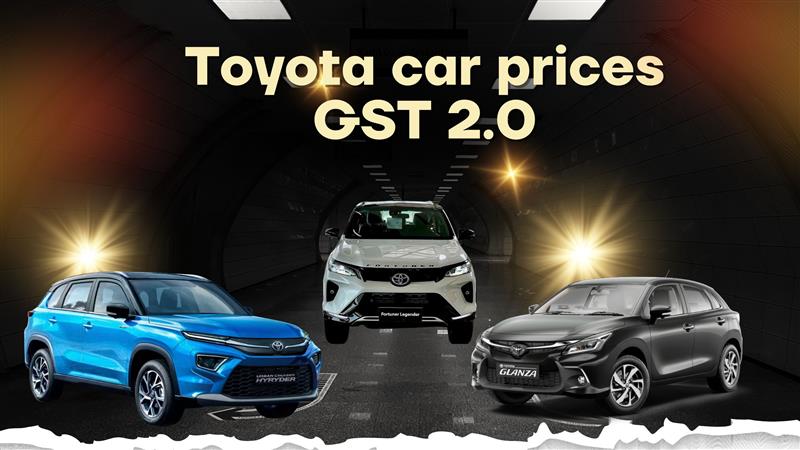
Toyota Kirloskar Motor has announced big price reductions on all its cars after GST 2.0, which came into effect on September 22, 2025. The company is planning to deliver all the benefits with the customers with Toyota car prices GST 2.0, resulting in significant savings between ₹48,700 and ₹3.49 lakh. The price varies upon the variant and model of the car. This is the big opportunity for Indian buyers to buy Toyota’s favorite model at less price.

The Revised GST Structure Changes

The reform GST structure and reduced tax are changed accordingly across small and large vehicles.

Small Cars

Petrol engines up to 1200cc Reduced from 29% to 18%
Diesel engines up to 1500cc Reduced from 31% to 18%

Larger Cars

Mid-size cars with engines up to 1500cc Reduced from up to 45% to 40%
SUVs with engines exceeding 1500cc Reduced from up to 50% (28% GST + 22% cess) to 40%

Model-Wise Price Reductions

Entry-Level and Compact Cars

Toyota Glanza

Price reduction Up to ₹85,300
Tax rate change 29% to 18%
New price range ₹6.39 lakh to ₹9.14 lakh According to the ex-showroom price
Savings Good savings around 8.5% 

Toyota Taisor

Price reduction Up to ₹1.11 lakh
Tax rate change 29% to 18%
New price range ₹7.21 lakh to ₹11.91 lakh According to the ex-showroom price
Savings Maximum savings 

Toyota Rumion

Price reduction Up to ₹48,700
Tax rate change 45% to 40%
New price range ₹10.44 lakh to ₹13.61 lakh According to the ex-showroom price
Savings Maximum savings up to 3.45%

Big Toyota SUVs

Toyota Urban Cruiser Hyryder

Price reduction Up to ₹65,400
Tax rate change 45% to 40%
New price range ₹10.95 lakh to ₹20.19 lakh According to the ex-showroom price
Savings all petrol, CNG, and hybrid variants gives good saving

Fortuner the big SUV

Price reduction ₹3.49 lakh (highest among all Toyota models)
Tax rate change 50% to 40%
New price range ₹33.65 lakh 
Savings Maximum savings on GR-S 4×4 AT variant

Fortuner Legender

Price reduction Up to ₹3.34 lakh
Tax rate change 50% to 40%
New price range ₹41.54 lakh to ₹46.75 lakh According to the ex-showroom price 
Savings Maximum savings 

MPVs and Family Vehicles

Innova Crysta

Price reduction Up to ₹1.81 lakh
Tax rate change 50% to 40%
New price range ₹18.66 lakh 
Savings Around 6.66%

Innova Hycross

Price reduction Up to ₹1.16 lakh
Tax rate change 50% to 40%
New price range ₹19.20 lakh to ₹31.34 lakh According to the ex-showroom price
Price drop  from 2.09% to 5.41%

Luxury Vehicles Price Drop

Premium Hilux 

Price reduction Up to ₹2.53 lakh
Tax rate change 50%
New price range ₹28.02 lakh

Toyota Camry

Price reduction Up to ₹1.02 lakh
Tax rate change 40%
New price range ₹47.48 lakh for both Elegant and Sprint variants

Toyota Vellfire

Price reduction Up to ₹2.78 lakh
Tax rate change Up to 40%
New price range ₹1.19 lakh to ₹1.29 crore
Price drop 1.22 cr drop to 1.20 cr

Land Cruiser 300

Price reduction No changes
Price range ₹2.15 crore to ₹2.24 crore

Read More :-  Chevy Silverado vs Ford F-150: Which Pickup Rules 2025?

Impact and Benefits for Customers

The New GST tax changes are implemented across all the Toyota cars and create a big advantage for their customers.

Enhanced Affordability

Now, most of the customers are attracted towards Toyota vehicles due to heavy price reduction rather than other segments.

Simplified Tax Structure

By removing complex cess calculation make price structure more simple

Festive Season Timing

In India, festive seasons boost the demands on most of the large products including cars. GST revision coincides with Navratri celebrations.

Transparent Pricing

Toyota’s commitment to passing full benefits, making the brand’s approach customer-centric.

Market Positioning

The price reduction reflected Toyota’s market position, boosting it to the next-level.

Entry-level segment

Glanza and Taisor become more competitive against Maruti Suzuki and Hyundai offerings

The SUV segment has become accessible to most of the buyers while its position remained premium.

The MPV dominance and Luxury segment are premium segments that hold the special value and its excellent models make up Toyota’s leadership. 

Conclusion

The new price of Toyota cars are impressive and attract many buyers to its excellent models including Fortuner, Crysta, and Glanza. Whether you want to buy small cars or large cars, the price reduction under the GST 2.0 applies to all the Toyota’s except Toyota Land Cruiser 300. The changes of Cruiser are too minor and don’t affect its old cost. But other luxury cars like the Vellfire and Camry price are also reduced.

Sharey Khan

Sharey Khan is an IT entrepreneur and petrol head & a car enthusiast. With a special focus on car-related content, he combines his deep passion for vehicles with a talent for crafting informative, engaging, and easy-to-understand content. His writing is driven by a genuine love for cars and he is committed to providing readers with accurate, up-to-date, and trustworthy information that empowers smarter driving decisions. 

Leave a Reply

Your email address will not be published. Required fields are marked *

The 2025 Toyota Camry: Performance, Features, and Safety

Toyota Camry 2025

The 2025 Toyota Camry is now on sale and it is shaking up the midsize sedan segment!Toyota is going all hybrid for the ninth-generation model – the traditional gas-only engines are being dropped. With four trims—LE, SE, XLE, and XSE—the Camry is melding efficiency with style and performance now more than ever. Loaded with all the latest technology and safety features and boasting a great design, the only question to answer is if you are an environmentally-friendly driver or just like a great ride. And with competitive starting prices, it’s obvious Toyota still wants the Camry to be a leader in its segment.  

Strategic Shift and Core Performance

What that means for 2025, that means the 10th-generation is available-standard as a hybrid powertrain. The fifth generation Toyota Camry is available only as a hybrid, utilizing the Toyota Hybrid System with a 2.5-liter 4-cylinder engine along with electric motors. This strategic shift dramatically elevates the baseline performance and results in exponential returns in efficiency. 

The default Front-Wheel Drive (FWD) setup has Rated Combined 225 horsepower output. For those who choose the Electronic On Demand All-Wheel Drive (AWD), which is optional, the system adds an additional rear electric motor and output rises to 232 net combined horsepower. Power is transmitted via an Electronically Controlled Continuously Variable Transmission (ECVT).  

The hybrid system requirement makes the 2025 Camry no less powerful and a whole lot more efficient than last stable’s base gasoline trim. With the instant torque of the electric motors, the car feels more lively around town and enables the sedan to deliver respectable 0-60 mph times between 6.8 and 7.7 seconds. 

Driving Dynamics and AWD Trade-Offs

The chassis received revised suspension and brake systems engineered to attain an ideal harmony of ride comfort and handling stability. Tighter body control in cornering is the result of sport-tuned independent front and multi-link rear suspensions on the SE and XSE trims, particularly the latter.

Toyota Camry Driving Dynamics and AWD Trade-Offs

Four different grades are available with the same AWD system engineered primarily for traction on diverse surfaces. It does come with a slight power increase of 7 horsepower over the FWD option, but it undoubtedly needs to be measured against the efficiency. Oil may be customers first choice in order to achieve the best fuel economy for maximum, but AWD models has a rather heavy penalty on mileage due to the extra weight and drag of the electronic AWD system so if your focus is absolute best fuel economy and you don’t want to drive in the snow, FWD is your better bet. 

Fuel Efficiency and Cost Analysis

The 2025 Camry is able to deliver best-in-class efficiency ratings with the standard THS 5 system equipped. The entry-level LE front wheel drive model sets the bar closer to the stars with a combined 51 MPG (53 city/50 highway) figure from the manufacturer. 

The standard THS 5 system allows the 2025 Camry to achieve best-in-class efficiency ratings. The base LE FWD model sets the bar higher with a manufacturer-estimated 51 combined mpg (53 city/50 highway). 

Table for Toyota Camry EPA-Estimated Fuel Economy

Trim  City MPG Highway MPG Combined MPG
LE FWD 53 50 51
LE AWD 51 49 50
SE FWD 48 47 47
SE AWD 46 46 46
XLE FWD 48 47 47
XLE AWD 46 46 46
XSE FWD 48 47 47
XSE AWD 44 43 44

Tech geeks will notice a flattening of fuel economy: the SE, XLE and XSE FWD models all have the same 47 combined MPG figure. That means when you go up the pack and up in wheel size and luxury amenities from the all-out efficiency focused base LE, you’re getting a 47 MPG ceiling on the FWD models. 

Pricing Structure and Standard Features

2025 Camry is pricier than the outgoing gas-only version, but it remains competitively priced, especially in light of the required advanced hybrid powertrain.

Toyota Camry Pricing Structure and Standard Features

The base LE model has a starting MSRP (Manufacturer’s Suggested Retail Price) of $28,400. All prices do not include the Dealer Processing and Handling Fee (DPH) of $1,095. 

Pricing by comfort and technology is clear:

LE: Begins at $28,400, delivering the most efficiency and the most robust standard features.

SE: Starting at $30,700, with sport styling, synthetic leather seating (SofTex), and 18-inch black-finished wheels. 

XLE: Begins at $33,400, opening the doors to luxury with rich materials and larger screens.  

XSE: Starting at $34,600, the top sport model comes with 19-inch smoked gray/black wheels.  

While it’s a bit pricier at the bottom end, the addition of the hybrid system and important standard tech makes it easy for the buyer to justify the expense. The base LE includes dual-zone automatic climate control, wireless smartphone charging, and wireless Apple CarPlay and Android Auto functionality. 

Interior Technology and Digital Segmentation

The cabin has been completely re-engineered for the ultimate comfort and latest technology. One of the levers in making the value proposition clear across the grades is the size of the digital displays. Its 8-inch Toyota Audio Multimedia screen is standard with LE and SE trims. 

However, the XLE and XSE models receive a significant upgrade: a massive 12.3-inch touchscreen that is flanked on the right by an identical size digital instrument cluster. This dramatic increase in digital real estate is one of the memorable tacit codes used to distinguish the mid/upper-trims. These luxury models also offer optional features including a 10-inch color Head Up Display (HUD) and heated and ventilated front seats. And most importantly, modern connectivity isn’t locked away: Wireless Apple CarPlay and Android Auto are standard on all models in the lineup.  

Read More 👉  The 2025 Volvo XC90 Review, Safety Ratings and Pricing in Detail — Best Trims for Families

Advanced Safety and Ratings

The commitment to high-level safety is evident in the availability of the all-new Toyota Safety Sense 3.0 (TSS 3.0) package as standard equipment across the entire 2025 Camry lineup. · Technology upgrades TSS 3.0 features upgrades like an upgraded forward-facing camera and radar sensor with wider field of view.   

Key features of TSS 3.0 Pre-Collision System with Pedestrian Detection Dynamic Radar Cruise Control (DDRC) Lane Tracing Assist (LTA) Proactive Driving Assist Spreading further safety You may also like. Plus two critical driver-assist tech — Blind Spot Monitor (BSM) and Rear Cross-Traffic Alert (RCTA) — are standard for every trim, including the base LE version.  

The 2025 Camry is built to be safest in class. The early international crash safety testing and the vehicle’s structural design suggest that it will pass the rigors of the IIHS Top Safety Pick+ award. Testing confirms strong performance including “Good” for the pedestrian auto frontal crash prevention system.  

One contributor to future vehicle durability is TSS 3.0 being Upgradable to Over The Air (OTA) Software Updates. This enables Toyota to roll out vital updates and additional advanced features to the ADAS suite post-purchase, maintaining the relevance and safety of the vehicle long-term, without ever needing the involvement of a dealer. 

Conclusion

The 2025 Toyota Camry deftly pivots from regular midsize sedan to technology-driven, full-hybrid vehicle. This ninth-generation model builds on the proven efficiency of THS 5 to offer a level of performance that is both competitive and class-leading in fuel economy, particularly in the base LE trim. With its range of essential safety and connectivity features (TSS 3.0, BSM, Wireless CarPlay) Toyota takes care of delivering good value for the all grades, while the large digital displays and luxury touches are reserved for the XLE and XSE grades.

Sharey Khan

Sharey Khan is an IT entrepreneur and petrol head & a car enthusiast. With a special focus on car-related content, he combines his deep passion for vehicles with a talent for crafting informative, engaging, and easy-to-understand content. His writing is driven by a genuine love for cars and he is committed to providing readers with accurate, up-to-date, and trustworthy information that empowers smarter driving decisions. 

Leave a Reply

Your email address will not be published. Required fields are marked *

Citroen Basalt X 1.2 Turbo Specs and Price Details Guide

Citroen Basalt X

There have been great launches in the Indian automotive world this year and the Citroën Basalt X 1.2 Turbo is one of the best-suited options in the compact SUV-coupe segment. If you were wondering if this turbocharged beauty might be deserving of your gaze, we’ve got the details on everything you need to know – specs, pricing and what makes it special from the pack. 

Understanding the Citroën Basalt X

When Citroën revealed the Basalt X in September 2025, they didn’t just throw on an ‘X’ badge and call it a day. This is a carefully cultivated special edition that combines premium design, leading-edge technology and high-caliber performance all in one package. The Basalt X is essentially a higher-spec version of the regular Basalt, catering for buyers who want that little bit extra in life without selling a kidney to afford it.​

the Citroën Basalt X

So consider it Citroën’s response to the burgeoning market for stylish, feature-packed small SUVs that don’t make practical or performance compromises. The real star here is the 1.2-liter turbocharged petrol engine, and we will tell you why it is so important. 

Powerful Engine and Powertrain:

The 1.2-liter turbo petrol engine that lies under the bonnet of the Basalt X is truly awe-inspiring. It develops a decent 108 horsepower at 6000 RPM and the torque ranges from 190-205 Nm based on which transmission you select. For perspective, that’s just enough punch to make city driving feel spirited and to ensure you’re never underpowered on highways.​

the Citroën Basalt X

You have a choice of two transmissions to suit your driving style - a 6 speed manual for those who want the traditional driving involvement, or a 6 speed torque converter automatic for easy urban living. The torque converter automatic deserves special mention as it strikes a happy medium between fuel efficiency and convenience — a combination that a lot of compact SUVs fail to achieve. 

Mileage That Really Matters to Buyers

Now that we have given you the overview, let’s talk about what really matters when you’re at the gas pump. The Basalt X 1.2 Turbo offers 18.7 to 19.5 km/l based on the transmission. Yes, you did read that right. A twin-scroll turbocharged engine with around 20 kilometers per liter is really praiseworthy. The manual is a bit more fuel efficient, which makes it the ideal choice if you do a lot of highway driving. 

Read More :- Lexus RX 350h Exquisite Grade: Price, Features & Specifications

The Basalt X Pricing

That’s where the Basalt X makes a great argument. The 1.2 Turbo variants are available at a starting price of ₹10.82 lakh and the top- end price is ₹13.11 lakh (ex-showroom).

Let’s go through each variant to know where each price point is: 

Variant Transmission Price Mileage
Plus 1.2 Turbo Manual ₹10.82 Lakhcartrade 19.5 km/lcartrade
Max 1.2 Turbo (MT) Manual ₹11.63 Lakhcartrade 19.5 km/lcartrade
Max 1.2 Turbo (MT) Dual Tone Manual ₹11.84 Lakhcartrade 19.5 km/lcartrade
Plus 1.2 Turbo Automatic (TC) ₹12.07 Lakhcartrade 18.7 km/lcartrade
Max 1.2 Turbo (AT) Automatic (TC) ₹12.90 Lakhcartrade 18.7 km/lcartrade
Max 1.2 Turbo (AT) Dual Tone Automatic (TC) ₹13.11 Lakhcartrade 18.7 km/l

Features That Make a Difference

Why the Basalt X truly stands out is not only on account of the engine. That list of features looks like a who’s who of modern-day conveniences. There’s a 10.2-inch floating touchscreen infotainment system with wireless Android Auto and Apple CarPlay, a 7-inch digital instrument cluster, and automatic climate control with rear AC vents.​

the Citroën Basalt X

The luxury Max variants add ventilated front seats, cruise control, wireless phone charging and a 360-degree camera system, the best in its class. A stylish black and tan color scheme with bronze trim accents makes the interior look more upscale compared to the regular Basalt. 

Safety: Because Comfort Means Nothing Without Security

Citroën has bundled the Basalt X with a robust safety suite that includes 6 airbags, hill-hold assist, rear parking camera with sensors, TPMS, and ISOFIX child seat anchorages.

the Citroën Basalt X

It may not yet have been NCAP tested, but these features ensure a rounded safety package when out on the road each day. 

Physical Dimensions and Tank Capacity

With a length of 4352mm, width of 1765mm and height of 1593mm, the Basalt X stretches solid road presence. The fuel tank holds 45 liters, which provides an impressive range between fill-ups, particularly with the turbo engine that is so efficient. 

Conclusion

The turbocharged performance, modern technology, thoughtful design and good value are all wrapped up in one package. The Manual or the Automatic, whichever you elect to use to engage the gears, it warrants to provide you a premium ownership experience that you notice without breaking your wallet. 

But if you’re in the market for a turbocharged compact SUV that’s fun to drive without sacrificing daily utility, the Citroën Basalt X 1.2 Turbo is definitely one to keep an eye on. 

Sharey Khan

Sharey Khan is an IT entrepreneur and petrol head & a car enthusiast. With a special focus on car-related content, he combines his deep passion for vehicles with a talent for crafting informative, engaging, and easy-to-understand content. His writing is driven by a genuine love for cars and he is committed to providing readers with accurate, up-to-date, and trustworthy information that empowers smarter driving decisions. 

Leave a Reply

Your email address will not be published. Required fields are marked *

New Gen Renault Duster Spied With More Detailed Design Changes

Renault Duster

So buckle up, because after a four-year wait, Renault is reviving one of the best-selling compact SUVs in India and it’s coming with a full makeover. The new-generation Renault Duster, which will be unveiled on 26 January 2026, is more than just a cosmetic refresh. Spy images from Indian roads show that Renault has reborn this much-loved SUV for the modern buyer, and the changes are staggering to say the least. 

A Bolder Face Meets Modern Tech

The first thing that catches your eye in the spy shots is the front end, which is all new. There are none of those simple, round headlights anymore. The new Duster comes with eye-catching street LED headlights with signature eyebrow-shaped LED DRLs (daylight running lamps), providing it a futuristic stance. This is especially intriguing because Renault is going India-specific here, the global model gets Y-shaped LED DRLs, but we get this unique eyebrow motif.

The front bumper is entirely new with triple slatted air intake with the rugged appearance of the SUV being maintained with some sophisticated touches. The fog lamps are nicely placed on either side in a narrow air dam that also contribute to the visual weight and presence. Face it: this is an SUV, and it has no regrets about it. 

The Rear Gets a Connected Heart

This is where Renault is looking to tailor to tastes in India. The global screen is made up of Y-bloop patterns tail lamps, but the Indian version has a special something that connect the tail lamps not just outfitted with a LED light strip that runs across the tailgate and connects the 2 tail lamps. This is a trend that is really building steam in India, and Renault knows what the buyers want. It’s a small touch, but it makes the rear profile look a lot more premium and contemporary.

The Rear Gets a Connected Heart

The roofline gains a notched spoiler for a sporty touch, while a roof spoiler and rear wiper enhance practicality. The overall silhouette is still squat and muscular—classic Duster DNA—but the proportions are more sophisticated, more mature. 

The Tech That Makes It Feel Premium

On the inside, the new Duster boldly enters the 21st century. The black-themed cabin is sporty with green stitching accents – a visual treat that instantly communicates a younger, more premium feel. That is a telling one-two punch that shows you Renault is not seeking to beat competitors on price, they’re going after buyers who want substance as well as style.

Now, the tech package is where things start to get really interesting. 

It features a 10.1-inch touchscreen infotainment system as well as a 7-inch digital driver’s display, giving you the triple-screen dashboard layout seen in far more expensive SUVs. With Android Auto and Apple CarPlay wireless, your smartphone integration is frictionless. Besides wireless phone charging, dual-zone automatic climate control and ventilated front seats that come on the higher trims, the Duster suddenly seems like a car built for comfort in the real world. 

Read More :- Rinku Singh Car Collection: From Maruti Swift to Fortuner Legender

Safety Meets Smart Features

Here’s something that really pops out: the new Duster will also be the first Renault in India to come equipped with an ADAS Level 2 suite. The radar sensor can be clearly seen in the spy shots below, which confirms this massive leap in safety. Pair that with a 360-degree camera rig (camera modules can be seen on the test vehicles), and you have features that are actually useful for Indian road conditions – be it getting out of tight parking spaces or highway driving.

Six airbags, electronic stability control, blind-spot detection, lane-keeping assist and tyre pressure monitoring complete a comprehensive safety package. That’s the sort of feature set which makes you wonder how safety standards have advanced in the compact SUV category. 

Under the Bonnet—Power Meets Efficiency

The India version of the Duster is also expected to be powered by a 1.5-litre diesel engine from Renault’s global range. If you are looking for a more frugal option, there is a 1.0-litre turbocharged petrol variant from the Kiger family. Transmission options will include a manual, CVT and a dual-clutch automatic, allowing buyers a degree of choice no matter the budget or driving style.

Under the Bonnet—Power Meets Efficiency

There’s also talk of a hybrid version being introduced within a year of the launch — a wise move in a time when efficiency is becoming more important to buyers in India. 

Additional Details That Matter

What truly captivates you when you see the spy shots is how well the India-spec Duster has been aligned. The rear door handles that are mounted on the C-pillar help in giving the profile a neater, more premium look. Large wheel-arch cladding and skid plates keep reminding you that this SUV still has a bit of a soft underbelly. A power tailgate, until now reserved for pricier models, is another practical feature signaling greater convenience.

The 17-inch or 18-inch (depending on the variant) alloys sport new designs that are exclusive to the Indian market, while roof rails and dual-tone ORVMs with turn indicators on them complete the exterior package. 

Read More:- Nissan Cars Launching Two Titans Together in India: Nissan Gravity MPV and Tekton SUV

Conclusion

The all-new Renault Duster is an interesting indicator of how Renault views the Indian market. But rather than just shelling out the global vehicle like they used to, they’re making real thị trường, arm-level compromises to it. The eyebrow DRLs, connected taillamps, interior styling, and premium features, hint that Renault has its finger on the pulse of what Indian buyers will want in 2026.

This isn’t just a return, it’s a reimagination. It will rival the Hyundai Creta, Kia Seltos and MG Hector, but with its own design language, well-rounded tech package and that undeniably rugged character, it is doing its bit to tell Indian car buyers why they once fell in love with the Duster. 

The release date is January 26, 2026. So mark your calendars – this is a comeback story for the ages. 

Sharey Khan

Sharey Khan is an IT entrepreneur and petrol head & a car enthusiast. With a special focus on car-related content, he combines his deep passion for vehicles with a talent for crafting informative, engaging, and easy-to-understand content. His writing is driven by a genuine love for cars and he is committed to providing readers with accurate, up-to-date, and trustworthy information that empowers smarter driving decisions. 

Leave a Reply

Your email address will not be published. Required fields are marked *

Audi vs Mercedes: Which is the Best Used Cars for Resale in 2025

Audi vs Mercedes

In the changing landscape of luxury cars, the ability to own a car that retains its value is a huge plus. When shopping for a premium used car in 2025, two titans that frequently come up are Audi and Mercedes-Benz. The two have really good engineering, prestige, and performance, but how do they compare in terms of resale value? So, if you’re considering a foray into the luxury pre-owned market this year, a little knowledge here could save you some cash and make for a less bumpy ride while you’re enjoying it. 

The Importance of Resale Value in Luxury Cars

Luxury cars generally depreciate faster than more mainstream makes. It’s a reality that most buyers have to grapple with: a new car loses a chunk of its value as soon as it drives off the lot. Still, how much it loses — and how quickly it depreciates — varies significantly between makes and models. In the case of luxury cars, this depreciation is typically rather steep in the first few years, but then it levels off as the car gets older.

Resale value is important because it indicates how much money you will recoup when you upgrade or get rid of your car. A car that holds its value well is generally more buyer-friendly as well, making it a better investment in the long run. 

Audi vs. Mercedes-Benz: Who Holds the Crown?

When comparing Audi vs. Mercedes-Benz, remember their resale value because it will become a financially strong decision. Both have different time-periods for resale options, as these manufacturers have differing behaviors in each of those time periods.

Mercedes-Benz: The Short-Term Resale Champion

Mercedes-Benz is a blend of luxury, reliability and prestige, that play a big part in its resale value. The make is particularly good at holding onto early ownership value. For example, the Mercedes E-Class generally recoups 55-60% of its original value after three years — a good number for the luxury class.

Mercedes-Benz

Why does Mercedes succeed so well? For one, there’s the brand’s cachet. Mercedes has a broadly established name and its service networks are vast especially in metro cities like delhi mumbai and bangalore. That gives buyers confidence that they won’t have a headache taking care of and servicing their car, which is a big plus when they go to resell it. 

There are used versions of the E-Class, the C-Class, and even the GLC SUV that are in high demand. In particular, the GLC capitalizes on increasing demand for luxury SUVs, occupying a solid position in the minds of buyers looking for a good premium compact SUV. 

Audi: The Long-Term Value Contender

Among premium brands, however, Audi is a different beast. It may not be worth as much as a Mercedes the first three years, but like Audi, Mercedes has an incredibly high long-term value. Studies show that Audi has a 54.4% retention rate over five years, beating Mercedes-Benz by a large margin, which is around 48.6% during the same period.

Audi’s attraction is a stylish mix of technology and more affordable maintenance. Such models as the Audi A4 and Q3 combine luxury and practicality with initial outlay that’s a bit lower than comparable Mercedes models – which appeals to buyers worried about both cost and quality.

Audi

In particular, the Q3 and Q5 have gained a massive following among city consumers because of their small size, sporty design and fuel efficient driving. Also, resale values for petrol versions are increasingly higher, as emission regulations and buyers’ preference shift away from diesel versions. 

Key Factors Driving Depreciation and Value Retention

Luxury vehicles lose value rapidly, often shedding half or more of their original purchase price by the time they reach three years old. Here’s a quick summary of the patterns of depreciation that most luxury vehicles are subject to:

  • The first year sees the sharpest decline, usually 15-25 %.
  • Years two to three then follow with an additional 10-15% drop per year.
  • During the fourth and fifth years, the rate falls to around 8-10% a year.
  • In most cases after six years, the car holds its value with depreciation slowing down. 

Several factors influence this depreciation rate:

  • Brand Prestige and Recognition: The long-term positioning and brand loyalty of Mercedes-Benz also provides it with a layer of protection from the rapid depreciation.
  • Service and Maintenance Infrastructure: The extensive network of Mercedes service centers also provides reassurance to prospective buyers who are vary of maintenance costs.
  • Fuel Type Preference: Due to increasing environmental consciousness and regulatory norms, petrol cars generally hold better resale value as compared to diesel cars.
  • Urban Demand: Metro cities are the place to buy and sell luxury cars and this impacts the turnaround of models such as the Audi Q3 or Mercedes GLC. 

Read More:- Top 10 Most Fuel-Efficient Cars in India Under ₹10 Lakhs You Must See in 2025

What Brand and Model Should You Get?

If you’re only interested in gaining the highest resale value over a short period, Mercedes-Benz (and particularly the E-Class) tends to be the safer bet. The combination of luxury and comfort coupled with high demand in the used car market really keeps its value high in the first 3 years. 

Mercedes-Benz

On the other hand, if you plan on keeping your vehicle for a little longer or you want to spend a bit less up front, Audi’s A4, Q3 and others models have appealing value propositions. Their long term resale value, sleek designs and the fact that they tend to be cheaper to maintain also makes them the best choice for those who intend to keep their vehicles for five years or more.

Audi

The rising popularity of luxury compact SUVs such as the Mercedes GLC or the Audi Q3 makes these top choices in terms of resale value. With the world turning more towards SUVs, their demand that they have makes their used car market very appealing. 

Here is a list of popular Audi and Mercedes models Along with their approximate market prices in India & what they will cost in 2025! 

Brand Model Market Price Range (₹ Lakhs) Expected Resale Price After 3 Years (₹ Lakhs) Notes
Mercedes E-Class 65 – 75 36 – 45 55-60% retention rate
Mercedes C-Class 45 – 55 25 – 30 Strong urban demand
Mercedes GLC 65 – 70 36 – 42 Popular luxury compact SUV
Audi A4 45 – 50 20 – 25 Petrol variants preferred
Audi Q3 40 – 45 18 – 22 Compact SUV with strong resale
Audi Q5 55 – 60 28 – 32 Strong brand loyalty

Timing Your Sale for Maximum Value

What many people also don’t know is that a key to making the most of your investment in a luxury car is to sell it at the right time. The sweet spot is usually about three years. At this stage, your car will have retained a hefty chunk of its original value, but you will have reaped most of the rewards of driving a new(ish) luxury car.

Keeping the car past five years is normally less about holding value, and more about holding the experience of ownership, unless you have an iconic, classic or rare model. 

Read More :-  Upcoming Car Launches in India for Diwali 2025

Conclusion

When it comes to picking between Audi and Mercedes-Benz for a used luxury car in 2025, it really depends on what you value most. For the short-term value, prestige, and service convenience, Mercedes-Benz will make you happier. Conversely, if you prefer a lesser upfront expense and a vehicle that retains its value well over the long haul, with excellent performance, then Audi could be the better choice.

Remember the effect of fuel type, model popularity and your location on resale values too. From the commanding presence of the Mercedes E-Class to the sleek and versatile Audi Q3, a little research and knowledge of depreciation can turn your luxury car experience into not only one of comfort but smarts when it comes to your finances.

Buying a luxury used car is a dance between passion and practicality, and in 2025 both Audi and Mercedes-Benz have plenty of intriguing choices for varied tastes and requirements. 

Sharey Khan

Sharey Khan is an IT entrepreneur and petrol head & a car enthusiast. With a special focus on car-related content, he combines his deep passion for vehicles with a talent for crafting informative, engaging, and easy-to-understand content. His writing is driven by a genuine love for cars and he is committed to providing readers with accurate, up-to-date, and trustworthy information that empowers smarter driving decisions. 

Leave a Reply

Your email address will not be published. Required fields are marked *

Maruti Suzuki e-Vitara to Feature Advanced Safety and Premium Equipment

Maruti Suzuki e-Vitara

When Maruti Suzuki at last arrived in the electric vehicles market with the e-Vitara, it wasn’t just another SUV — it was an Maruti Suzuki e-Vitara SUV that appeared to be crammed full of safety, comfort and luxury features. For a marque that was famed for making practical, no-nonsense family cars, this drift toward luxury and cutting-edge technology is refreshing, and, if we’re being honest, quite impressive.

The e-Vitara was in the news recently crashing a solid 5-star rating in Bharat NCAP, making it the first electric SUV in India to get a 5-star under the new testing regime. But what does that mean, really, as a buyer? It means Maruti has done something extraordinary: it has built a car that is truly safe, a car that shields you in ways that exceed not just those of any other Maruti before it, but that of any car, full stop. 

E-Vitara Conquered in Safety

Let’s talk about safety equipment first, because it’s really exhaustive. All e-Vitaras have seven airbags, including a driver-side knee airbag not offered by many competitors. But here is the interesting part: it is not only a safety checkbox. The whole structure of the vehicle is designed with safety in mind. Long story short, more than 50% of the body used high-tensile steel and the battery pack is secured with an energy-absorbing structure that helps to dissipate impact energy in the event of a crash. 

E-Vitara Conquered in Safety

What really distinguishes the e-Vitara, however, is its Level 2 ADAS (Advanced Driver Assistance Systems). This isn’t something you get on many cars in India, let alone from Maruti Suzuki. These systems include adaptive cruise control, lane keeping assist, automatic emergency braking and lane departure mitigation. Consider it as an additional perception on the road — the car is actively trying to keep you safe, not just responding after something bad happens. 

The 360-degree camera system is yet another well-conceived feature that makes parking on Indian city roads really conditioning-free. Together with front and rear parking sensors, electronic parking brake with auto-hold function, and a tyre pressure monitoring system, the e-Vitara makes daily driving a stressful experience to an expectable one. 

Read More :- New Kia Niro EV Price 2025 – Full Details, Features & Latest Updates

Premium Features That Actually Matter

Now let’s go past safety to the high-end features that really make driving everyday a pleasure. The interior quality is the first thing you notice when you step inside. Maruti has also given the e-Vitara a digital cockpit with a 10.1-inch infotainment touchscreen and a 10.25-inch digital driver’s cluster – both merged into a single, high-tech display layout. This isn’t just smoke and mirrors, the interface is user friendly, and includes wireless Apple CarPlay and Android Auto. 


Premium Features That Actually Matter

The convenience features are high in numbers also. Driver’s seat has 10-way power adjustment — best-in-segment for this category, so no matter what your height or preference, you will get the ideal driving position. The front seats are ventilated and the steering wheel even comes heated in most variants. For those riding in the rear, there’s a split rear seat (40:20:40) that reclines and slides, affording everyone in the vehicle true comfort for long hauls. 

The interior is further enhanced with an Infinity by Harman audio system, multi-color ambient lighting with 12 colors and 7 dimming levels. These may seem like frills, but they make the daily grind a little more tolerable. Throw in a panoramic roof and you have a vehicle that smells more like a million-bucks rather than what it actually costs. 

Modern Connectivity Features

Modern Connectivity Features

Maruti’s Next-Gen Suzuki Connect delivers 60+ connected features to the  e-Vitara. This translates to remote vehicle access, live location tracking, and vehicle health monitoring, all from your smartphone. It’s the sort of technology that makes driving nowadays feel like no-hassle, no-worry. 

Conclusion

What makes the Maruti Suzuki e-Vitara special is how Maruti has been able to integrate robust safety features with real premium-features, and not making the car feel over-engineered or unnecessarily complex. The 5-star Bharat NCAP rating is a testament to the company’s occupant protection, while the long list of premium features suggests they know what the modern Indian buyer wants.​

If you worry about your family’s safety, you crave the latest technology or you just want a car that makes no comfort compromises, the e-Vitara has you covered. It’s a car that shows electric doesn’t have to mean sacrificing on features — in fact, Maruti has taken the opportunity to do the opposite and significantly raise the bar for the entire range. 

In a segment increasingly dominated by safety and technology, the Maruti Suzuki e-Vitara raises the bar and that makes it an attractive proposition for those buyers who wouldn’t want to compromise on the best. 

Sharey Khan

Sharey Khan is an IT entrepreneur and petrol head & a car enthusiast. With a special focus on car-related content, he combines his deep passion for vehicles with a talent for crafting informative, engaging, and easy-to-understand content. His writing is driven by a genuine love for cars and he is committed to providing readers with accurate, up-to-date, and trustworthy information that empowers smarter driving decisions. 

Leave a Reply

Your email address will not be published. Required fields are marked *