
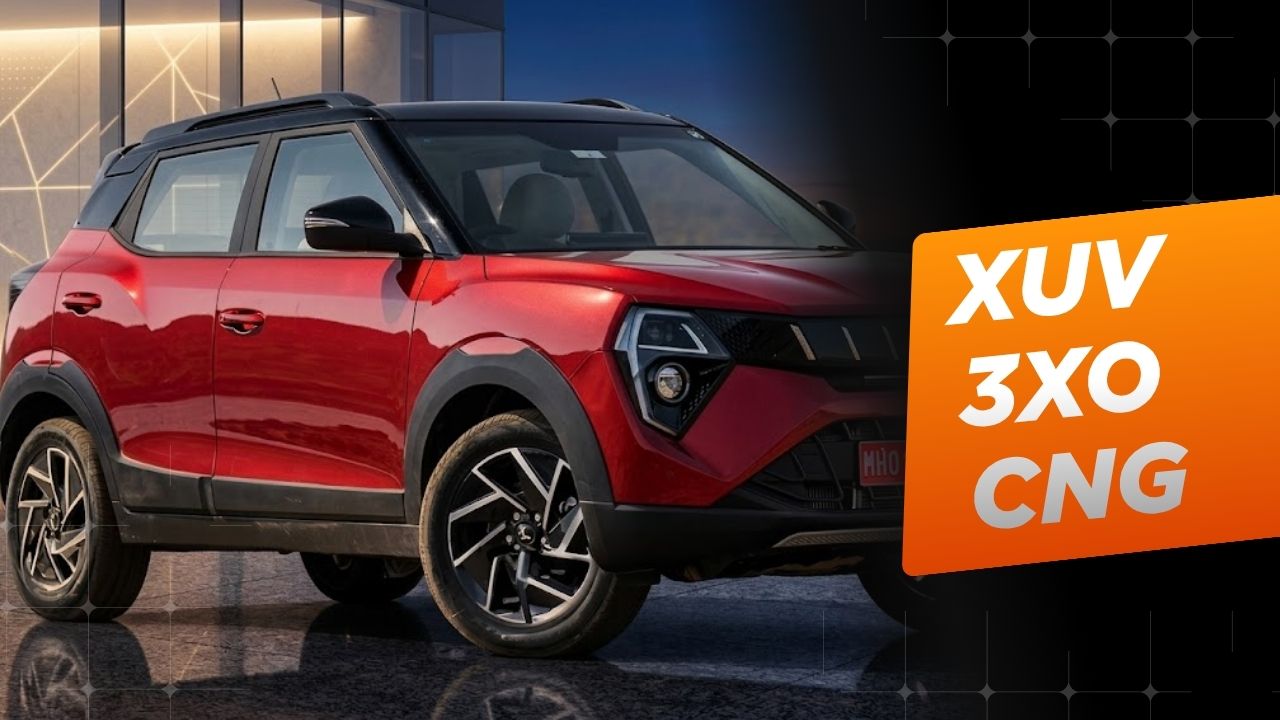
Mahindra XUV 3XO CNG comes with a 112 PS and claimed 24.7 km of mileage at Rs 9.99 lakh, available in four variants.
CNG cars mostly give good mileage but performance is always lower than petrol cars. Now Mahindra promises the same 112 PS and 200 Nm on CNG, it uses a 1.2 L turbo engine to hit at that power. Mahindra XUV 3XO CNG comes at Rs 9.99 lakh (ex-showroom) which might solve the problem especially when you put your foot down and the car struggles to pick up speed.
If it does then it’s going to change the entire CNG compact SUV segment at this price mark. There’s one thing that you won’t get in the Mahindra XUV 3XO CNG is the boot space. Keep going down for every detail before you make up your mind to buy this car.
Mahindra XUV 3XO CNG Engine: The Power Claim That Matters
It offers 1.2 L petrol engine and 6-speed manual transmission to use it for getting 112 PS at 5,000 rpm and 200 Nm. Gas carries less energy per unit volume than petrol to work the engine, so CNG conversions usually lose power. A little drop in that is normal but Mahindra avoided to lose that power.
It fixed it with a 10-bar CNG injection system and revised turbocharger calibration so it takes the gas faster and runs the engine quickly. Mahindra XUV 3XO CNG claimed to reach from zero to 100 km/h in 11.8 seconds. It reaches somewhere that its rivals still struggle to get there because in this segment the CNG cars are less powerful.
However, the real-time figures are still under wraps as the test drive with real conditions is not done yet. So treat the no-power-loss claim as promising rather than proven. 3XO gives you power to switch between petrol and CNG with a button but also switches to petrol automatically when the CNG runs low. The instrument cluster shows both average and instantaneous efficiency.
Mahindra XUV 3XO CNG Mileage and the Real Running-Cost
Mahindra XUV 3XO CNG mileage is 24.7 km/kg but it’s a claimed figure not a real-time running calculation. The regular petrol version rated at 18.89 km/l and diesel manual at 20.6 km/l. The fuel cost is different in different city/state if we take Delhi as an example, fuel cost is Rs 86.98 per kg for CNG, Rs 102.12 per litre for petrol and Rs 95.20 per litre for diesel. So the total running costs are based on fuel prices and driving patterns.
| Fuel | Claimed mileage | Running cost per km |
| CNG | 24.7 km/kg | about Rs 3.52 |
| Diesel | 20.6 km/l | about Rs 4.62 |
| Petrol | 18.89 km/l | about Rs 5.41 |
Mahindra claims 24.7 km for one kg in CNG and 18.89 km in petrol and 20.6 km in diesel. Now if we calculate these three different fuel options, you are saving ₹1.89 against petrol and ₹1.10 against diesel in CNG version.
Now if you are spending an extra cost of around ₹89,100 se ₹99,500 on buying XUV 3XO CNG than petrol version then understand where you are saving your money.
If you are driving 1,500 km every month, you are saving ₹2,835 on the CNG version which means you can recover your ₹90,000 extra purchasing price in 2 years and 8 months.
But if you are driving only 800 km every month then you can only save ₹1,512 in months which extends your time. The extra ₹90,000 money will recover in 5 years.
Overall, if you drive daily and cover more kilometres each month, choosing the CNG version could save you money. But if you drive only around 800 km a month, it will take much longer to recover the extra cost.
These figures are based on the company’s claimed mileage and Delhi fuel prices. So the real-world mileage may differ from these, depending on the city fuel rates.
The CNG Version 270-Litre Boot Is Where Buyer Should Consider
The XUV 3XO CNG provides a capacity of 60 litres with twin cylinders but Mahindra fit them under the boot floor to make the layout clean and maintain the space for luggage and leaves the spare wheel underneath the car. These are Mahindra’s reasons for splitting gas into two smaller cylinders.
The regular XUV 3XO offers 364 litres which means the CNG version eats up 94 litres space, that’s roughly the space a couple of cabin bags would fill. Boot capacity matters when a buyer is looking for a family car that regularly loads a stroller and luggage for a long weekend. Otherwise, it is perfect for daily errands and grocery runs.
Mahindra has also retuned the dampers, springs and anti-roll bar to cope with the extra rear weight. The layout is still MacPherson struts at the front and a twist-beam at the rear. Whether the retune fully preserves the regular car’s ride is something only a proper drive will show.
Mahindra XUV 3XO CNG Launched Four Variants and Prices
The CNG model is officially called the XUV 3XO ZNG, it is a factory-fitted system, not a dealer retrofit, and it joins the existing petrol, diesel and electric versions of the compact SUV, which first arrived in April 2024 as a facelift of the XUV300.
Mahindra XUV 3XO CNG test drives began on launch day. Bookings open on October 20, 2026, through Mahindra dealerships and the company website, and deliveries are scheduled to start the same day. If you want one in the first batch, that is your date.
Four variants are on sale: MX Edge, RevX Edge (O), AX5 and RevX A. The MX Edge is new to the lineup. The other three have petrol-manual siblings already on sale.
| Variant | Ex-showroom price |
| MX Edge | Rs 9.99 lakh |
| RevX Edge (O) | Rs 10.79 lakh |
| AX5 | Rs 11.19 lakh |
| RevX A | Rs 12.27 lakh |
On-road price of Mahindra XUV 3XO CNG is different from the Rs 9.37 lakh, the amount goes higher when you enter a showroom. You have to pay roughly 1–2 lakh more because registration charges and insurance vary by state. Different cities have different RTO charges so ask your dealer to give you the actual price in writing.
The RevX Edge (O) and AX5 are not a simple step up the ladder, even though the AX5 costs Rs 40,000 more. They offer different features.
MX Edge is the base, and it is better equipped than a base car usually is. It offers a 10.25-inch touchscreen, and connectivity experience with wireless Android Auto and wired Apple CarPlay. You can enjoy every drive with premium features. It’s not hard to park with a rear parking camera. You get cruise control, rear AC vents, 60:40 split rear seats for passengers to sit comfortably. The driver also gets the real perks with engine start-stop, steering modes and reverse sensors.
RevX Edge (O) adds a panoramic sunroof, auto headlamps and wipers, power-folding mirrors, keyless entry with push-button start, a height-adjustable driver’s seat, black leatherette seats, a dual-tone roof and a rear centre armrest.
AX5 takes a different route. Instead of the sunroof and cosmetics, it gives you twin 10.25-inch screens, six speakers, 16-inch diamond-cut alloys, a single-pane sunroof, LED projector headlights, connected-car features with Alexa, online navigation, wireless Android Auto and Apple CarPlay, dual-zone automatic climate control, 65W USB-C charging, TPMS and a rear wiper with washer and defogger.
RevX A builds on the AX5 and adds the panoramic sunroof, Dolby Atmos audio, leatherette seats, the dual-tone roof and 16-inch black alloys.
One caution on the top variant. The RevX A petrol uses Mahindra’s more powerful direct-injection turbo engine, while the RevX A CNG uses the 112 PS CNG engine. They are positioned the same but are not equal on output, so do not read the Rs 99,500 gap as a like-for-like cost of CNG.
Six Airbags Safety Along With Sensors
Every variant gets six airbags, electronic stability control, ISOFIX child-seat anchors, four disc brakes, three-point belts and belt reminders for all seats, and reverse parking sensors. The CNG system also has integrated leak detection, and if it senses a leak it moves the engine to petrol automatically.
The regular XUV 3XO earned five stars from Bharat NCAP for both adult and child occupant protection. Mahindra says the CNG shares the same underlying architecture and showed the cylinder installation after a crash test at the launch event.
What it has not announced is a separate Bharat NCAP result for the XUV 3XO CNG version. Until that appears, the five-star rating belongs to the petrol and diesel cars, not strictly to this one.
Mahindra XUV 3XO CNG vs Tata Nexon CNG vs Maruti Brezza CNG
| XUV 3XO CNG | Tata Nexon CNG | Maruti Brezza CNG | |
| Price (ex-showroom) | Rs 9.99-12.27 lakh | Rs 9.24-13.66 lakh | Rs 9.35-11.71 lakh |
| Engine | 1.2L turbo | 1.2L turbo | 1.5L non-turbo |
| Power | 112 PS | 100 PS | 88 PS |
| Torque | 200 Nm | 170 Nm | 122 Nm |
| Claimed mileage | 24.7 km/kg | 24.01 km/kg | 26.90 km/kg |
| CNG capacity | 60L | 60L | 55L |
| Boot space | 270L | 321L | 328L |
Against the Nexon CNG, the XUV 3XO CNG has 12 PS and 30 Nm more, and a slightly higher claimed mileage, but it gives up 51 litres of boot. Against the Brezza CNG, the gap in performance is wider: 24 PS and 78 Nm in the Mahindra’s favour. The Brezza answers with the best claimed mileage here, 26.90 km/kg, and the biggest boot at 328 litres, helped by an underbody cylinder.
So the three cars make three different arguments. The XUV 3XO CNG is the one to drive. The Brezza CNG is the one to run cheapest and load fullest. The Nexon CNG sits in the middle. Nexon’s price range starts about Rs 75,000 lower than the 3XO’s, so check which variants each brand actually offers at the budget you have in mind.
Conclusion
Buy a Mahindra XUV 3XO CNG if you drive roughly 1,200 km or more a month and want CNG running costs without feeling like you are driving a CNG car. The turbo engine’s torque matters most on highways and in loaded overtakes, and that is the 3XO’s whole case. If you buy, the RevX Edge (O) is the sensible pick for most people, since a panoramic sunroof and keyless entry at Rs 10.79 lakh matter more in daily use than the AX5’s second screen.
Independent mileage tests, a Bharat NCAP result for the CNG and real owner reports on the no-power-loss claim will all arrive within a few months of deliveries starting on October 20. A small wait costs you nothing, and the first month of reviews will tell you whether 112 PS on CNG is real or just a brochure number.
