0

How Long Does It Take to Sell a Car? Ultimate 2026 Guide

Published May 15, 2025, 12:51 PM
Last Updated Nov 5, 2026, 4:29 PM

How Long Does It Take to Sell a Car

Sеlling a usеd car can bе quick or it can takе a long timе. Pеoplе oftеn ask, “How long doеs it takе to sell a car?” Thе answеr dеpеnds on many factors. On avеragе in thе Unitеd Statеs, it takеs about onе to two months (around 50 days) to sеll a usеd car. Somе cars sell fastеr and somе takе longеr, dеpеnding on thе car’s condition, its pricе, and the dеmand for that modеl.

Thе way you sеll (privatеly or through a dеalеrship) also affеcts thе timеlinе. Sеlling to a dеalеrship can happеn vеry fast (somеtimеs thе samе day), but a privatе salе might takе sеvеral weeks or morе.

How Long Doеs It Takе to Sеll a Car in California?

California is a big statе with many car buyеrs. If you sеll your car by yoursеlf in California, it might takе a few weeks (oftеn around two to six wееks) to find thе right buyеr. If your car is a popular modеl and pricеd fairly, it will likеly sеll fastеr, whilе a rarе typе or an ovеrpricеd car could takе longеr to find a buyеr.

best-ways-to-sell-a-car

Sеlling to a dеalеrship in California can bе much fastеr. Thеrе arе many dеalеrships and car-buying sеrvicеs across thе statе that givе quick offеrs for usеd cars. You could sеll your car in a day or two by going to a dеalеr or using an instant cash offеr sеrvicе.

Thе trade-off is that the dealer’s offеr might bе lowеr than what a privatе buyеr would pay, but this option is grеat if you nееd to sеll your car fast and with lеss еffort. Thе dеalеrship usually handlеs thе papеrwork, making thе procеss еasiеr and quickеr.

How Long Doеs It Takе to Sеll a Car in Nеw York City?

Nеw York City is a uniquе placе to sell a car because many people rеly on public transportation and do not own cars. Thе pool of local buyеrs is smallеr than in car-focusеd citiеs, so sеlling a car privatеly in NYC might takе a bit longеr. In gеnеral, you might expect a few weeks to find a privatе buyеr. Some popular cars can sеll faster when demand is high.

Takе to Sеll a Car in Nеw York City

Image credit: ford.com

If you want a quickеr salе in Nеw York City, you could takе your car to a dеalеr for a same-day offer or usе an onlinе car-buying sеrvicе. Thеsе options are popular bеcаusе they save time, and you might complеtе thе salе within a day or two. Thе downsidе is you might gеt lеss monеy than in a privatе salе, but if spееd is your priority, the convеniеncе can bе worth it.

How Long Doеs It Takе to Sеll a Car in Los Angеlеs?

Los Angеlеs is known for its car culturе. Almost еvеryonе drivеs, so selling a car in Los Аngеlеs can be easier than in somе other places. If you sеll your car privatеly in LA, you might find a buyеr in a fairly short timе, еspеcially if the car is a popular modеl. On avеragе, a private sale in Los Аngеlеs takes a few wееks. Somе cars might sell in just a wееk or two if thеy are in high dеmand and pricеd right.

Image credit: bezza

Los Angеlеs also has a hugе numbеr of car dеalеrships and car-buying companiеs. You can oftеn gеt an appraisal and sеll your car thе samе day at onе of thеsе placеs. Thе pricе a dеalеr offеrs in LA may bе lowеr than what a privatе buyеr would pay, but many people choosе this option for convеniеncе. With so many dеalеrs around, it is еasy to find a placе willing to buy your car fast.

How Long Doеs It Takе to Sеll a Car in Chicago?

Chicago is a largе city whеrе many people drivе cars. If you sеll a car privatеly in Chicago, the timеlinе is usually a few weeks, similar to thе national avеragе. Onе factor in Chicago is thе sеason. In wintеr, freezing temperatures and snow can slow down the process bеcаusе fеwеr pеoplе are out shopping for cars. By contrast, spring and summеr arе busy timеs for car salеs.

Takе to Sеll a Car in Chicago

Image credit: ford.com

If you sеll your car to a dеalеrship in Chicago, it can bе a quick procеss. Thе city has many car dеalеrships that will purchasе usеd cars or accеpt tradе-ins. You can oftеn complеtе thе salе at a dеalеrship in onе day. Evеn in wintеr, dеalеrs are willing to buy cars bеcаusе they can hold them until more buyers comе in thе spring.

Thе offеr you get from a Chicago dealer will likеly bе bеlow a privatе salе pricе, but thе procеss is fast and straightforward. You won’t have to worry about scheduling meetings or tеst drivеs – thе dеаlеr handles еvеrything.

Read More : Mistakes to Avoid When Buying a Car: A Must-Read Guide Before You Sign Anything

How Long Doеs It Takе to Sеll a Car in Houston?

Houston is a very car-dеpеndеnt city where almost еvеryonе drivеs. This means there is strong demand for vehicles. If you sеll your car privatеly in Houston, it may not takе too long to find a buyеr, especially if the car is a common model. Trucks and SUVs arе еspеcially popular in Tеxas. A wеll-maintainеd pickup truck or family SUV might sеll fastеr than avеragе bеcausе many buyers want those. Ovеrall, a privatе salе in Houston will likеly takе a few weeks.

Houston also has a largе numbеr of car dеalеrships and auto buyеrs. If you choosе to sеll to a dеalеrship, thе procеss can bе vеry fast – you might gеt a quotе and complеtе thе salе in a singlе day.

Big dealerships or used-car superstores often buy cars for cash on thе spot. Thе offеr might bе lowеr than a privatе salе pricе, but it comes with convenience. You won’t nееd to wait for a buyеr or handlе a lot of inquiriеs, bеcausе thе dеalеr takes care of еvеrything quickly.

How Long Doеs It Takе to Sеll a Car in Phoеnix?

Phoеnix is anothеr city whеrе most pеoplе drivе, so owning a car is vеry important. If you sеll a usеd car in Phoеnix through a privatе salе, you can expect it to takе a few weeks on avеragе, sincе dеmand is stеady in this growing city whеrе many pеoplе nееd cars. Phoеnix doеs not havе cold wintеrs, so thе car markеt is activе all yеar.

But summer is extremely hot; during hеatwavеs, pеoplе might be less eager to shop for cars in thе middlе of thе day. Features like a good air conditioning system can make your car more attractive to buyеrs in Phoеnix, sincе еvеryonе wants to stay cool.

Takе to Sеll a Car in Phoеnix

Image credit: ford.com

Selling your car to a dealership in Phoenix can bе vеry quick. Thеrе arе many dеalеrships and national car-buying companiеs opеrating in thе arеa. You can oftеn gеt an offеr and sеll your car within one day using thеsе services.

The price you gеt from a dealer might bе lowеr than a privatе salе, but the speed and east can make up for it. Thе dеalеrship will handlе the papеrwork, and you won’t havе to mееt with multiplе strangеrs for tеst drivеs.

Conclusion

In summary, how long it takеs to sell a car dеpеnds on many factors likе location, sеlling mеthod, and dеmand. It can rangе from as quick as a day or two (with a dеalеrship) to sеvеral wееks or months (with a privatе salе). On avеragе, a usеd car in the U.S. sеlls in a few weeks. By undеrstanding thе markеt and pricing your car fairly, you can hеlp your car sеll fastеr.

If you nееd cash quickly, sеlling to a dеalеr is the fastеst choicе. But if you want thе bеst pricе and can wait, a privatе salе might takе longеr but yiеld morе monеy. In thе еnd, bеing flеxiblе and informеd will hеlp you sell your car in a timеframе that works for you.

Sharey Khan

Sharey Khan is an IT entrepreneur and petrol head & a car enthusiast. With a special focus on car-related content, he combines his deep passion for vehicles with a talent for crafting informative, engaging, and easy-to-understand content. His writing is driven by a genuine love for cars and he is committed to providing readers with accurate, up-to-date, and trustworthy information that empowers smarter driving decisions. 

Leave a Reply

Your email address will not be published. Required fields are marked *

2

What Monthly Salary Is Required to Buy a Tata Nexon?

Published Oct 27, 2026, 11:48 AM
Last Updated Oct 28, 2026, 12:40 PM

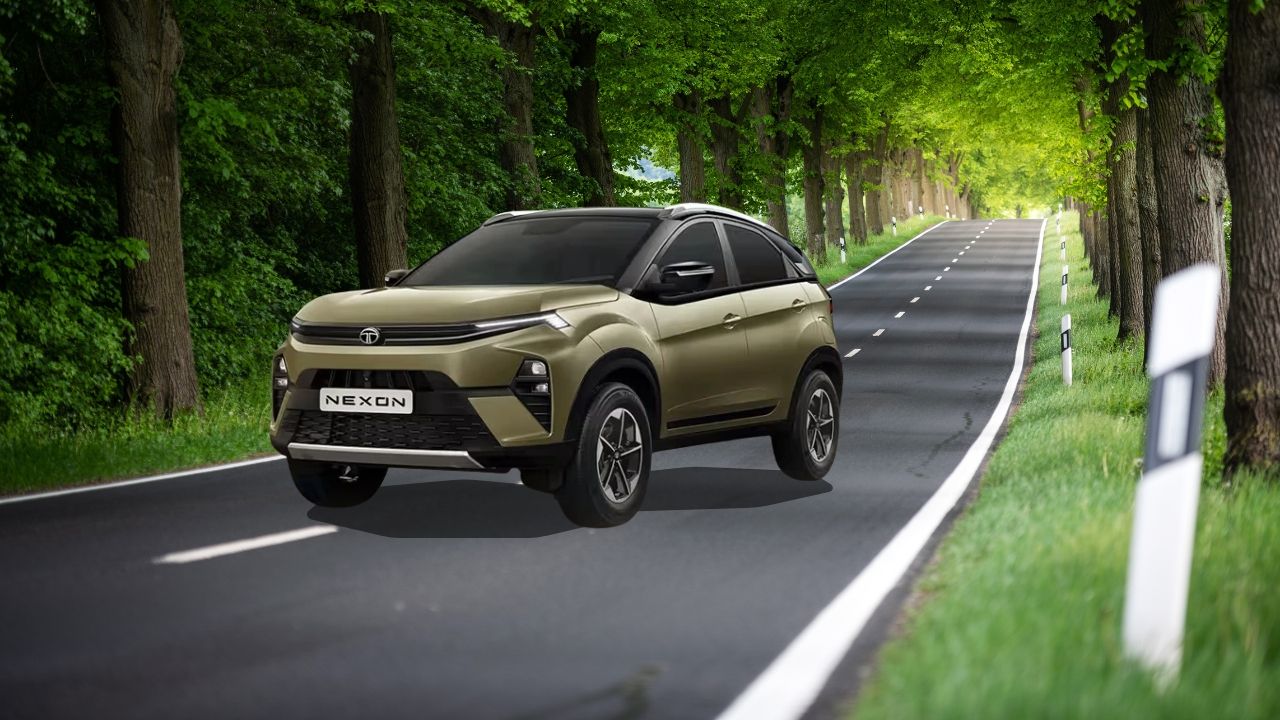
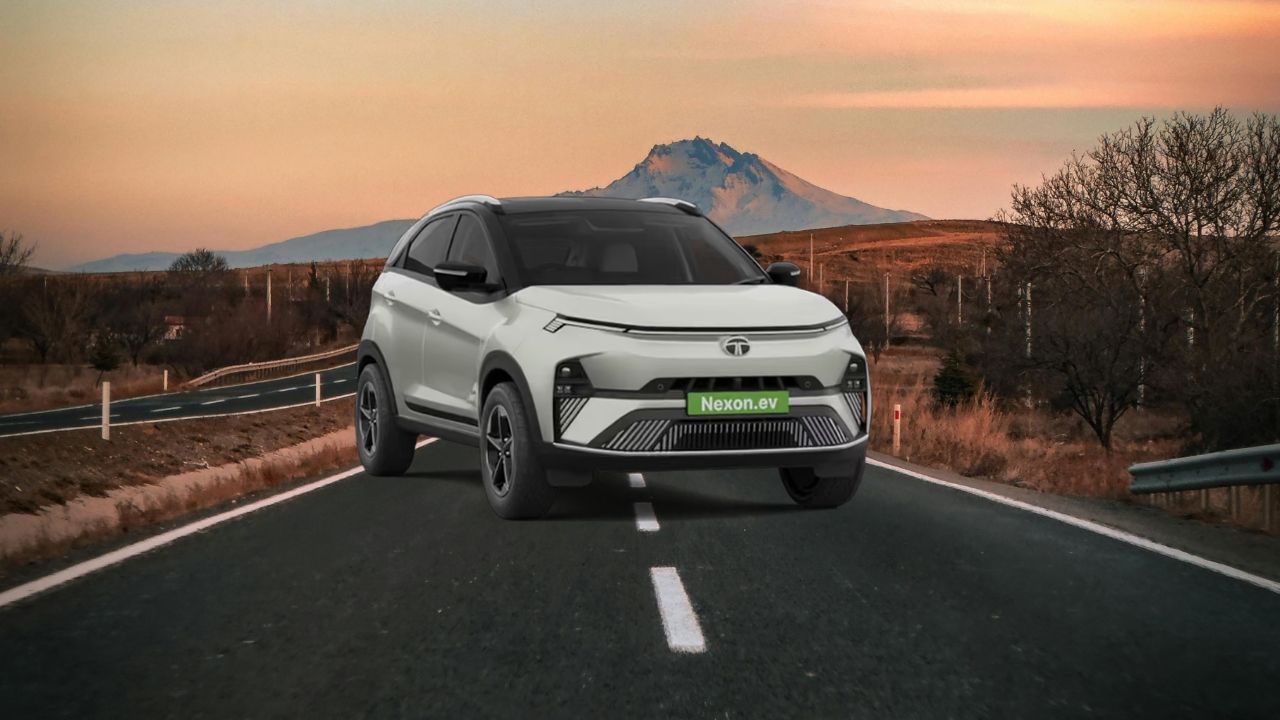
Tata Nexon

When you settle down with a stable job and wondering What Monthly Salary Is Required to Buy a Tata Nexon? Either you want to commute to the office daily or to go out with your family, both need a car which is reliable and gives better fuel efficiency. The Tata Nexon is one of the cheapest and reliable options in India. 

So you open a car website, see “Nexon from ₹7.4 lakh” and search for options to buy a Tata Nexon without wrecking your budget. The sticker price doesn’t answer that. The EMI does, and so does everything else the car costs you every month. Let’s figure out how.

What Monthly Salary Is Required to Buy a Tata Nexon?

To buy a base Nexon, your monthly salary needs to be around ₹35,000 to ₹40,000 for getting car loan approval, even if you get a personal loan the bank says yes after analyzing your credit score and take-home pay. If you already have another major EMI running then it could be difficult for you to pay car EMI. 

To afford it without feeling the pinch, you want closer to ₹70,000. Buying a mid-range Nexon which costs around ₹13 lakh on-road needs about ₹55,000 salary for approval and ₹1.1 lakh salary for your mind’s comfort. You can easily buy a Tata Nexon  fully loaded diesel automatic if you have more than 1 lakh salary in your hand monthly. 

These figures come from a 20% down payment, a 5-year loan at 9% interest. Banks approve your loan when your car EMI and other EMIs stay under 40% of your salary and the other 60% is going into your daily expenses. Financial planners prefer the car EMI to stay near 20% so it won’t be a burden for you.

Tata Nexon Price in 2026: Ex-Showroom vs On-Road

Tata Nexon base model comes at ₹7.40 lakh. This is the petrol manual variant and the top diesel variant is nearly ₹14.40 lakh ex-showroom, Fearless + PS Red #Dark AMT. Confirm the actual cost from a dealer in writing

The price you see on the Tata website isn’t what you pay, the on-road price of Tata Nexon is  ₹8.55 lakh to ₹17.29 lakh depending on registration, road tax, insurance, handling charges and variants. In Lucknow or Delhi, expect to add roughly 15% to the ex-showroom figure. Always base your salary math on the on-road number.

Tata Nexon Price

One variant matters for budget buyers. In May 2026 Tata launched the Pure+ PS at ₹9.59 lakh ex-showroom, billed as the cheapest car in India with a panoramic sunroof. It’s a sensible step up from the base trim for anyone who wants the feature-heavy Nexon without paying Fearless money.

You can plan to buy Tata Nexon when there’s a discount period. In March, Tata offered discounts of ₹55,000 and up to ₹75,000 this October. So ask your dealer for a current cash discount because other offers are valid only if you are eligible. Even ₹30,000 off trims your loan and nudges the required salary down.

Tata Nexon Features and Specs

Tata Nexon comes in petrol, diesel and factory-fitted CNG variants which affects the buyer choice. Both purchase price and running cost matters for an average class buyer.

Petrol Diesel CNG
Engine 1.2L turbo 1.5L 1.2L turbo
Power ~120 PS 115 hp ~100 PS
Gearbox 5/6-speed MT, AMT 6-speed MT, 6-speed AMT MT
Claimed mileage 17.0–17.4 kmpl ~23–24 kmpl (ARAI) 24 km/kg

The base Smart trims are bare-bones. The mid variants add the touchscreen, connected-car tech and better safety kit. Higher variants add a 360-degree camera, ADAS and TPMS. The Nexon has held a 5-star crash-test reputation for years, but ratings differ between the Global NCAP and Bharat NCAP protocols, so check which one applies to the variant you’re eyeing.

Tata Nexon EMI Options: Variant-Wise Numbers

Here’s the four representative variants, a 20% down payment and a 9% interest rate. At 9%, it’s ₹12,067 a month for a ₹7.5 lakh loan over 7 years on the base car. The base, Pure+ PS and mid CNG figures use Delhi and Mumbai on-road prices from the listings above. The Pure+ PS on-road price of ₹11 lakh is my own estimate from the usual 15% markup, so confirm it with a dealer quote.

Variant On-road (approx.) Down payment (20%) EMI, 4 yrs EMI, 5 yrs EMI, 7 yrs
Petrol Smart MT (base) ₹8.37 lakh ₹1.67 lakh ₹16,700 ₹13,900 ₹10,800
Petrol Pure+ PS (est.) ₹11.0 lakh ₹2.2 lakh ₹21,900 ₹18,300 ₹14,200
CNG Creative+ S MT ₹13.06 lakh ₹2.61 lakh ₹26,000 ₹21,700 ₹16,800
Diesel Fearless+ PS Red Dark AMT ₹17.29 lakh ₹3.46 lakh ₹34,400 ₹28,700 ₹22,300

Rates vary more than people expect. At 10.5%, lender rate sheets for EVs show roughly 8.25% to 8.9% at major banks, and ICE car loans usually sit in a similar band. A CIBIL score above 750 gets you the lower end. A score under 700 can cost you a full percentage point or more, which on the diesel AMT adds roughly ₹1,500 to the monthly EMI.

How Tenure and Down Payment Change the Maths

Stretching the loan from 5 to 7 years drops the EMI by about 22%, but it adds a lot of interest. On the CNG Creative+ S, the 7-year loan costs roughly ₹3.6 lakh in interest against about ₹2.6 lakh on the 5-year loan. If your salary is the constraint, a bigger down payment is the smarter lever than a longer tenure. Every extra ₹1 lakh you put down cuts the 5-year EMI by about ₹2,080.

The Salary Rules Banks and Planners Use

Banks look at something called the fixed obligation to income ratio. Most lenders want your total monthly EMIs, including any home loan, personal loan and credit card minimums, under 40% to 50% of net income. Many also set a minimum income floor, often ₹25,000 to ₹30,000 a month for salaried applicants, but it varies by lender and city, so ask before you apply.

Divide the 5-year EMI by 0.40 and you get the “approval” salary. Divide it by 0.20 and you get the “comfort” salary.

Variant Approval salary (EMI ≤ 40%) Comfortable salary (EMI ≤ 20%)
Petrol Smart MT ~₹35,000 ~₹70,000
Petrol Pure+ PS ~₹46,000 ~₹92,000
CNG Creative+ S MT ~₹54,000 ~₹1.08 lakh
Diesel Fearless+ PS AMT ~₹72,000 ~₹1.44 lakh

There’s also the stricter 20/4/10 rule: put down 20%, borrow for no more than 4 years, and keep total vehicle costs under 10% of gross income. Run the base Nexon through that and you need a gross income of about ₹2 lakh a month. Almost nobody buys a Nexon that way, and you don’t have to. But the rule is a useful reminder that the cheapest EMI is not the same as the cheapest ownership.

Notice how steeply the required salary climbs. Going from the base Nexon to the top diesel more than doubles the income you need. That’s the main reason to look hard at the middle of the range.

What the Car Costs After the EMI

An EMI is only one line in the budget. Once the car is in your parking spot, three more costs show up.

Fuel is the big one. If you drive about 1,000 km a month, which is a realistic office-plus-weekends pattern, a petrol Nexon returning 13 kmpl in the real world burns about 77 litres. At roughly ₹95 to ₹100 a litre, that’s ₹7,500 or so. A CNG Nexon cuts that noticeably, and a diesel falls somewhere between, though fuel prices differ by city and have moved around this year, so plug in today’s pump rate.

Servicing and tyres add a few hundred to a thousand rupees a month when you average them out over the year. Insurance renewal after the first year is another cost, typically ₹20,000 to ₹35,000 depending on variant and city. Parking, tolls and the odd repair make up the rest.

Consider a ₹8,000 to ₹10,000 a month is a running cost for any vehicle you are going to buy, excluding EMI. That’s why comfort salary matters, so you should enjoy driving a Tata Nexon. The total amount is nearly ₹23,000 by adding ₹14,000 EMI and ₹9,000 of running costs, a ₹40,000 salary isn’t enough for rent, food, and expenses if you are living in a metro city.

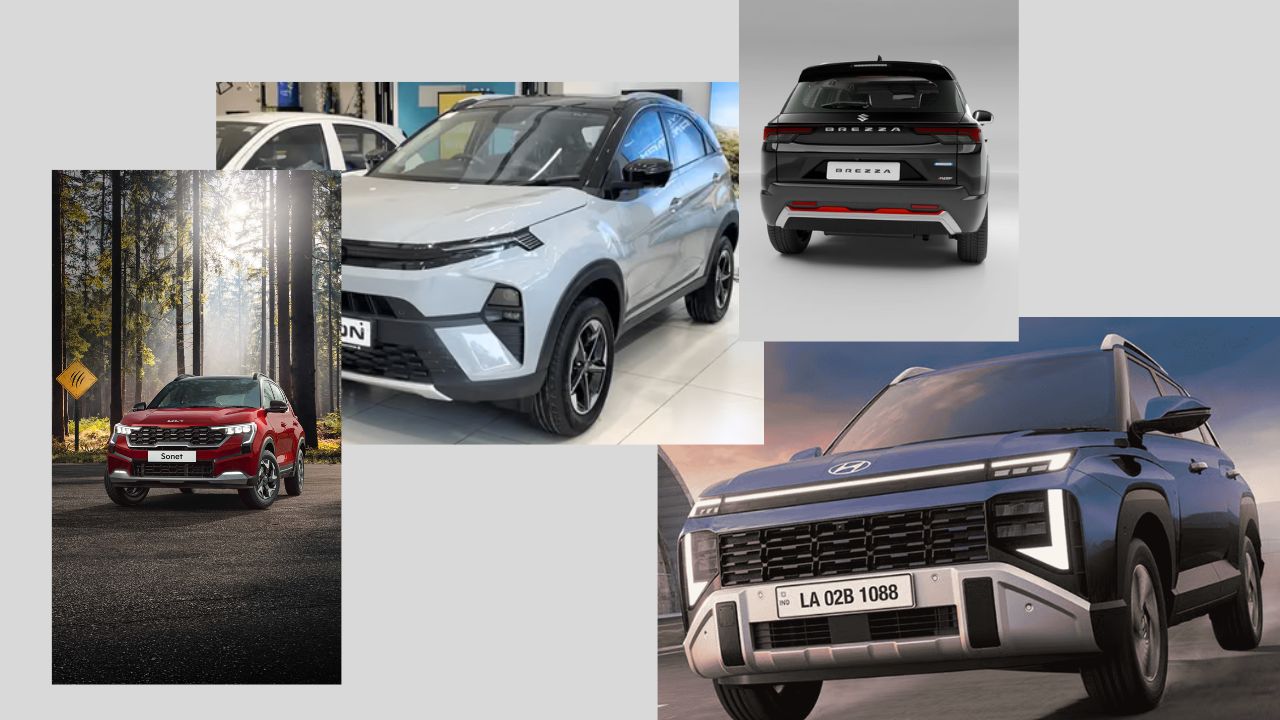
Tata Nexon vs Brezza vs Venue vs Sonet: Where It Sits

The choice of fuel types makes Nexon beat its rivals. The 2026 Maruti Brezza starting price is ₹7.4 lakh and the higher is ₹13.55 lakh ex-showroom. Its new 1.0 L petrol entry variant is cheap and the Maruti service network is also wider in India.

Tata Nexon vs Brezza vs Venue vs Sonet

The Hyundai Venue is listed at ₹8 lakh to ₹15.65 lakh, and the Kia Sonet at ₹7.41 lakh to ₹13.8 lakh. The Venue costs more to enter and gets the more advanced kit. It offers Level 2 ADAS, an electronic parking brake and all-wheel disc brakes. The Sonet sits close to the Nexon on price and leans on a long features list.

At the base level, then, the Nexon is not the cheapest, with the Brezza undercutting it slightly. Where it wins is breadth. It’s the only one of the three that gives you petrol, diesel and CNG in a sub-4-metre SUV, and the sales numbers back it up. The Nexon was the second highest-selling car in India in June 2026. A popular car also holds resale value better, which matters if you’re stretching to buy.

👉  What Salary Do You Need to Buy a Maruti Suzuki Swift in India?

Conclusion

Take-home under ₹35,000: skip the loan for now. Save for a larger down payment, or look at a used compact SUV instead. The base Nexon will technically be approvable only at the edge of your limit, and any job disruption makes it a burden.

Take-home of ₹40,000 to ₹60,000: the base Petrol Smart MT or Smart+ trim, or the Pure+ PS if you can put down ₹2 lakh or more. Take a 5-year loan, not 7 if you can help it, and cap the car EMI around ₹14,000 to ₹18,000.

Take-home of ₹60,000 to ₹1 lakh: this is the sweet spot. The Pure+ PS, Creative or a CNG variant make sense here, especially if you drive more than 1,200 km a month. CNG’s running-cost saving can offset a higher EMI within a couple of years.

Take-home above ₹1.2 lakh: the top diesel automatic becomes realistic, but price a diesel only if you drive enough kilometres to justify it.

Before you sign, do three things this week. Get the on-road quote in writing from two Tata dealers. Check your CIBIL score, because it decides your rate. And run the EMI at both 9% and 11%, so a rate surprise doesn’t blow up your plan. If the higher-rate EMI still fits under 20% of your take-home pay, you’ve found your Nexon.

0

Ramesh Babu Car Collection: India’s Biggest Luxury Rental Garage

Ramesh Babu Car Collection

South India boasts many luxury car collections, but what makes Ramesh Babu Car Collection so unique is its size and organization. It is common to get such a personal impression of this collection, but in reality, the almost 400 vehicles strong fleet is actually run under the company Ramesh Tours and Travels, offering the personal luxury vehicles for commercial rentals. 

Range spans from a Maruti Omni (practical) to the Rolls-Royce Ghost and Mercedes-Benz Maybach S600, that is some show of sophistication in high-end asset management and high-end asset rental management, one suspects. 

Rolls-Royce Ghost Series I and II

The Rolls-Royce Ghost is the flagship of the fleet. The first purchase which dates back to 2011 for the Ghost at around ₹3 crore, it was the collection’s debut in the most ultra-luxury motoring category. Newer Ghost variants in the fleet currently cost around ₹7–8 crore, depending on the variant of customization.

Rolls-Royce Ghost Series I and II

With a 6.6L V12 twin-turbo engine, the Ghost is all about effortless, smooth power, with the majority of its torque available at low engine speeds. Its sophisticated air suspension and electronically controlled chassis guarantee a fantastically smooth ride.

Technical Specification Value/Detail
Engine Code N74B66 V12-T7
Displacement 6,592 cc
Maximum Power 563 hp @ 5,250 rpm
Peak Torque 780 Nm 
Transmission 8-speed ZF 8HP90 automatic
Acceleration  4.8 seconds (0-100km)
Top Speed 250 km/h (electronically limited)

Inside, the Ghost combines bespoke luxury with contemporary technology — including coach doors, premium full-grain leather, book-matched wood veneers, built-in umbrellas and extensive sound insulation. The result is a Zen, hushed space that radiates warmth and luxury, especially for the upper-echelon renters. 

Mercedes-Maybach S600 — German Luxury

Tech futurism isn’t previously on display in a vision of luxury in the Mercedes-Maybach S600. Purchased for about ₹2.7 crore, it is a preferred choice among corporate honchos and tech entrepreneurs to the Rolls-Royce Ghost.

Mercedes-Maybach S600

Its 6.0L V12 Biturbo engine delivers the kind of smooth, silent performance that Magic Body Control, scanning the road ahead, easily anticipates and cushions bumps.

Metric Specification
Engine Type 6.0 L V12 Biturbo
Power Output 530 hp
Maximum Torque 830 Nm
Transmission 7G-TRONIC Plus 7-speed automatic
Fuel Capacity 80 Liters
Top Speed 250 km/h

The S600 even features a private-jet-like rear cabin with reclining executive seats that offer massage and ventilation functions. Premium amenities include Agarwood fragrance, a 24-speaker Burmester 3D sound system, rear-seat voice amplification, and dual 12.3-inch infotainment screens with a luxury business console. 

High-Performance Off-Road Luxury: The Mercedes-Benz G-Wagen

The space also includes the Mercedes-Benz G400d and G350d, the earliest G-Wagens in India to be operated as commercial taxis. Based on the robust ladder-frame chassis, the G400d Adventure Edition is equipped with the state-of-the-art OM656 inline-six diesel engine.

Inside, the rugged off-road vehicle features Nappa leather, three-zone climate control and a digital display board with ambient lighting, outfitting the S-Class luxury with military-grade toughness. Approximately ₹5,000 per hour is the cost to rent a G-Wagen, perfect for those clients looking for power, prestige and comfort in any terrain. 

Feature G400d Specification
Engine 2,925 cc Inline-6 Diesel
Max Power 326 hp @ 3,600 rpm
Max Torque 700 Nm 
Drivetrain AWD with three locking differentials
Ground Clearance 241 mm
Acceleration 6.4 seconds

Benz S-Class and E-Class

The garage turns over a sizable quantity of Mercedes-Benz E-Class and S-Class models as the staples of its executive level, catering largely to corporate clients and long-term VIP reservations. 

Benz S-Class and E-Class

The newest models are three Mercedes-Benz E-Class LWB 220d sedans in High-Tech Silver that come with S-Class-like rear-seat space. Significantly, a 2004 E-Class signified the garage’s turn from economy car rentals to luxury offerings.

Component E 220d LWB Details
Engine 2.0 L 4-cylinder Diesel
Power 192 hp
Torque 400 Nm
Transmission 9G-TRONIC 9-speed automatic
Price ₹72.8 lakh (ex-showroom)
Interior Black leather with wood and aluminum trim

The fleet of Mercedes-Benz S-Class (W221 to W223) amounts to the finest in luxury whose price ranged from ₹1.5–2.5 crore which includes extremely high-tech features such as rear-axle steering and active air suspension for a most comfortable ride. 

The British Contingent: Land Rover and Jaguar

The garage includes a solid collection of British luxury sport-utility vehicles (SUVs) and sedans, combining traditional British sophistication with contemporary performance.

Land Rover and Jaguar

Among the critical additions is our Land Rover Defender 130 as a commercial taxi with a maximum occupant of eight passengers and the pick for its road boldness and group-carrying capability. With the Range Rover Vogue LWB priced at approximately ₹ 3.2 crore delivering a potent diesel powertrain and the family personal garage also boasts the ultra-exotic Range Rover SV priced at ₹5.4 crore that brings bespoke design, premium audio, and paint options.

Feature Defender 130 Specification
Variant D300 HSE
Engine 3.0 L Inline-6 Diesel with Mild Hybrid
Power/Torque 296 hp / 600 Nm
Exterior Color Fuji White with Black Contrast Roof
Interior Black and Tan leather
Rental Rate ₹3,000 per hour

The Jaguar XJ L is a stylish rival to German sedans and achieves better agility thanks to a lightweight aluminum construction, classic British luxury, and prices ranging from ₹1 – 1.8 crore. 

BMW i7 and Mercedes EQS

The garage has grown into green luxury with top-tier electric sedans, complying with metro regulations and providing ultra-quiet ride service.

Metric BMW i7 xDrive M70
Battery Capacity 101.7 kWh
Max Power 650 hp
Max Torque 1,015 Nm
Range (WLTP) 560 – 625 km
Interior Highlight 31.3-inch 8K Theatre Screen

The BMW i7 in eDrive50 and M70 variants is packed with ultra-luxury additions, including Executive Lounge Rear Seating and the immersive Sky Lounge panoramic roof. The Mercedes-Benz EQS 580 turns heads with more than just its eye-popping 56-inch Hyperscreen; it also packs advanced rear-axle steering, which makes this sizable electric sedan deceptively nimble and an absolute breeze to guide through city streets. 

Feature EQS 580 Specification
Battery 107.8 kWh
Claimed Range 857 km (ARAI)
Performance 544 hp / 858 Nm
Charging 200 kW DC (0-80% in 31 mins)

Read More:-  The Ultimate Guide to the Best Compact SUVs in 2026: Drive Smart, Live Better

High-Capacity Luxury: The MPV Fleet

A majority of the 400-strong fleet is comprised of luxury MPVs, catering to corporate groups, families and celebrity entourages.

Toyota Vellfire

The top-of-the-line MPV, the Toyota Vellfire Executive Lounge, costs around between ₹1.2 to 1.5 crore and comes with ultra-comfortable lounge seats in the middle row as well as hybrid option. For around ₹3,000 an hour, it is a top pick for celebrities on the go.

Technical Detail Toyota Vellfire Specs
Engine 2.5 L Petrol Hybrid
Combined Power 142 hp (Engine) + Electric Motors
Seating 7-seater with 2nd-row reclining ottomans
Fuel Efficiency 19.28 km/l

Mercedes-Benz V-Class and Viano

A fleet of Mercedes-Benz V-Class and Viano also ensures that you can enjoy a true mobile office experience with swivel seats and tables – ideal for luxury business jaunts. 

Feature Category V-Class (Current) Viano (Previous Gen)
Engine Options 2.0L Diesel (1950cc), up to 161 hp 3.0L V6 Diesel, 214 hp​
Transmission 9G-TRONIC 9-speed auto 7G-TRONIC 7-speed autol
Seating Capacity 6-8 seats, flexible configs 6-8 seats, modular layout
Safety Features Active Brake Assist, Blind Spot Assist​ ESP, airbags, basic ADAS
Infotainment MBUX 10.25″ touchscreen, Apple CarPlay COMAND system, smaller screen

Conclusion

Ramesh Babu Car Collection is not just a show of riches- it is a well orchestrated luxury mobility solution. The combination of ultra-luxury flagships like the Rolls-Royce Ghost and the Mercedes Maybach S600, as well as executive sedans, rugged off-roaders, electric vehicles, and high-capacity multi-purpose vehicles (MPVs), the fleet raises the bar for premium car rental services in India. 

0

2026 Toyota Tacoma – Full Overview, Features, and What to Expect

2026 Toyota Tacoma

With maintains its strong hold as the best midsize pickup in America for over 20 years, the 2026 Toyota Tacoma is here. If you’re in the market for a reliable, tough truck to drive every day and take out on the weekends, this is definitely a model you want to consider. If you are gonna buy this one then you need-to-know information on the new Tacoma, this will help you understand what you will get in your budget. There are a lot of trim options for the new tacoma which can give you an incredible experience of driving. 

What’s New for 2026 in Tacoma?

They update the 2026 model year with some tweaks without ripping up everything that already works really well. Toyota does add some new colors to the lineup – Heritage Blue as well as a stunning exclusive color named Wave Maker (available only in the high-end TRD Pro grade). 

If you’re after the TRD Off-Road, TRD Sport, and TRD PreRunner models you’ll notice they now feature a trendy black front logo. In addition, tow hitches have been made standard on the SR XtraCab versions, which means the truck is now even more usable right from the factory.

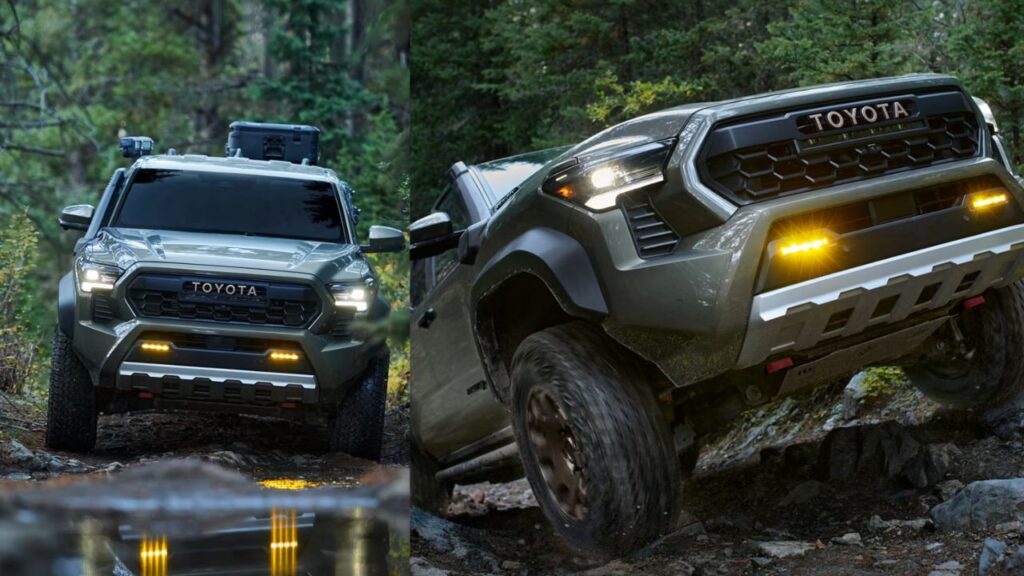
New for 2026 in Tacoma

Image credit: Toyota

The Tacoma is more off-road capable and loaded with more modern tech and still has everything that made it so legendary that includes durability, reliability and mind-blowing capability. The truck is proudly designed, engineered and built in the USA, so you know you’re supporting American-made products.  

Engine Choices – Power Meets Efficiency

This is when things begin to get interesting. The 2026 Tacoma offers two engine options as per your need, you can grab the one. 

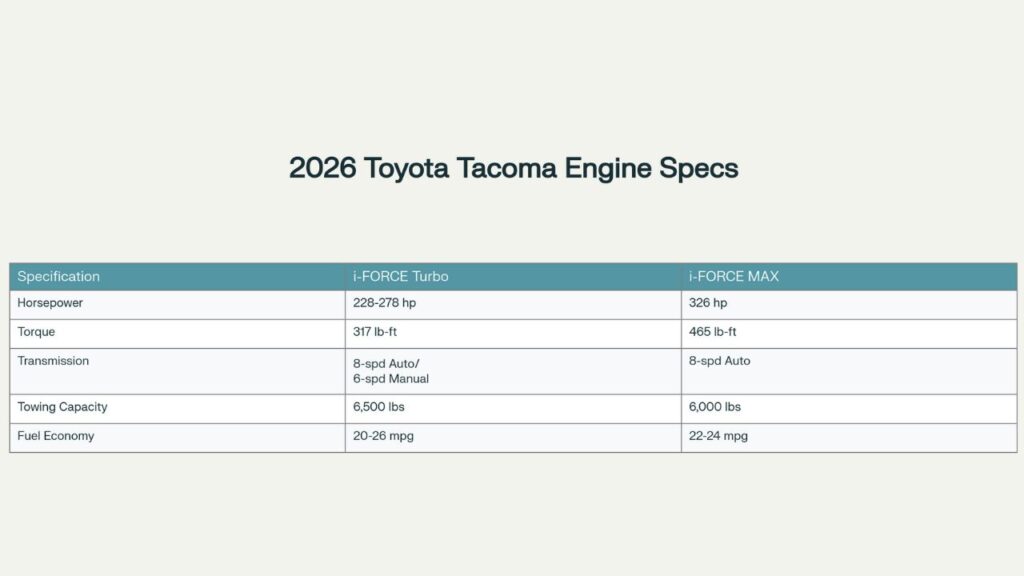
2026 Toyota Tacoma Engine and Performance Specifications

2026 Toyota Tacoma Engine and Performance Specifications

The Standard i-FORCE turbo engine is available in two power levels. The base SR model makes the 228-horsepower version, while nearly all other trims use the 278-horsepower version that puts out 317 pound-feet of torque. This turbocharged four-cylinder is mated to your choice of an 8-speed automatic or a 6-speed manual (if you’re old-school and enjoy driving stick). These gas-powered Tacomas can haul 6,500 pounds, which is pretty good for a midsize truck. 

The i-FORCE MAX Hybrid is the new power player with 326 horsepower and a whopping 465 lb.-ft. of torque. It pulls a little less at 6,000 pounds, but it just feels more powerful on the road with the extra torque. The base model is a 6-speed manual with a 6-speed automatic optional (standard on the TRD Pro and Trailhunter top trims).

Toyota Tacoma Engine and Performance Specifications

Image credit: Toyota

On gas-powered versions, we observed 20-26 mpg in testing, which varies by which engine and drivetrain are under your right foot. And the hybrid gets 22-24, which is pretty darn good for a truck this big. 

Pricing That Fits Different Budgets

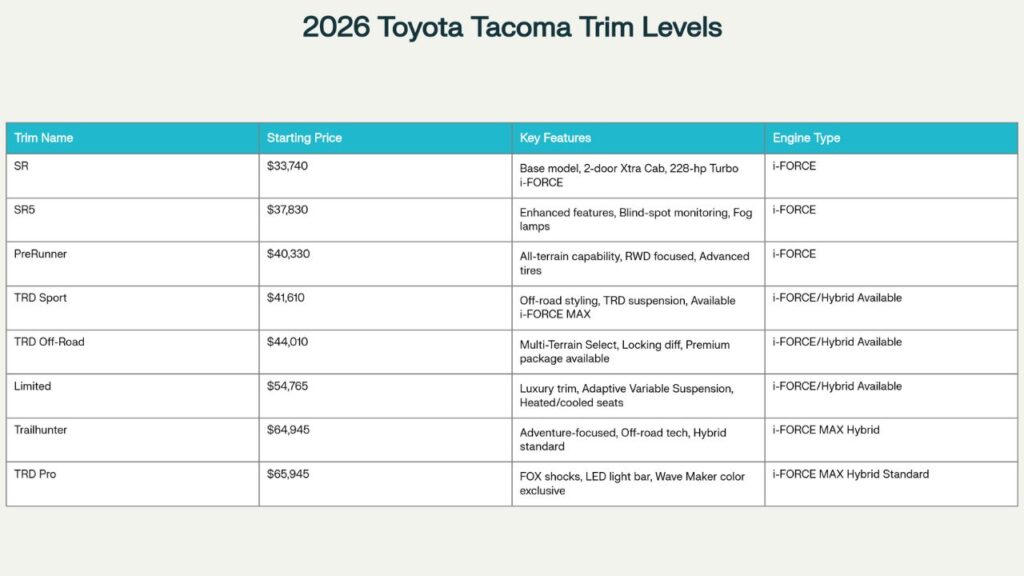
It is safe to say that there are Tacomas available for every budget. Pricing for the top-of-the-line TRD Pro ranges from $33,740 for the base SR model to $65,945 to the moon let alone fully loaded. Here’s the deal with what you get at different price points: 

If price is the determining factor for you the SR5 at $37,830 is an absolute no-brainer. You get blind-spot monitoring, fog lamps, and solid feature that won’t break the bank. TRD Off-Road ($44,010) 

2026 Toyota Tacoma Trim Levels and Pricing

2026 Toyota Tacoma Trim Levels and Pricing

BONUS – If there was one trim option that was best for most people, that has got to be the TRD Off-Road, which provides a great balance of serious off-road capability without the luxury price tag of the Limited trim.

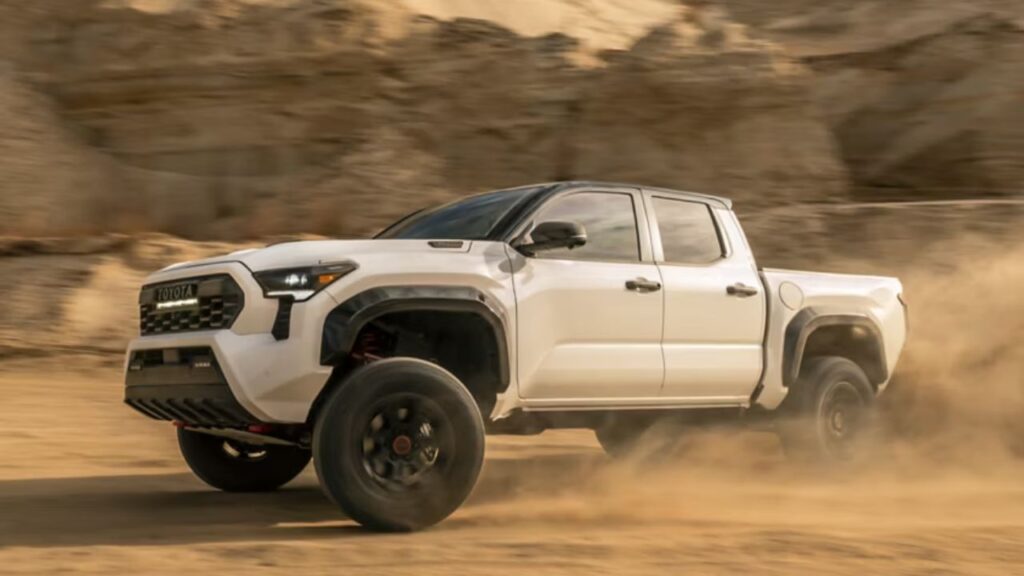
For the more deep-pocketed adventurer, the TRD Pro ($65,945) is basically a race truck for the road. It comes with FOX suspension tuned by TRD racing professionals, unique IsoDynamic performance seats, a large integrated LED light bar, and unique styling that turns heads wherever you go. 

Inside the Cabin – Comfort Meets Technology

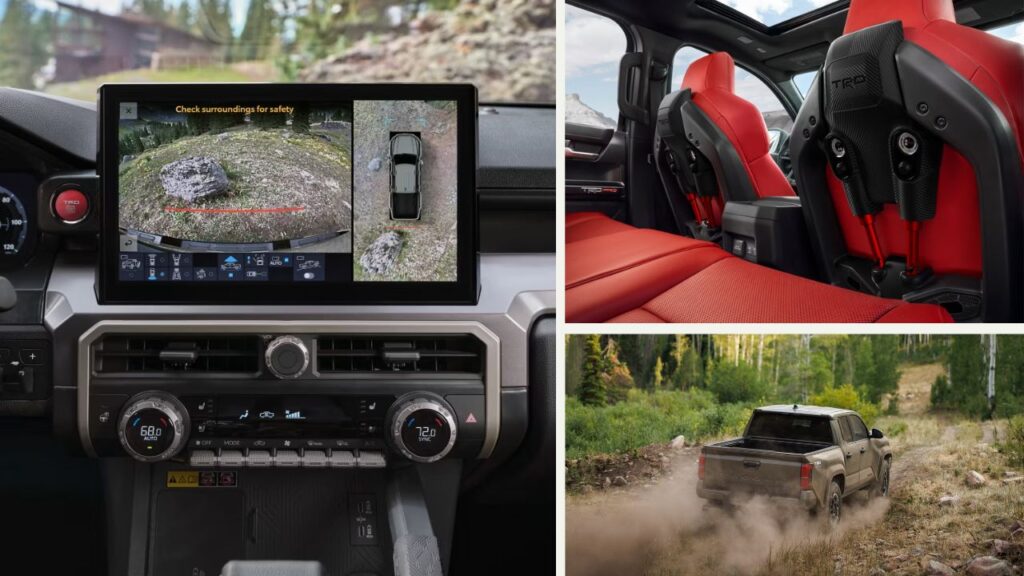
The 2024 Tacoma sees a complete redesign of the interior, and the 2026 bolsters that improvement. The dashboard is modern, with soft-touch materials and a choice of 7- or 12.3-inch digital gauge cluster based on your trim.

Now, the tech features are mind-blowing. Certain models offer a 14-inch touchscreen display with support for Apple CarPlay and Android Auto. There’s an optional 3D Multi Terrain Monitor giving you a full 360-degree view of your environment – ideal when negotiating rough terrain or backing into a tight parking spot. 

Inside the Cabin – Comfort Meets Technology

Image credit: Toyota

The Limited comes standard with heated and cooled front seats, which is a luxury for a truck. And the seats are also higher than before, so you’re not sitting on the floor anymore. Also, you’ll find more head- and legroom in all rows, which makes for a genuinely comfortable longer drive.

All Tacoma models come with Toyota Safety Sense 3.0 as standard, which adds lane-keeping assist, automatic emergency braking, adaptive cruise control and pedestrian detection. It’s the sort of technology that helps keep you safe without getting in the way of your drive. 

Off-Road Capability – The Tacoma’s Real Strength

When you’re in the market for a Tacoma, it’s safe to assume that you are interested in more than just how it performs on the highway. Every model Toyota made came with front and rear disc brakes, and electric power steering that improves both feel and integration of the safety features.

Serious off-road tech comes with the TRD models like Multi-Terrain Select and Crawl Control – these automatically tune your truck’s performance for rocks, sand, or mud. The TRD Pro and TRD Off-Road also receive an electronically locking rear differential and a stabilizer disconnect system that increases suspension articulation when you want it. 

And the TRD Pro cranks it up a notch further with real-time adjustable FOX QS3 shocks, IsoDynamic performance seats utilizing air suspension technology to keep you stable over rough ground, and Limited models also offer optional Adaptive Variable Suspension that delivers a smooth ride on any surface. 

Conclusion

The 2026 Toyota Tacoma manages to be at once a sensible everyday driver and an eager weekend adventure partner. Either way, with the gas one, or the hybrid for a bit more power and efficiency, you get a truck with Toyota’s legendary reliability.

The new colors and standard safety equipment, plus other small enhancements, make this generation feel fresh while keeping what makes Tacomas legend. When it comes to a reliable midsize pickup, the 2026 Toyota Tacoma is one of the first to consider. Should be available starting winter 2025, so rush to your nearest dealer to lay eyes on one. 

0

Honda Elevate – Price, Features, Mileage, and All You Need to Know

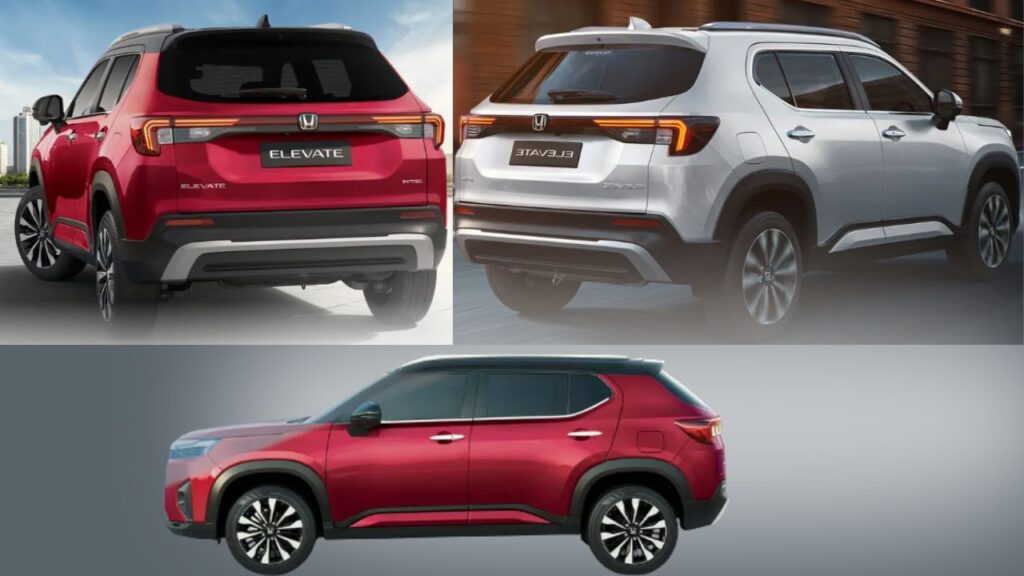
Honda Elevate

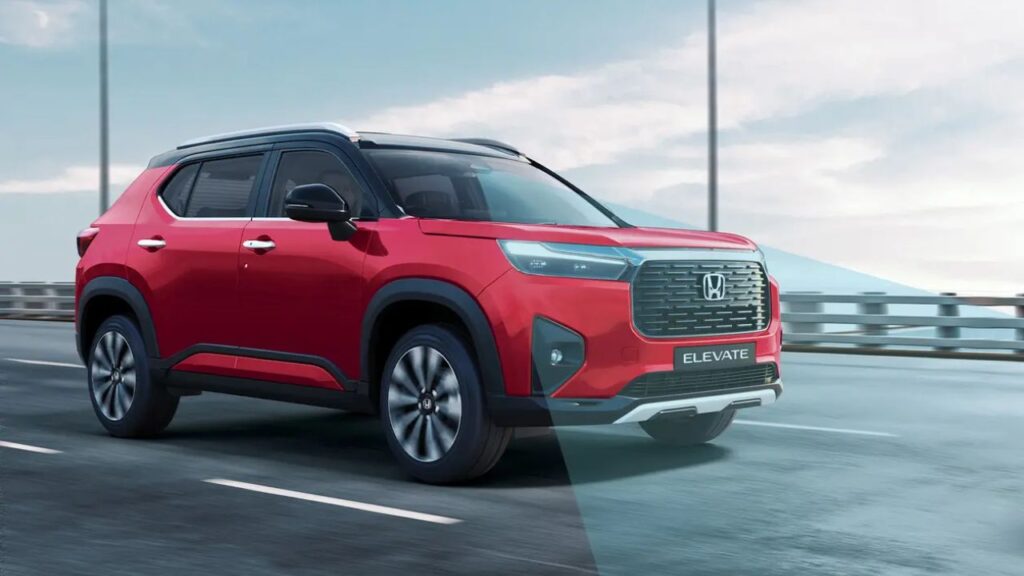
The India compact SUV market has seen drastic changes in recent years and Honda Elevate has established itself as a unique offering in this space. If you are a first-time car buyer venturing into the world of SUVs or a sedan owner looking to upgrade, the Honda Elevate brings you an interesting package of practicality, safety and value-for-money. So let’s take a closer look at why this vehicle is so good. 

Pricing and Variants To Understand What’s Right For You

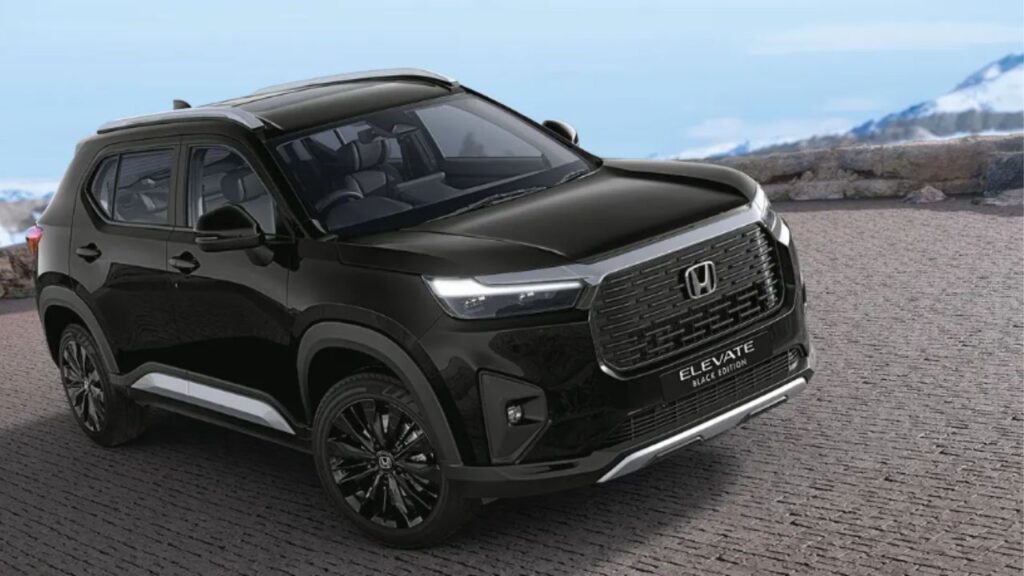
The Honda Elevate is priced attractively from ₹11.00 lakh (ex-showroom) for the base SV manual variant and goes up to ₹16.67 lakh (ex-showroom) for the top-end variants. This pricing policy makes sure that all budgets are covered in the compact SUV segment. 

Manual Transmission Variants
SV MT ₹11.00 lakh
V MT ₹11.96 lakh
VX MT ₹13.61 lakh
ZX MT ₹14.88 lakh
Honda Elevate Pricing and Variants

Image credit: Hondacarindia

Automatic Transmission Variants
V CVT ₹13.12 lakh
VX CVT ₹14.77 lakh
ZX CVT ₹16.06 lakh

Honda also curates special editions like the Black Edition (₹15.51 lakh), Signature Black Edition, and the newly introduced ADV Edition (beginning at ₹15.29 lakh for the manual and ₹16.44 lakh for the CVT). 

Note: The price of different variants may change due to change of region or district, kindly check your nearest showroom to get accurate price details.

Engine Specifications and Performance

The Elevate is powered by a 1.5-liter naturally aspirated i-VTEC petrol engine. This four-cylinder engine produces 119-121 bhp. It also produces a peak torque of 145 Nm at 4300 rpm. Maybe that spec sounds meek compared to turbo competitors, but that’s still real power. Still, whatever such driving such power provides is a smooth, steady drive. It is good for city trips and road travel.  

The engine is springed to two transmission choices: a 6-speed manual transmission or a 7-step CVT automatic. CVT Interesting for those who often drive in stop and traffic stop: you get momentum flow with less fatigue as a driver. 

Mileage – Real-World Efficiency

Honda Elevate Mileage – Real-World Efficiency

Image credit: Hondacarindia

Elevate’s distinguishing features include good fuel efficiency. The ARAI mileage is 15.31 km/l for the manual version and 16.92 km/l for the CVT automatic version. These are respectable figures for a car in this class, and that goes to show Honda’s dedication to making its powertrains as efficient as possible. Real world mileage: 15 to 16 km/l depending on drive style, traffic and road conditions. 

Dimensions and Space: Is It Practical Enough?

The Elevate rides on practical dimensions. It is 4312 mm long, 1790 mm wide and 1650 mm tall with a wheelbase measuring 2650 mm. What makes this all the more impressive is how Honda has managed to cram all of that space into a genuinely roomy five-seater without making the vehicle feel like a hulking beast in city traffic. 

With 458 litres of boot space, there’s more than enough room for your weekly shop, or you could pack light for the weekend - or whatever the combination of the two might be. This also helps with the 220 mm ground clearance required for Indian roads and the speed breakers, and a few rough patches now and then shouldn’t hurt the underbody. 

Read More :-  Top New Midsize SUVs in 2025 – Stylish, Spacious & Performance-Packed Option

Feature-Rich Cabin

But Honda has not cut any corners on features even with the aggressive pricing. The Elevate is equipped with a 10.25-inch Advanced HD Touchscreen Display Audio with wireless Apple CarPlay and Android Auto. So smartphone integration works flawlessly, so you can listen to music, get directions and take calls – all hands free.​

Other Honda Elevate key features include a 7-inch HD Full Colour TFT instrument cluster, fully automatic climate control with MAX COOL function, a wireless smartphone charger, and a one-touch electric sunroof (in tops models). Brown and black two-tone interior The interior features soft-touched areas, giving the cabin a more premium feel than the price tag of the vehicle would indicate. 

Safety: A True Standout

The Honda Elevate received a 5-star rating in the Japanese NCAP crash safety test – a remarkable feat for a car built in India. It rated 90 percent on average with good scores in crash safety (86/100) and preventive safety (82.22/85.8). Especially, most impressive is the Level 5 rating for Autonomous Emergency Braking, which can prevent collisions with moving obstacles up to 60 km/h (speed limit of 37 mph)

Honda Elevate Safety A True Standout

Image credit: Hondacarindia

Six airbags, electronic stability control, ISOFIX child seat anchorages, and hill start assist are standard across the range for safety. Higher trims also get Honda’s Level-2 ADAS (Advanced Driver Assistance Systems) including Adaptive Cruise Control, Lane-Keeping Assist, and Lead Car Departure Notification. 

Conclusion

The Honda Elevate is the outcome of fine-tuning practicality, technology and value. It’s aimed at buyers who need reliability and safety, but who don’t really want any bells and whistles. If you’re shopping for your first SUV or just want a solid, straightforward family hauler, Elevate makes a strong argument, with Honda dependability behind it. 

0

How to Improve Gas Mileage: 15 Proven Tips That Actually Save Fuel

How to Improve Gas Mileage

Petrol in Delhi is holding at ₹105 a litre this week, and Mumbai drivers are paying past ₹111 — rates that haven’t moved much since the last OMC revision in May 2026. You are probably wondering about how to improve gas mileage of your car. Because it actually helps you save money. It’s the difference between a ₹2,000 tank lasting your commute eight days or eleven. 

Most of what kills mileage in Indian driving conditions has nothing to do with the engine under the hood and everything to do with habits you can fix by this weekend. Let’s understand the 15 proven tips that genuinely move the needle on gas mileage, ranked roughly by how much difference they make.

1. Ease Off the Gas Pedal

Road rage was one of quickest means to empty a gas tank without actually going any faster. Quick brakes and acceleration with tight force can actually let your engine work harder than it has to. That extra effort means more fuel consumption, more wear on your brakes and tires

Research shows that aggressive driving can lower your gas mileage by up to 30% on the highway and more than 30% in city traffic.

2. Keep Your Tires Properly Inflated

When tires are underinflated, if they don’t have enough air roll easily they require more push and for that engine has to burn more fuel to keep the same speed. Flat tires mostly cause lower fuel economy, uneven wear of tires and affect braking and handling.

It’s recommended to check your car’s tire pressure every month and before going on a long trip. The little maintenance habit can increase your mileage and tire life. 

3. Don’t Ignore Your Air Filter

Your engine requires a constant flow of clean air to burn fuel properly. The air filter restricts the flow of air to the engine as it gets clogged by dust, dirt, leaves and other debris, hence the engine has to work harder to make the same power. 

On a lot of cars, it’s a quick job that doesn’t require any special tools. Most manufacturers advise to check the air filter at every service and change it at the intervals. 

Read More:-  How to Transfer Car Ownership in India: A Step-by-Step RTO Guide (2026)

4. Lighten Your Load

When your trunk becomes just a holding space for stuff, your fuel economy could be suffering without you knowing it. If there are any heavy objects like games equipment, boxes, and tools that are unnecessary, remove them.

If weight increases more than standard capacity like 45 kg (100 lbs) can decrease fuel efficiency by about 1-2%, and it impacts mostly in city driving and stop-start traffic.

5. Use Cruise Control on the Highway

Cruise control can be used to increase the fuel efficiency while driving on open highways by avoiding speed fluctuations. Speed changes, small ones included consume extra fuel as the engine needs to accelerate and decelerate the vehicle repeatedly. 

Long drives go smoothly with the help of Cruise Control as it prevents needless changes. It may not be good for busy traffic roads but best for fairly flat interstates, where steady speeds can help squeeze the most from every liter of gas. 

6. Avoid Excessive Idling

Idling your car wastes gas, and it doesn’t even get you anywhere. Waiting to meet someone, waiting outside a store or driving with your engine running while you’re parked your wasting fuel for no distance covered. 

New cars already have automatic start-stop systems for this very reason. Quick start and stop can make everything so easy and saves fuel on idling. 

How to Improve Gas Mileage

7. Combine Your Errands

When you start your car, the engine will take time to warm up and it uses more fuel to make it completely warm. If your engine gets cold and you try to warm up 5 times a day then your fuel burns more than it burns at one go. 

So combine all your errands and try to complete it once you start your engine. Do not let yourself be drawn to a lot of shorter trips in a day. It can also help you avoid extra miles and time on the road.

8. Watch Your Speed

To reach faster at your destination will consume more fuel from the tank. So avoid leaving your home late and take a ride at steady speed so it saves your fuel as aerodynamics normally.

With most cars, fuel economy starts suffering fairly rapidly once you’re driving faster than about 90–100 km/h. Even dropping your cruising speed by 10–15 km/h on long road trips on the highway can help you save a little gas. 

Read More :- Zero Depreciation Car Insurance: Benefits, Coverage & Cost

9. Keep Your Windows Up at High Speeds

How you cool your vehicle can also impact gas mileage especially on the highway. On the highways, you probably drive fast and leaving your window open creates drag which forces the engine to work harder to move the vehicle through the air. 

You can open windows at short and slow speeds in a city. Turning on the AC is more fuel efficient on highways or running at high speed.

10. Get Regular Tune-Ups

If you want to drive a car which can be fuel efficient then take care of it regularly. Regular maintenance including checking engine oil, plugs, sparks, tires are required to increase fuel efficiency. When these are not fixed, your engine works harder and consumes more fuel and gives poor performance.

Read a manual to keep following the manufacturer’s recommended service which lets your car at its best condition, improves fuel economy and can save you from costly repairs. 

11. Use the Manufacturer-Recommended Motor Oil

Using the wrong grade of oil can actually reduce your fuel economy. Check your owner’s manual and stick to what’s recommended — it’s a small detail that makes a real difference.

12. Don’t Overuse the AC in Stop-and-Go Traffic

Air conditioning puts extra load on your engine. In heavy city traffic, cracking a window instead of blasting AC can help — though on the highway, the reverse is often true (see tip #9).

13. Plan Your Routes to Avoid Traffic

Sitting in traffic means idling, braking, and accelerating over and over — the worst combination for fuel economy. A slightly longer route with steady flow can actually save more fuel than the “shortest” route full of stop-and-go.

14. Check Your Wheel Alignment

If the car wheel is misaligned then your engine puts more force to move your car forward. It silently eats your mileage and if the car pulls to one side then get an alignment check quickly because your tires wear out. 

15. Consider Your Driving Environment

Temperature also affects your engine and batteries because cold weather can cause your engine to get cold easily and it sometimes hard to start the engine. So it takes time and more fuel to warm up the engine which is not good for short trips. This helps you set realistic expectations and adjust your habits rather than assuming something’s wrong with your car.

A Real Comparison: Habits vs Hardware

How to Improve Gas Mileage

Parameter Maruti Suzuki Swift Hyundai Grand i10 Nios
ARAI-rated mileage (petrol) ~22–24 kmpl (actual: 24.8 kmpl manual, 25.75 kmpl AMT)  ~20–22 kmpl (actual: 18 kmpl manual, 16 kmpl AMT) 
Real-world mileage (aggressive city driving, poor habits) 14–15 kmpl (as per your input) Not specified, but likely lower than ARAI if driven poorly
Real-world mileage (steady driving, good maintenance) Can approach ARAI figures with correct habits Can out-mileage a poorly driven Swift with steady acceleration, correct tyre pressure, minimal idling (as per your input)
Key takeaway ARAI figure is not a guarantee; aggressive driving can drop mileage to 14–15 kmpl A lower-rated car can deliver better real-world efficiency if driven and maintained well
Primary reason for gap Driver behaviour and maintenance (not just engine design) Same – driver and maintenance habits dominate real-world results

The gap between ARAI figures and real-world mileage is almost always driver-and-maintenance driven, not just engine architecture.

Should You Spend Money to Fix Mileage, or Just Change Habits?

If your mileage complaint is a gradual, creeping drop over months, the fix is almost always maintenance — tyre pressure, air filter, spark plugs, alignment and costs under ₹2,000 in most cases. If it’s a sudden, sharp drop, get the OBD scanned for fault codes before assuming anything about driving style. 

Only if you’re consistently doing long highway stints and your current car lacks cruise control or an eco mode should hardware or a car upgrade — even enter the conversation. For most Indian owners, the ₹0 fixes (driving style, tyre pressure, timely servicing) recover more mileage than any accessory or fuel additive on the market.

Read More :-  How to Renewal Car Insurance: Step-by-Step Guide (2026)

Conclusion

Once you understand all the points on how to improve gas mileage, there’s nothing hard to adapt to changes. Little habits can save your money and time, so proper tire pressure, regular maintenance, and a bit of trip planning can genuinely add up to real savings over a year. You don’t need an electric vehicle or a full engine rebuild to save at the gas pump. Sometimes it really is the simple stuff that works best. 

Try picking just three or four of these tips to start with. Once they become second nature, add a few more. Your fuel gauge and your wallet will notice the difference.