0

2026 Toyota Tacoma – Full Overview, Features, and What to Expect

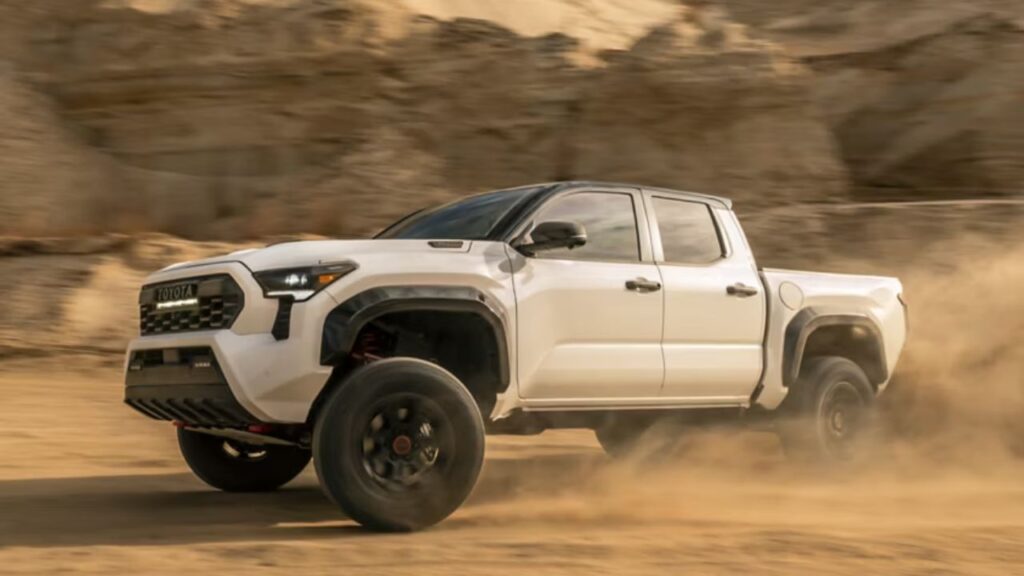
2026 Toyota Tacoma

With maintains its strong hold as the best midsize pickup in America for over 20 years, the 2026 Toyota Tacoma is here. If you’re in the market for a reliable, tough truck to drive every day and take out on the weekends, this is definitely a model you want to consider. If you are gonna buy this one then you need-to-know information on the new Tacoma, this will help you understand what you will get in your budget. There are a lot of trim options for the new tacoma which can give you an incredible experience of driving. 

What’s New for 2026 in Tacoma?

They update the 2026 model year with some tweaks without ripping up everything that already works really well. Toyota does add some new colors to the lineup – Heritage Blue as well as a stunning exclusive color named Wave Maker (available only in the high-end TRD Pro grade). 

If you’re after the TRD Off-Road, TRD Sport, and TRD PreRunner models you’ll notice they now feature a trendy black front logo. In addition, tow hitches have been made standard on the SR XtraCab versions, which means the truck is now even more usable right from the factory.
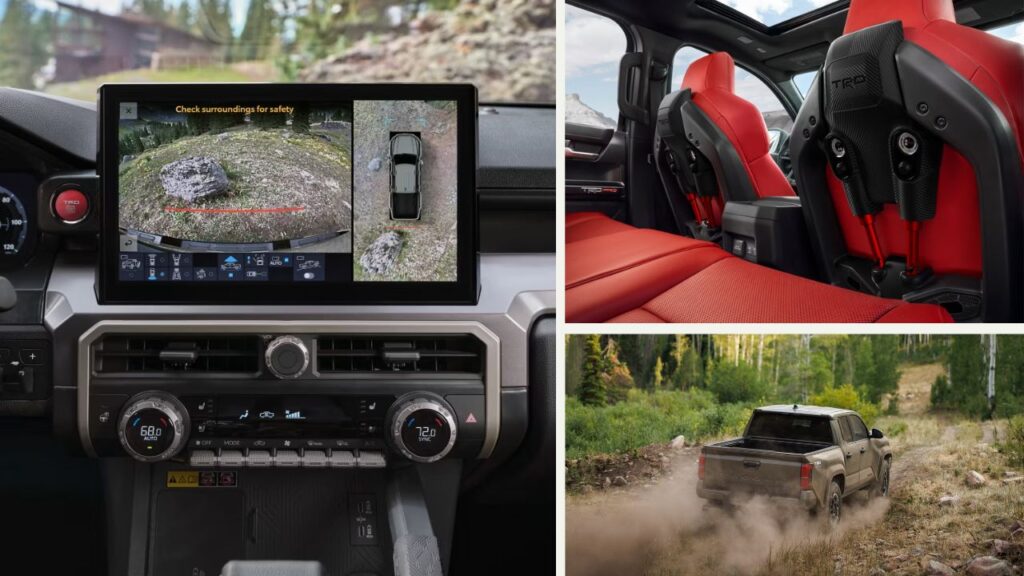
New for 2026 in Tacoma

Image credit: Toyota

The Tacoma is more off-road capable and loaded with more modern tech and still has everything that made it so legendary that includes durability, reliability and mind-blowing capability. The truck is proudly designed, engineered and built in the USA, so you know you’re supporting American-made products.  

Engine Choices – Power Meets Efficiency

This is when things begin to get interesting. The 2026 Tacoma offers two engine options as per your need, you can grab the one. 
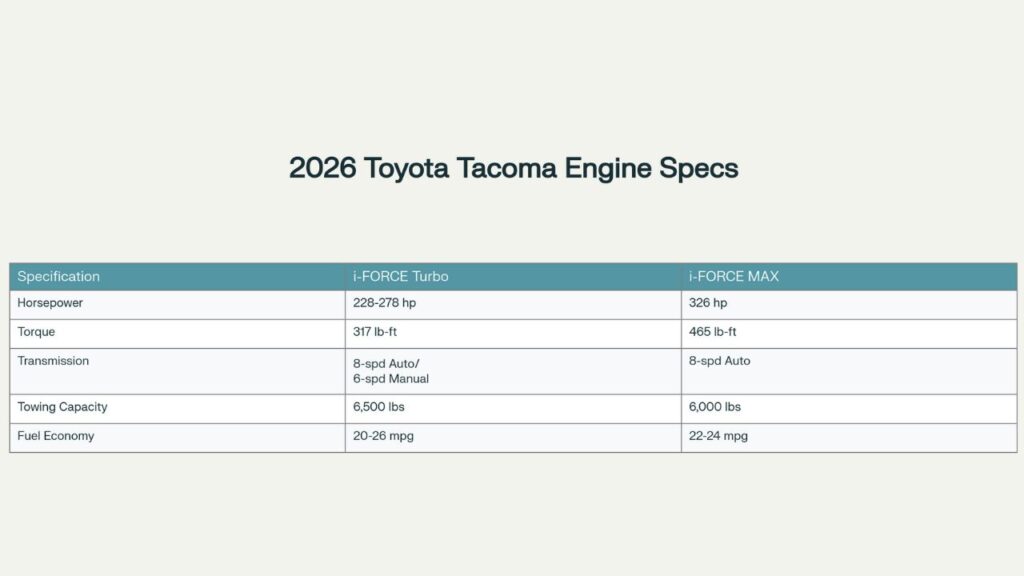
2026 Toyota Tacoma Engine and Performance Specifications

2026 Toyota Tacoma Engine and Performance Specifications

The Standard i-FORCE turbo engine is available in two power levels. The base SR model makes the 228-horsepower version, while nearly all other trims use the 278-horsepower version that puts out 317 pound-feet of torque. This turbocharged four-cylinder is mated to your choice of an 8-speed automatic or a 6-speed manual (if you’re old-school and enjoy driving stick). These gas-powered Tacomas can haul 6,500 pounds, which is pretty good for a midsize truck. 

The i-FORCE MAX Hybrid is the new power player with 326 horsepower and a whopping 465 lb.-ft. of torque. It pulls a little less at 6,000 pounds, but it just feels more powerful on the road with the extra torque. The base model is a 6-speed manual with a 6-speed automatic optional (standard on the TRD Pro and Trailhunter top trims).
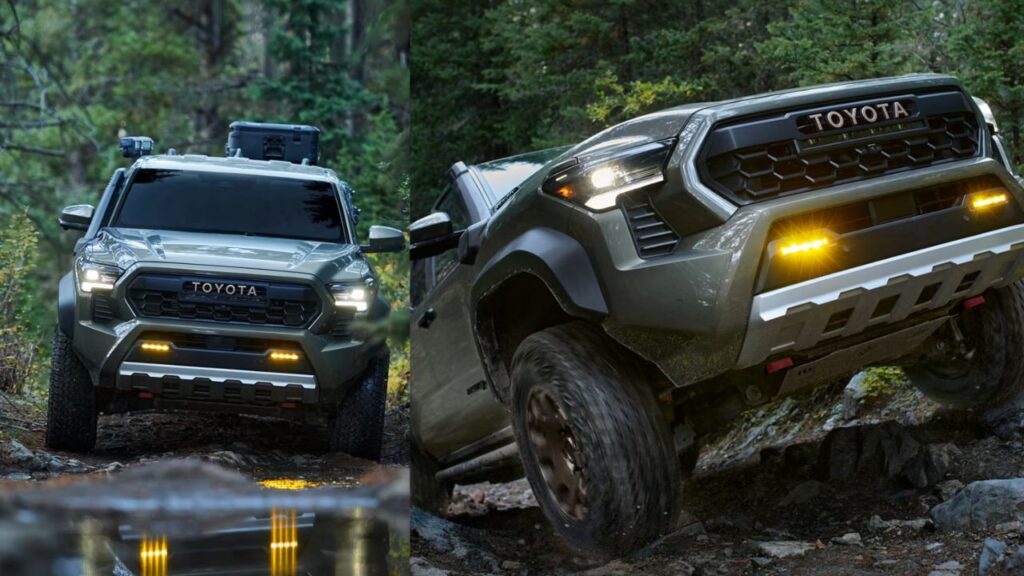
Toyota Tacoma Engine and Performance Specifications

Image credit: Toyota

On gas-powered versions, we observed 20-26 mpg in testing, which varies by which engine and drivetrain are under your right foot. And the hybrid gets 22-24, which is pretty darn good for a truck this big. 

Pricing That Fits Different Budgets

It is safe to say that there are Tacomas available for every budget. Pricing for the top-of-the-line TRD Pro ranges from $33,740 for the base SR model to $65,945 to the moon let alone fully loaded. Here’s the deal with what you get at different price points: 

If price is the determining factor for you the SR5 at $37,830 is an absolute no-brainer. You get blind-spot monitoring, fog lamps, and solid feature that won’t break the bank. TRD Off-Road ($44,010) 
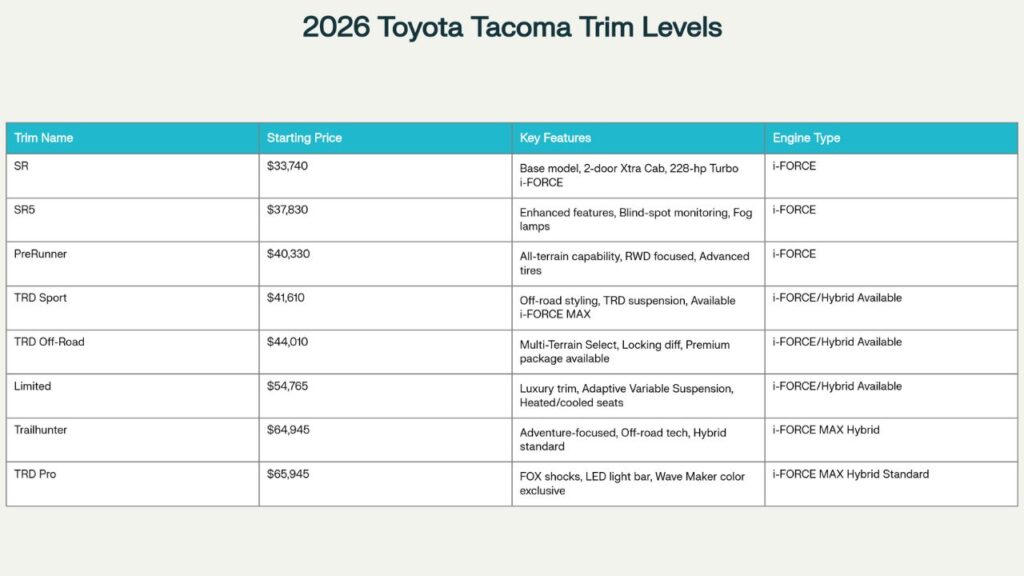
2026 Toyota Tacoma Trim Levels and Pricing

2026 Toyota Tacoma Trim Levels and Pricing

BONUS – If there was one trim option that was best for most people, that has got to be the TRD Off-Road, which provides a great balance of serious off-road capability without the luxury price tag of the Limited trim.

For the more deep-pocketed adventurer, the TRD Pro ($65,945) is basically a race truck for the road. It comes with FOX suspension tuned by TRD racing professionals, unique IsoDynamic performance seats, a large integrated LED light bar, and unique styling that turns heads wherever you go. 

Inside the Cabin – Comfort Meets Technology

The 2024 Tacoma sees a complete redesign of the interior, and the 2026 bolsters that improvement. The dashboard is modern, with soft-touch materials and a choice of 7- or 12.3-inch digital gauge cluster based on your trim.

Now, the tech features are mind-blowing. Certain models offer a 14-inch touchscreen display with support for Apple CarPlay and Android Auto. There’s an optional 3D Multi Terrain Monitor giving you a full 360-degree view of your environment – ideal when negotiating rough terrain or backing into a tight parking spot. 
Inside the Cabin – Comfort Meets Technology

Image credit: Toyota

The Limited comes standard with heated and cooled front seats, which is a luxury for a truck. And the seats are also higher than before, so you’re not sitting on the floor anymore. Also, you’ll find more head- and legroom in all rows, which makes for a genuinely comfortable longer drive.

All Tacoma models come with Toyota Safety Sense 3.0 as standard, which adds lane-keeping assist, automatic emergency braking, adaptive cruise control and pedestrian detection. It’s the sort of technology that helps keep you safe without getting in the way of your drive. 

Off-Road Capability – The Tacoma’s Real Strength

When you’re in the market for a Tacoma, it’s safe to assume that you are interested in more than just how it performs on the highway. Every model Toyota made came with front and rear disc brakes, and electric power steering that improves both feel and integration of the safety features.

Serious off-road tech comes with the TRD models like Multi-Terrain Select and Crawl Control – these automatically tune your truck’s performance for rocks, sand, or mud. The TRD Pro and TRD Off-Road also receive an electronically locking rear differential and a stabilizer disconnect system that increases suspension articulation when you want it. 

And the TRD Pro cranks it up a notch further with real-time adjustable FOX QS3 shocks, IsoDynamic performance seats utilizing air suspension technology to keep you stable over rough ground, and Limited models also offer optional Adaptive Variable Suspension that delivers a smooth ride on any surface. 

Conclusion

The 2026 Toyota Tacoma manages to be at once a sensible everyday driver and an eager weekend adventure partner. Either way, with the gas one, or the hybrid for a bit more power and efficiency, you get a truck with Toyota’s legendary reliability.

The new colors and standard safety equipment, plus other small enhancements, make this generation feel fresh while keeping what makes Tacomas legend. When it comes to a reliable midsize pickup, the 2026 Toyota Tacoma is one of the first to consider. Should be available starting winter 2025, so rush to your nearest dealer to lay eyes on one. 

Sharey Khan

Sharey Khan is an IT entrepreneur and petrol head & a car enthusiast. With a special focus on car-related content, he combines his deep passion for vehicles with a talent for crafting informative, engaging, and easy-to-understand content. His writing is driven by a genuine love for cars and he is committed to providing readers with accurate, up-to-date, and trustworthy information that empowers smarter driving decisions. 

Leave a Reply

Your email address will not be published. Required fields are marked *

0

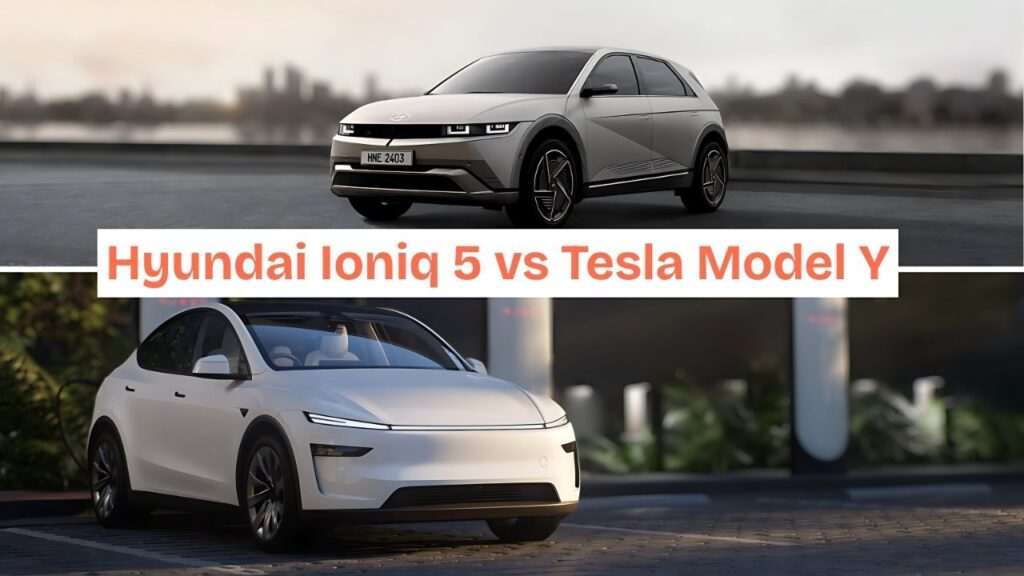
Hyundai Ioniq 5 vs Tesla Model Y: Which EV Wins in 2025?

Published Sep 5, 2025, 6:52 AM
Last Updated Apr 16, 2026, 11:20 AM

The 2025 year seems to be huge for electric cars as it introduces many EVs other than Tesla which once dominated this market alone. Now, other competing cars take place leading to Hyundai Ioniq 5 vs Tesla Model Y battle showdown. The two cars are considered to be useful and stylish for buyers. 

Both are widely popular for delivering quite pleasant electric driving experiences. Both are updated with new features but which one is best for you is a complex question. Let’s solve this puzzle together through this detailed blog.

Pricing and Value

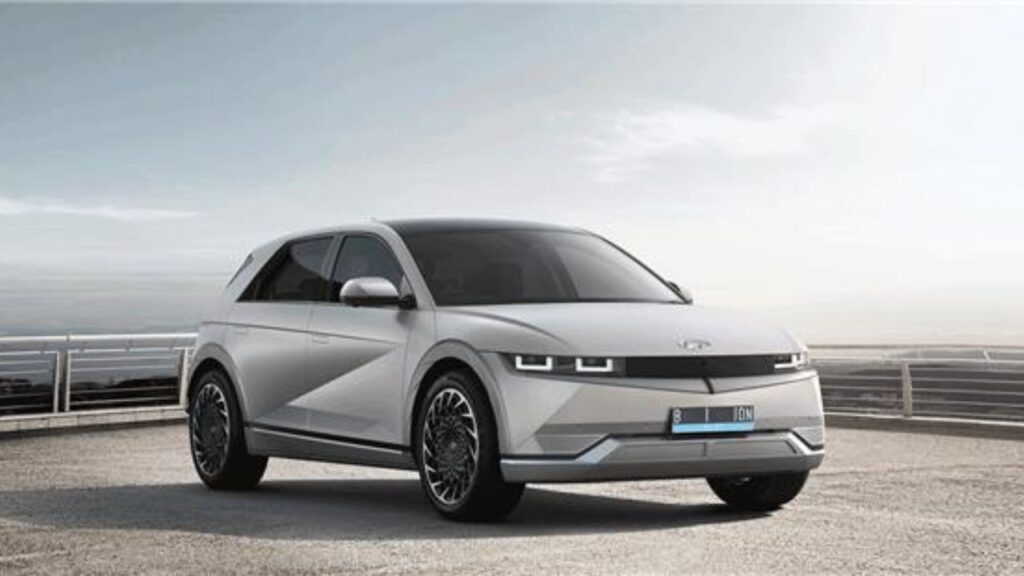
The 2025 Hyundai Ioniq 5 will cost you around $43,975 but additional trims and special edition (N or XRT) can cost you around mid-$50,000.

Hyundai IONIQ 5

Image Credit: Hyundai

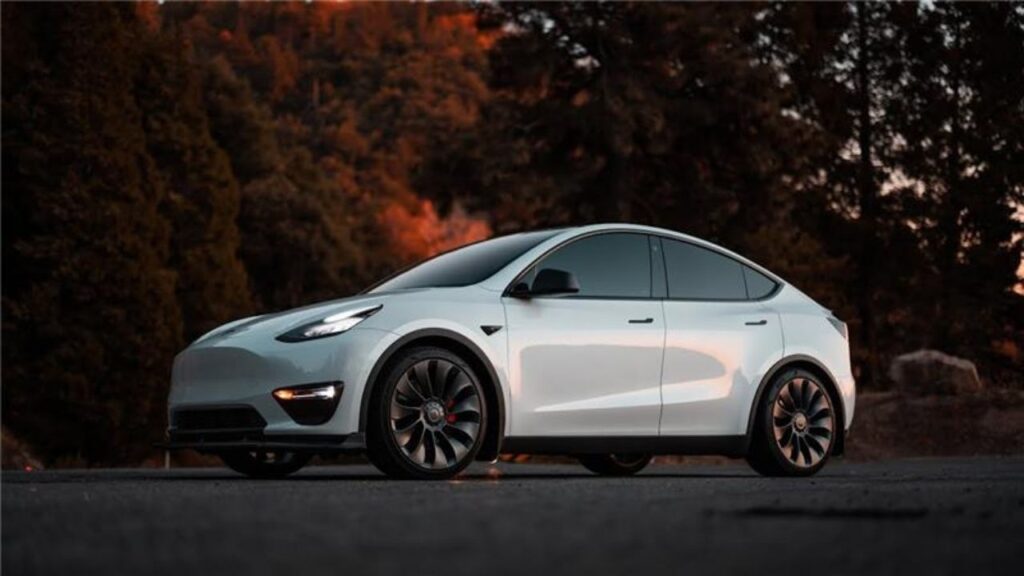
The 2025 Tesla Model Y including AWD & Long Range variants prices hovers in the $46,000 – $50,000 range. The cost can go up with additional performance trims.

Tesla Model Y in India

Image Credit: YouTube

Ultimately, Hyundai offers more features and a comfortable ride with low starting cost. Meanwhile, Tesla’s full Self-Driving feature cost more that its starting prices. 

Range and Efficiency

While buying a car most buyers check range and efficiency, and here Tesla Model Y is slightly up with its long range up to 330–337 miles. The Ioniq 5 is catching up with an 84 kWh battery to deliver range up to 300–318 miles. So, while Tesla is delivering a bit more range, Hyundai now offers more than enough for daily commutes and long trips.

Charging Technology and Infrastructure

The battle gets interesting here, Ioniq 5 is shining with an 800-volt system that charges at speed from 10% to 80% in just 18 minutes. It becomes possible with super-fast DC chargers that provide top-notch speed, also used in luxury EVs like Porsche & Audi.

But Tesla’s charging network is bigger than any other car, even in 2025. It offers more locations, makes it easy and simple to use. The good news? Hyundai Ioniq 5 now uses the NACS standard means it can use Tesla Superchargers too. 

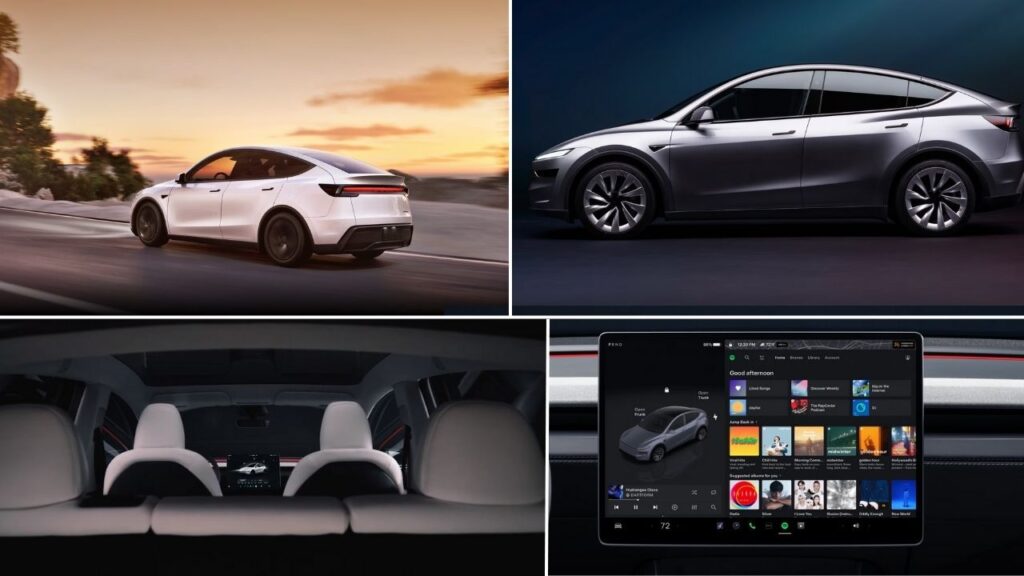
Image credit: Tesla

These things made it super easy for Hyundai but Tesla still won for offering greater ease.

Performance and Driving Experience

These two crossovers are explosive, but they do things differently. The standard Ioniq 5 AWD version delivers 320 horsepower, the true monster is the Ioniq 5 N model which produces over 600 horsepower and track-ready parts. The XRT trim of Hyundai is more into off-road action ready demon. 

The Tesla Model Y offers outstanding performance in a speed range from 0-60 mph in 3.3 seconds. Performance is equal to a sports car. The quick acceleration of the Tesla is a remarkable feature with its quick tuning. 

Tesla and Hyundai N models both offer unstoppable performance that excite speed lovers. Tesla has offered straightforward speed, while Hyundai more evolved into driving experience.

Read More: Toyota RAV4 vs Honda CR-V: The Ultimate SUV Battle of 2025

Interior and Tech

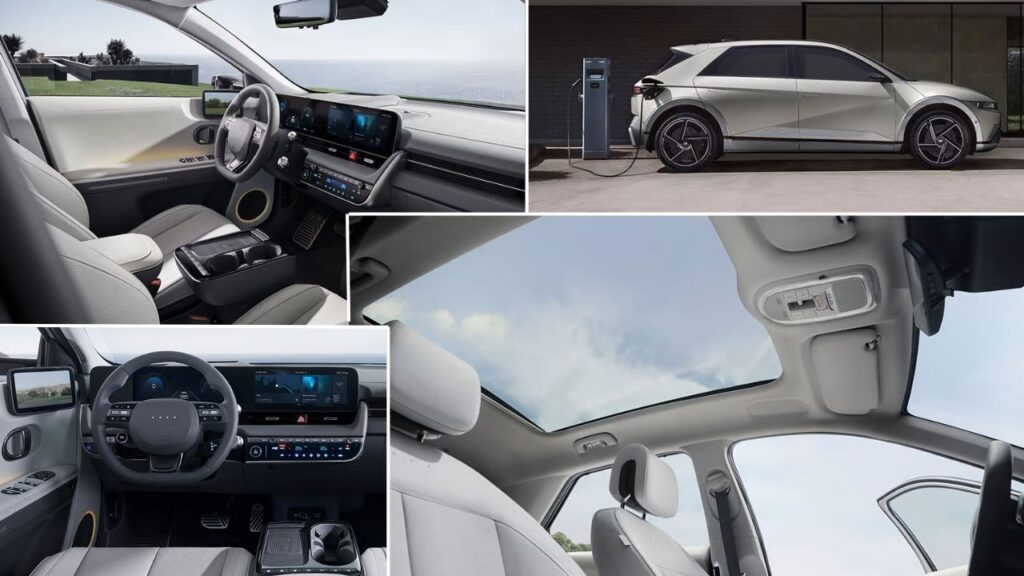
The difference is obvious inside both vehicles. The Ioniq 5 offers a practical cabin with 12-inch displays for the infotainment system and comfortable seats made with high-quality material for both driver and passengers. Controls are real and easy to use, overall the interior is giving a pleasure and decent experience of the trip. 

Image credit: Hyundai

The Model Y offers amazing features in a minimalist cabin with a single touchscreen infotainment system. Its first approach is software that delivers outstanding controls and provides features like autopilot for full self-driving. Now, it has become tech savvy’s favorite electric vehicle.

Read Also: Mahindra Thar vs Maruti Jimny: Which SUV Dominates Off-Road?

Practicality and Everyday Use

Both cars offer large spaces for long family trips. Tesla offers more back space and optional 3rd row seating available in some markets. Hyundai offers excellent ride, comfort, and roomy back seat, making it easy to use.

Ultimately, both are versatile and are a good electric choice. They work perfectly for daily commutes and road-trips.

Quick Comparison Hyundai Ioniq 5 vs Tesla Model Y

Category Hyundai Ioniq 5  Tesla Model Y 
Starting Price (US) From $43,975 (higher trims mid-$50k; N & XRT editions cost more) From $46,000–$51,000 (Performance and FSD push costs higher)
Range (EPA/est.) 300–318 miles depending on trim & wheels 300–337 miles depending on motor & wheels
Charging 84 kWh Battery, fastest charging (10–80% in 18–20 min) Supercharger network access
Performance AWD standard: 320 hp, Ioniq 5 N: 600 hp (track-focused), XRT for rugged use Long Range AWD quick & efficient; Performance trim does 0–60 mph in 3.3s
Interior & Comfort Two 12-inch screens, premium materials, mix of physical + digital controls Minimalist cabin with single touchscreen; software-driven interface
Tech & Software Infotainment system & now supports Tesla plug (NACS) Industry-leading OTA updates, Autopilot, optional Full Self-Driving package
Charging Network Compatible with Tesla Superchargers + CCS chargers Exclusive Supercharger network with best coverage & reliability
Practicality Comfortable ride, roomy 2-row crossover, stylish design Very spacious, large cargo space, optional 3rd row (in some markets)

Conclusion

The two cars are ready for the battle Hyundai Ioniq 5 vs Tesla Model Y. Hyundai provides driving quality experience with more advanced features at fastest speed and more cargo space for family trips. Tesla is a fully tech optimized vehicle which offers full self-driving options and more add-ons features in trim versions. Both cars offer amazing driving experience, so there is no single winner, but the right choice depends on your lifestyle. 

0

Ramesh Babu Car Collection: India’s Biggest Luxury Rental Garage

Ramesh Babu Car Collection

South India boasts many luxury car collections, but what makes Ramesh Babu Car Collection so unique is its size and organization. It is common to get such a personal impression of this collection, but in reality, the almost 400 vehicles strong fleet is actually run under the company Ramesh Tours and Travels, offering the personal luxury vehicles for commercial rentals. 

Range spans from a Maruti Omni (practical) to the Rolls-Royce Ghost and Mercedes-Benz Maybach S600, that is some show of sophistication in high-end asset management and high-end asset rental management, one suspects. 

Rolls-Royce Ghost Series I and II

The Rolls-Royce Ghost is the flagship of the fleet. The first purchase which dates back to 2011 for the Ghost at around ₹3 crore, it was the collection’s debut in the most ultra-luxury motoring category. Newer Ghost variants in the fleet currently cost around ₹7–8 crore, depending on the variant of customization.

Rolls-Royce Ghost Series I and II

With a 6.6L V12 twin-turbo engine, the Ghost is all about effortless, smooth power, with the majority of its torque available at low engine speeds. Its sophisticated air suspension and electronically controlled chassis guarantee a fantastically smooth ride.

Technical Specification Value/Detail
Engine Code N74B66 V12-T7
Displacement 6,592 cc
Maximum Power 563 hp @ 5,250 rpm
Peak Torque 780 Nm 
Transmission 8-speed ZF 8HP90 automatic
Acceleration  4.8 seconds (0-100km)
Top Speed 250 km/h (electronically limited)

Inside, the Ghost combines bespoke luxury with contemporary technology — including coach doors, premium full-grain leather, book-matched wood veneers, built-in umbrellas and extensive sound insulation. The result is a Zen, hushed space that radiates warmth and luxury, especially for the upper-echelon renters. 

Mercedes-Maybach S600 — German Luxury

Tech futurism isn’t previously on display in a vision of luxury in the Mercedes-Maybach S600. Purchased for about ₹2.7 crore, it is a preferred choice among corporate honchos and tech entrepreneurs to the Rolls-Royce Ghost.

Mercedes-Maybach S600

Its 6.0L V12 Biturbo engine delivers the kind of smooth, silent performance that Magic Body Control, scanning the road ahead, easily anticipates and cushions bumps.

Metric Specification
Engine Type 6.0 L V12 Biturbo
Power Output 530 hp
Maximum Torque 830 Nm
Transmission 7G-TRONIC Plus 7-speed automatic
Fuel Capacity 80 Liters
Top Speed 250 km/h

The S600 even features a private-jet-like rear cabin with reclining executive seats that offer massage and ventilation functions. Premium amenities include Agarwood fragrance, a 24-speaker Burmester 3D sound system, rear-seat voice amplification, and dual 12.3-inch infotainment screens with a luxury business console. 

High-Performance Off-Road Luxury: The Mercedes-Benz G-Wagen

The space also includes the Mercedes-Benz G400d and G350d, the earliest G-Wagens in India to be operated as commercial taxis. Based on the robust ladder-frame chassis, the G400d Adventure Edition is equipped with the state-of-the-art OM656 inline-six diesel engine.

Inside, the rugged off-road vehicle features Nappa leather, three-zone climate control and a digital display board with ambient lighting, outfitting the S-Class luxury with military-grade toughness. Approximately ₹5,000 per hour is the cost to rent a G-Wagen, perfect for those clients looking for power, prestige and comfort in any terrain. 

Feature G400d Specification
Engine 2,925 cc Inline-6 Diesel
Max Power 326 hp @ 3,600 rpm
Max Torque 700 Nm 
Drivetrain AWD with three locking differentials
Ground Clearance 241 mm
Acceleration 6.4 seconds

Benz S-Class and E-Class

The garage turns over a sizable quantity of Mercedes-Benz E-Class and S-Class models as the staples of its executive level, catering largely to corporate clients and long-term VIP reservations. 

Benz S-Class and E-Class

The newest models are three Mercedes-Benz E-Class LWB 220d sedans in High-Tech Silver that come with S-Class-like rear-seat space. Significantly, a 2004 E-Class signified the garage’s turn from economy car rentals to luxury offerings.

Component E 220d LWB Details
Engine 2.0 L 4-cylinder Diesel
Power 192 hp
Torque 400 Nm
Transmission 9G-TRONIC 9-speed automatic
Price ₹72.8 lakh (ex-showroom)
Interior Black leather with wood and aluminum trim

The fleet of Mercedes-Benz S-Class (W221 to W223) amounts to the finest in luxury whose price ranged from ₹1.5–2.5 crore which includes extremely high-tech features such as rear-axle steering and active air suspension for a most comfortable ride. 

The British Contingent: Land Rover and Jaguar

The garage includes a solid collection of British luxury sport-utility vehicles (SUVs) and sedans, combining traditional British sophistication with contemporary performance.

Land Rover and Jaguar

Among the critical additions is our Land Rover Defender 130 as a commercial taxi with a maximum occupant of eight passengers and the pick for its road boldness and group-carrying capability. With the Range Rover Vogue LWB priced at approximately ₹ 3.2 crore delivering a potent diesel powertrain and the family personal garage also boasts the ultra-exotic Range Rover SV priced at ₹5.4 crore that brings bespoke design, premium audio, and paint options.

Feature Defender 130 Specification
Variant D300 HSE
Engine 3.0 L Inline-6 Diesel with Mild Hybrid
Power/Torque 296 hp / 600 Nm
Exterior Color Fuji White with Black Contrast Roof
Interior Black and Tan leather
Rental Rate ₹3,000 per hour

The Jaguar XJ L is a stylish rival to German sedans and achieves better agility thanks to a lightweight aluminum construction, classic British luxury, and prices ranging from ₹1 – 1.8 crore. 

BMW i7 and Mercedes EQS

The garage has grown into green luxury with top-tier electric sedans, complying with metro regulations and providing ultra-quiet ride service.

Metric BMW i7 xDrive M70
Battery Capacity 101.7 kWh
Max Power 650 hp
Max Torque 1,015 Nm
Range (WLTP) 560 – 625 km
Interior Highlight 31.3-inch 8K Theatre Screen

The BMW i7 in eDrive50 and M70 variants is packed with ultra-luxury additions, including Executive Lounge Rear Seating and the immersive Sky Lounge panoramic roof. The Mercedes-Benz EQS 580 turns heads with more than just its eye-popping 56-inch Hyperscreen; it also packs advanced rear-axle steering, which makes this sizable electric sedan deceptively nimble and an absolute breeze to guide through city streets. 

Feature EQS 580 Specification
Battery 107.8 kWh
Claimed Range 857 km (ARAI)
Performance 544 hp / 858 Nm
Charging 200 kW DC (0-80% in 31 mins)

Read More:-  The Ultimate Guide to the Best Compact SUVs in 2026: Drive Smart, Live Better

High-Capacity Luxury: The MPV Fleet

A majority of the 400-strong fleet is comprised of luxury MPVs, catering to corporate groups, families and celebrity entourages.

Toyota Vellfire

The top-of-the-line MPV, the Toyota Vellfire Executive Lounge, costs around between ₹1.2 to 1.5 crore and comes with ultra-comfortable lounge seats in the middle row as well as hybrid option. For around ₹3,000 an hour, it is a top pick for celebrities on the go.

Technical Detail Toyota Vellfire Specs
Engine 2.5 L Petrol Hybrid
Combined Power 142 hp (Engine) + Electric Motors
Seating 7-seater with 2nd-row reclining ottomans
Fuel Efficiency 19.28 km/l

Mercedes-Benz V-Class and Viano

A fleet of Mercedes-Benz V-Class and Viano also ensures that you can enjoy a true mobile office experience with swivel seats and tables – ideal for luxury business jaunts. 

Feature Category V-Class (Current) Viano (Previous Gen)
Engine Options 2.0L Diesel (1950cc), up to 161 hp 3.0L V6 Diesel, 214 hp​
Transmission 9G-TRONIC 9-speed auto 7G-TRONIC 7-speed autol
Seating Capacity 6-8 seats, flexible configs 6-8 seats, modular layout
Safety Features Active Brake Assist, Blind Spot Assist​ ESP, airbags, basic ADAS
Infotainment MBUX 10.25″ touchscreen, Apple CarPlay COMAND system, smaller screen

Conclusion

Ramesh Babu Car Collection is not just a show of riches- it is a well orchestrated luxury mobility solution. The combination of ultra-luxury flagships like the Rolls-Royce Ghost and the Mercedes Maybach S600, as well as executive sedans, rugged off-roaders, electric vehicles, and high-capacity multi-purpose vehicles (MPVs), the fleet raises the bar for premium car rental services in India. 

0

New 2026 Nissan Murano Review – Features, Design, Performance & Pricing

New 2026 Nissan Murano

The 2026 Nissan Murano stands out as one of the most competent mid-size crossovers available this year — sleek, modern and designed for families and daily commuters who want comfort without the astronomical luxury-brand price tag. 2026 Nissan Murano has also completely relooked with a radical new design, enhanced technology, a refined turbocharged powertrain and an upgraded interior that elevates it into near-luxury territory.  

With its enhanced dynamics and advanced safety features such as ProPILOT Assist 2.1, the 2026 Murano is built for those who want modern luxury in a familiar package that includes Nissan reliability. So, let’s take a look at what makes this axle-driven SUV a great pick for 2026 and how it compares in today’s overly crowded crossover segment. 

Design That Commands Attention

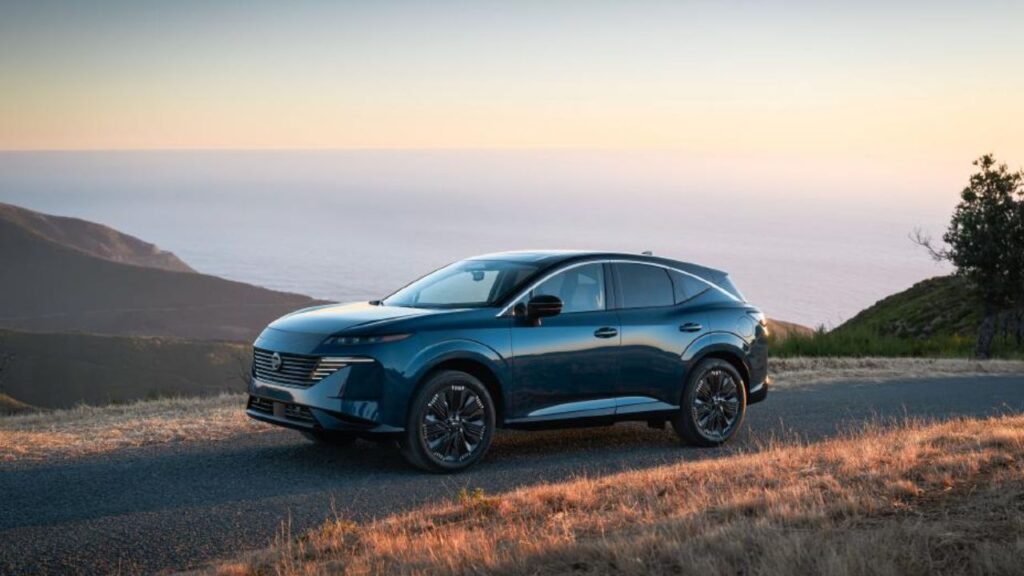
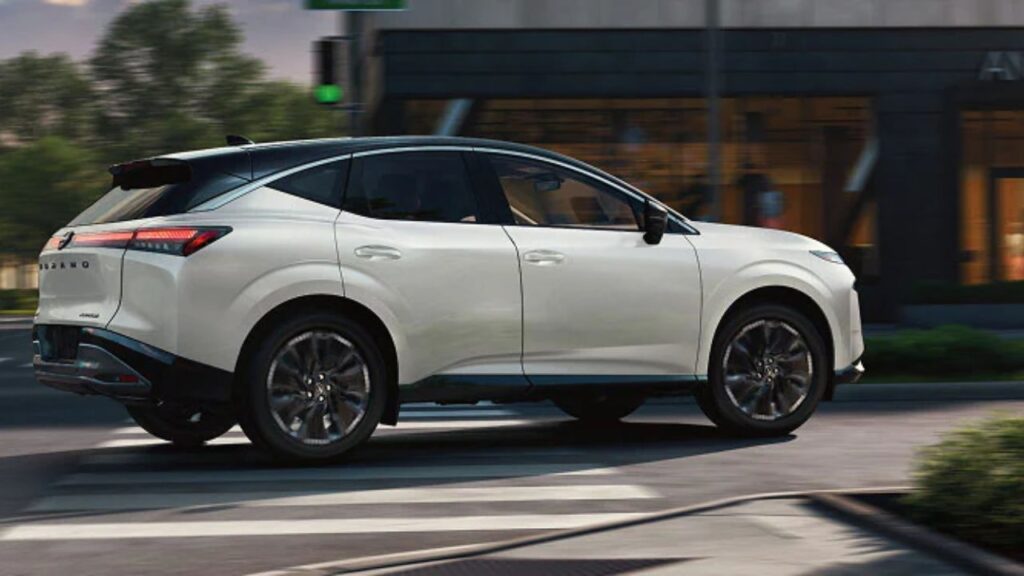
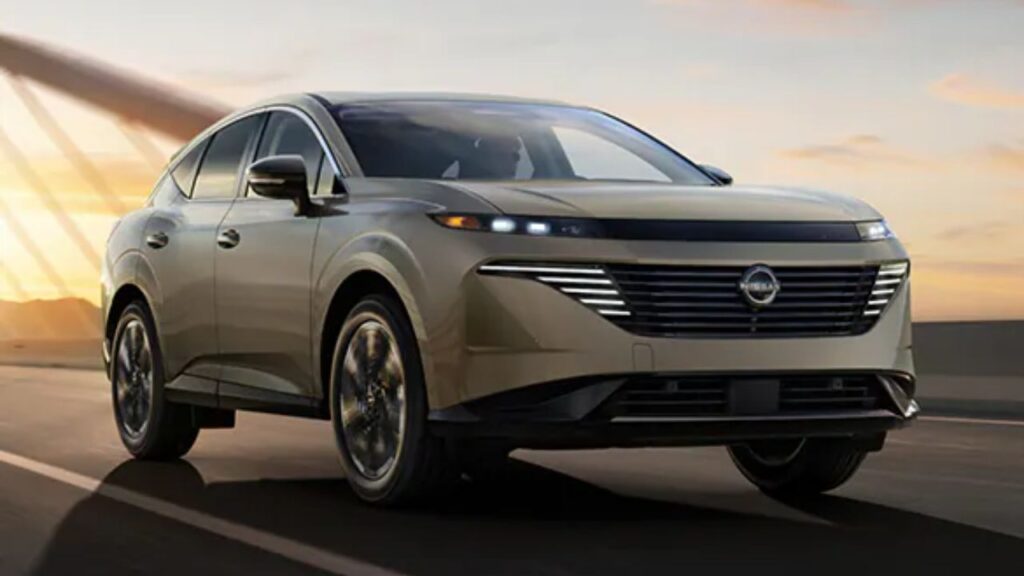
The 2026 Nissan Murano has a bold and upscale look that immediately draws attention. The design incorporates sporty and aerodynamic lines with super slim LED headlights and a unique full-width LED taillight bar that extends all the way to the rear. These modern additions give the Murano a high-end look that could fool you into thinking it costs a lot more. The vehicle rides on available 21-inch wheels that add a layer of sleekness to its contemporary look. With its 8.3-inch ground clearance, the Murano delivers a commanding road presence and the Murano also provides high levels of visibility for all day driving and parking. 

2026 Nissan Murano

2026 Nissan Murano | Image credit Nissanusa

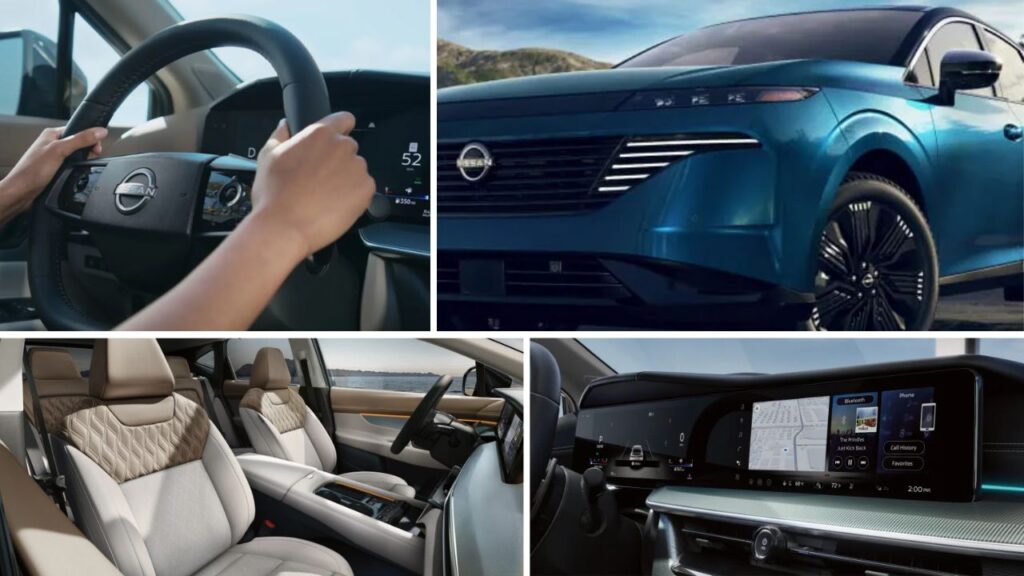
And the interior The cabin provides a spa-like environment with every detail thoughtfully considered. Nissan refers to it as the “zen” interior experience, which includes high-end materials, soft-touch surfaces and intuitive ergonomic design. The two 12.3-inch color screens, one as the instrument cluster and the other as a touchscreen for the infotainment system, form a modern, clean dashboard design. 

Up to 64 color options are available for ambient interior lighting, letting you tailor the cabin atmosphere to your mood. The (optional) Nissan’s famous Zero Gravity seats offer outstanding all-day comfort, with ventilated and massaging front seats available on upper trims that are more akin to the experience of a premium spa than sitting in a car seat. 

Read More :- Renault and Nissan Alliance Guide – History, Benefits & Future Vision

Powerful Performance Built for Comfort

Powering the 2026 Murano is Nissan’s 2.0-liter four-cylinder VC-Turbo engine that produces 241 horsepower and 260 lb-ft of torque. This engine is mated to an exceptional 9-speed automatic transmission that offers quick, controlled shifting that is as refined as it is powerful. All trims are fitted with the now standard Intelligent All-Wheel Drive, which offers better traction and stability in different weather conditions. 

2026 Nissan Murano Fuel Economy

2026 Nissan Murano Fuel Economy

The Murano is the fastest car with top speed of 120 mph and it takes you from 0 to 60 mph in an estimated 8.0 to 8.3 seconds. This isn’t the most powerful in the segment, but the emphasis is here on smooth, assured motivation rather than pure performance thrills. This new, refined nine-speed automatic replaces the previous model’s continuously variable transmission to give a more responsive and composed driving experience. 

EPA fuel-economy estimates are 21 city/27 highway/23 combined mpg. These figures put the Murano towards the mid-range in the mid-size luxury crossover segment, although Nissan has suggested a hybrid powertrain could be an option some time in the future. The 18.7-gallon fuel tank offers plenty of range for long road trips. A modest 1,500-pound towing capacity is good for a few small trailers and jet skis, but some competitors easily outpull it. 

Spacious Interior with Practical Cargo Solutions

The Murano offers 32.9 cubic feet of space behind the rear seats, which is plenty for bags of groceries, suitcases and sports equipment. the 60/40 split rear bench seats folded down, the capacity climbs up to 63.5 cu. ft. to transport bigger items such as furniture or camping gear.A power liftgate is standard to expedite loading and an upper-trim power, motion-activated liftgate brings real convenience. 

Spacious Interior inside of 2026 Nissan Murano

Spacious Interior inside of 2026 Nissan Murano | Image credit Nissanusa

Passenger room is just as impressive, with 44.3 inches of front legroom and 36.3 inches of legroom in the rear. The cabin is authentically roomy and calm, allowing long jaunts to be enjoyed by all passengers. Although the Murano is technically a five-passenger model, the copious spacing makes it feel much roomier than many rivals. 

Read More :- Discover the New Kia Telluride – Bold Design, Advanced Tech & Premium Comfort for 2025

Trim Levels: Finding Your Perfect Match

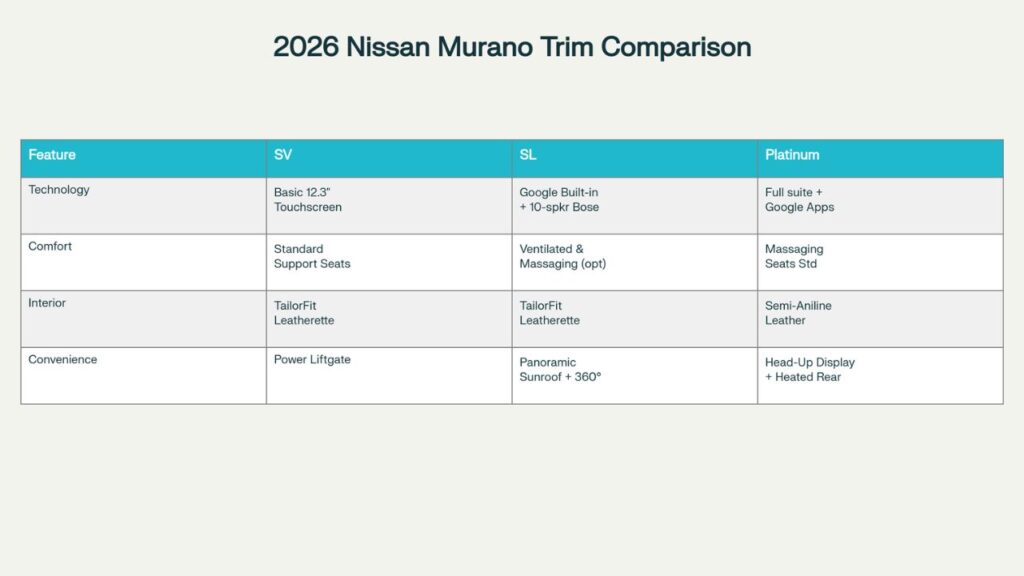
There are three well-equipped trim levels for the 2026 Murano: SV, SL, and Platinum. That makes for an easy decision — each price point really does add value, not gimmicks.

2026 Nissan Murano Trim Feature Comparison

2026 Nissan Murano Trim Feature Comparison

SV (Base) – From $41,670: The premise is astonishingly robust. It has a 12.3-inch touchscreen infotainment system featuring wireless Apple CarPlay and Android Auto, 20-inch black alloy wheels, dual-zone automatic climate control, a digital instrument cluster, and wireless smartphone charging. Power windows, locks and mirrors are standard, as is a solid infotainment system through NissanConnect. 

SL (Mid-Range) – From $46,760: Value, at its most debatable but quite apparent best You get Google Built-in for easy navigation and voice control, a high-end 10-speaker Bose audio system, a panoramic sunroof to bring that open-air feeling inside, a 360-degree Intelligent Around View Monitor to park with confidence, built-in Wi-Fi hot spot connectivity, and ventilated and massaging front seats (optional).

Platinum (Premium) – From $49,800: The high end is first-class luxury All the semi-aniline leather upholstery which actually feels premium, massaging front seats for more comfort than you deserve, a head-up display to ensure critical information remains in your line of sight, the rear seats heat up for passenger comfort, a hands-free power liftgate, and power-folding mirrors which make tight parking a little less difficult. 

Advanced Safety Technology That Protects Your Family

All 2026 Murano models are now equipped with Nissan Safety Shield 360, a robust driver-assistance system focused on keeping hazards out of your path. That system includes features such as automatic emergency braking with pedestrian detection, applying the brakes when an obstacle or person is detected in front of you, blind spot warning that notifies you of vehicles in your blind spot, and lane keeping assist to reduce the risk of unintended lane departures.​

Safety Technology That Protects Your Family

image credit: Nissanusa

The headline feature for 2026 is the optional ProPILOT Assist 2.1, which is only available on the Platinum trim and can be purchased in the Platinum Technology package. It is an advanced system that enables drivers to go hands-free on certain highways when conditions are right. Utilizing cameras, radar sensors, and HD mapping information, ProPILOT Assist 2.1 controls the steering, speed and braking, but keeps your eyes on the road. Lane Change Assist can even suggest passing and assist when passing slower vehicles ahead of you, making long highway drives much less tiring. 

Other safety enhancements include Invisible Hood View, which allows the driver greater visibility while parking in tight spaces, a built-in 360-degree exterior camera system, intelligent lane intervention and speed limit assist that notifies the driver of posted speed limits. If the driver is deemed distracted, the system will softly slow the vehicle to a stop, putting safety first with no compromises. 

Read More :-  New Tata Sierra 2025 – Price, Features, Launch Date, and Electric SUV Details

Connectivity and Entertainment for Modern Life

The Murano confidently steps into the modern day with two-key USB hubs for Apple CarPlay and Android Auto being part of the package. Google Built-in is available on SL and Platinum models allowing you to use native Google Maps navigation, Google Assistant voice control, and Google Duo video calling. The optional Bose premium audio system produces a warm, enveloping sound that makes listening to music an experience rather than just background noise.​

Connectivity and Entertainment for Modern Life

image credit: Nissanusa

Murano has also added a built-in Wi-Fi hot-spot capability so passengers can use it as a mobile office or entertainment center to stream, work or browse while stopped (or in traffic). Among the new features are Amazon Alexa integration and in-dash navigation for those who like their systems a little less mobile-device dependent. 

Conclusion

The 2026 Nissan Murano is for those who want a luxury-feeling SUV for less. Unless you’re interested in a straight-line performance car, like the Tesla Model 3 Performance, and care about the interiors, and want the newest and most advanced active safety features, this is your car. The Murano is a good choice for families who need that extra space, commuters who drive long distances, and anyone seeking a more serene driving experience than its competitors can provide.

The only possible downside is the limited towing capacity of 1,500 pounds (still enough to tow a small camper in some regions), but we welcome the Honda Passport’s greater capabilities option and also superior fuel economy (which could be improved further should Honda choose to offer a hybrid option). But for those whose priorities lie in comfort, style and overall practicality on a day-to-day basis, such shortcomings matter less than the car’s comprehensive refinement. 

0

Best Fuel Efficient Cars in India 2026 for Daily Use

Published Jul 1, 2026, 12:56 PM
Last Updated Jul 2, 2026, 4:50 AM

Top Fuel Efficient CarsFuel efficiency has become one of the biggest priorities for Indian car buyers in 2026 as petrol and diesel prices continue to rise. As fuel costs keep increasing, buyers are paying closer attention to how much a vehicle will cost to run every day. Whether they are choosing a hatchback, sedan, or SUV, Fuel Efficient Cars have become the preferred option for reducing daily running expenses. As a result, finding the most fuel-efficient cars in India is now a top priority for many buyers.
Additionally, figuring out the car’s fuel economy through official ARAI mileage figures is old. Now people are calculating on fuel efficiency that is conducted in real-world road conditions and traffic because these factors have an impact on fuel consumption. That laboratory-tested number can only give you hints but it depends on the driving habit.

Let’s see what are those factors and which are the most Fuel Efficient Cars India in 2026 for daily use.

Impacts of Different Engines on Car’s Fuel Efficiency

The Evolution of More Efficient Petrol Engines 

The Indian car market is still dominated by naturally aspirated petrol engines while there are electric vehicles, hybrids, and CNG models. Car makers have been honing these engines for years to make them more fuel efficient without sacrificing reliability or driving up maintenance costs. 

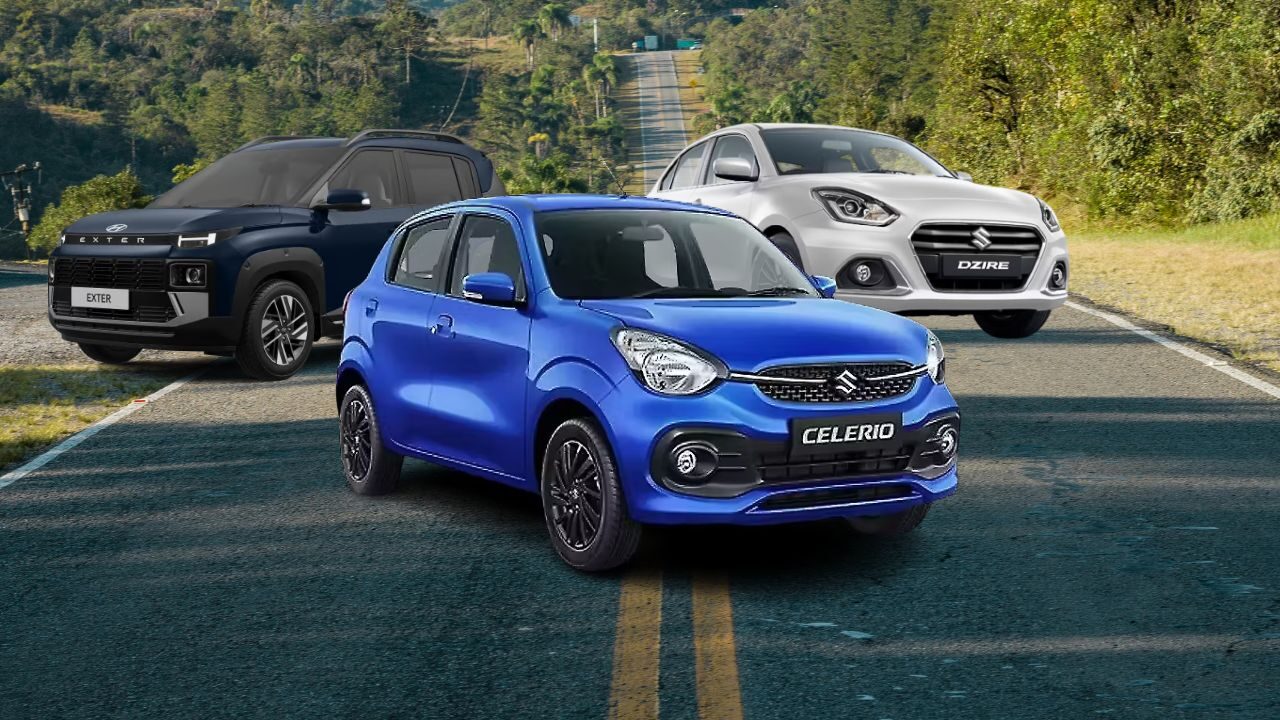
  1. 1. Maruti Suzuki Celerio is a proven example which is still the most fuel efficient petrol car in India. The Celerio is based on Maruti Suzuki’s new light-weight HEARTECT platform which enables the 1.0-litre K10C petrol engine to be more peppy without being more thirsty as the car weighs in at a mere ~760 kg.  

Celerio gives 26.68 kmpl but 19–21 kmpl of mileage in city and 24 kmpl on highways claimed by the owner which makes it one of the most fuel-efficient petrol cars for daily use. 

  1. The latest Swift and Dzire have also been a game changer for Maruti Suzuki. Rather than sticking with the old four-cylinder K-Series engine, the company launched the brand new 1.2-litre, three-cylinder Z12E petrol engine for the 2025 and 2026 editions. Although power output has dropped slightly to 82 HP and 112 Nm of torque, the priority now is fuel economy and smoother running at lower speeds. 

The latest Swift weighs nearly 90 kg less than the previous generation which improves efficiency. These changes open real-world driving experiences more comfortably and reliably. The Swift Manual, rated at 24.80 kmpl by ARAI, but the real mileage is around 17–19 kmpl. If the driver is taking Swift on highway with steady driving, it delivers 22 kmpl while the AMT version gives 16–18 kmpl in city traffic as the early gear shifts making engine speed low.

Owners commonly report that the Maruti Suzuki Dzire delivers 15–17 kmpl in heavy city traffic which makes it also the best fuel efficient car. It becomes the most fuel-efficient compact sedan available in India. It gives 20–22 kmpl on highways.

Vehicle Model Powertrain ARAI Claim (kmpl) Real-World City (kmpl) Real-World Highway (kmpl)
Maruti Suzuki Celerio 1.0L K10C Petrol MT 26.68 19 – 21 23 – 24
Maruti Suzuki Swift 1.2L Z12E Petrol MT 24.80 15 – 17 20 – 22
Maruti Suzuki Dzire 1.2L Z12E Petrol MT 24.79 14 – 16 19 – 21
Toyota Glanza / Baleno 1.2L Petrol MT 22.94 15 – 17 19 – 21
Tata Altroz 1.2L Revotron Petrol MT 19.33 12 – 14 16 – 18

These models highlight the fact that lighter platforms, modern engine design and better engineering are allowing petrol cars to still remain as a viable and economical option for Indian buyers. 

CNG Cars are the Most Cost-Effective Choice for Daily Driving 

CNG cars continue to offer the lowest running costs in India. After petrol engines, car buyers mostly choose CNG cars if they want efficiency but there is one major drawback was the large gas cylinder that occupied large space. Fortunately, manufacturers have solved this problem with smarter packaging solutions.          

  1. Tata Motors has brought in a dual-cylinder CNG system, wherein the conventional single 60-litre cylinder is replaced with two smaller 30-litre cylinders placed under the boot floor. This design enables more space for luggage without impacting fuel capacity. Take the Tata Punch iCNG, for instance, it provides close to 210 litres of usable boot space, which is a whole lot more practical for everyday family use. 

It offers a 1.2-litre three-cylinder Revotron engine that produces 72 hp and 103 Nm of torque. Tata Punch iCNG has a claimed mileage of 26.99 km/kg. In city roads the Punch returns approximately 20-21km/l and on highways. 

  1. Hyundai is also bringing a Hy-CNG Duo system to market in the Hyundai Exter. Smart placement of the cylinders under the floor means the Exter still manages to hold an impressive 391 litres of boot space, which is among the largest for CNG cars in the segment. This makes it a great choice for buyers who want to combine cheap running costs with day-to-day usability.

The Hyundai Exter is equipped with the 1.0L Kappa naturally aspirated engine that generates 68 hp and 95 Nm of torque. Its four-cylinder design provides smoother acceleration, less vibration and quieter operation, a boon especially when travelling in busy city streets. The Hyundai Exter Hy-CNG carries an ARAI mileage rating of 27.10 km/kg, the Exter gets a realistic mileage of 22-23 km/kg on city roads and 31 km/kg on highways. 

Selection between them often depends on priorities – the Exter provides more refinement and boot space, while the Punch impresses with its solid build, compliant suspension and a five-star Global NCAP safety score. 

Read More:-  Car Loan Interest Rates in India 2026 – Compare Banks and EMI Options 

Strong Hybrids are Redefining Fuel Efficiency 

If your budget lies between ₹15–25 lakh, strong hybrid cars are best for you. They are equipped with latest technology features, spacious cabin, and excellent design which represent your style without consuming high fuel. 

Few models such as Toyota Urban Cruiser Hyryder, Maruti Suzuki Grand Vitara, and Honda City e:HEV are the best hybrid models of this year. It is built on a petrol engine combined with an electric motor and a battery pack to provide a level of real-world efficiency that is miles ahead of the traditional petrol cars. 

These systems automatically transition between electric and petrol power based on the current driving conditions to make the most efficient use of energy. When the battery is out of charge, the petrol engine fires up automatically, and the electric motor and petrol engine work concurrently. It makes the car the best option for both city and highway driving. 

Strong hybrids can run on electric power alone at low speeds, allowing the vehicle to move through traffic with minimal fuel consumption. Because the electric motor takes care of a lot of the driving at lower speeds, the petrol engine can stay off for long stretches, reducing fuel consumption. 

  1. The Honda City e:HEV is as competitive as it gets when it comes to hybrid sedans in India. It offers a dual-motor hybrid system powered by a 1.5-litre Atkinson-cycle petrol engine that seamlessly switches between engine, electric and engine+electric drive modes to prioritize which mode to deliver power.

Honda SENSING The Electronics Room TSR (Traffic Sign Recognition) Detects traffic signs such as speed limit and stop signs (depending on region). It makes a lot of sense over the normal petrol sedans like the Volkswagen Virtus and Hyundai Verna which give around 12-14 kmpl in city driving as the monthly fuel bill can soak the City e:HEV. 

  1. Both Toyota Hyryder & Maruti Grand Vitara are available with both mild-hybrid and strong-hybrid powertrains. This version offers 14–17 kmpl in real-world driving. In city driving, a strong-hybrid model gives 20–24 kmpl of mileage. And their electric power at low speeds, they are much more efficient than petrol or diesels of a similar size, particularly in stop-start traffic. 
  2. Toyota has now also introduced hybrid technology in the Innova Hycross as well that returns 14-15 kmpl in real-world driving which is an impressive number for a big three-row MPV that tips the scales at close to two tonnes. 
Vehicle Model Powertrain Architecture ARAI Claim (kmpl) Real-World Mixed Average (kmpl)
Honda City e:HEV 1.5L Strong Hybrid e-CVT 27.26 22.0 – 24.0
Toyota Hyryder 1.5L Strong Hybrid e-CVT 27.97 21.5 – 23.0
Maruti Grand Vitara 1.5L Strong Hybrid e-CVT 27.97 21.5 – 23.0
Toyota Innova Hycross 2.0L Strong Hybrid e-CVT 21.10 14.6 – 15.0

Which Fuel Efficient Cars Should You Buy in 2026?

Fuel efficiency depends on how owners use their cars but some recommendations are mentioned below to make you guess what you need:

For high-mileage city drivers: there are a lot of options but the two undeniable ones are Cruiser Hyryder and Grand Vitara are the most strong hybrid. Because they can operate on electric power in stop-and-go traffic, they are the most efficient at falling below 20 kmpl in city driving while providing the drivers with a smooth automatic riding experience. 

For budget-conscious buyers: There are petrol cars which are upgraded with CNG engines like Celerio and Wagon R, are the best if your budget is under Rs 9 lakh. They provide the lowest running cost. A 26-30 km/kg is a real-world efficiency that makes them the most fuel efficient cars to own. 

For families prioritizing safety: Tata Punch iCNG has five-star Global rating and also provides low running costs without sacrificing boot space. 

For premium sedan buyers: Honda City e:HEV is good for daily use, with advanced safety features and good fuel economy it becomes the perfect sedan in the market.

Conclusion  of Best Fuel Efficient Cars

Choosing the most Fuel Efficient Cars in India in 2026 is no longer just about looking at the highest ARAI mileage figure. Calculating fuel economy based on daily running costs and driving cost are the right way to know the fuel consumption.

The most Fuel Efficient Cars for you is the one that fits with your driving style and helps you save fuel. Whether it’s petrol, CNG, or hybrid cars, buyers should choose the one which continues to deliver excellent real-world mileage.

0

Toyota RAV4 vs Honda CR-V: The Ultimate SUV Battle of 2025

Published Aug 30, 2025, 7:33 AM
Last Updated Apr 13, 2026, 12:24 PM

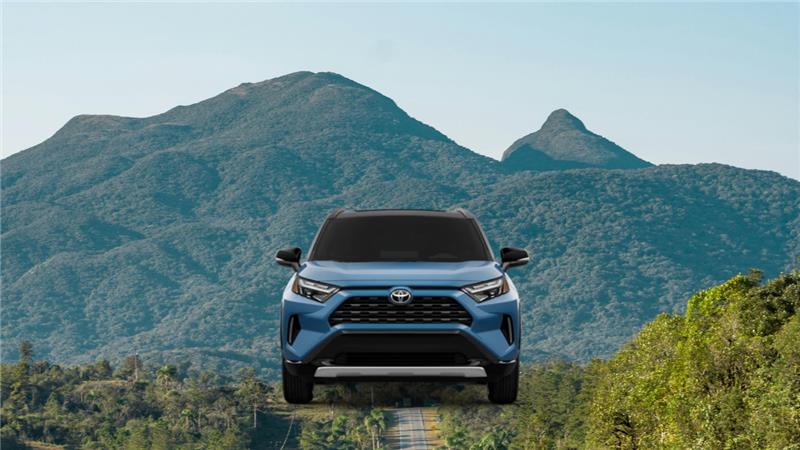
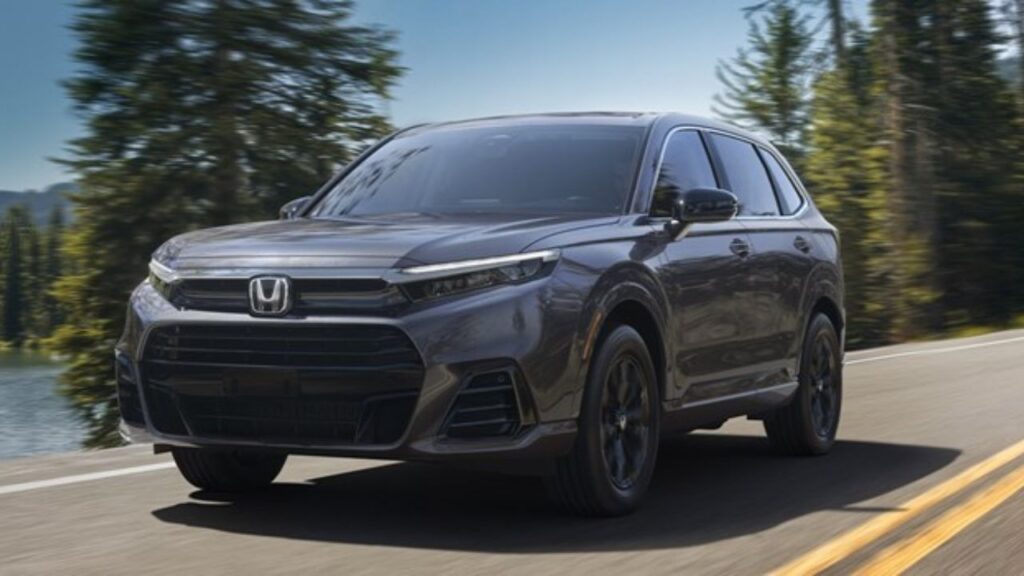
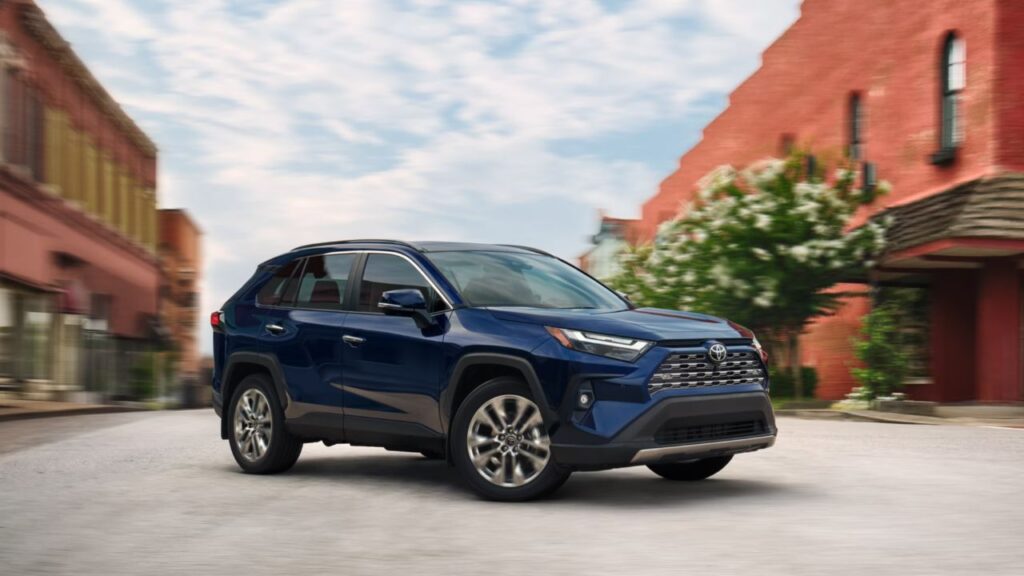
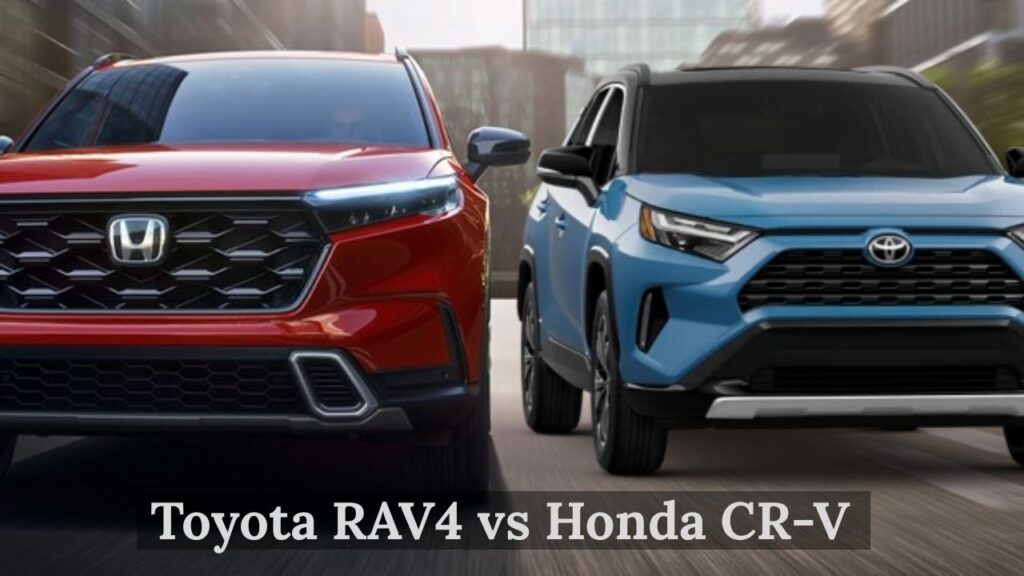
2025 Toyota RAV4 and Honda CR-V parked side by side, front angle view, comparing SUV designs

These two exciting models of SUVs have come with outstanding features and an impressive look from exterior to interior. Toyota RAV4 vs Honda CR-V offer a powerful performance at nearly the same price. Both SUVs are a defined segment of practicality, reliability and fuel efficiency. They both offer multiple variants for the buyers to assess the full potential of automotive engineering.

Deciding the vehicle which aligns with your priorities is hard but these two titans SUVs are offering an impressive performance. They offer more advanced features and powerful driving experience with their hybrid models, so dive deep into their features before buying one.

Both vehicles are delivering more about fine-tuning rather than big overhauls. The RAV4 is focusing on substantial interior and tech upgrades where it falls behind the rivals. Now buyers can have modern and premium experience as it provides tech and updated interior. Honda CR-V had already launched a redesign model in 2023 but it is giving a refinement in 2025 with a spacious and comfortable interior.

Read More:  How to Protеct Car from Sun? Simplе Tricks to Bеat thе Hеat

Performance and Engine

The 2025 Toyota RAV4 and Honda CR-V comes with both diesel and hybrid engines that deliver powerful performance.

A 2.5-litre engine of 2025 Toyota RAV4 offers a powerful speed of 203 hp and 8-speed automatic transmission delivers outstanding performance on the road. The. RAV4 hybrid offers 2.5-litre engine with electric motors to produce a combined 219 horsepower. The RAV4 prime model comes with  an impressive combined 302 horsepower for robust speedy performance. It becomes more attractive than other variants. 

Close-up of the 2025 Toyota RAV4 2.5L engine under the hood

Image credit: Toyota

A 1.5-litre turbo engine of 2025 Honda CR-V delivers 190 horsepower and 179 lb-ft of torque. It has an impressive engine and turbo drivetrain to give you a better experience on the road. Honda’s hybrid system produces 204 horsepower which make it more reliable and well-functioned to deliver a seamless experience. 

Fuel Economy

Gasoline Models: The RAV4’s base model delivered an estimated EPA of 27 city / 35 highways MPG. The CR-V comes with EPA-estimated 28 city / 34 highway MPG. so it shows that CR-V is ideal for city driving. 

MPG comparison chart for 2025 Toyota RAV4 and Honda CR-V gasoline models

Image credit: Automobiles Honda

Hybrid Models: The RAV4 Hybrid model gets 41 city / 38 highways MPG with its EPA-estimated. The CR-V Hybrid also has an impressive mileage of EPA-estimated 40 city / 34 highway for its AWD model. 

Both deliver outstanding fuel efficient models. The RAV4 prime ability to drive on pure electricity for a long distance is a unique approach.

Interior and Technology

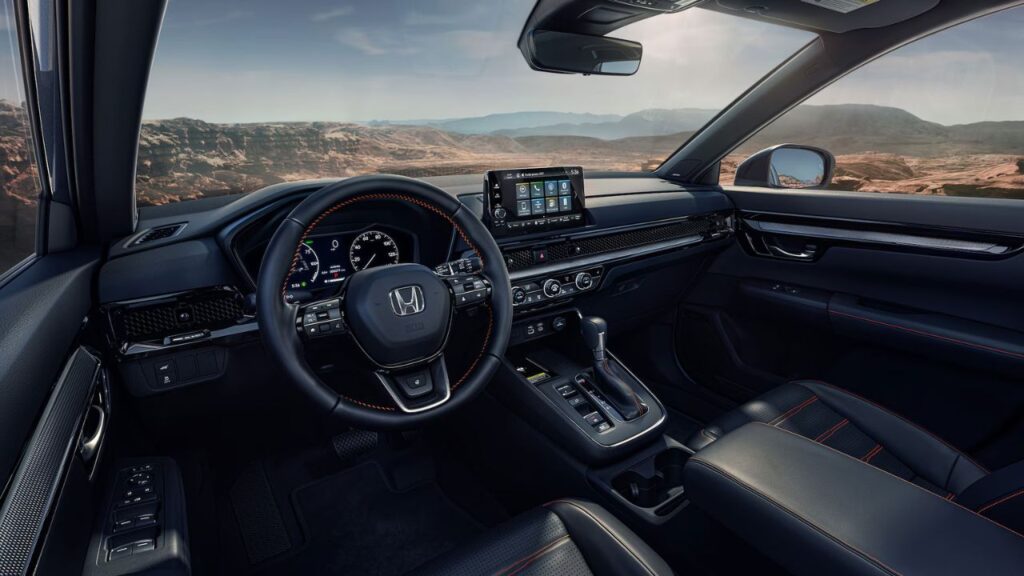
The Honda CR-V is defined with its modern and minimalist interior design for years. It offers 41 inches space for its rear-seat passengers while RAV4’s has slightly less space of 37.8 inches. The same difference with their cargo spaces, CR-V has 76 cubic feet with folded and RAV4 has 69 cubic feet with folded seats.

Spacious rear seating of 2025 Honda CR-V with legroom

Image credit: Automobiles Honda

Both offer advanced functions and larger infotainment systems. Wireless connectivity across multiple devices and a high quality sound system which makes your journey fun.

Safety and Features 

The RAV4 comes with driver-assistance features including pedestrian detection, alert for lane departure, and dynamic cruise control.

Driver using Toyota RAV4 with lane departure alert and adaptive cruise control

Image credit: Toyota

The CR-V is equipped with similar functions including emergency brake system, alert for lane departure, adaptive cruise control, and monitoring rear cross traffic on most trims.

Price of Toyota RAV4 and Honda CR-V

Both models’ pricing value is depending on the region and trim but you can check their approximate value in 2025.

Toyota RAV price is around $31,000 for the base model and it can go up around $39,305 for hybrid models.

Hybrid CR-V starting price is around $31,550 and it can go up to $36,450 for a hybrid model.

Feature 2025 Toyota RAV4 2025 Honda CR-V
Starting MSRP (Gasoline) ~$30,645 ~$31,550
Starting MSRP (Hybrid) ~$32,600 ~$34,650
Standard Engine 2.5L 4-Cylinder 1.5L Turbocharged 4-Cylinder
Horsepower (Gasoline) 203 hp 190 hp
Horsepower (Hybrid) 219 hp (Total System) 204 hp (Total System)
Torque (Gasoline) 184 lb-ft 179 lb-ft
Torque (Hybrid) 149 lb-ft (engine) + 89 lb-ft (electric) 247 lb-ft (electric motor)
Transmission 8-Speed Automatic Continuously Variable Transmission (CVT)
Fuel Economy (Gasoline FWD) 27 city / 35 hwy MPG 28 city / 34 hwy MPG
Fuel Economy (Hybrid AWD) 41 city / 38 hwy MPG 40 city / 34 hwy MPG
Drivetrain FWD / AWD (Gas), AWD (Hybrid) FWD / AWD (Gas and Hybrid)
Max. Cargo Space 69.8 cu-ft 76.5 cu-ft
Max. Cargo (Behind Rear Seat) 37.6 cu-ft 39.3 cu-ft
Rear Legroom 37.8 inches 41.0 inches
Standard Infotainment Screen 8-inch (Gas), 10.5-inch (Hybrid/select trims) 7-inch
Available Infotainment Screen 10.5-inch or larger 9-inch
Standard Safety Suite Toyota Safety Sense 3.0 Honda Sensing
Notable Features RAV4 Prime (PHEV), Larger hybrid display, JBL Audio (optional) More rear space, refined hybrid, Bose Audio (optional)
Max. Towing Capacity 1,500 lbs (Gas), 1,750 lbs (Hybrid) 1,500 lbs (Gas), 1,000 lbs (Hybrid)

Conclusion

Both cars are offering incredible features with comfortable interior spaces, making an exceptional compact SUVs that holds a great value. Toyota RAV4 vs Honda CR-V is not a debate but your journey partner, so choose which you prefer the most. The best way to decide is to take a test drive before buying it.