0

Ramesh Babu Car Collection: India’s Biggest Luxury Rental Garage

Ramesh Babu Car Collection

South India boasts many luxury car collections, but what makes Ramesh Babu Car Collection so unique is its size and organization. It is common to get such a personal impression of this collection, but in reality, the almost 400 vehicles strong fleet is actually run under the company Ramesh Tours and Travels, offering the personal luxury vehicles for commercial rentals. 

Range spans from a Maruti Omni (practical) to the Rolls-Royce Ghost and Mercedes-Benz Maybach S600, that is some show of sophistication in high-end asset management and high-end asset rental management, one suspects. 

Rolls-Royce Ghost Series I and II

The Rolls-Royce Ghost is the flagship of the fleet. The first purchase which dates back to 2011 for the Ghost at around ₹3 crore, it was the collection’s debut in the most ultra-luxury motoring category. Newer Ghost variants in the fleet currently cost around ₹7–8 crore, depending on the variant of customization.

Rolls-Royce Ghost Series I and II

With a 6.6L V12 twin-turbo engine, the Ghost is all about effortless, smooth power, with the majority of its torque available at low engine speeds. Its sophisticated air suspension and electronically controlled chassis guarantee a fantastically smooth ride.

Technical Specification Value/Detail
Engine Code N74B66 V12-T7
Displacement 6,592 cc
Maximum Power 563 hp @ 5,250 rpm
Peak Torque 780 Nm 
Transmission 8-speed ZF 8HP90 automatic
Acceleration  4.8 seconds (0-100km)
Top Speed 250 km/h (electronically limited)

Inside, the Ghost combines bespoke luxury with contemporary technology — including coach doors, premium full-grain leather, book-matched wood veneers, built-in umbrellas and extensive sound insulation. The result is a Zen, hushed space that radiates warmth and luxury, especially for the upper-echelon renters. 

Mercedes-Maybach S600 — German Luxury

Tech futurism isn’t previously on display in a vision of luxury in the Mercedes-Maybach S600. Purchased for about ₹2.7 crore, it is a preferred choice among corporate honchos and tech entrepreneurs to the Rolls-Royce Ghost.

Mercedes-Maybach S600

Its 6.0L V12 Biturbo engine delivers the kind of smooth, silent performance that Magic Body Control, scanning the road ahead, easily anticipates and cushions bumps.

Metric Specification
Engine Type 6.0 L V12 Biturbo
Power Output 530 hp
Maximum Torque 830 Nm
Transmission 7G-TRONIC Plus 7-speed automatic
Fuel Capacity 80 Liters
Top Speed 250 km/h

The S600 even features a private-jet-like rear cabin with reclining executive seats that offer massage and ventilation functions. Premium amenities include Agarwood fragrance, a 24-speaker Burmester 3D sound system, rear-seat voice amplification, and dual 12.3-inch infotainment screens with a luxury business console. 

High-Performance Off-Road Luxury: The Mercedes-Benz G-Wagen

The space also includes the Mercedes-Benz G400d and G350d, the earliest G-Wagens in India to be operated as commercial taxis. Based on the robust ladder-frame chassis, the G400d Adventure Edition is equipped with the state-of-the-art OM656 inline-six diesel engine.

Inside, the rugged off-road vehicle features Nappa leather, three-zone climate control and a digital display board with ambient lighting, outfitting the S-Class luxury with military-grade toughness. Approximately ₹5,000 per hour is the cost to rent a G-Wagen, perfect for those clients looking for power, prestige and comfort in any terrain. 

Feature G400d Specification
Engine 2,925 cc Inline-6 Diesel
Max Power 326 hp @ 3,600 rpm
Max Torque 700 Nm 
Drivetrain AWD with three locking differentials
Ground Clearance 241 mm
Acceleration 6.4 seconds

Benz S-Class and E-Class

The garage turns over a sizable quantity of Mercedes-Benz E-Class and S-Class models as the staples of its executive level, catering largely to corporate clients and long-term VIP reservations. 

Benz S-Class and E-Class

The newest models are three Mercedes-Benz E-Class LWB 220d sedans in High-Tech Silver that come with S-Class-like rear-seat space. Significantly, a 2004 E-Class signified the garage’s turn from economy car rentals to luxury offerings.

Component E 220d LWB Details
Engine 2.0 L 4-cylinder Diesel
Power 192 hp
Torque 400 Nm
Transmission 9G-TRONIC 9-speed automatic
Price ₹72.8 lakh (ex-showroom)
Interior Black leather with wood and aluminum trim

The fleet of Mercedes-Benz S-Class (W221 to W223) amounts to the finest in luxury whose price ranged from ₹1.5–2.5 crore which includes extremely high-tech features such as rear-axle steering and active air suspension for a most comfortable ride. 

The British Contingent: Land Rover and Jaguar

The garage includes a solid collection of British luxury sport-utility vehicles (SUVs) and sedans, combining traditional British sophistication with contemporary performance.

Land Rover and Jaguar

Among the critical additions is our Land Rover Defender 130 as a commercial taxi with a maximum occupant of eight passengers and the pick for its road boldness and group-carrying capability. With the Range Rover Vogue LWB priced at approximately ₹ 3.2 crore delivering a potent diesel powertrain and the family personal garage also boasts the ultra-exotic Range Rover SV priced at ₹5.4 crore that brings bespoke design, premium audio, and paint options.

Feature Defender 130 Specification
Variant D300 HSE
Engine 3.0 L Inline-6 Diesel with Mild Hybrid
Power/Torque 296 hp / 600 Nm
Exterior Color Fuji White with Black Contrast Roof
Interior Black and Tan leather
Rental Rate ₹3,000 per hour

The Jaguar XJ L is a stylish rival to German sedans and achieves better agility thanks to a lightweight aluminum construction, classic British luxury, and prices ranging from ₹1 – 1.8 crore. 

BMW i7 and Mercedes EQS

The garage has grown into green luxury with top-tier electric sedans, complying with metro regulations and providing ultra-quiet ride service.

Metric BMW i7 xDrive M70
Battery Capacity 101.7 kWh
Max Power 650 hp
Max Torque 1,015 Nm
Range (WLTP) 560 – 625 km
Interior Highlight 31.3-inch 8K Theatre Screen

The BMW i7 in eDrive50 and M70 variants is packed with ultra-luxury additions, including Executive Lounge Rear Seating and the immersive Sky Lounge panoramic roof. The Mercedes-Benz EQS 580 turns heads with more than just its eye-popping 56-inch Hyperscreen; it also packs advanced rear-axle steering, which makes this sizable electric sedan deceptively nimble and an absolute breeze to guide through city streets. 

Feature EQS 580 Specification
Battery 107.8 kWh
Claimed Range 857 km (ARAI)
Performance 544 hp / 858 Nm
Charging 200 kW DC (0-80% in 31 mins)

Read More:-  The Ultimate Guide to the Best Compact SUVs in 2026: Drive Smart, Live Better

High-Capacity Luxury: The MPV Fleet

A majority of the 400-strong fleet is comprised of luxury MPVs, catering to corporate groups, families and celebrity entourages.

Toyota Vellfire

The top-of-the-line MPV, the Toyota Vellfire Executive Lounge, costs around between ₹1.2 to 1.5 crore and comes with ultra-comfortable lounge seats in the middle row as well as hybrid option. For around ₹3,000 an hour, it is a top pick for celebrities on the go.

Technical Detail Toyota Vellfire Specs
Engine 2.5 L Petrol Hybrid
Combined Power 142 hp (Engine) + Electric Motors
Seating 7-seater with 2nd-row reclining ottomans
Fuel Efficiency 19.28 km/l

Mercedes-Benz V-Class and Viano

A fleet of Mercedes-Benz V-Class and Viano also ensures that you can enjoy a true mobile office experience with swivel seats and tables – ideal for luxury business jaunts. 

Feature Category V-Class (Current) Viano (Previous Gen)
Engine Options 2.0L Diesel (1950cc), up to 161 hp 3.0L V6 Diesel, 214 hp​
Transmission 9G-TRONIC 9-speed auto 7G-TRONIC 7-speed autol
Seating Capacity 6-8 seats, flexible configs 6-8 seats, modular layout
Safety Features Active Brake Assist, Blind Spot Assist​ ESP, airbags, basic ADAS
Infotainment MBUX 10.25″ touchscreen, Apple CarPlay COMAND system, smaller screen

Conclusion

Ramesh Babu Car Collection is not just a show of riches- it is a well orchestrated luxury mobility solution. The combination of ultra-luxury flagships like the Rolls-Royce Ghost and the Mercedes Maybach S600, as well as executive sedans, rugged off-roaders, electric vehicles, and high-capacity multi-purpose vehicles (MPVs), the fleet raises the bar for premium car rental services in India. 

Bipin Sharma

Bipin Sharma is a seasoned automotive content writer with over 10 years of hands-on experience in the world of cars. From the latest car news and reviews to in-depth maintenance tips and expert buying guides, Bipin covers everything that drives the automotive world. Writing about cars isn’t just his profession — it’s his passion. His deep industry knowledge and love for automobiles fuel every blog he creates, helping readers make informed decisions and stay updated on the fast-evolving auto landscape.

Leave a Reply

Your email address will not be published. Required fields are marked *

0

Tata Nexon EV vs MG ZS EV: Choose the Electric SUV That Fits Your Lifestyle

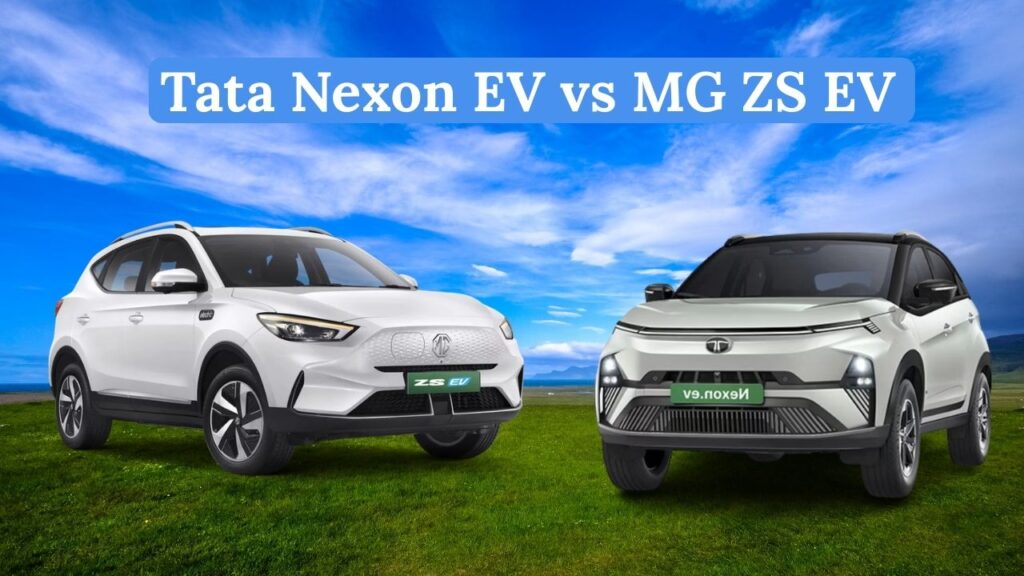
Tata Nexon EV vs MG ZS EV

If you’re considering an electric SUV this decision can be hard to make and exciting at the time. Do you opt for maximum value and ease on the budget, or do you splurge a little for a modicum of premium comfort, tech and punch? That’s where this comparison Tata Nexon EV vs MG ZS EV has a clear interesting factor.

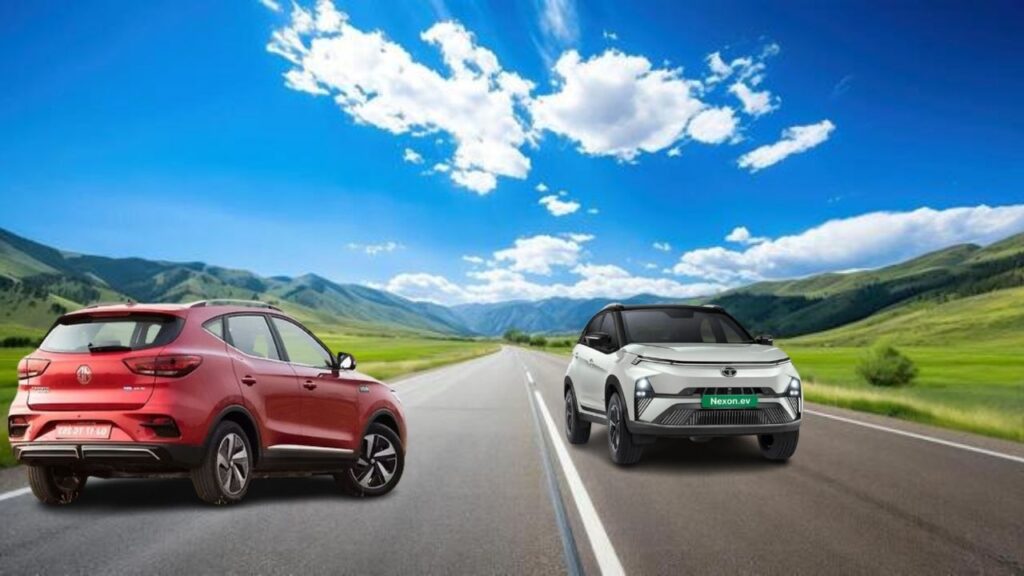
Tata Nexon EV vs MG ZS EV are two of India’s best electric vehicle contenders, however, they are dual solutions for very different kinds of buyers. One is about intelligent functionality and mass market access, the other is about refinement, power and high-end aspirations. Let’s take a real, no BS look at them and help you decide which one really fits your life. 

Pricing: The Accessibility Factor

This is where the entire equation changes. The Tata Nexon EV starts at a very affordable ₹12.49 lakh (ex-showroom) for the Creative Plus Medium Range variant, making it one of the cheapest premium electric SUVs in the country. Even the fully loaded Empowered Plus A 45 Dark Edition tops out at ₹17.49 lakh, and for what it is, that doesn’t seem too bad at all.

The Accessibility Factor

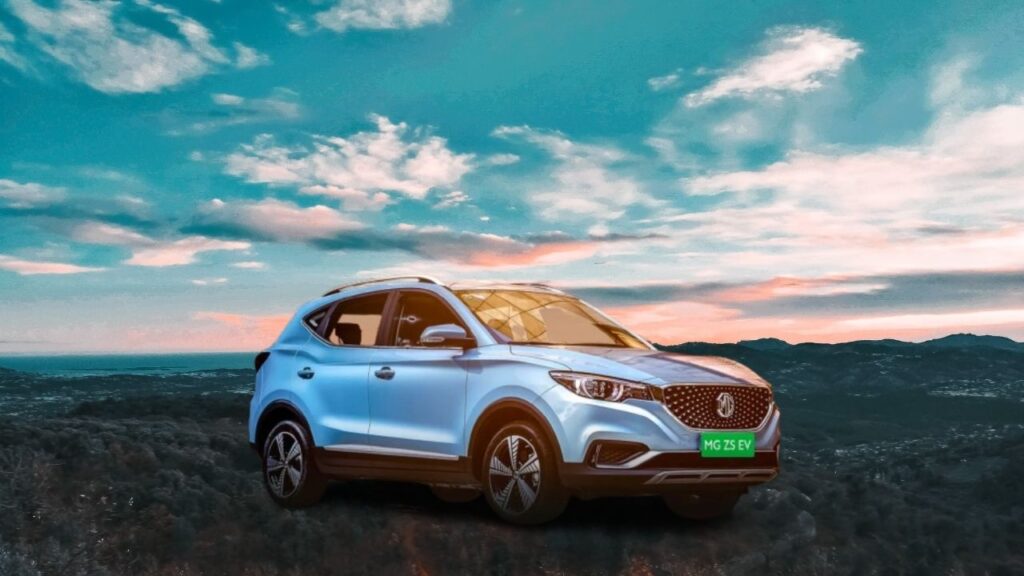
In contrast, the MG ZS EV is more of a premium offering. Prices begin from ₹17.99 lakh for the Executive variant and go up as high as ₹20.50 lakh for the Essence variant. That’s a big jump, roughly a difference of ₹5.5 lakh already at the base level. And honestly, that difference in price could be all it takes to sway thrifty customers who want to squeeze the most value for their money, but aren’t looking to go too far.  

Battery & Range: Two Different Philosophies

Tata provides a pair of battery choices for its cars: a 30 kWh Medium Range (MR) pack, whose range has been certified by ARAI as 325 km and a 45 kWh Long Range (LR) variant that offers a range of 489 km. The MR models pack a 127 bhp motor while the LR versions offer more power with a 143 bhp motor. 

Two Different Philosophies

MG adopts a one-size-fits-all solution, with a 50.3 kWh prismatic cell battery offering 461 km of range and 174.33 bhp that way more power than even the Nexon EV’s top trim. For the highway buffs, the ZS EV’s extra grunt and uniform range across all variants is an eye catcher. 

Variant Breakdown: Choices vs. Simplicity

Brand Trim/Variant Price (₹ Lakh, ex-showroom) Key Features
Tata Curvv EV Creative Plus MR 12.49 Smart digital DRLs, LED headlamps, 6 airbags, 17.78 cm touchscreen
Fearless (range) 13.29 – 14.99 26.03 cm cinematic display, wireless Android Auto/Apple CarPlay, 16-inch alloys
Empowered (range) 14.79 – 17.49 360° camera, panoramic sunroof, ventilated seats, JBL sound, ADAS Level 2 (on Empowered Plus A)
MG Executive 17.99 50.3 kWh battery, Smart featuring technology with good interior
Excite Pro 18.50 (Builds on Executive; specifics not detailed)
100 Year Edition 19.50 (Special edition; builds on lower trims)
Exclusive Plus 19.50 360° cameras, leather seats, 6-way power driver seat, wireless charging
Essence 20.50 Everything for safety in ADAS 2

Connecting Experience with Great Features

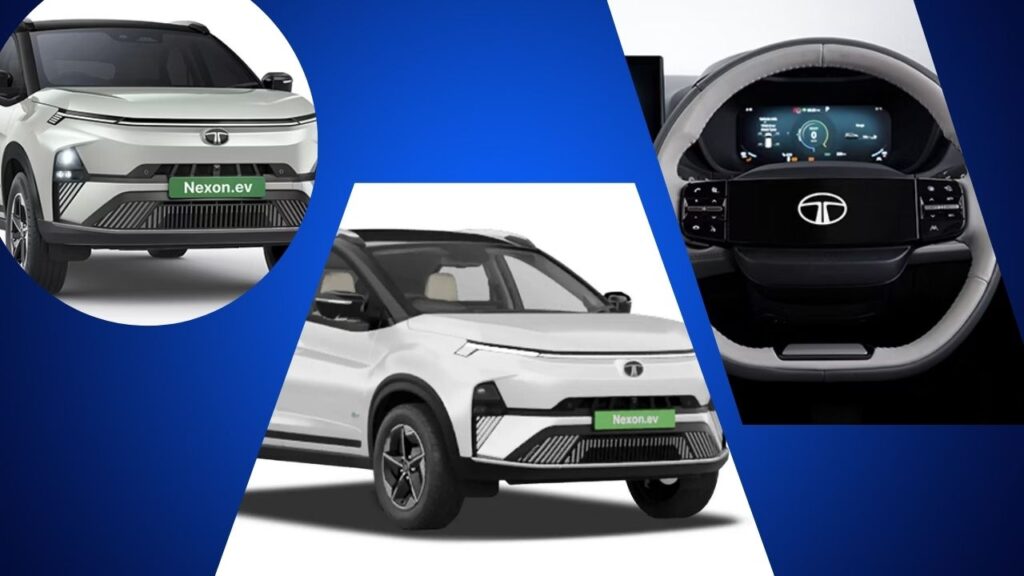
Tata Nexon EV vs MG ZS EV have tech to talk up. Tata Arcade.ev suite of applications delivers OTT streaming, games and navigation to the 31.24 cm touchscreen on higher variants. Special features include Vehicle-to-Load (V2L) and Vehicle-to-Vehicle (V2V) charging – run your home appliances or aid another EV owner. The Red Dark Edition also features exclusive carbon black exteriors with red-themed interiors for ₹17.19L–₹17.49L.

Connecting Experience with Great Features

MG follows up with i-SMART 2.0 with 75+ connected features. The dual paned panoramic sky roof, JBL audio(DLR fitment) and digital Bluetooth key are the noticeable additions. What differentiates MG is the uniformity across the board — the 50.3 kWh battery and 461 km range are standard on all variants, while Tata’s lowest rung buyers must make do with 325 km. 

Top Safety

Tata Nexon EV vs MG ZS EV makers focus on safety. The Nexon EV also has 5-star Bharat NCAP ratings, 6 airbags as standard across variants, ESP with i-VBAC, and ADAS in the top trims .MG matches with 6 airbags, ABS+EBD and a suite of advanced MG Pilot driver aids even includes lane departure warning and blind-spot detection on higher variants. 

Read More:-  2026 Isuzu V-Cross Launched at ₹25.50 Lakh, 4×2 Trims Discontinued

Conclusion

Go for the Tata Nexon EV if content with the best electric mobility bang for your buck. At ₹12.49L, it’s almost ₹5.5L cheaper than MG’s threshold, and the variety of variants means you can purchase just what you need. The 45 kWh Long Range variant at ₹13.99L (Creative 45) has a range of 489 km — a clear winner against MG’s 461 km — for ₹4L lesser than the ZS EV Executive.

Choose the MG ZS EV if the performance and premium feel matter to you. The 174 bhp power output smashes Tata’s 143 bhp, and the uniform 50.3 kWh battery means you now have range anxiety irrespective of variant. ADAS Level 2 suite on Essence variants is said to be more feature-rich than Tata’s variant.

Nexon EV makes electric mobility a mass market product; the ZS EV pleasures those with more money to spend on continuous refinement. Tata Nexon EV vs MG ZS EV are the face of India’s EV revolution – just at different price-points. 

0

Maruti e-Vitara: Launch expected in December 2025

Maruti e-Vitara

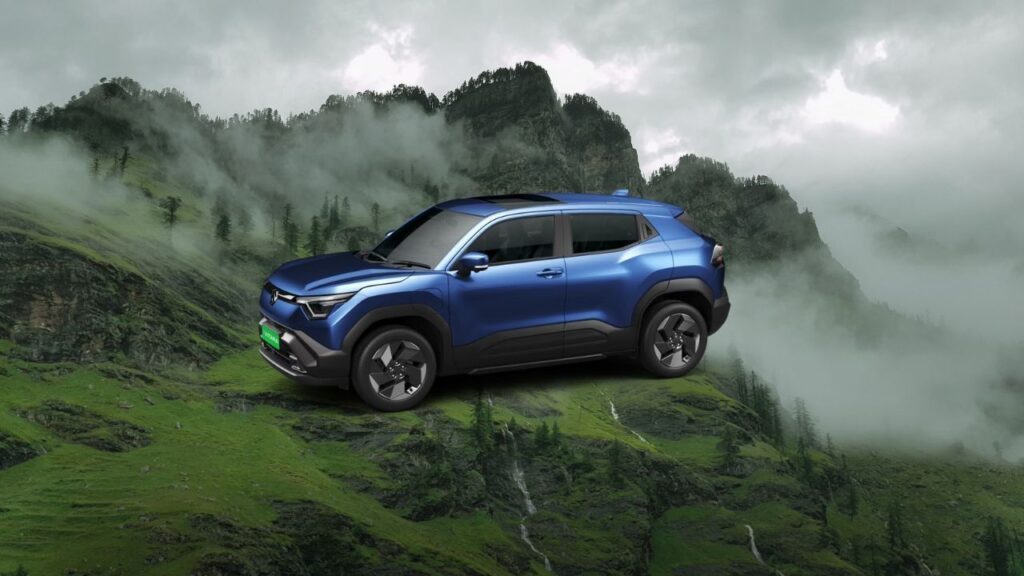
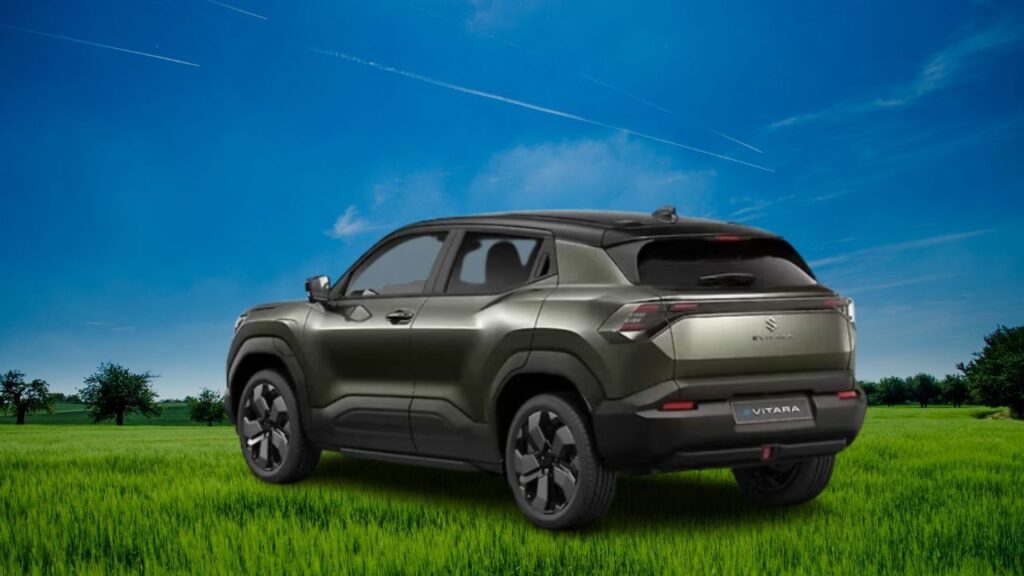
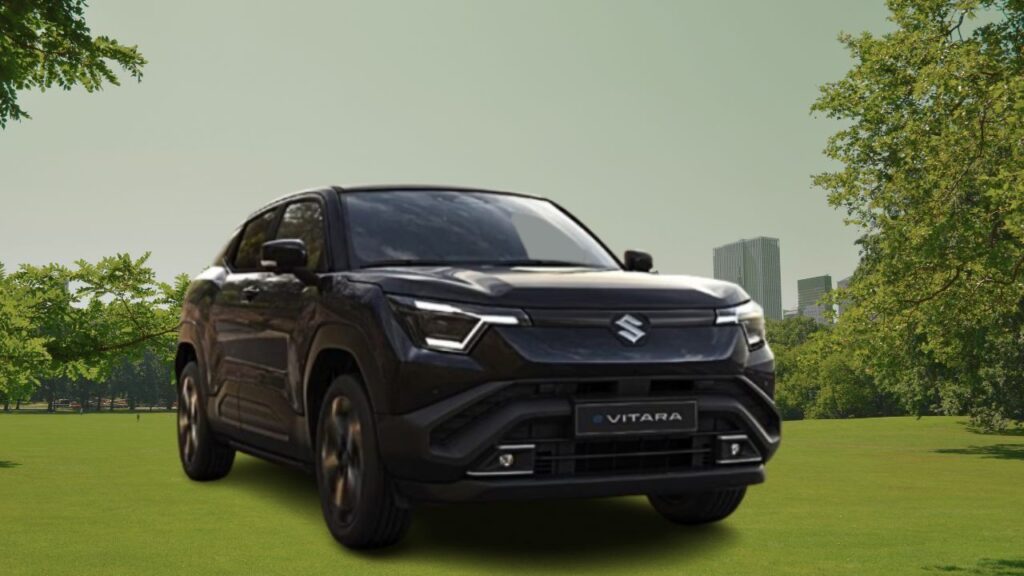
India’s EV revolution is about to be pushed into high gear with the launch of Maruti Suzuki’s first electric SUV — the Maruti e-Vitara, anticipated to arrive by December 2025. The e-Vitara will bring Maruti’s legendary reliability and next-generation electric technology as the country’s most trusted carmaker makes its EV debut. Built on the all-new Heartect-e platform developed jointly with Toyota, this SUV delivers the perfect balance of performance, efficiency, and safety — tailor-made for Indian roads and global aspirations. 

With a distinctly futuristic appearance and strong dual battery options promising a range of up to 500 km, the e-Vitara is intended to offer everything Indian buyers have been asking for from an electric SUV — long range, fast charging, advanced features, and Maruti’s reassurance. With aggressive styling, luxurious interiors and industry-first Level 2 ADAS safety technology, this SUV may transform the mid-size EV market. 

Built on a New Platform for Excellence

The e-Vitara is also based on the new Heartect-e platform by Maruti. This setup is ideal for electric cars. Toyota was one of the creators. The design enhances performance, reduces energy consumption and places the batteries just right. More than half of the body is made from high-strength high-tensile steel for enhanced rigidity and safety. 

Battery Options and Impressive Range

Maruti offers the e-Vitara with two battery options to cater to different needs of the buyers. 

The 49 kWh is the basic pack. It has an electric motor at the front axle. That engine produces 142 bhp and 192.5 Nm of torque. The car goes from 0 to 100 kmph in around 9.6 seconds. 

Maruti e-Vitara Battery Options and Impressive Range

The 61 kWh pack produces 172 bhp. It retains the same 192.5 Nm of torque. This iteration does 0-100 kmph in 8.7 seconds. Most importantly, it gives you a range of over 500 km on a single charge, as per MIDC tests. 

Both battery packs use advanced Lithium Iron-Phosphate (LFP) blade cell technology supplied by BYD.

Charging Convenience

The e-Vitara supports AC and DC fast charge modes. A 61 kWh battery is recharged from 10 to 80 percent in just 45 minutes by a DC fast charger. A 7 kW AC charger takes around 9 hours for a full top up at home (10-100%). An 11 kW reduces that to about 5.5 hours. 

Maruti has launched an end-to-end charging ecosystem – ‘e for me’ – that comprises smart home chargers with remote access and plug-and-play DC fast chargers at NEXA outlets across India. 

Bold and Futuristic Design

The e-Vitara reflects Maruti’s “Crafted Futurism” stance in its bold design and seamless airflow characteristics. It measures 4,275 mm in length, 1,800 mm in width, and 1,640 mm in height, and is equipped with a 2,700 mm wheelbase, making it one of the maximum in the mid-size electric SUV category. 

Maruti e-Vitara Bold and Futuristic Design

Outside there are 18-inch air-flow formed alloy wheels, cool tri-slash LED daytime running light, sharp LED projector headlights, and a sleek front end with shutters that open or close depending on how you are driving. The charging port is located on the front left fender for easy access. 

Premium Interior and Advanced Features

Just step inside and you’ll be greeted by a neat dual-screen setup at the front. It sports a 10.1-inch touchscreen for infotainment along with a 10.25-inch digital dash cluster. The infotainment is connected wirelessly with Apple CarPlay and Android Auto. Music enthusiasts will appreciate the premium Infinity by Harman sound system. 

On the inside, the cabin shakes a chic black-and-tan color scheme. It has a stacked floating console and lights that change colors. You get cool air on front seats. Ten-way power-adjustable driver’s seat with memory function. Rear seats slide, tilt back and fold 60:40. Flat floors give you more room. A large sunroof allows fresh air in. 

Next-Generation Connectivity

The e-Vitara comes equipped with Next-Gen Suzuki Connect with 60+ smart features.Remote vehicle controls, live vehicle information, e‑Call with an SOS button, and full car monitoring via an easy-to-use mobile application.

Multiple Drive Modes for Every Situation

The e-Vitara provides the three drive modes: Eco, Normal and Sport. Choose one to suit your vibe behind the wheel. There’s a Snow mode, too for enhanced traction in inclement weather. Plus, the smart regen brakes mean you can drive one pedal. That extends your range and conserves energy. 

Read More:- Ford Capri II vs Toyota Celica vs Vauxhall HP Firenza: The Global Decade of Style

Industry-Leading Safety Features

The e-Vitara prioritises safety as Maruti’s first car to come with Level 2 ADAS technology. Its ADAS suite features over 15 functions including Adaptive Cruise Control, Lane Keep Assist, Lane Departure Warning, Adaptive High Beam System, Automatic Emergency Braking, Blind Spot Monitoring, Active Cornering Control, Multi-Collision Braking and Rear Cross-Traffic Alert. 

There are seven airbags in all versions of the e-Vitara as standard from the word go. That has a knee airbag for the driver. There’s also Electronic Stability Program, or ESP. Ventilated disc brakes at front and rear. There is an electronic parking brake (EPB) which also applies the brakes automatically. A Tyre Pressure Monitoring System monitors your tyres. The 360-degree camera works with parking sensors. And there is an Acoustic Vehicle Alerting System that warns pedestrians when you are travelling slowly. 

Variants and Expected Pricing

The e-Vitara is available in three variants: Delta, Zeta and Alpha. They all remain front-wheel drive. The Indian model doesn’t have the all-wheel-drive option you get overseas. Expected Pricing is between ₹17 lakh and ₹22.50 lakh ex-showroom, making it a rival of Tata Curvv EV, Hyundai Creta Electric, MG ZS EV, Mahindra BE 6, and VinFast VF 7. 

Made in India for the World

On 26 August 2025, Prime Minister Narendra Modi inaugurated the first e-Vitara unit from Maruti’s Hansalpur plant. It’s the first step towards production at its new home. Maruti had invested ₹21,000 crore in the facility. It can produce 7,50,000 units per annum.

Why the e-Vitara Stands Out

The Maruti e-Vitara has some real advantages. It begins with the rock-solid Maruti Suzuki brand, known for reliable cars, massive after-sales network and great value for money. Not to mention, it offers a real 500+ km range, which mitigates the top concern for people looking at EVs in India. And its reasonable price makes it accessible to more buyers than those flashy electric SUVs. 

With Level 2 ADAS and 7 airbags, the full safety package makes it one of the safest cars in its class. Premium features, roomy cab and cutting-edge technology mean it doesn’t skimp on comfort or convenience. 

Conclusion

The Maruti e-Vitara signifies a quantum leap for electric vehicles in India. This is the top automaker’s first EV. It combines leading EV technology a strong driving range with a comprehensive set of safety tools and the trusted build quality of Maruti. The release is December 2025. This vehicle will simplify EV ownership for the Indian people. It also shows India’s world-class car making capability. 

Families seeking greener travel options without compromising on space, useful tech, and worry-free driving will also find the Maruti e-Vitara a compelling choice. It combines a good driving range, fast charging, the best safety equipment, premium features and probably low running costs. This makes it a crucial electric car launch in India’s car industry. 

0

How to Buy a New Car in India – Step by Step Car Buying Guide

Buy a New Car in India

Whenever you are going to buy a car you can get confused because of the sheer volume of choices. Don’t let your excitement make your wallet empty, carefully check the prices of the car then calculate them by adding RTO charges, insurance add-ons, etc. that surely seems hard to buy a new car in India. You will feel the sudden joy of owning a new car and getting buried under a pile of paperwork and pressure tactics.

If you’re planning to Buy a New Car in India, you should know your budget for driving the car home so you don’t end up overpaying. You can’t just go and buy a car from your neighbourhood showroom, choosing the right body style and brand to fit specific lifestyle needs is also important. 

This Car Buying Guide will help you understand what you should look for before buying a new car for yourself or your family member.

Why Buying a New Car is Hard?

There are tons of choices that attract you first but you get confused and never able to choose one right car for you. The fear that you might regret later so you are going to ask your friends and family members. 

What’s the catch? Car makers are upgrading features and variants each year so your friend who knows about the car which launched last year, but doesn’t know the latest launch of another car with the same price. The value of a car depreciates after one year, but if you want the right one which helps you commute places without burning your fuel and cause you expensive maintenance then look closely on the Car Buying Guide.

Why You Can’t Trust Car Dealership

Sales staff have pressure enough that they want to sell off the models which maximize profit. They know inside details from invoice pricing to backend profit margins but there are platforms like CarDekho that calculate it for you.

Dealerships often disguise the real amount of a car and often try to shift the focus to the monthly payment which costs you more than the total price of the car. This is a tactic to disguise inflated interest rates or extended loan terms. 

Financial Structure is Rarely Straightforward 

One thing you must understand is that a car price is just an approx amount, when you end up in a showroom then there are other charges that add-on and increase its value. Buyers have to account for taxes, registration fees of a car, dealership documentation fees along with add-ons charges.

Read More:- Best Automatic Cars in India Under 10 Lakhs – Easy Driving Options

How to Buy a New Car in India With Complete Car Buying Guide 

Step 1: Decide Your Budget 

Most people start by falling in love with a car model and then trying to “make the budget work.” Flip that approach.

Calculate your other commitments like mobile EMI, house rent, school fees and saving goals. After you put them aside, what’s your monthly take-home income will decide which car you can afford. A safe rule of thumb is to keep your total car-related EMI under 15-20% of your monthly income. Just make sure that those 15% includes the insurance, maintenance, and fuel cost too.

Don’t depend on the ex-showroom price that you see in ads. Search for on-road price of the car or calculate them with your state, RTO registration, road tax, and insurance. Overall, these charges are different across India but likely it’s somewhere between ₹80,000 to over ₹2 lakh.

Step 2: Decide Between Petrol, Diesel, CNG, Hybrid, or Electric

Where you wanna drive your car and upfront cost is a factor to decide which variant is best for you. It also matters on what purpose you are buying a car for:

Petrol cars are good for those who drive less than 1,000-1,200 km a month which means you wanna drive in a city. Maintenance cost is lower but fuel expenses can be higher over time. While diesel cars are good for drivers who run on highways because it can give you better fuel efficiency only at higher usage. 

CNG cars are a strong choice for those who want to switch from petrol or diesel cars. CNG cars offer great fuel efficiency but boot space and access to CNG stations are still a major problem. Hybrid cars offer both— better fuel efficiency and no worries on charging access but they are expensive.

Electric vehicles are best for those who have charging access at their home. City commuters can buy EV for their daily use within a predictable range. But if you live outside metro cities then it is still an issue for charging.

There’s no single car that comes as the best fuel type, only the one that matches your actual driving pattern.

Step 3: Shortlist 3-4 Cars, Not 1

It’s easy to get attached to a particular car after seeing an advertisement but make a decision after you’ve driven it yourself. It’s totally a different experience once you’re behind the wheel. 

Take a three–four cars test drive within the same budget and segment. Then compare their features to decide which one fits you. If the roads are rough, check if the car offers enough ground clearance. If you are looking for a car for your family then boot space and rear-seat comfort matters.

If you prefer CNG or electric cars then the service network in your city must be wider. It’s also wise to consider resale value trends and independent safety ratings since these can have a significant impact on long-term satisfaction. 

Spend time reading real owner reviews, not just marketing brochures. Forums and YouTube long-term review videos often reveal issues that don’t show up in a 15-minute test drive.

Step 4: Take a Proper Test Drive

Many buyers take a decision right after a 5-minute spin around the showroom parking lot which is just a waste of time. Real test driving must be performed in everyday conditions like rough roads, and traffic jams.

It will let you know ride comfort and suspension quality. Try reverse parking as well to assess visibility, turning radius, and the effectiveness of parking sensors or cameras. Also check features, air conditioning and cabin. Give a few minutes to check the comfort from every seat. Since the person who drives isn’t always the only person who matters in that car.

Step 5: Compare On-Road Prices Across Dealerships

Compare offers from multiple dealerships is the easiest way to stop overpaying. Many buyers think that there is a fixed price on a car but dealership margin, discount, and monthly sales targets can all influence the final amount you pay. 

Check out 3–4 dealerships and collect written on-road quotations. Don’t trust on words, just research about the RTO charges, Insurance deals, Add-ons, Accessories and warranty. Then add to the Ex-showroom price to get the actual price of the car. 

This single step alone can save you anywhere from ₹10,000 to ₹50,000, especially toward the end of a sales quarter when dealers are more flexible on discounts.

Step 6: Decide How You’ll Pay — Cash, Loan, or Lease

The way you finance your car can also affect the total cost of the car, buying at once can eliminate interest expenses. In the case of a car loan, choose the best offer among two–three lenders. 

If you’re paying upfront, you skip a lot of paperwork and interest cost — but make sure you’re not draining your emergency savings to do it. Dealership financing is convenient but they aren’t always the most cost-effective option. 

A few things to check before signing any loan agreement:

  • Processing fees and foreclosure charges
  • Whether the interest rate is fixed or floating
  • Loan tenure (shorter tenure means higher EMI but lower total interest)
  • Down payment requirement (usually 10-20% of on-road price)

If you change cars frequently or want lower monthly outflow without ownership hassles, a car lease through your employer (if available) is worth exploring too.

Read More:- How Electric Cars Are Changing the Future of Transportation

Step 7: Choose the Right Insurance — Don’t Just Take What the Dealer Offers

Dealers often bundle insurance into the on-road price, and it’s rarely the cheapest option available. You’re free to buy insurance from any insurer, not just the one the dealer pushes.

Compare:

  • Comprehensive vs. third-party-only cover (comprehensive is strongly recommended for a new car)
  • Zero depreciation add-on (almost essential for the first 3-5 years)
  • If you live in a city where roads are getting floody then engine protection is useful for you. 
  • Engine protection cover can also be beneficial, especially in cities that frequently experience flooding or waterlogging 
  • Other features such as No Claim Bonus protection and Roadside assistance can take away the financial burden of unexpected repairs or emergency assistance.

Step 8: Understand the Paperwork Before You Sign

This is where most first-time buyers get rushed. Take your time and check:

  • Booking receipt – confirms variant, color, and price locked in
  • Sales invoice – should match the agreed on-road price exactly
  • RC (Registration Certificate) application – usually handled by the dealer, but confirm the timeline
  • Verify that the policy details, coverage, and Insured Declared Value (IDV) are correct and match what was promised. 

Take care of document verification by yourself and never sign incomplete or blank forms.

Step 9: Do a Thorough Pre-Delivery Inspection (PDI)

Check everything before the car officially becomes yours. A final check is always a smart move even if the dealer has completed an inspection. Examine exterior and interior of the car, look for paint, panel gaps, tyres manufacturing dates, read odometer, and all the inside features and sensors. 

Confirm that all promised items have been delivered including extra tyre, manual and toolkit that listed in the invoice. Any missing item, tell the dealer before confirming the delivery. Solve every issue before the paperwork is completed so there is no headache after you completely own the car.

Step 10: Register the Car and Get RTO Formalities Done

You must know what’s happening even if the dealer is handling all the RTO registration for you. So there are no surprises after delivery. 

  • Temporary registration is usually valid for 30 days
  • Permanent registration and the RC book typically follow within a few weeks
  • HSRP (High Security Registration Plate) is mandatory and should be fitted before or shortly after delivery
  • FASTag activation is required before you take the car on toll roads

Organizing and keeping physical copies of key records such as the invoice, insurance policy, registration documents is necessary when roadside checks happen or during insurance.

A Few Things People Often Overlook

  • Resale value matters even on day one. Some brands and colors tend to retain their value better. If you might sell within 3-5 years, it can help you recover more of your investment.
  • Maintenance cost over 5 years, It’s also important to look beyond the sticker price, determining the real cost of ownership. A cheaper car with expensive spare parts can cost more in the long run.
  • Festive season discounts Dealerships often offer their most attractive discounts during festive season (Navratri, Diwali, year-end) are often the best time to buy. 
  • GST and cess on cars in India are already baked into the ex-showroom price, so don’t expect any further reduction there — buyers can often secure better deals through dealer discounts, complimentary accessories.

Conclusion of How to Buy a New Car in India

When there are a lot of cars around you that capture your eyes, how to Buy a New Car in India is the question that gets stuck into your mind. Why is it so hard and a Car Buying Guide will help you understand which car is right for you to buy.

There are reasons such as your budget, finance, variant, and design that reflects your decision. So choose 3–4 cars and compare them to buy a car, who rushed through one of these steps because they got excited or got pressured by a sales pitch regret later.

Take your time, ask for everything in writing, and remember that the dealer’s job is to sell you a car — your job is to make sure it’s the right car, at the right price, with the right paperwork. Do that, and buying your new car in India can actually be the smooth, satisfying experience it’s supposed to be.

0

New 2026 Nissan Murano Review – Features, Design, Performance & Pricing

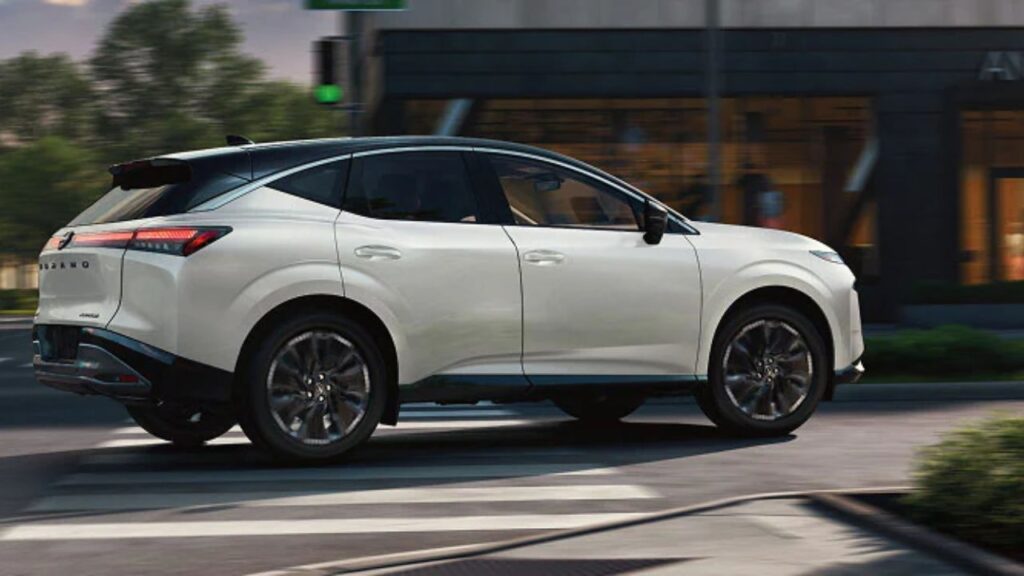
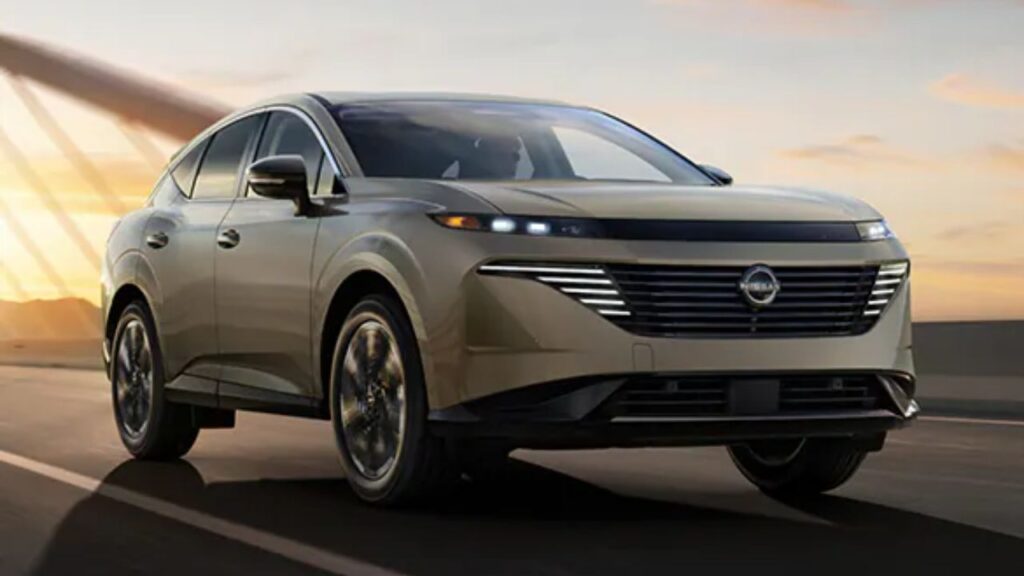
New 2026 Nissan Murano

The 2026 Nissan Murano stands out as one of the most competent mid-size crossovers available this year — sleek, modern and designed for families and daily commuters who want comfort without the astronomical luxury-brand price tag. 2026 Nissan Murano has also completely relooked with a radical new design, enhanced technology, a refined turbocharged powertrain and an upgraded interior that elevates it into near-luxury territory.  

With its enhanced dynamics and advanced safety features such as ProPILOT Assist 2.1, the 2026 Murano is built for those who want modern luxury in a familiar package that includes Nissan reliability. So, let’s take a look at what makes this axle-driven SUV a great pick for 2026 and how it compares in today’s overly crowded crossover segment. 

Design That Commands Attention

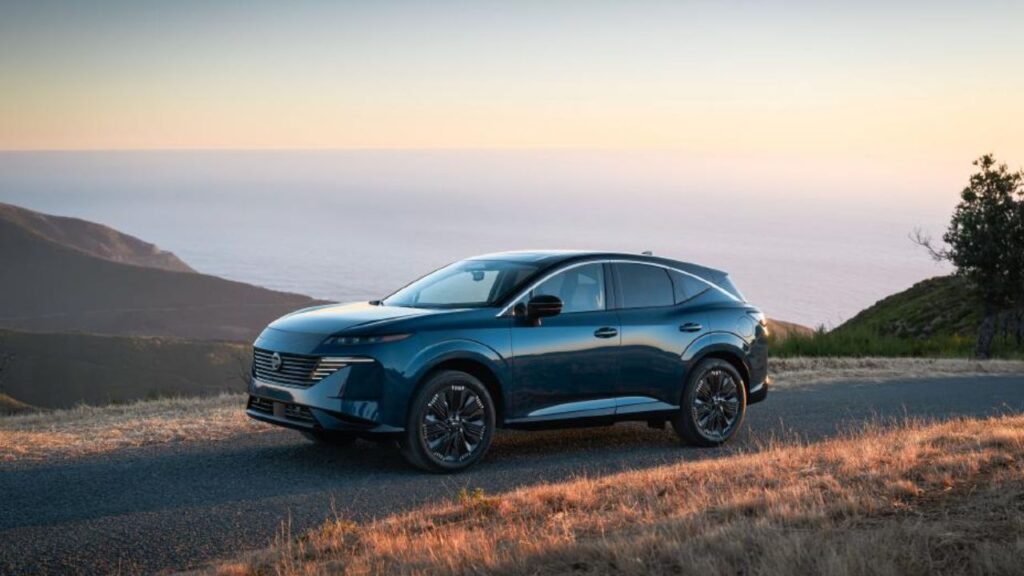
The 2026 Nissan Murano has a bold and upscale look that immediately draws attention. The design incorporates sporty and aerodynamic lines with super slim LED headlights and a unique full-width LED taillight bar that extends all the way to the rear. These modern additions give the Murano a high-end look that could fool you into thinking it costs a lot more. The vehicle rides on available 21-inch wheels that add a layer of sleekness to its contemporary look. With its 8.3-inch ground clearance, the Murano delivers a commanding road presence and the Murano also provides high levels of visibility for all day driving and parking. 

2026 Nissan Murano

2026 Nissan Murano | Image credit Nissanusa

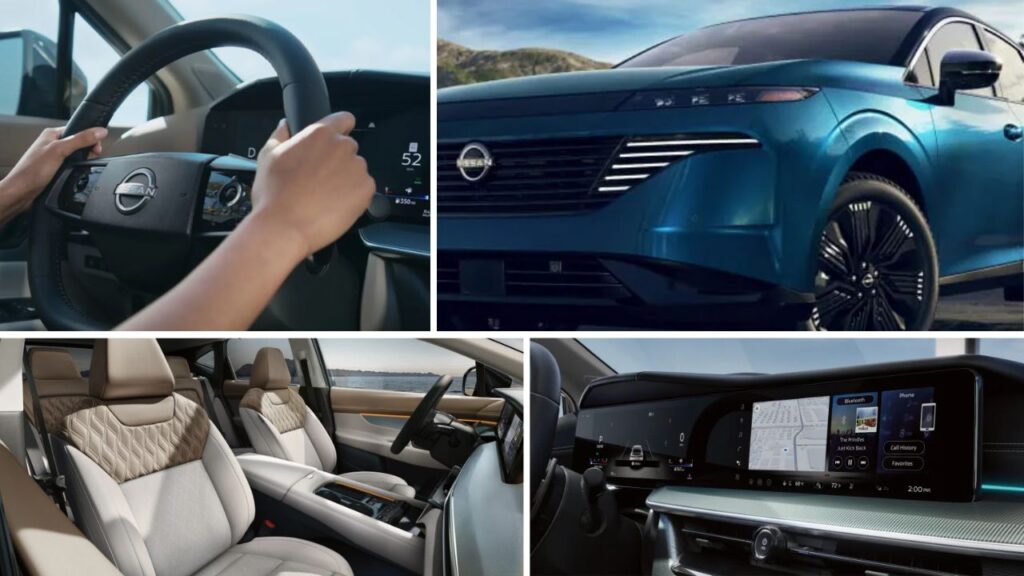
And the interior The cabin provides a spa-like environment with every detail thoughtfully considered. Nissan refers to it as the “zen” interior experience, which includes high-end materials, soft-touch surfaces and intuitive ergonomic design. The two 12.3-inch color screens, one as the instrument cluster and the other as a touchscreen for the infotainment system, form a modern, clean dashboard design. 

Up to 64 color options are available for ambient interior lighting, letting you tailor the cabin atmosphere to your mood. The (optional) Nissan’s famous Zero Gravity seats offer outstanding all-day comfort, with ventilated and massaging front seats available on upper trims that are more akin to the experience of a premium spa than sitting in a car seat. 

Read More :- Renault and Nissan Alliance Guide – History, Benefits & Future Vision

Powerful Performance Built for Comfort

Powering the 2026 Murano is Nissan’s 2.0-liter four-cylinder VC-Turbo engine that produces 241 horsepower and 260 lb-ft of torque. This engine is mated to an exceptional 9-speed automatic transmission that offers quick, controlled shifting that is as refined as it is powerful. All trims are fitted with the now standard Intelligent All-Wheel Drive, which offers better traction and stability in different weather conditions. 

2026 Nissan Murano Fuel Economy

2026 Nissan Murano Fuel Economy

The Murano is the fastest car with top speed of 120 mph and it takes you from 0 to 60 mph in an estimated 8.0 to 8.3 seconds. This isn’t the most powerful in the segment, but the emphasis is here on smooth, assured motivation rather than pure performance thrills. This new, refined nine-speed automatic replaces the previous model’s continuously variable transmission to give a more responsive and composed driving experience. 

EPA fuel-economy estimates are 21 city/27 highway/23 combined mpg. These figures put the Murano towards the mid-range in the mid-size luxury crossover segment, although Nissan has suggested a hybrid powertrain could be an option some time in the future. The 18.7-gallon fuel tank offers plenty of range for long road trips. A modest 1,500-pound towing capacity is good for a few small trailers and jet skis, but some competitors easily outpull it. 

Spacious Interior with Practical Cargo Solutions

The Murano offers 32.9 cubic feet of space behind the rear seats, which is plenty for bags of groceries, suitcases and sports equipment. the 60/40 split rear bench seats folded down, the capacity climbs up to 63.5 cu. ft. to transport bigger items such as furniture or camping gear.A power liftgate is standard to expedite loading and an upper-trim power, motion-activated liftgate brings real convenience. 

Spacious Interior inside of 2026 Nissan Murano

Spacious Interior inside of 2026 Nissan Murano | Image credit Nissanusa

Passenger room is just as impressive, with 44.3 inches of front legroom and 36.3 inches of legroom in the rear. The cabin is authentically roomy and calm, allowing long jaunts to be enjoyed by all passengers. Although the Murano is technically a five-passenger model, the copious spacing makes it feel much roomier than many rivals. 

Read More :- Discover the New Kia Telluride – Bold Design, Advanced Tech & Premium Comfort for 2025

Trim Levels: Finding Your Perfect Match

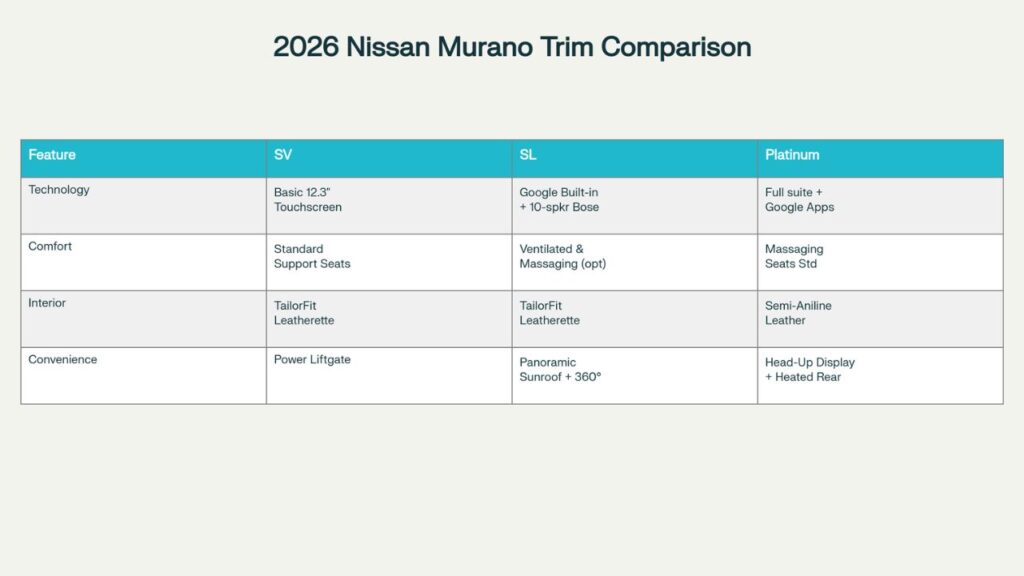
There are three well-equipped trim levels for the 2026 Murano: SV, SL, and Platinum. That makes for an easy decision — each price point really does add value, not gimmicks.

2026 Nissan Murano Trim Feature Comparison

2026 Nissan Murano Trim Feature Comparison

SV (Base) – From $41,670: The premise is astonishingly robust. It has a 12.3-inch touchscreen infotainment system featuring wireless Apple CarPlay and Android Auto, 20-inch black alloy wheels, dual-zone automatic climate control, a digital instrument cluster, and wireless smartphone charging. Power windows, locks and mirrors are standard, as is a solid infotainment system through NissanConnect. 

SL (Mid-Range) – From $46,760: Value, at its most debatable but quite apparent best You get Google Built-in for easy navigation and voice control, a high-end 10-speaker Bose audio system, a panoramic sunroof to bring that open-air feeling inside, a 360-degree Intelligent Around View Monitor to park with confidence, built-in Wi-Fi hot spot connectivity, and ventilated and massaging front seats (optional).

Platinum (Premium) – From $49,800: The high end is first-class luxury All the semi-aniline leather upholstery which actually feels premium, massaging front seats for more comfort than you deserve, a head-up display to ensure critical information remains in your line of sight, the rear seats heat up for passenger comfort, a hands-free power liftgate, and power-folding mirrors which make tight parking a little less difficult. 

Advanced Safety Technology That Protects Your Family

All 2026 Murano models are now equipped with Nissan Safety Shield 360, a robust driver-assistance system focused on keeping hazards out of your path. That system includes features such as automatic emergency braking with pedestrian detection, applying the brakes when an obstacle or person is detected in front of you, blind spot warning that notifies you of vehicles in your blind spot, and lane keeping assist to reduce the risk of unintended lane departures.​

Safety Technology That Protects Your Family

image credit: Nissanusa

The headline feature for 2026 is the optional ProPILOT Assist 2.1, which is only available on the Platinum trim and can be purchased in the Platinum Technology package. It is an advanced system that enables drivers to go hands-free on certain highways when conditions are right. Utilizing cameras, radar sensors, and HD mapping information, ProPILOT Assist 2.1 controls the steering, speed and braking, but keeps your eyes on the road. Lane Change Assist can even suggest passing and assist when passing slower vehicles ahead of you, making long highway drives much less tiring. 

Other safety enhancements include Invisible Hood View, which allows the driver greater visibility while parking in tight spaces, a built-in 360-degree exterior camera system, intelligent lane intervention and speed limit assist that notifies the driver of posted speed limits. If the driver is deemed distracted, the system will softly slow the vehicle to a stop, putting safety first with no compromises. 

Read More :-  New Tata Sierra 2025 – Price, Features, Launch Date, and Electric SUV Details

Connectivity and Entertainment for Modern Life

The Murano confidently steps into the modern day with two-key USB hubs for Apple CarPlay and Android Auto being part of the package. Google Built-in is available on SL and Platinum models allowing you to use native Google Maps navigation, Google Assistant voice control, and Google Duo video calling. The optional Bose premium audio system produces a warm, enveloping sound that makes listening to music an experience rather than just background noise.​

Connectivity and Entertainment for Modern Life

image credit: Nissanusa

Murano has also added a built-in Wi-Fi hot-spot capability so passengers can use it as a mobile office or entertainment center to stream, work or browse while stopped (or in traffic). Among the new features are Amazon Alexa integration and in-dash navigation for those who like their systems a little less mobile-device dependent. 

Conclusion

The 2026 Nissan Murano is for those who want a luxury-feeling SUV for less. Unless you’re interested in a straight-line performance car, like the Tesla Model 3 Performance, and care about the interiors, and want the newest and most advanced active safety features, this is your car. The Murano is a good choice for families who need that extra space, commuters who drive long distances, and anyone seeking a more serene driving experience than its competitors can provide.

The only possible downside is the limited towing capacity of 1,500 pounds (still enough to tow a small camper in some regions), but we welcome the Honda Passport’s greater capabilities option and also superior fuel economy (which could be improved further should Honda choose to offer a hybrid option). But for those whose priorities lie in comfort, style and overall practicality on a day-to-day basis, such shortcomings matter less than the car’s comprehensive refinement. 

0

Kia Carens CNG, Clavis CNG & Carnival Hybrid Pre-Bookings Open In India

Kia Carens CNG

Kia has opened pre-bookings for three new powertrain options in India — the Carnival Hybrid, Carens CNG and Carens Clavis CNG but none has an official price yet. The Carnival Hybrid pre-bookings create excitement among buyers because it brings electrification to Kia’s flagship MPV, while the two Carens variants finally offer a factory-fitted CNG setup instead of a dealer-installed kit. 

If you’ve been waiting for a factory-fitted CNG Kia or a hybrid alternative to the diesel Carnival, here’s what you’re actually signing up for before you hand over a booking amount.

Carnival Hybrid Pre-Bookings Are Open, But The Price Isn’t Announced

The Carnival Hybrid pre-bookings went live days after Kia showcased the model at its Inspiration Day event in early September 2026 — the same event where the new three-row Kia Sorento was unveiled. 

The Sorento launched on September 4 at Rs 27.99 lakh ex-showroom with diesel, hybrid and AWD options, and the Carnival Hybrid borrows the underlying idea: a strong-hybrid setup built around a 1.6-litre G1.6T turbo-petrol engine, paired here with a 6-speed automatic gearbox.

Carnival Hybrid

Kia is offering the hybrid only on the Carnival’s Limousine+ trim, which today is sold exclusively with a diesel engine at Rs 59.65 lakh ex-showroom. That number is the one to anchor your expectations to. The hybrid isn’t replacing the diesel — it’s slotting in alongside it as a premium alternative, expecting it to land above that Rs 59.65 lakh mark rather than undercut it. Kia hasn’t confirmed a figure yet.

What Changes Over The Diesel Limousine+ 

Design and Exterior

A 18-inch Crystal Cut dual-tone aero alloy wheels, Active Air Flaps for better aerodynamics, and a Virtual Engine Sound System that generates an audible warning when the Carnival is crawling on electric power alone. 

That last one isn’t a gimmick — strong hybrids can be silent enough at parking-lot speeds to genuinely surprise pedestrians, so the artificial sound is a real safety addition, not badge dressing. 

Interior Features & Functions

Inside, Kia has added a Smart Pure Air Purifier with an AQI readout, retractable height-adjustable seat-back tables with wireless charging built in, monotone ambient lighting, and leatherette-wrapped door trims. 

Everything that already worked on the Limousine+ carries over unchanged: dual 12.3-inch displays, three-zone climate control, a 12-speaker Bose system, eight airbags, Level 2 ADAS, and a 360-degree camera.

Kia Hybrid Discount Rate

Under India’s GST 2.0 structure, in effect since September 2025, hybrids don’t get the same tax break as pure EVs — only battery electric vehicles sit at the concessional 5% rate. A large hybrid like the Carnival, well over 4 metres long and running a 1.6-litre engine, falls into the same 40% GST slab as any other big diesel or petrol SUV in that size class. 

Whatever premium the Carnival Hybrid ends up carrying over the diesel Limousine+ will come entirely from Kia’s own component and engineering costs, not from any tax advantage passed on to buyers — worth knowing if you were assuming “hybrid” automatically means a lighter tax bill in India the way it does with EVs.

Kia Hybrid Rivals in The Market

The awkward part for anyone trying to cross-shop Carnival Hybrid against India’s other hybrid MPV. The Toyota Innova Hycross tops out around Rs 32.95 lakh ex-showroom for its fully loaded ZX(O) hybrid variant and returns an ARAI-claimed 23.24 kmpl. 

Kia Hybrid and Toyota Innova

The Carnival Hybrid will likely launch at close to double that price. These two aren’t really fighting for the same buyer — the Hycross is the practical, efficiency-first hybrid MPV; the Carnival Hybrid is Kia betting that a narrower slice of luxury-MPV buyers wants electrification without giving up the Limousine+ badge and its chauffeur-driven positioning. 

If you’re putting the two on a spreadsheet expecting a like-for-like fight, you’re comparing the wrong cars — the Carnival Hybrid’s real rival is arguably its own diesel sibling, not anything wearing a Toyota badge.

Read More 👉 Tata Nexon On-Road Price Lucknow — Best Compact SUV At This Price Point


Carens CNG And Clavis CNG Finally Give Kia A Factory-Fitted Option

The second half of Carnival Hybrid pre-bookings announcement matters more for volume, because it fixes something Kia has never offered in India. Every CNG Carens on the road today runs on a government-approved dealer-fitted kit sourced from Lovato — bolted on after the car leaves the factory, tuned around an engine that was never designed to run on gas. 

Kia Hybrid

The Carens CNG and Carens Clavis CNG change that by moving CNG integration onto the assembly line itself, which means the engine calibration, fuel delivery, and even the suspension tuning are built around dual-fuel operation from day one instead of retrofitted around it.

Power and Transmission Performance

Both use Kia’s G1.5 naturally aspirated 1.5-litre petrol engine, paired exclusively with a 6-speed manual gearbox — there’s no automatic CNG option at launch, so buyers who want a slushbox will have to stick with petrol or diesel. The tank is a 60-litre unit mounted under the boot floor, and Kia claims usable boot space still comes in around 116 litres, which will matter to anyone who has watched an aftermarket CNG kit swallow an entire trunk. 

Running on gas, the engine makes 93hp and 123Nm, down from 115hp and 144Nm on petrol. That drop is normal for factory CNG tuning, but it’s worth knowing going in if you’re used to how the regular Carens drives and expect the CNG version to feel identical under load.

Kia has also revised the suspension tuning and switched to 16-inch wheels with 16-inch disc brakes, specifically to handle the extra weight the tank and hardware add over the rear axle. Inside, there’s a dedicated CNG Fuel Change Switch and a 4.2-inch colour TFT instrument cluster that shows CNG Distance-to-Empty — a small thing, but a genuine upgrade if you’ve ever driven a retrofitted CNG car with no real idea how many kilometres of gas are left in the tank.

Trim availability is where the two models split. The standard Carens CNG is expected to be limited to the Premium trim, plus a dedicated M-Drive trim built for commercial and fleet buyers — cab operators, essentially. 

The Carens Clavis CNG, positioned as the more premium option, gets its own HTM trim for the same commercial use case, alongside CNG on regular passenger trims. If you’re buying for a fleet specifically, ask your dealer directly about what the M-Drive and HTM trims strip out, since fleet-spec variants often drop features you’d expect on a personal-use car.

Read More 👉 Hyundai Creta On-Road Price In Lucknow: Get Details Before Entering Into a Showroom

How Kia’s Numbers Stack Up Against Ertiga, XL6 And Rumion

Kia isn’t creating a new segment here — it’s entering one Maruti Suzuki has quietly dominated for years, with Toyota’s badge-engineered version riding along. 

Model Engine CNG Output Claimed Mileage Ex-showroom Price
Kia Carens CNG 1.5L NA petrol 93hp / 123Nm Not yet disclosed Not yet announced
Kia Carens Clavis CNG 1.5L NA petrol 93hp / 123Nm Not yet disclosed Not yet announced
Maruti Ertiga CNG 1.5L K15C petrol ~87hp / 121.5Nm 26.11 km/kg ~Rs 10.9–12 lakh
Maruti XL6 CNG 1.5L K15C petrol ~87hp / 121.5Nm 26.11–26.3 km/kg ~Rs 12.28–12.43 lakh
Toyota Rumion CNG 1.5L petrol ~86hp / 121.5Nm 26.11 km/kg ~Rs 11.4 lakh

Kia hasn’t disclosed a CNG mileage figure for either model, and that’s a real gap, not a footnote — mileage is the entire reason someone chooses a CNG MPV over petrol or diesel, and until Kia publishes an ARAI number there’s no way to know if the Carens CNG actually beats the Ertiga’s proven 26.11 km/kg or just matches it with a nicer cabin around it. 

For a rough price anchor, Kia’s existing dealer-fitted Carens Premium CNG kit currently sells for around Rs 11.77 lakh ex-showroom — useful context, but not a preview of what the new factory-fitted variant will cost, since factory integration typically carries its own premium over a retrofit. 

Should You Put Down A Booking Amount?

Booking amounts in India are typically refundable — but “typically” is doing a lot of work in that sentence, and refund terms vary by dealer, so read the booking form before you pay, not after. 

Beyond that, the real question is what a Carnival Hybrid pre-bookings buys you right now: a place in the queue, not a locked-in price. 

Carnival Hybrid

If Kia’s own timeline holds and pricing lands by “end of September or early October 2026,” per its dealer network, you’re looking at a wait measured in weeks, not months — short enough that booking early mostly secures faster delivery once prices are announced, rather than protecting you from a price hike between now and launch.

Where Carnival Hybrid pre-bookings gets genuinely tactical is the CNG decision. If lower running costs are your only reason for wanting a Carens or Clavis, don’t book blind — wait a few weeks it’ll take Kia to publish an ARAI mileage figure. 

A CNG MPV returning 22 km/kg instead of the Ertiga’s 26 km/kg changes five-year ownership economics by a meaningful amount, and right now nobody outside Kia knows which side of that gap the Carens CNG lands on. 

For the Carnival Hybrid, the calculation runs differently — buyers at that price point aren’t shopping on running costs, they’re deciding whether the added kit and the hybrid badge justify a premium over a diesel Limousine+ that already does the job well.

Fleet and commercial buyers eyeing the M-Drive or HTM trims. Commercial variants tend to sell out of early production allocations fast because operators buy in volume, and waiting for a finalised spec sheet rarely changes the math the way it might for a private, feature-conscious buyer.

Read More 👉  Maruti Suzuki September 2026 Offers: Save Money On Your New Car

Conclusion

Kia’s three pre-bookings are aimed at very different buyers. The Carnival Hybrid is a premium alternative to the diesel Limousine+, while the Carens and Clavis CNG are more practical attempts to take on the factory-CNG MPVs that Maruti and Toyota have dominated for years.

For private buyers, there’s little reason to rush for Carnival Hybrid pre-bookings before the missing numbers arrive. The Carnival Hybrid needs an official price to show whether its premium over the diesel makes sense, while the Carens CNG needs its ARAI mileage figure to prove that it can compete with the Ertiga, XL6 and Rumion on running costs. 

If you’re a fleet buyer targeting the M-Drive or HTM trims, booking early makes more sense. For everyone else, waiting a few weeks for Kia’s final pricing and mileage figures could make the decision much easier.