0

Maruti Fronx vs Baleno: See What’s The Right Choice For You in 2026 

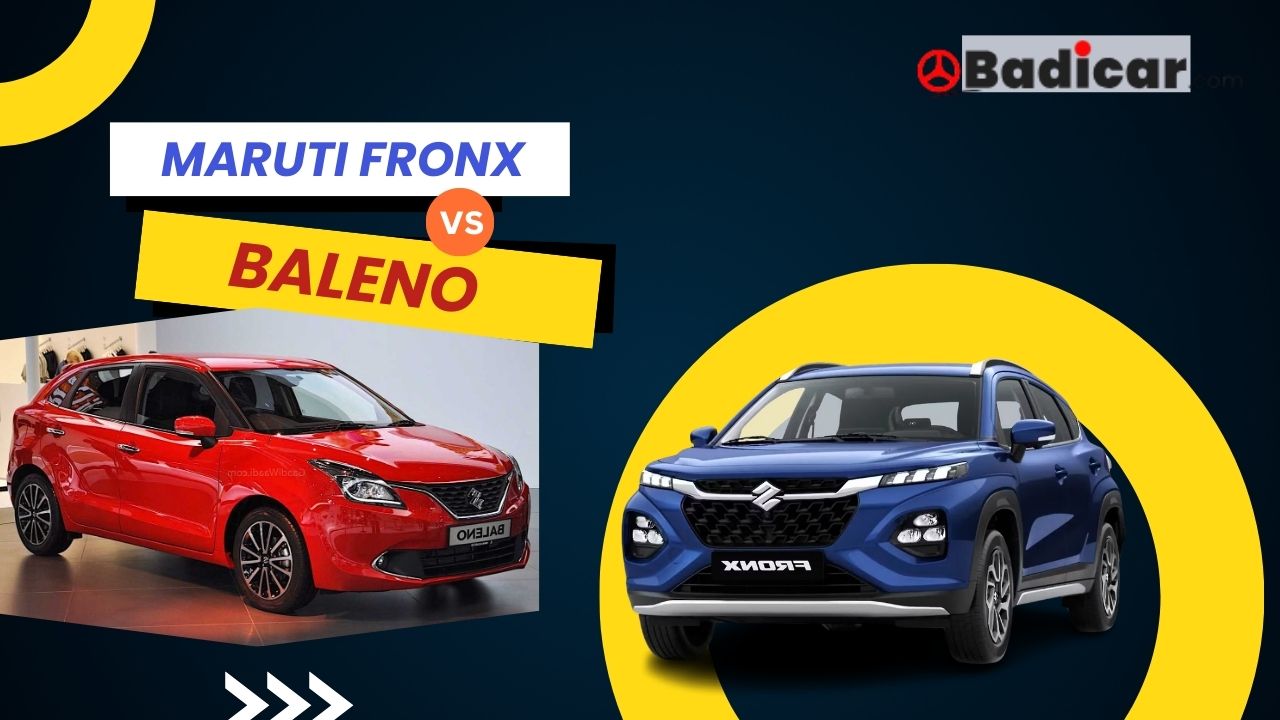
Maruti Fronx vs Baleno

Let’s just be honest. Walking into a Maruti Suzuki showroom these days seems less about buying a car and more about placing an order for coffee at some third-wave café—there are simply too many variants that look and sound almost identical, but have really subtle taste-based differences. 

Half-way through this menu is the ultimate dilemma for modern buyers: the Maruti Fronx and the Maruti Baleno. On the one hand, there’s the Baleno: the uncontested monarch of the premium hatchback space. It’s the car that’s probably been sitting in your neighbour’s driveway for ages. And then there’s the Fronx is the new entrant, the “compact SUV” that has created a sensation with its robust looks.

But here’s the real question: Given that they have the same engines, platform, and even the same showroom, if you’re really going to own just one, does it make more sense to go for the utilitarian hatchback or the evo-styled SUV? I have gone through a bit of research and here is my blunt, plain talk comparing price, mileage and features to help you pick up where you might want to invest your money. 

Aspect Maruti Baleno Maruti Fronx
Starting Price ₹6.61 lakh (base petrol) ₹7.51 lakh (base petrol)
Top-End Price ~₹10 lakh (Alpha Auto) ~₹13 lakh (Turbo Auto)
Engines 1.2L DualJet petrol (89 bhp) 1.2L DualJet (89 bhp) + 1.0L Turbo (100 bhp)
Transmission 5MT / 6AT 5MT / 6AT
Mileage (Petrol MT) 21-22 km/l (city/highway) 21-22 km/l (1.2L); 18-19 km/l (Turbo)
Key Features 9″ Smartplay Pro+ (wireless AA/CP), HUD (top), sleek interior Sunroof (mid variants), raised SUV stance, same infotainment
Safety 6 airbags, ESP, hill-hold (AT) Same as Baleno
Style/Vibe Premium hatchback, refined city drive SUV coupe, bold presence, adventure feel
Best For Value, efficiency, daily urban use Style, turbo punch, road presence


The Vibe Check: Style vs. Substance

Maruti Fronx Style

Before the numbers, we have to talk feelings. Because really, most of us buy cars with our hearts and only use our brains to justify the purchase.

The Baleno is sleek and premium, wide-bodied with a sporty slanting roofline. It is polished and refined, making it perfect for daily drives and the monotony of city living. 

The Fronx is, however, a completely different animal. It adopts the “SUV coupe” shape, that is reminiscent of its larger sibling the Grand Vitara. It sits up higher, has cladded wheel wells and a front grille that seems like it’s glaring at you. It’s made for the young (or the young at heart). If you imagine yourself hitting the open road on the weekends, when the highway might not be in quite such good shape, the Fronx appeals to that sense of adventure. 

The Money Talk: Prices

So what does this cost you? Both vehicles are similar enough that you’re not necessarily paying a boatload of money just for the “SUV” name.

The Maruti Baleno’s starting price is slightly lower, at around the ₹6.61 lakh (ex-Showroom) for the base petrol, getting close to ₹10 lakh on the higher side for the top-end Alpha Automatic.

Maruti Fronx, the all-new SUV from Maruti Suzuki, is priced at around ₹7.51 lakh (ex-showroom) in India. But the high-end models actually come at prices that are quite similar to the Baleno’s, just short of the ₹13 lakh mark in case you get the Turbo Automatic.

The Baleno wins if you’re counting pennies or just need the cheapest entrance point. But the difference in price is almost imperceptible if you’re looking at the mid-to-high end models (that’s what most of us buy). Two very different personalities and you are essentially paying the same money. 

Mileage and Performance: The Engine Room

This is a closely-guarded secret that Maruti doesn’t reveal on billboards: under the skin, these two are almost siblings.

  • Both car models come with the 1.2-litre DualJet petrol unit that makes around 89 bhp. 
  • Options for transmission are the same as well, with a 5-speed manual or a 6-speed torque-converter automatic. 
  • Used in the same mechanicals, the fuel economy figures are surprisingly close. City and highway fuel economy for the petrol manual is 21-22 km/l. Less for you but negligible for us With the automatic variants you get slightly less, but this is negligible difference for us.

The Fronx

But there is a twist: The Fronx also offers something the Baleno doesn’t have (at least, not yet in the same form): The 1.0L Turbo Boosterjet engine. This is a pellet, isn’t it? bhp and takes you on a burst of torque that makes moving out on highways a cakewalk. The trade off: mileage takes a hit, down to around 18-19 km/l, and high-speed petrol is needed (we recommend 91 octane).

If you’re a sedentary driver who wants to just sip fuel, stick to the conventional 1.2L engine in either car. Fronx Turbo: For all the enthusiasts who like a bit of punch when they floor the accelerators, this is your only winner here. 

Feature Fight: Tech vs. Comfort

Maruti Baleno

Step inside, the arrangement of the dashboard, the steering wheel and gear stick in both models are the same. But it’s the details that count.

The Baleno is all about “smart tech.” You get the sleek 9-inch Smartplay Pro+ infotainment system that offers wireless Android Auto and Apple CarPlay support – a feature we all crave secretly to avoid entangled cables. The top model also gets a heads up display (HUD), which is pretty futuristic.

Then there’s the Fronx, which, as SUVs go, puts a premium on a somewhat different experience. Although it doesn’t get the HUD in the lower variants as the Baleno does, it makes up for it with a sunroof in the mid-variant — a feature that can be a deal-breaker for many consumers in India. 

The Fronx also has a slightly raised stance, putting you at a ”commanding view of the road,” while the Baleno feels more like you’re driving inside it rather than on it. both cars come brimming with safety features- including 6 airbags, ESP and a hill-hold assist (automatic only), so you’re not compromising on safety whichever is your pick.  

Conclusion

When all is said and done, the Fronx vs Baleno is not a competition of spec sheets and mileage charts – it is a reflection of who you are as a driver.

If you’re big on predictable daily-driving, tight city parking and low running costs, and are looking for a car that’s well-judged and quietly premium, then the Maruti Baleno still holds more water. It’s more tolerable, a bit easier on the bank balance, a little more fuel-efficient, and seems like the kind of car that’s already worked life out. It doesn’t strain—-and that’s what makes it charming.

The Baleno is aimed at the more conservative buyers, while the Maruti Fronx is for those who want it to make a statement. You get the SUV-like stance, an elevated driving position, optional turbo-petrol thrill, plus lifestyle additions like a sunroof that have more emotional value than rational. You aren’t paying too much more — you’re paying for attitude, presence, that little bit of an “upgrade” every time you walk up to it. 

  • Go for the Baleno if you want the most value, refinement and hassle-free ownership.
  • Pick the Fronx if you want style, road presence and a ride that feels a bit more special – even if the daily grind is the same. 

Same engine options. Same showroom. Same reliability.

Different personalities. Take your pick and find the one that feels right for you. 

Sharey Khan

Sharey Khan is an IT entrepreneur and petrol head & a car enthusiast. With a special focus on car-related content, he combines his deep passion for vehicles with a talent for crafting informative, engaging, and easy-to-understand content. His writing is driven by a genuine love for cars and he is committed to providing readers with accurate, up-to-date, and trustworthy information that empowers smarter driving decisions. 

Leave a Reply

Your email address will not be published. Required fields are marked *

0

Car Owners Should Know These Differences Between Hybrid & Electric Cars

Hybrid And Electric Cars 

The transition from traditional cars to electric and hybrid cars is happening fast. If you are also thinking of changing your car and adapting to serve nature then Hybrid & Electric Cars are ideal for you. But deciding what’s right for you is confusing, understanding the difference between hybrid and electric cars might help you decide. 

There are Plug-in hybrid, Full hybrid, Battery electric, Range extender which seems like automakers created a new language specifically to confuse car buyers. So, let’s understand the difference to help you choose the right car for you. Which one actually makes sense for your life needs details on what these cars are, how they work, what they cost you.

How Many Types of Car In The Market?

A traditional petrol or diesel car runs entirely on fuel which burns to move that car. All the old models of cars are basically built on the engine which needs petrol or diesel to run. 

A hybrid car built on two motors, one for petrol and other for electricity. Hybrid cars are most reliable because they can be used for both short and long drives. A small battery contains the energy that gets charged up while you drive so you can drive a few kilometers without burning your fuel. Most hybrids never need to be plugged in, they charge themselves though regenerative braking at low speed.

An electric car or BEV has no petrol engine at all. They built an engine which moves on energy from a larger battery. They need large batteries because there is no fuel option. But you must have a charging point at your home or nearby public network.

Most people prefer Hybrid cars because it is a bridge of old and new era of cars. This new world experience of owning these two types of car is quite different. 

Read Also: Car Insurance Guide ,Cost & Best Policy Tips

Difference Between Hybrid & Electric Cars at a Glance

Feature Hybrid Electric
Fuel type Petrol + electric Electricity only
Need to plug in? No (or optional for PHEVs) Yes
Range 500–700 km (full tank) 300–600 km (full charge)
Refuel/recharge time 5 minutes (petrol) 20 min–8 hours
Running costs Lower than petrol Lowest overall
Upfront cost Moderate Higher (falling fast)
Emissions Lower than petrol Zero tailpipe
Maintenance Moderate Low
Infrastructure needed Petrol stations (everywhere) Charging network (less)

How Do Hybrid and Electric Cars Work in Daily Life?

Living with a Hybrid

Hybrid cars don’t let you feel different from a regular car. Travel to a petrol pump to fill the tank and drive with the same experience until it’s needed to switch between electric motor and the petrol engine. 

At low speeds, in traffic, or when you’re cruising gently, the electric motor often takes over. It makes hybrid an ideal version for city commutes. They shine over huge stop-start traffic, stepping on for more power, the petrol engine joins in seamlessly. The fuel tank is smaller than a regular car, which is quite understandable because you’re using less fuel overall. 

Plug-in hybrids (PHEVs) are a step further. They won’t charge by themselves, you need to go to the charging station or your garage. These are most reliable for longer trips as it provides longer electric-only range (usually between 30 to 70 kilometres). Shorter trips might not give you a chance to switch the petrol engine, but on longer trips, the petrol engine is always there as a backup. 

Living with an Electric Car

It’s a little hard to change the habit of driving when you’re behind the wheel which moves by fuel. The biggest change is remembering to plug in before you go to bed, so you can get a fully charged car to go to the office. If you have a garage, then it is more convenient than going to a fuel station. 

The driving experience is also different in a way that almost everyone finds pleasurable. The engine is not taking too long to rev up, turn the key and get ready to accelerate. This instant torque makes even modest electric cars feel punchy and responsive. 

There is no sound while starting and driving the car, peak silence is also pleasurable, no vibration at all. Sometimes it gets tough when you want to go on longer trips because an electric car can take from 20 minutes to several hours to recharge. Petrol cars take 5-minute fill-ups and give you 500+ kilometres, which seems pretty easy. 

Comparing Cost, Range, and Efficiency

Purchase Price

Electric cars tend to cost more upfront than equivalent hybrid models. Hybrid cars have a starting price range between ₹20–25 lakh in India, whereas an electric car can cost you ₹25–45 lakh or more. The price can go higher with large battery packs in EVs because it is expensive to manufacture.

However, prices are falling. The technology is moving forward faster than ever, manufacturers are launching more affordable electric options every year. In the upcoming years, electric cars will be more affordable. Meanwhile Plug-in hybrids filled the gap until then, but it is more expensive than normal hybrids but often cheaper than full EVs.

The higher to lower costs:

  • Full EVs
  • Plug-in hybrid
  • Hybrid 
  • Petrol or Diesel

Running Costs

This is where electric cars start winning back their premium price. Petrol is more expensive than electricity in terms of range. Charging at home costs a fraction of what you’d spend on petrol for the same distance — often 60 to 80% less. Once you spend a large amount, you can save a substantial amount within 3–5 years of ownership.

Hybrids are also less expensive on running than normal cars, usually saving 20–40%. Your driving style and charging station also affects the running cost on hybrid cars. But fully electric vehicles still save your money more than Hybrid.

Electric vehicles are cleaner and clearer, there’s no need to change engine oil, exhaust system, or clutch (in most cases) which makes electric cars more cheaper to service. Hybrids have both a petrol engine and an electric system, making it more complex for maintenance. More parts in a car means it needs more time and money for their service.

Range – How Far Can They Go? 

Modern electric cars have improved enormously. They provide 300–500 kilometres rigorously on full charge. Premium models exceed up to 600 km. Daily commuters of 30–80 km a day find it more efficient than petrol cars.

Hybrids that charge externally are profitable because most of the hybrids usually cannot drive far on electric power alone. Their batteries are not large enough to depend on, that’s why they mainly run on petrol. The total driving range is around 500–700+ km.

Hybrid or plug-in hybrid is less stressful in the matter of range. EV is the best option, if you mostly drive short distances and can charge at home.

Which Option Is Better for the Environment?

Electric cars produce zero tailpipe emissions. No burning fuel to suffocate the air with black clouds. Air quality and health will be maintained in the cities. EVs produce significantly less carbon dioxide than petrol cars. EVs produce much less carbon dioxide in manufacturing and the electricity used for charging than petrol cars hum alone makes. 

Hybrids are cleaner than traditional cars but not as clean as electric cars. They still burn petrol, exhaust pipes, but they still burn petrol and can be more supportive for nature because they depend on owner choice. If you do most driving on electricity by regularly charging them. 

Larger battery production has an environmental effect because it requires lithium and cobalt which is a big concern. But studies consistently show EVs still stand by serving lifetime environmental effects as compared to petrol cars. 

Charging vs Refuelling: The Practical Reality

Are Hybrid Cars More Convenient Right Now?

Hybrids are more convenient at this time because changing from petrol to fully electric may take time to adapt new habits. It is most popular with “transition” vehicles, as it gives improved efficiency without requiring huge change.

Plug-in hybrids add the option to charge, if you wanna adapt eco-friendly. If you forgot to charge then there is no problem running on petrol.

Is EV Charging Easy Enough in India?

A basic 3-pin plug works but is slow so it takes time, overnight charging is best for EVs. If you have a home wallbox charger then using an electric vehicle is more easy and convenient. Public charging stations are expanding everywhere now and you can find nearby charging points through PlugShare, Tata Power EV. 

Fast chargers can offer 100–200 km of range in 20–30 minutes but still hybrid makes more practical sense right now. You’ll need fuel sometime to run somewhere urgently because charging infrastructure is not fully developed in India.

Who Should Buy a Hybrid?

  1. For consistent long distance commuters, hybrid cars make particular sense.
  2. charging infrastructure isn’t available in your area.
  3. You couldn’t charge overnight if you don’t have a private parking space.
  4. Hybrids offer fuel efficiency without changing your habits from traditional cars.
  5. Budget is a big issue while buying a full EV but you can afford a Hybrid.

Who Should Buy an Electric Car?

  1. Daily drivers who commute daily for school, office or delivery can find this efficient and eco-friendly. 
  2. You can charge at home and give you lower running costs.
  3. You care deeply about reducing your environmental impact but enjoy technology and driving experience.
  4. You live in a city where charging infrastructure is available easily.

Conclusion

Hybrid & Electric Cars have their pros and cons, but neither is inherently “better.” It depends on your needs, lifestyle and driving habits. If you have home charging, then there’s not a problem in switching to EVs but standard hybrids are ideal if you don’t want to change habits, going on long trips frequently.  

Both hybrids and electric cars represent the future of personal transport. Because fuel prices are increasing which makes them more reliable and eco-friendly to use. Difference between hybrid and electric cars let you understand which one is right for you.

1

How Electric Cars Are Changing the Future of Transportation

Published Jun 13, 2026, 12:16 PM
Last Updated Nov 2, 2026, 5:04 PM

Electric Cars

For years petrol or diesel cars have dominated on the road, but now the future of transportation is shifting to Electric Cars. They are already in the market and become a practical choice for millions of people worldwide. People prefer EVs to buy in 2026 as they offer low running cost, advanced technology, and less expensive maintenance.

However, car makers are still working on the batteries to provide more range. That future is near when average people can also afford Electric Cars. Governments and automakers invest heavily in electrification for making charging accessible easily.

The Transportation Shift is Already Happening

The smarter, faster, comfortable transport will become Electric Cars in the future. So choose wisely before you’re going to buy a new car. The resale value also dropped of petrol and diesel cars and EVs offer excellent technology with good range of driving. 

Global electric vehicle sales crossed 17 million units in 2024. China alone put more EVs on the road last year than the entire world did in 2021. India’s EV two-wheeler and three-wheeler market is exploding, with four-wheelers catching up fast. Tata Nexon EV is no longer a novelty on Indian roads — it’s traffic.

The question isn’t whether Electric Cars will change transportation. They already are. So are you going to be ahead of that change, or scrambling to catch up?

Read More:- The Future of Electric Vehicles: What Drivers Need to Know

What Actually Changes When a Car Runs on Electricity

The engine disappears. Not just physically — the entire relationship between a driver and maintenance changes. No oil changes. No coolant flushes. No timing belt anxiety. An electric motor has roughly 20 moving parts. A combustion engine has over 2,000. That’s not a small difference — that’s a different category of machine.

Refuelling becomes recharging — and that changes your whole routine. You stop thinking about fuel the way you think about groceries. Instead, you plug in at home overnight. Your car is full every morning. The “range anxiety” people talk about? It’s mostly psychological — the average Indian commuter travels under 40 km a day. Even entry-level EVs handle that with room to spare.

The car becomes a software device. This is the part that surprises people most. EVs aren’t just cars with batteries — they’re computers on wheels. They get over-the-air software updates. Their performance can literally improve after you buy them. Tesla has pushed updates that added features and improved range on cars already sitting in someone’s garage. That’s unprecedented in automotive history.

What This Means for Roads, Cities, and Air

If your city’s electricity is primarily coal-generated, an EV charged there is still indirectly burning fossil fuel — just upstream. India is working to fix this. Renewable energy capacity is growing rapidly, and as the grid gets cleaner, every EV on that grid gets cleaner automatically, without any change from the owner. That’s a compounding advantage no petrol car can ever have.

But air quality? That improvement is immediate and local. No tailpipe means no exhaust in city traffic. Anyone who’s sat in Delhi or Lucknow traffic in summer knows exactly how much that matters at street level.

Urban noise also drops. Electric motors are nearly silent. A city with predominantly electric vehicles would be a fundamentally quieter place — and that has real mental health implications that researchers are only beginning to document.

You Know That:- Which Car Is Best: Petrol or Diesel?

Pricing Structure For Electric Cars

Transportation isn’t just about getting from home to office or one city to another. It’s an enormous economic engine and Electric Cars are rewiring it.

The fuel economy argument alone is stark. Running an EV in India typically costs around ₹1–1.5 per km in electricity. A petrol car costs ₹6–8 per km at current fuel prices. For someone driving 15,000 km a year, that’s a saving of ₹67,500 to ₹1.05 lakh annually — every year. The higher upfront cost of an EV starts looking very different when you do that math over five years.

Then there’s what this does to jobs. Petrol stations, engine mechanics, spare parts manufacturers — entire ecosystems built around combustion are under slow pressure. New ecosystems are being built: charging infrastructure, battery manufacturing, software engineers for automotive systems. The jobs aren’t disappearing, they’re migrating. But migration is uncomfortable for the people in the middle of it.

EV Batteries Are Still a Problem

Batteries are still a big problem for EV cars and people hesitate while buying an electric car because of this.

Recent reporting of child labor in Africa raises concern as this happened in Cobalt mines. The material is used in batteries along with lithium and manganese. Recycling infrastructure isn’t completed properly yet. This doesn’t mean that EVs are harmful for our environment, instead it pushed manufacturers for stronger policies on battery sourcing.

The technology is improving. Solid-state batteries, sodium-ion alternatives, and better recycling processes are all in active development. But “it’ll be better later” isn’t the same as “it’s fully solved now.”

Where The Future of Transportation is Going?

The trajectory is clear, even if the timeline isn’t perfectly predictable.

Several countries have set deadlines to phase out new petrol and diesel car sales — Norway by 2025 (already there), UK by 2035, India pushing hard toward electrification targets under its FAME scheme. Automakers globally are retooling factories. Maruti Suzuki, which long resisted full electrification, is now accelerating its EV lineup. When the most conservative, mass-market carmaker in India pivots, the direction of travel is settled.

What remains uncertain is speed and equity. If charging infrastructure will expand fast to reach Tier 2 and Tier 3 cities and cut the manufacturing costs with time to make a car affordable for middle-income buyers. 

Read More:- Car Maintenance Tips That Save Money And Valuable Time

Conclusion 

In a changing world, people are choosing cars with batteries rather than petrol or diesel. Electric Cars support sustainability and reshaping transportation, cities, and the global automotive industry. Adaptation of EVs are growing faster, despite facing challenges like battery production, recycling, and charging infrastructure.

The future of transportation is not a petrol or diesel car anymore. But Electric Cars are leading that transformation to a greener world. Although, it’s not limited to it, it offers advanced tech in a car, speed and comfort too.

0

Mahindra Bolero Neo 2025 – Latest Price in India, Variants, Mileage and Key Features

Published Nov 4, 2025, 7:13 AM
Last Updated Apr 22, 2026, 11:51 AM

Mahindra Bolero Neo 2025

For the Indian buyer, eyeing a reliable SUV but not willing to pinch too many pockets, the Mahindra Bolero Neo was always the safe bet. With the 2025 overhaul, the Indian manufacturer has given the thick-skinned little workhorse a new lease on life while retaining its basic characteristics. If you are in the market for a utilitarian, value-for-money SUV to serve your family or business, here’s all you need to know about the new Bolero Neo. 

Pricing That Won’t Break Your Budget

The 2025 model of the Mahindra Bolero Neo is one of the cheapest cars in its segment owing to the pricing being actually quite aggressive. The Bolero Neo is within reach of middle-class Indian families as it is priced at ₹8.49 lakh for the base N4 variant and goes up to ₹9.99 lakh for the new top-end N11. Ex-showroom prices of the five variants are as follows: 

There are excellent feature upgrades as you move up the ladder without a shocking price jump, thanks to a clever pricing decision. When a budget between ₹9.74 upto ₹11.45 lakh for the N4 and the N11 respectively is considered, that’s what you’ll need to calculate as on-road price (inclusive of insurance, registration and other taxes) based on your location. 

Five Variants to Suit Every Need

Mahindra has segmented the Bolero Neo 2025 into five variants to meet the needs of different buyers: 

Mahindra Bolero Neo Five Variants to Suit Every Need

Credit: autoMahindra

N4(₹ 8.49 lakh): The no-nonsense all-rounder starting point hero. With halogen headlamps, fabric upholstery, power steering, manual air conditioning, dual airbags with ABS and steel wheels, it is indeed a practical machine. Perfect for one who likes practicality over indulgence.    

N8 (₹9.29 lakh): The N8 is a rung above the base variant and introduces four speakers, a basic infotainment system, steering-mounted controls, a rear wiper and defogger, plastic wheel caps and wheel arch cladding.  

N10 (₹9.79 lakh): Now, the starts to get interesting. This mid-level variant has some modern styling elements such as chrome strips, 16-inch alloy wheels, LED DRLs and a unique spoiler. It offers front armrests, a substantial 9-inch touchscreen infotainment along with a 6-speaker Sony sound system and much more comfort. 

N11, or ₹9.99 lakh: The newly introduced N11 is the new flagship, which brings high-end features that allow it to compete against much pricier SUVs. It brings some features and styling to the N10. 

The top of the line N10(O) (₹10.49 lakh) with mechanical locking differential and other performance centric enhancements is also the highest priced variant in the standard Bolero Neo range. 

Engine and Performance: Proven Reliability

Mahindra Bolero Neo Engine and Performance Proven Reliability

Credit: autoMahindra

The 1.5-litre mHawk100 diesel engine that powers the vehicle has been refined over years of real-world serve on Indian roads. This 3-cylinder turbocharged motor makes 100 hp and 260 nm of torque. It gets a slick five-speed manual gearbox. 

It was specifically developed for Indian roads. The mHawk100 marries efficient combustion with impressive low end torque output, vital for running in city traffic and over craggy mountain terrain. This equilibrium can be felt in the ability of the Neo to take on stop-start urban traffic and cruising on the open road without ever feeling underpowered. 

Read More:-  Affordable CNG Cars Under 20 Lakhs in India

Fuel Efficiency That Actually Matters

Fuel economy of the Bolero Neo is a real attraction point in a day and age when the cost of gas looks like going up every other week. Your mileage may vary based on driving habits and road conditions but ARAI certified 17.29 km/l can deliver 16-17 km/l on highway and 13-15 km/l in city. With a 50-litre fuel tank, you can go for more than 800 kilometres on a full tank, which is great for long road trips as you don’t have to stop for filling up frequently. 

Design: Modern Yet Unmistakably Bolero

Mahindra Bolero Neo Design Modern Yet Unmistakably Bolero

Credit: autoMahindra

The Bolero Neo 2025 smartly tweaks and does not radically reinvent itself. The redesigned front facial now sports a horizontal chrome slatted grille that looks sleek and modern which makes the Neo look more sophisticated. The new 16-inch dark-grey alloy wheels enhance the look instantly and the new bumpers are fitted with silver skid inserts adding to the rugged aesthetic. 

Conclusion

The 2025 Mahindra Bolero Neo remains an embodiment of utilitarian, reliable and tough appeal in the compact SUV space. Powered by a refined mHawk100 diesel engine, offers great mileage and comes in a feature-packed variants range, it really offers the perfect combination of value for money and performance. Mahindra has found a way to bring the Bolero Neo into the 21st century without compromising its DNA – a tough, plain-vanilla SUV made for both cities and villages. 

0

How to Improve Gas Mileage: 15 Proven Tips That Actually Save Fuel

How to Improve Gas Mileage

Petrol in Delhi is holding at ₹105 a litre this week, and Mumbai drivers are paying past ₹111 — rates that haven’t moved much since the last OMC revision in May 2026. You are probably wondering about how to improve gas mileage of your car. Because it actually helps you save money. It’s the difference between a ₹2,000 tank lasting your commute eight days or eleven. 

Most of what kills mileage in Indian driving conditions has nothing to do with the engine under the hood and everything to do with habits you can fix by this weekend. Let’s understand the 15 proven tips that genuinely move the needle on gas mileage, ranked roughly by how much difference they make.

1. Ease Off the Gas Pedal

Road rage was one of quickest means to empty a gas tank without actually going any faster. Quick brakes and acceleration with tight force can actually let your engine work harder than it has to. That extra effort means more fuel consumption, more wear on your brakes and tires

Research shows that aggressive driving can lower your gas mileage by up to 30% on the highway and more than 30% in city traffic.

2. Keep Your Tires Properly Inflated

When tires are underinflated, if they don’t have enough air roll easily they require more push and for that engine has to burn more fuel to keep the same speed. Flat tires mostly cause lower fuel economy, uneven wear of tires and affect braking and handling.

It’s recommended to check your car’s tire pressure every month and before going on a long trip. The little maintenance habit can increase your mileage and tire life. 

3. Don’t Ignore Your Air Filter

Your engine requires a constant flow of clean air to burn fuel properly. The air filter restricts the flow of air to the engine as it gets clogged by dust, dirt, leaves and other debris, hence the engine has to work harder to make the same power. 

On a lot of cars, it’s a quick job that doesn’t require any special tools. Most manufacturers advise to check the air filter at every service and change it at the intervals. 

Read More:-  How to Transfer Car Ownership in India: A Step-by-Step RTO Guide (2026)

4. Lighten Your Load

When your trunk becomes just a holding space for stuff, your fuel economy could be suffering without you knowing it. If there are any heavy objects like games equipment, boxes, and tools that are unnecessary, remove them.

If weight increases more than standard capacity like 45 kg (100 lbs) can decrease fuel efficiency by about 1-2%, and it impacts mostly in city driving and stop-start traffic.

5. Use Cruise Control on the Highway

Cruise control can be used to increase the fuel efficiency while driving on open highways by avoiding speed fluctuations. Speed changes, small ones included consume extra fuel as the engine needs to accelerate and decelerate the vehicle repeatedly. 

Long drives go smoothly with the help of Cruise Control as it prevents needless changes. It may not be good for busy traffic roads but best for fairly flat interstates, where steady speeds can help squeeze the most from every liter of gas. 

6. Avoid Excessive Idling

Idling your car wastes gas, and it doesn’t even get you anywhere. Waiting to meet someone, waiting outside a store or driving with your engine running while you’re parked your wasting fuel for no distance covered. 

New cars already have automatic start-stop systems for this very reason. Quick start and stop can make everything so easy and saves fuel on idling. 

How to Improve Gas Mileage

7. Combine Your Errands

When you start your car, the engine will take time to warm up and it uses more fuel to make it completely warm. If your engine gets cold and you try to warm up 5 times a day then your fuel burns more than it burns at one go. 

So combine all your errands and try to complete it once you start your engine. Do not let yourself be drawn to a lot of shorter trips in a day. It can also help you avoid extra miles and time on the road.

8. Watch Your Speed

To reach faster at your destination will consume more fuel from the tank. So avoid leaving your home late and take a ride at steady speed so it saves your fuel as aerodynamics normally.

With most cars, fuel economy starts suffering fairly rapidly once you’re driving faster than about 90–100 km/h. Even dropping your cruising speed by 10–15 km/h on long road trips on the highway can help you save a little gas. 

Read More :- Zero Depreciation Car Insurance: Benefits, Coverage & Cost

9. Keep Your Windows Up at High Speeds

How you cool your vehicle can also impact gas mileage especially on the highway. On the highways, you probably drive fast and leaving your window open creates drag which forces the engine to work harder to move the vehicle through the air. 

You can open windows at short and slow speeds in a city. Turning on the AC is more fuel efficient on highways or running at high speed.

10. Get Regular Tune-Ups

If you want to drive a car which can be fuel efficient then take care of it regularly. Regular maintenance including checking engine oil, plugs, sparks, tires are required to increase fuel efficiency. When these are not fixed, your engine works harder and consumes more fuel and gives poor performance.

Read a manual to keep following the manufacturer’s recommended service which lets your car at its best condition, improves fuel economy and can save you from costly repairs. 

11. Use the Manufacturer-Recommended Motor Oil

Using the wrong grade of oil can actually reduce your fuel economy. Check your owner’s manual and stick to what’s recommended — it’s a small detail that makes a real difference.

12. Don’t Overuse the AC in Stop-and-Go Traffic

Air conditioning puts extra load on your engine. In heavy city traffic, cracking a window instead of blasting AC can help — though on the highway, the reverse is often true (see tip #9).

13. Plan Your Routes to Avoid Traffic

Sitting in traffic means idling, braking, and accelerating over and over — the worst combination for fuel economy. A slightly longer route with steady flow can actually save more fuel than the “shortest” route full of stop-and-go.

14. Check Your Wheel Alignment

If the car wheel is misaligned then your engine puts more force to move your car forward. It silently eats your mileage and if the car pulls to one side then get an alignment check quickly because your tires wear out. 

15. Consider Your Driving Environment

Temperature also affects your engine and batteries because cold weather can cause your engine to get cold easily and it sometimes hard to start the engine. So it takes time and more fuel to warm up the engine which is not good for short trips. This helps you set realistic expectations and adjust your habits rather than assuming something’s wrong with your car.

A Real Comparison: Habits vs Hardware

How to Improve Gas Mileage

Parameter Maruti Suzuki Swift Hyundai Grand i10 Nios
ARAI-rated mileage (petrol) ~22–24 kmpl (actual: 24.8 kmpl manual, 25.75 kmpl AMT)  ~20–22 kmpl (actual: 18 kmpl manual, 16 kmpl AMT) 
Real-world mileage (aggressive city driving, poor habits) 14–15 kmpl (as per your input) Not specified, but likely lower than ARAI if driven poorly
Real-world mileage (steady driving, good maintenance) Can approach ARAI figures with correct habits Can out-mileage a poorly driven Swift with steady acceleration, correct tyre pressure, minimal idling (as per your input)
Key takeaway ARAI figure is not a guarantee; aggressive driving can drop mileage to 14–15 kmpl A lower-rated car can deliver better real-world efficiency if driven and maintained well
Primary reason for gap Driver behaviour and maintenance (not just engine design) Same – driver and maintenance habits dominate real-world results

The gap between ARAI figures and real-world mileage is almost always driver-and-maintenance driven, not just engine architecture.

Should You Spend Money to Fix Mileage, or Just Change Habits?

If your mileage complaint is a gradual, creeping drop over months, the fix is almost always maintenance — tyre pressure, air filter, spark plugs, alignment and costs under ₹2,000 in most cases. If it’s a sudden, sharp drop, get the OBD scanned for fault codes before assuming anything about driving style. 

Only if you’re consistently doing long highway stints and your current car lacks cruise control or an eco mode should hardware or a car upgrade — even enter the conversation. For most Indian owners, the ₹0 fixes (driving style, tyre pressure, timely servicing) recover more mileage than any accessory or fuel additive on the market.

Read More :-  How to Renewal Car Insurance: Step-by-Step Guide (2026)

Conclusion

Once you understand all the points on how to improve gas mileage, there’s nothing hard to adapt to changes. Little habits can save your money and time, so proper tire pressure, regular maintenance, and a bit of trip planning can genuinely add up to real savings over a year. You don’t need an electric vehicle or a full engine rebuild to save at the gas pump. Sometimes it really is the simple stuff that works best. 

Try picking just three or four of these tips to start with. Once they become second nature, add a few more. Your fuel gauge and your wallet will notice the difference.

0

Lexus RX vs BMW X5: Which Luxury SUV Dominates 2025?

Published Sep 26, 2025, 3:05 PM
Last Updated Apr 16, 2026, 11:18 AM

The debate is never going to end between best SUVs because the automotive companies are delivering more new models with high end features and comfortable cabins that make them more attractive. Lexus RX vs BMW X5 are current models of luxury SUV which offer mostly the same features with a slight distinct price & tech. Well, if you are going to buy a luxury SUV which dominates in 2025 then both have positioned themselves in the list. Check out the features and price of these models to understand what can be matched with your taste.

Everyone’s choice is different— not everyone wants a fuel efficient SUV but more speedy and powerful rides. So, there is no single yes or no in this because overall both cars have outstanding features and amazing design which marks your presence anywhere you ride on it.

Still, The BMW X5 beats the Lexus RX in speed, power, and cargo room. The Lexus RX offers superior fuel economy and a lower starting price. Go for the X5 if you want top performance and space. Those prioritizing efficiency and value will lean toward the RX.

Pricing & Positioning

Lexus RX 350 price starts at $49,125 while BMW X5 xDrive40i starting price is $69,775

The RX’s base price is roughly $20,000 less than the X5. This makes it an easier way to get into the luxury midsize SUV market.

Powertrain & Performance 

Image credit: Lexus


Model Engine Power/Torque 0–60 mph
Lexus RX 350 2.4 L turbo-4 6,000 rpm with 275 hp; 1,700 rpm with 317 lb-ft   6.8–7.6 s 
BMW X5 xDrive40i 3.0 L turbo-inline-6 with 48 V mild-hybrid 5,200 rpm with 375 hp; 1,850 rpm with 398 lb-ft 5.2 s 

The X’s powerful inline-6 setup delivers 100 hp that makes it more favorite for speed seekers, it also offers sharper acceleration over the RX. These SUVs stand out at the top positions side-by-side because of their powertrain and outstanding performance. 

Also Read: Honda HR-V vs Toyota Corolla Cross: Which Small SUV Should You Buy in 2025?

Fuel Economy

Lexus RX 350 delivers more fuel efficiency with 25 mpg combined that can run up to 22 city and 29 highways with unstoppable speed. For people seeking a long-trip model, RX can be a better option for them.

BMW X5 xDrive40i offers all-wheel drive with 19 mpg combined that can run up to 17 city and 22 highway. It is also a better option for folks who are interested in AWD rides. 

Interior Space & Cargo

Image credit: BMW


Metric Lexus RX BMW X5
Passenger Volume (cu ft) 52–55 (front) / 45–47 (rear) 56 (front) / 50 (rear) 
Cargo Capacity (cu ft) 30–46  34–72


The X5 is offering more passenger space up to 10% and nearly 60% more cargo volume which makes it the best family SUV in 2025.


Chassis & Ride

Lexus RX offers a unibody SUV where the MacPherson struts used in Front and rear uses multilink setup that make this one look more cool. It marks presence with fluent speed and dynamic transmission up to 8-speed automatic.

BMW X5 has a different approach, with four-wheel independent suspension and 8-speed Steptronic automatic transmission giving a powerful ride without compromising comfort. 

Technology & Safety


Features Lexus RX 
Screen 14-inch touchscreen
Audio Mark Levinson 21-speaker audio
Connectivity Apple CarPlay/Android Auto
Lexus Safety System+ 3.0 pedestrian detection, lane-tracing assist, adaptive cruise


Features BMW X5
Screen Dual 12.3-inch digital displays, Available head-up display
Active Driving Assistant Pro lane-keep assist, Evasion Aid, Stop & Go

Both SUVs offer advanced diver-assist suites and an amazing sound system for a wonderful journey. BMW is giving more options in screening with a modern infotainment interface.

Final Verdict

This is not a static selection but choice is dynamically made for both SUVs because they both offer amazing features and incredible safety features. Whether you decide to buy a BMW or Lexus, the decision depends on the performance, space, design, and price of the SUVs. For better performance, more cargo space and premium cabin features, you can choose BMW X5. For lower entry cost, fuel efficiency, refined ride comfort, you can choose Lexus RX.