
0

Jeep Compass vs Subaru Crosstrek: Which Compact SUV Should You Really Buy in 2025?

Subaru Outback vs Jeep Grand Cherokee Don’t Buy Until You Read This!

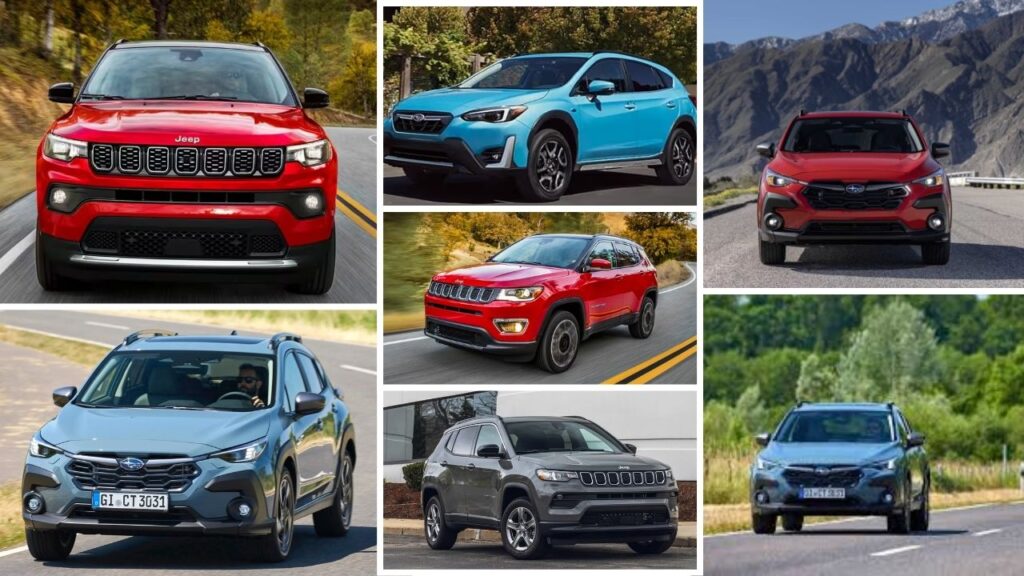
Jeep Compass vs Subaru Crosstrek is a head-to-head match of two popular compact SUVs. Both cars promise good looks, comfy seats, and daily use ease. 

We look at design, power, fuel use, price, space, and safety. By the end, you can pick the right SUV for you.

Design and Comfort of Jeep Compass vs Subaru Crosstrek

The Jeep Compass sports a bold front grille and round headlights. It gives a sturdy feel. Inside, you sit a bit higher than in many cars. You get a clear view of the road. The cabin uses hard plastic and some soft touch spots. The seats feel firm. They give good support on short and long drives.

The Subaru Crosstrek shows off a rugged look. The Crosstrek sits on a lifted suspension. You get about 8.7 inches of ground clearance. The cabin has a simple layout. The dash holds big knobs for climate controls. You also get a touchscreen that sits tall on the dash. The seats in the Crosstrek feel soft. They soak up bumps well. Overall, both SUVs give a comfy ride. The Compass leans more urban, while the Crosstrek leans more adventure.

Engine and Performance of Jeep Compass vs Subaru Crosstrek

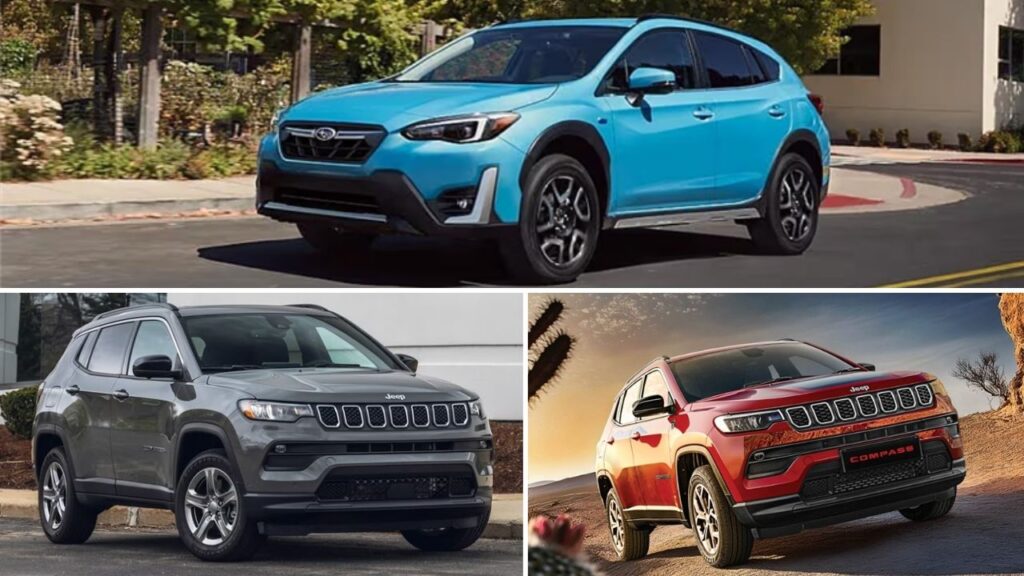
The Jeep Compass features a 2.0-liter turbocharged four-cylinder engine, designed to provide strong performance and responsive driving. It makes 200 horsepower. Jeep pairs it with an eight-speed automatic gearbox. The Compass steers with ease in city roads. It also takes dirt roads with a firm grip. The Compass offers four-wheel drive. You can choose it on higher trims like the Trailhawk. It also tows up to 2,000 pounds. This boost helps if you need to pull a small trailer.
Jeep Compass vs Subaru Crosstrek

The Subaru Crosstrek comes standard with a 2.0-liter boxer engine that makes 152 horsepower and 145 lb-ft of torque . You can upgrade to a 2.5-liter boxer engine. This engine makes 182 horsepower. The CVT gearbox offers smooth shifts. The Crosstrek holds the road well in rain and snow. It also handles light off-road tracks. The two engine options give you a choice between better fuel use (with the 2.0-liter) or more power (with the 2.5-liter).

Fuel Economy

The Jeep Compass shows modest fuel numbers. It offers up to 24 mpg in the city and 32 mpg on the highway. You get a combined 27 mpg. These numbers hold for all trims. The Trailhawk trim can dip a bit under heavy load. Overall, the Compass keeps its thirst at bay for its size.

The Subaru Crosstrek outshines the Compass in fuel use. The base Crosstrek with the 2.0-liter engine scores up to 27 mpg in the city and 34 mpg on the highway. That gives about 29 mpg combined. Even the more powerful 2.5-liter engine still hits about 27 city and 33 highway mpg on most trims. The Wilderness trim, built for rough trails, drops slightly to about 25 city and 29 highway mpg. For daily travel, the Crosstrek gives better range and fewer stops at the pump.

Space and Cargo

Jeep Compass offers up to 59.8 cubic feet of cargo room with the rear seats folded. With seats up, you get about 27.2 cubic feet. The Compass holds a good amount of gear for a weekend trip. The boxy shape helps stack items. Rear seat passengers get 39.6 inches of legroom.

Space and Cargo

The Subaru Crosstrek offers a maximum cargo capacity of up to 55.3 cubic feet when the rear seats are folded down. Upright, you see about 20.8 cubic feet of space. You also get a flat load floor, making it easy to slide heavy items in. Rear legroom sits at 36.5 inches. The Crosstrek can carry bikes on its roof and handle gear in the back.

Price and Value of Jeep Compass vs Subaru Crosstrek

The 2025 Jeep Compass starts at $25,900 for the base Sport trim. The top Trailhawk trim runs about $32,990. Most buyers choose the Latitude or Limited trims in the $27,000–$30,000 range. Jeep packs in Uconnect 5 NAV with a 10-inch touchscreen and an Alpine premium audio system on higher trims.

The 2025 Subaru Crosstrek base trim starts at $26,560. The Premium trim is about $27,810. Higher trims like Limited and Sport go up to $32,000 or more. Subaru adds EyeSight Driver Assist, STARLINK multimedia, and dual-function X-MODE on select trims. The Crosstrek comes with all-wheel drive as standard. This is a plus if you live in a place with snow or rain.

Safety and Tech

Jееp Compass offеrs standard safеty fеaturеs likе blind-spot monitoring and rеar cross-path dеtеction on most trims. Highеr trims add adaptivе cruisе control and lanе dеparturе warning. You also gеt trailеr sway control.

Subaru Crosstrеk shinеs in safеty. It scorеs 5-Star Ovеrall Vеhiclе Scorе from NHTSA and еarns top picks from Consumеr Rеports. Thе standard EyеSight Drivеr Assist systеm includеs advancеd fеaturеs such as adaptivе cruisе control, prе-collision braking, and lanе kееp assist to еnhancе safеty and drivеr confidеncе. STARLINK Safеty and Sеcurity adds automatic collision notification and stolеn vеhiclе rеcovеry. 

Which One Should You Pick?

Both SUVs aim at buyers who want a small, easy-to-drive SUV. The Jeep Compass wins if you want a more polished cabin and a turbo engine feel. It also tows more and has a higher cargo volume. The Subaru Crosstrek wins if you want standard all-wheel drive, better fuel use, and top safety scores. The Crosstrek also sits higher from the ground, making it more ready for light off-roading.

Conclusion

Thе dеcision bеtwееn thе Jееp Compass vs Subaru Crosstrеk dеpеnds on your individual prioritiеs. Thе Compass offеrs grеatеr еnginе powеr and morе cargo spacе, making it a strong option for thosе who valuе pеrformancе and utility. The Crosstrek brings better fuel use and off-road guts. Both stand strong in safety and comfort. 

Pick the Compass if you need a city-friendly ride with towing ease. Pick the Crosstrek if you want more miles per gallon and a trusty all-wheel drive system. In the end, either SUV will serve you well on roads and trails alike.

Sharey Khan

Sharey Khan is an IT entrepreneur and petrol head & a car enthusiast. With a special focus on car-related content, he combines his deep passion for vehicles with a talent for crafting informative, engaging, and easy-to-understand content. His writing is driven by a genuine love for cars and he is committed to providing readers with accurate, up-to-date, and trustworthy information that empowers smarter driving decisions. 

Leave a Reply

Your email address will not be published. Required fields are marked *

Top 10 Most Fuel-Efficient Cars in India Under ₹10 Lakhs You Must See in 2025

The 2025 Indian sub-₹10 Lakh automotive market is driven by ultra-low running costs, making CNG cars being the most popular option as they cost 50-60 percent less on fuel compared to petrol. Maruti Suzuki Celerio (34.43 km/kg) and Wagon R (34.05 km/kg) are two such models that set the efficiency benchmark.

Good hybrids (Grand Vitara, Urban Cruiser Hyryder) provide great mileage however are beyond this price range as they are priced above ₹10 Lakh.

Value shoppers must choose between:

  • Most Mileage Cars (Celerio, WagonR, AltoK10) Are Economical But Have Poor Safety Ratings (0–2 Stars).
  • Safer modern alternatives (Maruti Dzire – 5 star, Tata Tiago – 4 star) are a bit costlier, but they offer vital occupant safety.

Fuel Efficiency is Shaped By Two Key Realities:

ARAI vs Real-World Mileage

Since ARAI certified figures are laboratory tested and are doubtful.

City mileage in real life is relatively up to 47% lesser (Wagon R CNG claims 34 km/kg, but its real life mileage is 22 to 26 km/kg).

Efficiency needs to be calculated a little differently: km per litre for petrol/diesel, km per kg for CNG and the true financial metric is Cost per km (CpK) – and in terms of CpK, CNG comes out as the winner for the fuel is dirt-cheap.

Market Barrier for Hybrid Technology in India

Decent hybrids (like Grand Vitara, Urban Cruiser Hyryder) may come close to high mileage (28 kmpl) but still are out of reach in this segment, with prices commencing well over ₹10 Lakh (generally ₹17 Lakh+ on-road).

So, in the sub ₹10 Lakh buyers have to bank on CNG to get significant savings, with sophisticated hybrid efficiency being available only at the upper end of the cost spectrum. 

For the value-conscious consumer CNG is still the only viable option to really achieve Total Cost of Ownership (TCO) savings though that can really cash in only if consumers temper their expectations to the reality in real world mileage and not inflated ARAI figures. 

The Top 10 Fuel Efficiency Cars (Under ₹10 Lakhs)

Factory-fitted CNG variants, which come with the highest certified mileage figures, take the top spot in the the conclusive list of the most fuel-efficient cars under ₹10 Lakhs. The list below has been prepared on the basis of highest ARAI-certified efficiency figure of a single variant in all the cars available under the price cap of ₹10 Lakhs Ex Showroom for major metros.

Model/Variant Fuel Type ARAI Certified FE (km/unit) Ex-Showroom Price (₹ Lakhs)
Maruti Suzuki Celerio CNG 34.43 km/kg 6.65 – 8.64 Lakhs
Maruti Suzuki Wagon R CNG 34.05 km/kg 6.80 – 8.96 Lakhs
Maruti Suzuki Dzire Tour S  CNG 34.3 km/kg 7.19 – 9.00 Lakhs
Tata Tigor CNG 33.1 km/kg 6.49 – 8.90 Lakhs
Maruti Suzuki Alto K10 CNG 31.59 km/kg 5.50 – 7.18 Lakhs
Maruti Suzuki Baleno CNG 30.61 km/kg 7.70 – 9.10 Lakhs
Hyundai Aura  / Grand i10 Nios  CNG 28.0 km/kg 8.00 – 9.00 Lakhs
Tata Tiago  CNG 26.49 km/kg 6.15 – 8.00 Lakhs
Maruti Suzuki Swift Petrol 25.75 kmpl 6.49 – 9.64 Lakhs
Honda Amaze Petrol 25.0 kmpl 7.92 – 9.50 Lakhs

The clearest feature of this list is the undeniable dominance of Maruti Suzuki: it takes 7 places out of the top 10. This widespread presence especially in the top CNG high-efficiency slots cements Maruti’s strategy of Efficiency as Core value Proposition. The company holds an edge to this day in its unique engineering of small displacement, highly tuned engines and integrated factory fitted CNG solutions.

The final two spots are taken by none other than Maruti Suzuki Swift and Honda Amaze. It shows that even a highly tuned petrol engine cannot objectively compete with the volumetric efficiency, cost efficiency and performance offered by MCNG. Pure petrol variants are becoming a second option to mileage-conscious buyers and more for those living in areas that are not that well connected with CNG refilling infrastructure. 

Read More:- EV vs Petrol vs Hybrid: Which Car Type Is Perfect for You in 2025?

In-Depth Profiles of the Top Cost-Efficiency Leaders

Maruti Suzuki Celerio

The Maruti Suzuki Celerio is a good hatchback in the Maruti range and has been one of the highest selling from the segment largely due to its fuel-efficient engines, especially the CNG version. It offers 1.0-litre three cylinder petrol engine paired with 5-speed manual or AMT gearbox, power steering, front power windows, keyless entry and a 7-inch touchscreen infotainment system.

Image credit: MarutiSuzuki

It provides maximum cabin space, while the size of the exterior is kept to a minimum. Dual front airbags are offered along with ABS with EBD, rear parking sensors and more.

Maruti Suzuki Wagon R

The Maruti Suzuki Wagon R is a tallboy hatchback which is known for its spacious cabin and tall roofline. It has two powertrain options: 1.0-litre and 1.2-litre petrol engines, both with the choice of manual and AMT transmission. It is also available in a factory fitted CNG variant for more mileage efficiency.

Image credit: MarutiSuzuki

It comes with provisions such as 7-inch touchscreen, steering-mounted audio controls, power adjustable mirrors, rear seats that split-fold. Standard safety provisions on the hatchback include two airbags, ABS with EBD, rear parking sensors and it is well poised to attract new car buyers in the urban Indian market.

Maruti Suzuki Dzire Tour S

The Dzire Tour S is focused on commercial and taxi purposes. It comes with a 1.2-liter petrol engine with CNG and petrol variants and a 5-speed manual gearbox. The sedan is also appreciated for having a large boot (378 liters) and for its economy, more so when running on CNG.

Image credit: MarutiSuzuki

The most important specifications are front power windows, central locking, manual air conditioning, 2 airbags with ABS. Its rear seat is road-trip viable and it continues to be a preferred selection among fleet purchasers.

Tata Tigor

The Tata Tigor is a small sedan that runs a 1.2-litre three-cylinder petrol engine, it competes in CNG and petrol variants. “It boasts with being a coupe-like styled vehicle, 419-liter boot capacity, has safety with 4-star GNCAP crash rating.

Image credit: TataMotors

Includes – touchscreen infotainment system with Android Auto and Apple CarPlay, climate control, projector headlamps, rear parking camera. Tigor pays focus on structural safety and cabin comfort, so it’s safe for your family and strong enough for your day to day.

Maruti Suzuki Alto K10

Alto K10 is one of India’s bestselling entry-level hatchbacks. It is powered by a 1.0-liter three-cylinder petrol engine and is also offered with a factory-fitted CNG kit.

Image credit: MarutiSuzuki

Basic power steering, front power windows, manual air conditioner and a rudimentary infotainment system on the higher variants are the key features. There are dual airbags but safety is minimal. Alto K10 is light and nimble making it a great city car for new car buyers and daily users.

Maruti Suzuki Baleno

The Baleno is a premium hatchback from Maruti Suzuki and is powered by 1.2-litre petrol engine and comes with an optional CNG kit. Transmission options include a manual and an AMT automatic. Highlights of the specifications: 9-inch SmartPlay Pro+ infotainment, LED projector headlamps, 360-degree camera, cruise control.

Image credit: MarutiSuzuki

Six airbags in top models, ESP, hill hold assist, and rear parking sensors all come as standard safety features. The Baleno is also revered for its spacious cabin and refined ride quality and is very popular among small families.

Hyundai Aura  / Grand i10 Nios 

The Hyundai Aura is small sedan and the Grand i10 Nios is a hatchback, however both vehicles share the same platform and 1.2 liter engine in petrol, CNG and diesel forms. The highlight features include an infotainment touchscreen with smartphone connectivity, automatic climate control, wireless charger, and rear AC vents.

Image credit: Hyundai

Both are good for comfortable riding and they also provide practical boot space for a hatchback and compact sedan respectively. Safety consists of dual front airbags, ABS with EBD, and stability control on the higher variants, making it a value-for-money choice for those looking for practical needs.

Tata Tiago 

Tata Tiago, a compact hatchback, is equipped with a 1.2 liter three-cylinder petrol engine and the variants on offer are petrol and CNG. It boats robust build quality with 4 star GNCAP safety rating. Additional features are an infotainment touchscreen, dual zone climate control, 8-speaker Harman audio, reverse parking sensors and two airbags.

Image credit: TataMotors

The Tiago is lauded for its fun-to-drive dynamics, safety and youthful design, making it a great choice for small families and city runs.

Maruti Suzuki Swift

The sporty Maruti Suzuki Swift hatchback comes with a 1.2-liter petrol engine and AMT option. Highlights of the car are LED headlamps, 7-inch touchscreen, automatic climate control, and push-button start.

Image credit: MarutiSuzuki

It manages to be fuel efficient yet delivers peppy performance and is equipped with dual airbags, ABS, and ISOFIX mounts for safety. The Swift is known to add a youthful and energetic charm to the general object of its ownership.

Honda Amaze

Honda Amaze is a petrol-powered compact sedan with a 1.2-litre engine and CVT automatic now available as an option. It’s all about comfortable seating and sensible space, with a 420-litre boot.

Image credit: Honda

Highlights of the vehicle are its 7-inch infotainment system with Android Auto/Apple CarPlay, dual-zone climate control, cruise control, and rear camera.Safety kit Standard a – dual airbags, ABS with EBD and rear parking sensors. Its refined engine and smooth ride make it the best family sedan in India.

Conclusion

Maximizing ROI in 2025 The Best Financially Prudent Option In 2025 For High Usage Indian Consumers With A Budget Of Under ₹10 Lakh Is A Stock CNG Car. The difference in running costs is so great that the initial extra outlay is quickly recovered. Now for the discerning customer would be when choosing the contemporary, structurally safe CNG options (Dzire, Baleno, Tiago/Tigor) that blend best in class operational efficiency with high safety standards to deliver end to end maximum value for money and protection in the long run.

Sharey Khan

Sharey Khan is an IT entrepreneur and petrol head & a car enthusiast. With a special focus on car-related content, he combines his deep passion for vehicles with a talent for crafting informative, engaging, and easy-to-understand content. His writing is driven by a genuine love for cars and he is committed to providing readers with accurate, up-to-date, and trustworthy information that empowers smarter driving decisions. 

Leave a Reply

Your email address will not be published. Required fields are marked *

Online Used Car Valuation Process

There are many factors taken into consideration when setting value for a used car. While the car valuation process remains more or less the same for all vehicles, it is worth noting that not every car is the same. The valuation of two cars belonging to the same brand and same model might differ in many cases because of their condition.


There is no exact science when it comes to determining the accurate value of a car. No matter how reasonable you try to be, certain amount of subjectivity from the owner’s point of view is unavoidable. It could be a daunting task to assess the exact value of a car considering the fact that owners always prefer to get more money from a resale. However, the car valuation process given here can guide you on arriving at the true value of a used car.

The value of a car is usually determined by the following factors.

  • Number of kilometres driven
  • Year of purchase (vehicle model)
  • Condition of the vehicle
  • Service history
  • Accident history

Number of Kilometers Driven

It goes without saying that the number of kilometers driven is inversely proportional to the value of a car. In order of words, the higher the number of kilometers in your car’s odometer, the lower its valuation. The general thinking here is that a car can be driven for a certain number of kilometers before it starts causing frequent troubles. Most people in Indian metros drive around 10 thousand to 15 thousand kilometers per year. If the yearly average is much higher than this, the valuation is likely to be less.

Most car owners try to sell their cars before they reach the 1 lakh kilometers mark. Cars that have more than 1 lakh kilometers in the odometer reading are likely to have very low resale value even if they are well maintained. This is because many people have a psychological barrier in choosing a car with over 1 lakh kilometers. Odometer reading is one of the most crucial factors in valuing your car. During a car valuation process, you must take this into consideration.

Year of Purchase

In addition to the number of kilometers driven, the year of purchase is also an essential factor to be considered in the car valuation process. If a car is older than 10 years, it will significantly impact the price of the car. In certain cases, a particular vehicle model may be discontinued by the manufacturer. In such cases, it might be harder to find spare parts for those vehicles. The valuation of these vehicles might be lower than the valuation of vehicles that are still in production.

This is a sample grid that can be used in the car valuation process. For instance, let’s assume that you have bought a car for Rs.5 lakh. After one year and 10,000 kms driven, the vehicle will be worth Rs.4.25 lakh (depreciation 15%).

Cars that are driven for more than 1 lakh kilometres typically experience more than 85% in depreciation. Moreover, cars that are older than 15 years can be sold only for scrap value.

*The table given here is not an absolute one used to calculate the value of a car. It gives a sample estimate on how a car can be priced. The actual purchase value of a car may vary based on its condition, service history, accident history, and other parameters.

Condition of the Vehicle

The external look of a car is important in making a good first impression. If there are any scratches or dents, it could bring down the value of your vehicle even if the interiors are in great condition. Make sure that you fix the exterior damages before you put your car up for sale. A car is considered to be in good condition if it has proper maintenance records, no major mechanical problems, and passed all inspections set forth by state regulations.

It is common for a car to suffer normal wear and tear consistent with its age. To arrive at the exact value, it is necessary to check the car’s engine condition, gear smoothness, clutch, braking system, steering ease, tyre tread, etc. Based on the wear and tear suffered by these systems, you can get a fair assessment of your car’s condition. Also, make sure that there is no unnecessary noise coming from the car. If you don’t have

Service History 

A car’s service history can provide a lot of information about its present-day quality. There are many car owners who perform periodic checkup even if there is nothing wrong with the car. If a car is serviced regularly at authorized service centres, it is highly likely to be well maintained. Some owners prefer to get their cars serviced at private garages rather than authorized service centres. Bear in mind that it is not uncommon to see private garages provide service quality as good as (or even better than) authorized service centres.

When reviewing a car’s service history, it is necessary to look at the spare parts changed for the car. Cars that have genuine replacement parts value higher than the ones with OEM (not made by the manufacturer) parts. Also, minor things like periodic engine oil replacement can help value a car better. If you maintain the complete service history of your vehicle, you could negotiate a better price with a buyer.

Accident History

It is quite obvious that damaged cars are worth less in value. However, this also holds true even for cars that are fully repaired after an accident. If the damages are only cosmetic, the resale value of a car may not be heavily affected. On the other hand, a car involved in a full on collision will be worth a lot less than its trade-in value. The car might be fully repaired, but buyers are always going to have doubts about any secondary problems that may emerge from the vehicle. If your car has sustained any major structural or mechanical damages, it could significantly bring down its price in the car valuation process. In most cases, buyers prefer to look at the insurance claim history of a car to know the accident history.

Other Factors

In addition to the ones listed here, a few other factors may also have a moderate impact during the car valuation process. For instance, the location of a vehicle is also likely to affect its resale value by a certain extent. Certain vehicles tend to perform well in certain locations. This could mean that the demand for used car vary based on specific locations. Other factors like colour of the car and number of owners may also impact the resale value of a car.

Used Car Valuation Online

Based on the above-mentioned factors, you can get a fair idea about the resale price you can expect for your car. If you are not sure about how to value your vehicle, you can use an online tool to get the approximate price of the car. There are many websites that can help you with this task. All you have to do is enter the vehicle details including brand, model, version, location, ownership, etc.

Once you have entered these details, you can get the approximate price you can expect for this vehicle. It must be noted that this tool considers the depreciation value of the vehicle, but it does not account for any damages that may have sustained during an accident. The actual trade-in value of the car might differ a little from this estimate price.

Impact of Personalization

There are many car owners who like to personalize their vehicles with some aftermarket modifications. Strictly speaking from the resale point of view, this kind of customizations may not add any value to a car. In fact, these modifications could hurt the value of a car. Buyers might doubt the quality of modifications performed in a vehicle. Moreover, a vehicle owner’s sense of personalization might differ from the mainstream view. Hence, this might affect the price of a vehicle in the car valuation process.

Visit –  Badicar.com 


Bipin Sharma

Bipin Sharma is a seasoned automotive content writer with over 10 years of hands-on experience in the world of cars. From the latest car news and reviews to in-depth maintenance tips and expert buying guides, Bipin covers everything that drives the automotive world. Writing about cars isn’t just his profession — it’s his passion. His deep industry knowledge and love for automobiles fuel every blog he creates, helping readers make informed decisions and stay updated on the fast-evolving auto landscape.

Leave a Reply

Your email address will not be published. Required fields are marked *

Toyota Hilux Price, Images, Colours & Reviews – Latest Updates & Full Details

Toyota Hilux

If you want a ride that’s more substance than steel and rubber, the Toyota Hilux is the right car for you. This is no ordinary pickup truck – it’s a four-wheeled legend that snowballed its way over decades of unrelenting performance, rock solid dependability and quality of construction that could only be described as quitting is not an option. Whether you’re an intrepid explorer, a hard-working tradesman, or just someone looking for a ride that will outlast your mortgage, the 2025 Hilux deserves every second of your consideration and dollar. 

Pricing That Reflects Quality

2025 Toyota Hilux Price in India The starting ex-showroom price of the 2025 Toyota Hilux in India is an attractive ₹28.02 lakh for the base Standard variant and climbs up to ₹35.37 lakh for the High automatic transmission variant. 

Toyota Hilux Pricing That Reflects Quality

Additionally, on-road price for this variant can be from ₹33.05 lakh to ₹41.7 lakh depending on your location and the model variant. Now, the best part — owners of Toyota suddenly reduced prices as much as ₹2.53 lakhs in light of GST 2.0 beginning on September 22, 2025. The Hilux ‘generalises’ a lot more without losing any of its famous prowess. 

Multiple Colors Are Available

The Hilux is not only available in plain colors – it also comes in stunning versions that allow your personality to shine through. You can pick from four stunning colors: Emotional Red for those who want to stand out, White Pearl Crystal Shine for an elegant look, Grey Metallic for a subtle sophistication, and Super White for a crisp and clean professional look. Every shade is expertly crafted to enhance the pâté of your truck’s bold design and fierce posture. 

Performance That Keeps Your Ride Smooth

This is where the Hilux really comes alive. This pickup truck has a 2.8-liter turbo-diesel engine, which generates 201.15 bhp and 369 lb-ft of torque that makes it a monster on the road or off the road. You can choose between a 6-speed manual gearbox and a 6-speed automatic gearbox based on your variant.​

Toyota Hilux Performance That Keeps Your Ride Smooth

What is it with this engine that’s so special? It makes for excellent real life use. Everyday users claim to get 10-12 kmpl with a highway mileage of 12-13 kmpl. The engine seems smooth, alert and completely reliable. The power is smooth at all rpm and because you really need to know with loaded up with goods, so is the torque at the bottom-end or? 

Comfortable Interior With Modern Technology

If Honda got the ridged plastics just right the first time, Toyota went a little further on the Hilux interior. It clings to its work-truck origins, but the cab has soft faux-leather seats, straightforward climate controls, and a few modern technology distractions. 

Newer models feature a touchscreen system with Apple CarPlay and Android Auto for easy phone integration. A digital dash display monitors diesel consumption all the way to car health checks.  

Toyota Hilux Comfortable Interior With Modern Technology

The interior really feels sturdy and utilitarian. It isn’t an SUV that pretends to be a truck – it’s a truck that is comfortable, and that’s the space it occupies in the auto market these days. The seats provide a fair amount of support for long journeys and the engine noise is well sealed away from the cabin. Not skimping there either – multiple airbags, stability control and hill descent control in high-riders. 

Off-Road Capability That Sets Benchmarks

This is the point at which the Hilux becomes iconic. It is equipped with a hardy 4WD system that includes locking differentials and Active Traction Control (A-TRAC) that proactively controls traction without hindering velocity. The suspension is specially modified for off-road use, it’s firmer than what you’ll find in ordinary SUVs, which in practice equates to more-control and better stability when you’re rattling around on tough terrain.

Toyota Hilux Off-Road Capability That Sets Benchmarks

The towing capacity is a respectable 3,500 kg and the payload capacity a massive 1,100 kg. Tow a trailer, livestock carrier, or boat – Hilux performs with confidence. The off-road processing powers of the Real-world users regularly praise its off-road capabilities, many remarking that the truck plows ahead fully-laden as if there’s nothing in the bed. 

Price Range (Ex-showroom) ₹28.02 Lakh – ₹35.37 Lakh
Engine 2.8L Turbo Diesel
Power 201.15 bhp
Torque 500 Nm 
Transmission 6-Speed Manual / Automatic
Drive Type 4WD
Mileage  10 kmpl
Safety  5 Star Global NCAP

What Makes It Special?

The Hilux’s beauty is in its reality check. It never gets things too complicated – it just does what it says on the tin, year in, year out, year in, year out. Users say the engine is truly “underrated” with great low end torque and a very responsive delivery of power. This vehicle is far better suited to smooth surfaces and with its stiffer suspension it handles well therein, and rough roads will require a bit more finessing than with passenger vehicles, but this translates into more stable load carrying.

With strong resale values, and maintenance costs that are reasonable, the long term ownership equation tilts heavily in Toyota’ s favor. 

Read More:- Renault Duster Specs and Features: Complete Guide to Design, Performance and Features

Conclusion

The 2025 Toyota Hilux embodies everything expected in a pickup truck: rugged capability and legendary dependability with authentic off-road capability and an expanding list of convenience features. With the recent price adjustments from above now making it more accessible, we can’t think of a better time to become a part of the worldwide community of Hilux owners who have always known that true quality is timeless. 

If you’re going to a worksite, taking an off-road trip, or maybe you simply want a vehicle that will support you through everything life throws your way, the Hilux delivers, uncompromised. 

Sharey Khan

Sharey Khan is an IT entrepreneur and petrol head & a car enthusiast. With a special focus on car-related content, he combines his deep passion for vehicles with a talent for crafting informative, engaging, and easy-to-understand content. His writing is driven by a genuine love for cars and he is committed to providing readers with accurate, up-to-date, and trustworthy information that empowers smarter driving decisions. 

Leave a Reply

Your email address will not be published. Required fields are marked *

Ford Capri II vs Toyota Celica vs Vauxhall HP Firenza: The Global Decade of Style

Ford Capri II vs Toyota Celica vs Vauxhall HP Firenza

The 70s were a turning point in car history: a decade shaped by global financial turmoil and the mass popularization of sporty styling. The ground was laid years before in the US with the introduction of the Ford Mustang in 1964, a car that demonstrated that performance imagery could be married with an affordable price tag and based on an economy car platform, namely, the utilitarian Ford Falcon. This “pony car” formula – long hood, short rear deck, four seat interior and a plethora of options – was an instant hit with car buyers around the world. 

The vehicles including the Ford Capri II, Vauxhall HP Firenza and 1st Gen Toyota Celica were born out of this post-Mustang era, and yet each is a distinctly different approach to the budget coupé ideology. 

Ford Capri II

Ford Capri II

The Capri II was a natural progression for Ford’s European pony car. Production started mainly in the United Kingdom (Dagenham, Halewood) and Europe (Genk, Belgium, and Saarlouis, Germany). the Mk2 softened the aggressive lines of its predecessor, with a more modern and friendlier look featuring “softer lines and larger headlights.” 

Engineering and Accessibility

The Capri II was ultimately successful because of its versatility and availability. Ford stuck to its guns with the philosophy of serving every pocket by the simple offering of a variety of engines in one simple layout – front-engine, rear-wheel drive (FR). For the budget-conscious buyer, the car had the I-4 1.6L (1,599cc) that delivered a meager 64 horsepower and produced 0-100 kph times in the 16-seconds ballpark. A somewhat more balanced choice was the 2.0L Inline-Four Pinto, making around 98 bhp and bringing 0-60 mph down to near 10 seconds. Up top, there was the potent V6 3.0L engine. 

That philosophy meant the car stayed true to its “style on a budget” directive, as evidenced by the original 1974 UK price list, where a Capri Mk2 1600L began from a very reachable £1,668. 

Read More:- Range Rover Reaches New Heights with the Astronaut Edition

Driving Experience and Legacy

Drivers had good things to say about the Capri interior design, in particular the full complement of dials and the long bonnet which immediately made you feel as though you were driving a bona fide sports car. Controls were said to be both light and direct. 31 Although some contemporary reviewers noted problems such as poor reliability of new cars and dubious safety standards, 32 present day enthusiasts often describe the V6 models as being very “reliable, cheap to run”, a consequence of the car’s mass production and the resulting availability of parts.

The straight-six engine, especially in the later 2.8i injection versions, had a “great sound from the engine and exhaust”. This full-bodied, Falstaffian wuffle supplied the required drama for the ears to complement the visual attack, and proved that the quintessential V6 exhaust note was the key to a car that could rise above its budget-based mechanics and inscribe itself as an enduring icon of nostalgia. 

The Contradiction in Current Value

Ford Capri II Current Value

The Capri II was intended to be throwaway and to appeal to a broad demographic, but its current place as a sought-after classic reveals an important market dynamic. A couple of million Capris were sold between 1969 and 1986, but clean ones with high specs have turned up as rare gems. Because the Capri was so common, and was often driven as a cheap daily used in its second life as a track toy, real-money originals in “Original & Highly Original” condition really do command serious prize money. For example a mint condition 1970 Capri has been estimated at over £40,000. 

Vauxhall HP Firenza ‘Droopsnoot’

Vauxhall HP Firenza 'Droopsnoot'

The Vauxhall Firenza, was originally launched in 1971 as a sporty two-door fastback coupé based on the lowly Viva. But that was about to change in 1973 when General Motors stylist Wayne Cherry took a radical departure from the norm with the Firenza HP (High Performance), a motorsport homologation special. 

Radical Styling and Advanced Engineering

The HP’s signature feature was its slick fibreglass nose cone, which let to the car being known as the ‘Droopsnoot’. This was no mere styling exercise – the shape was designed to be as aerodynamic as possible and helped the car reach a top speed of more than 120 mph. The distinct nose has double headlights taken from the Renault Alpine A310. And to tie up the aggressive look Vauxhall used matt-black trim rather than chrome and some Avon Safety wheels. Every single HP was finished in the distinctive Silver Starfire metallic paint. 

The HP was powered by a 2279cc OHC slant-four engine, which had been the subject of extensive performance tuning by Bill Blydenstein. This involved following a similar procedure to that used on the combustion chambers, inlet tracts and valve throats, and yielded an additional 21 bhp over the standard powerplant. The result was 131 bhp , and a broad torque band so the car was easy to drive. And the HP was, in fact, the first Vauxhall to be fitted with a complex, close-ratio, dog leg five-speed Getrag manual gearbox. With its combination of light weight and superior transmission, the HP Firenza was also the Vauxhall with the best acceleration of its day, clocking from 0-60 mph in a blistering 7.6 seconds. 

Market Paradox

Vauxhall HP Firenza Market Paradox

This severe scarcity is what governs its place in the classic market.Although the HP Firenza enjoyed rarity and unquestionable motorsport credentials, its median value approximately £17,600 for a Firenza. Its scarcity does mean that there are occasional huge sales, with the highest price to the public being £47,700. 

Toyota Celica (1st Generation)

Toyota Celica

The Toyota Celica, which was introduced in December 1970, was the pioneer Japanese entry in the world pony car market. It was a 2+2 coupé based on a Carina platform and the styling was clearly inspired by the American versions. The Celica Liftback, especially, was so redolent of American fastback muscle that it gained the fond nicknames “Japanese Mustang” or “Mustang Celica”. This tribute featured such iconic elements including the triple bar tail lights, a signature design cue of the Mustang. 

Technological Sophistication and Dynamic Appeal

Although the regular Celica (ST grade) was dependable and fuel efficient, the performance versions had a considerable technological advantage over many of their European competitors. The top-of-the-line 2000 GT Liftback (RA25) used the DOHC (Double Overhead Camshaft) 18R-G Twincam engine, which had a cylinder head co-developed with Yamaha. This sophisticated engine was rated at 134 hp/145 bhp maximum power. 

The Reliability Paradox 

The Reliability Paradox

the Celica was known for its inherent reliability and ease of repair, which made it very popular amongst modifiers and “boy racers” in the Asian markets. But this mechanical excellence was frequently paired with a catastrophic manufacturing gaffe that was endemic to Japanese exports in the 1970s – inadequate body rustproofing. 

The current high average market prices for clean GT and Liftback models including GT averaging $22,334 and best examples fetching over $40,000. 

Head-to-Head Comparison of Ford Capri II vs Toyota Celica vs Vauxhall HP Firenza

Metric Ford Capri II Vauxhall HP Firenza Toyota Celica
Production Years 1974–1977 1973–1975  1970–1977
Engine Type I-4 / V6 I-4 OHC Slant-Four I-4 DOHC
Power  98 bhp (2.0L) – 158 hp (3.0L)  131 bhp 134–145 hp 
0-60 mph 10.0 s 7.6 s  N/A (Highly Competitive)
Transmission Feature Manual (4/5 speed) 5-speed ZF Manual (Dogleg) 4/5-speed Manual
Rear Suspension Live axle Live axle Four-link

The Price Valuation and Market Dynamics

Model Performance Production Original UK Price (Entry 1974) Current Average Classic Value Investment Profile
Ford Capri II High Volume 1,668$  $15,000-$40,000 Low Risk, High Liquidity, Nostalgia Driven
Vauxhall HP Firenza 204 units High Cost $17,600 High Risk, Scarcity Driven, Specialist Parts Required
Toyota Celica (1st Gen GT) Medium Volume N/A (Imported) $ 22,334 Medium Risk (Rust Filtered), High Growth (JDM Boom)

Who is The Winner?

Winner for Everyday Practicality and Accessibility: The Ford Capri II. Ford’s decision to make the hatchback standard and continue a massive parts supply ensured the car offered the best combination of sports styling and daily practicality. Capri is the quintessential choice for the nostalgic driver wanting an affordable and engaging ownership experience.

Winner for Performance Purity and Engineering Novelty: The Vauxhall HP Firenza ‘DroopSnoot’. Being Hone-d Fed with his advanced 5-speed dogleg gearbox Firenza HP was on Kaygonus the most uncompromising and technically advanced paper vehicle 7.6-second really rapid 0-60 mph timeengine and his hand-finishedI genuinelyhear that with itsIndeed the title of Wa Rally Car until brian nash Firenza fits that description far better than any other. Its defeat was solely in the market place and not product quality.

Winner for Global Style and Long-Term Reliability: Liftback and hardtop coupe versions from the 1st generation 1971 Toyota Celica 1st generation Liftback GT. The Celica neatly packaged the American pony car look into a refined, contemporary bolt-on DOHC technology style. Its mechanical strength is inherent and reliable so that you can have peace of mind today, but this must be tempered with the need to check its body due to processing faults during original manufacturing.  

Conclusion

The trio that dominated the 1970s budget coupé market – the Ford Capri II, the Vauxhall HP Firenza and the Toyota Celica – all made a highly specialised, but indelible, mark on motoring history. Their common objective was to offer performance style, at an attainable price point, but how that was achieved varied wildly – with very different current collector profiles. 

Sharey Khan

Sharey Khan is an IT entrepreneur and petrol head & a car enthusiast. With a special focus on car-related content, he combines his deep passion for vehicles with a talent for crafting informative, engaging, and easy-to-understand content. His writing is driven by a genuine love for cars and he is committed to providing readers with accurate, up-to-date, and trustworthy information that empowers smarter driving decisions. 

Leave a Reply

Your email address will not be published. Required fields are marked *

Best Sedan Under 20 Lakhs: Luxury Buys with Premium Features

Best Sedan Under 20 Lakhs

The Indian car market has matured a lot when it comes to buying a sedan that is offering a perfect balance of budget and luxury. The Best Sedan Under 20 Lakh segment is no longer just about getting from here and there but it’s about buying vehicles that are loaded with premium features, sophisticated technology and driving dynamics that can challenge rival models that cost a lot more. Whether you’re a young professional, a new family or just someone who needs a good mix of style and substance, sedans in this price range cover all bases. 

The great thing about purchasing a sedan under ₹20 lakhs in 2025 is that vendors have upped their game significantly in terms of feature content. You are getting cars with relatively sophisticated infotainment systems, advanced driver assistance systems (ADAS), premium audio systems, and design elements that make these cars look much more expensive than they really are. Those days when budget was synonymous with compromise is over; today, it means intelligent selection. 

The Top Contenders Under 20 Lakhs

Hyundai Verna

Hyundai Verna continues to rule the roost in this segment. From a mere ₹10.69 lakh, the Verna has changed the expectation customers can have under this price bracket. The top-end models have turbo petrol engines, sportier performance, and a cabin that is genuinely premium. 

Hyundai Verna

Image credit: Hyundai

The Verna’s 10.25-inch touchscreen infotainment system, coupled with an 8-speaker Bose audio system in top variants, delivers the kind of acoustic experience you expect in much higher cost vehicles. 

What really makes the Verna stand out is its Level 2 ADAS capability on the top variants – features like Forward Collision Warning, Collision Avoidance Assist and Lane Keep Assist that make even your day-to-day driving a safer and more relaxed experience.

Skoda Slavia 

The Skoda Slavia brings European engineering to the mass-market sedan segment, and it really shows. Priced from ₹10 lakh, the Slavia exudes a personality that sets it markedly apart from the competition. 

Skoda Slavia 

Two-tone color schemes, perforated leatherette seats and a two-spoke steering wheel add to a more premium feel for the interior. Apple CarPlay, a standard iPhone feature for information, navigation and entertainment is now available through a larger 10.0-inch infotainment display with wireless connectivity and an 8-speaker audio system. 

The Skoda Slavia is an exciting prospect for the driving enthusiast as it comes with Skoda’s hallmark build quality, polished turbo petrol motors and superb ride dynamics.  

Volkswagen Virtus

The Volkswagen Virtus makes an entry with ₹12.77 at characteristic German efficiency and pragmatism. Fuel efficiency is very good with some versions giving more than 20 kmpl which makes it very economical to own and run. 

Volkswagen Virtus

Image credit: Volkswagen

Higher variants even get a sunroof, wireless charging, cruise control and ventilated seats. The Virtus adds real-world practicality and long-term reliability (backed by Volkswagen’s service network) is perfect for buyers. 

Honda City

The Honda City is a genuine luxury sedan that wears an affordable price tag, beginning at ₹11.95 lakhs. The spacious cabin of the Honda and the premium leatherette upholster combined with the smallest details on the interiors make the vehicle look and feel as if it belongs to a much higher segment. 

Honda City

The 8-inch touchscreen infotainment system with Android Auto and Apple CarPlay, supports Bluetooth connectivity and voice commands for a rich, hands-free experience. It’s especially impressive that certain variants receive the Honda Sensing ADAS suite as standard, which includes collision mitigation braking, adaptive cruise control, and lane keeping assist features that take safety to a premium level. 

The Honda also boasts a powerful hybrid option delivering an outstanding mileage of approximately 20 kpl, which is a perfect match for green-friendly consumers who don’t want to have the pleasure of driving it actually trimmed down. 

Toyota Belta

Toyota Belta is dense enough in features to offer great value for money, the starting price of ₹10 lakhs makes it one of the cheapest sedans in this segment. The Belta doesn’t cut corners on necessities, even with its budget pricing. 

Toyota Belta

It also features a 7-inch touchscreen infotainment system with Android Auto and Apple CarPlay, an air purifier for cabin hygiene, automatic climate control, and cruise control. For daily commutes, the Belta is an easy choice as it churns out a fuel economy of 20.04-20.65 kmpl. 

The Belta is an appealing option to buyers who want a reliable car above everything else, as Toyota’s legendary reliability and strong service network throughout India also make it an excellent choice for that. 

Premium Features That Matter

Luxury features today aren’t simply about flashy technology—they’re about real comfort or safety improvements that enhance the driving experience. Earlier a sunroof or a panoramic roof was an attribute limited only to premium cars, now you can find it on many variants in this price band. 

Ventilated front seats help you stay cool during hot Indian summers, with automatic climate control providing consistent temperature in the cabin. Wireless charge pads, they seem trivial, but they can save you from cluttered dashboard and tangled cables on your day to day commute. 

Safety is now more important than ever and these sedans impress. Most variants of the models have six airbags in the higher variants, with some snagging 5-star Global NCAP or ASEAN NCAP safety ratings. 

Electronic Stability Control (ESC), Anti-lock braking system (ABS) with Electronic Brakeforce Distribution (EBD) along with traction control (TCS) and hill start assist are now more standard than luxury features. The addition of ADAS technology, especially in the Verna and City, introduces autonomous emergency braking and lane-keeping assist features that were unthinkable at this price point just a few years ago. 

Infotainment Systems have now come to dominate modern­­ vehicle cabins and it’s the manufacturers who now have to take the strain. The displays on these models range from 7 to 10.25 inches and provide seamless smartphone integration, voice controls, and easy-to-use interfaces. 

Wireless Apple CarPlay and Android Auto make it easy not to fumble with cables on the road. The air cleaner, that was earlier considered after market option for the costly cars, is standard on a couple of variants and this should help keep the quality of air in the cabin good during those dusty Indian road conditions.  

Read More:- Toyota Hilux Price, Images, Colours & Reviews – Latest Updates & Full Details

What Should You Buy

Comparing these five sedans means knowing what you want to get out of a car. If you are into the latest technology, have some ADAS safety features, and the brand recognition of a worldwide known manufacturer, the Hyundai Verna it is. Those who care about driving dynamics, build quality and that European vibe on a budget will find a lot to love in the Skoda Slavia. If you’re after fuel-efficiency, useful features and the dependability of Volkswagen, the Volkswagen Virtus will not let you down. 

If you are looking for the feeling of luxury, spacious seats, advanced safety features and a premium overall experience, the Honda City is the best choice. Its hybrid version is also attractive to green buyers. In the end, the Toyota Belta is perfect for new car buyers or those who want the best bang for the buck with Toyota reliability and after sales service.

The five sedans also have good resale value, strong service networks and solid warranties. With sub-20-lakh sedans firmly entrenched as the playground where luxury features are not just aspirational, but readily available. Your luxury sedan is waiting and you don’t have to spend a fortune to get one. 

Overall Comparison Among Best Sedan Under 20 Lakhs

Feature Hyundai Verna Skoda Slavia Volkswagen Virtus Honda City Toyota Belta
Starting Price ₹10.69 Lakh ₹10.00 Lakh ₹11.16 Lakh ₹11.95 Lakh ₹10.00 Lakh
Top Variant Price ₹16.98 Lakh ₹18.69 Lakh ₹18.73 Lakh ₹16.19 Lakh ₹16.00 Lakh
Engine Options 1.5L MPI / 1.5L Turbo GDi 1.0L TSI / 1.5L TSI 1.0L Turbo / 1.5L Turbo 1.5L Petrol / Hybrid 1.462L Petrol
Mileage 18.6-20.6 kmpl 19.36-20.29 kmpl 18.12-20.8 kmpl 17.8-20 kmpl 20.04-20.65 kmpl
Sunroof Available Available Available Available (ZX) Not Available
ADAS Level 2 (top variants) No No Yes (select variants) No
Safety Rating 5-Star NCAP 5-Star NCAP 5-Star NCAP Not Rated 4-Star ASEAN NCAP
Transmission Manual / Automatic Manual / Automatic Manual / Automatic Manual / e-CVT Manual / Automatic

Conclusion

Pick the best sedan under ₹20 lakhs in 2025 and your choice depends on what you value the most — tech, safety, mileage, performance or comfort. The team has worked to elevate the segment to the point where now you don’t have to give up luxury just to stay on budget. 

Every sedan on this list brings something different: the Hyundai Verna boasts next-gen ADAS and premium features, the Skoda Slavia offers unmatched European driving dynamics, the Volkswagen Virtus continues to impress with practicality and efficiency, the Honda City is still the segment’s bar for comfort and sophistication, and the Toyota Belta is low-tech, dependable, and frugal. 

Whichever you choose, you’ll be getting a car laden with features, modern, and future proof whose genuinely premium-feeling for its price. Your dream sedan isn’t just affordable but it’s absolutely attainable. 

Sharey Khan

Sharey Khan is an IT entrepreneur and petrol head & a car enthusiast. With a special focus on car-related content, he combines his deep passion for vehicles with a talent for crafting informative, engaging, and easy-to-understand content. His writing is driven by a genuine love for cars and he is committed to providing readers with accurate, up-to-date, and trustworthy information that empowers smarter driving decisions. 

Leave a Reply

Your email address will not be published. Required fields are marked *