0

Kendrick Lamar Car Collection is Classic Garage With Old & New Luxury Cars

Published May 27, 2026, 12:44 PM
Last Updated Jun 19, 2026, 9:47 AM

Kendrick Lamar Car Collection

Anyone could think that Kendrick Lamar Car Collection will be filled with cars which wrap in neon lights and shiny rims because he is a rapper. But Kendrick’s choice is wrapped with old classic and modern futuristic technology. Artists who won Pulitzer treats his garage the same way he treats his music.

He knows which car gives him the best ride experience. He respects the depth and history of each car he owns like his own music. Kendrick’s car collection is valued at $8 million to $10 million. His classy and decent taste tells the story of his life, his lifestyle from West Coast hip-hop culture. 

Let’s look inside the Kendrick Lamar Car Collection and understand what makes his taste in cars so effortlessly cool. 

The West Coast Classics: Rooted in Compton 

Growing up in Compton, Kendrick was surrounded by classic American cars which grew his interest in the classic era. He began to love cars that are modified to ride low to the ground and he bought them right after he made a successful career.

The 1964 Chevrolet Impala

1964 Chеvrolеt Impala

Imagе Crеdit: YouTubе

The ’64 Impala is the ultimate symbol of California car culture. Dr. Dre and Snoop Dogg featured this car in their music video and Kendrick paid tribute to those roots. Most people chose flashy cars with shiny paint and attractive looks along with modifications but he chose the Chevrolet Impala that was already designed uniquely with long body and classic lines.

The 1990 Cadillac Brougham

1990 Cadillac Brougham

Imagе Crеdit: YouTubе

Kendrick’s love for old-school luxury is endless, he bought an amazing 1990 Cadillac Brougham. He featured this hero in his smash-hit music video for “King Kunta.” This vehicle represents old-school power and dignity with a massive, square, and big cabin which makes you fall for it. 

The First Cars: Sentimental Value

When he got successful, he bought his first car, a 1992 Cadillac Seville which was not that fast but it was a really reliable and comfortable car at that time. He also carried sentimental value for Buick Regal which appears in his stories about growing up in the 1990s. 

The Heavy Hitters: Modern Luxury and Speed 

Let’s come to the modern cars which Kendrick bought for enjoying comfort and engineering of modern luxury. But his modern choices also reflect how he respects the beauty of machines.

Porsche 911 Carrera 

Many rappers buy loud, mid-engined supercars to flex on social media. But Kendrick’s style is unique, he owns a Porsche 911 Carrera which masters in incredible handling and timeless design. This car perfectly suits his personality of silent nature until he takes a mic in his hand. 911 Carrera is a superfast luxury car which makes people’s heads turn.

Rolls-Royce Phantom 

Rolls-Royce Phantom offers a 6.75-liter twin-turbo V12 engine which produces 563 horsepower. This is the most expensive car and an absolute fortress of isolation that makes it ideal for Kendrick. He takes this car whenever he needs to go alone to clear his mind for writing music. He keeps it classic, letting the elegance of the vehicle speak for itself. 

Car Model Estimated Base Price Key Feature Why It Fits Kendrick
Porsche 911 Carrera $120,000 Timeless sports coupe Because he doesn’t show off, he actually loves fast cars,
Mercedes-Benz G-Wagon $180,000 Boxy, rugged luxury SUV Perfect model for him to travel privately,
Lamborghini Urus $235,000 High-performance SUV Can be used as a daily driving partner without losing its beauty of luxury.
Rolls-Royce Phantom $460,000 ultra-luxury sedan Full black and quiet just like him. A true definition of elegance and commanding presence.

The Future and The Rare Gems 

Kendrick also owns a car that fills the gap between old supercars and modern practicality. His garage was filled with masterpieces that showed his knowledge and power of peace.

The 2017 BMW i8

This plug-in hybrid sports car is a definition of modern tech, along with its striking visual design to contrast his older, classic vehicles. i8 represents Kendrick’s interests towards futuristic automotive design other than his older vehicles. 

BMW i8

BMW i8

This car also featured in the music video for “LOYALTY” which adds a glimpse to the visuals of wild, reckless lifestyle. BMW i8 represents design structure as a concept spaceship that has swing doors.

Feature  Specification 
Engine  1.5-Liter Turbocharged 3-Cylinder + Electric Motor 
Horsepower  357 hp 
0 to 60 MPH Time  4.2 seconds 
Top Speed  155 mph 
Electric-Only Range  15 miles 

The 1987 Buick GNX 

1987 Buick Rеgal GNX

Imagе Crеdit: YouTubе

1987 Buick GNX is one of the prestigious cars which can outrun ferraris at that time. This powerful legendary “sleeper” car looks regular but the monster sedan wraps up with a fastest speed engine. It reflects Kendrick’s public persona, quiet and modest until he steps up to the microphone. 

Read More:- Nicholas Pooran Car Collection: IPL Champion Owns Cars That Suits His Lifestyle

Conclusion

Kendrick Lamar Car Collection is effortlessly cool just like his personality. He chooses every car to add to his collection very carefully. He buys cars that mean something to him not to fit into a rapper stereotype. Many people choose cars that highlight them in public but he owns what he loves. Kendrick’s garage proves that true class is quiet, historic, and deeply personal. 

Sharey Khan

Sharey Khan is an IT entrepreneur and petrol head & a car enthusiast. With a special focus on car-related content, he combines his deep passion for vehicles with a talent for crafting informative, engaging, and easy-to-understand content. His writing is driven by a genuine love for cars and he is committed to providing readers with accurate, up-to-date, and trustworthy information that empowers smarter driving decisions. 

Leave a Reply

Your email address will not be published. Required fields are marked *

0

Mahindra XUV700 Facelift 2026 – New Features, Design Updates & Latest Details

Published Nov 25, 2025, 1:02 PM
Last Updated Apr 10, 2026, 7:21 AM

Mahindra XUV700 Facelift 2026

The Mahindra XUV700 has been the undisputed leader in the Indian SUV space ever since its launch in 2021. Now it’s time for the company to prepare a thrilling new edition to keep that trend very much alive and well. The 2026 refresh is set to include such an impressive array of updates that it’s expected to entice even more buyers. So, let’s take a look at what’s new, what’s changed and why this facelift is worth the wait. 

What’s the Big Deal with the Facelift?

A “facelift” in terms of cars, is when a vehicle is given a bit of a design and feature refresh to keep it looking up to date and competitive. The XUV700 facelift 2026 is not a mere patchwork-up. It brings massive changes on the outside and inside the SUV. Facelift is all set to keep Mahindra ahead in the war marred mid-size SUV segment which is their bread and butter where it faces competition from Tata Safari, MG Hector Plus, Hyundai Alcazar.

The good news is the update will make the XUV700 even more capable while still being the XUV700 that owners already love. The upcoming model is expected to debut in 2026, and judging from the spy shots of the prototype, we now have a peek at what is coming. 

Design Updates

The body of 2026 XUV700 facelift remains same but gets an all new front end- which will be a huge change in the new model. Here’s what’s changing:

Front Fascia: The circular headlights are disappearing to give way to dual-pod LED projector headlights which look much sharper and modern. The new lamps will have a new design for the C-shaped LED DRLs, appearing more futuristic and aggressive. 

Grille: The grille at the front has been redesigned. It’s more upright and has more slats, which gives the XUV700 a new identity that is more premium and unique. The restyled design was inspired by Mahindra’s new electric SUVs such as the BE 6 and XEV 9e.​

Bumper Design: The lower part of the front bumper is restyled with a more streamlined air dam and a new lower lip on the bumper that gives a more refined finished look. The rear bumper gets revisions too in line with the new design language. 

Alloy Wheels: There will be new alloy wheel designs that match the contemporary exterior style.​

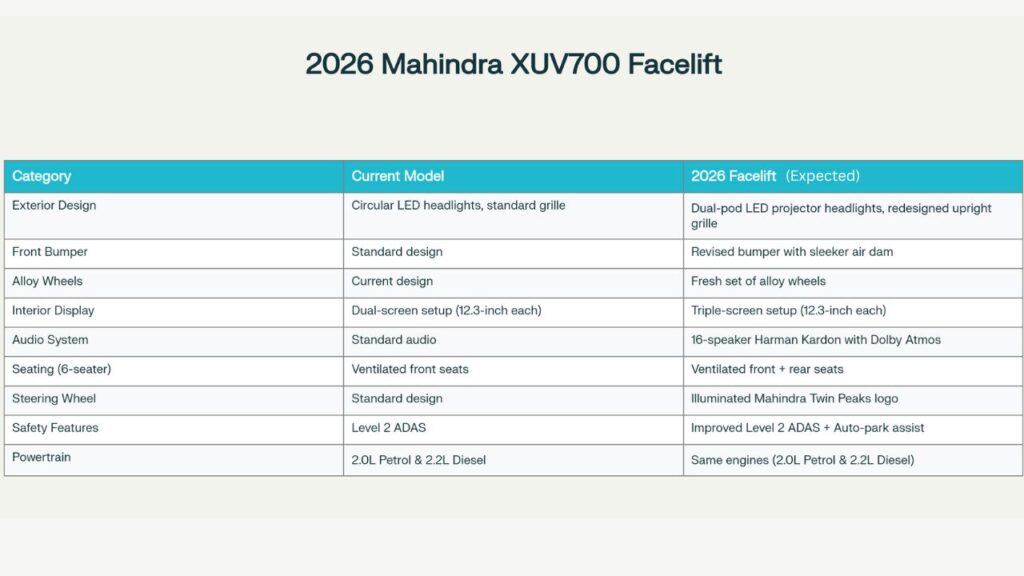
Mahindra XUV700 Facelift 2026 vs Current Model

Mahindra XUV700 Facelift 2026 vs Current Model – (Expected) Key Updates Comparison

Rear End : The rear receives minor changes that includes a new LED lightbar and restyled bumper. The dual tail light set up with vertical extensions mounted on both sides is also said to modernize its looks. 

Interior Features

It’s the interior of the new XUV700 that truly sizzles. Mahindra is bringing certain features from its electric SUVs to enhance the premium feel of the cabin and make it more tech-forward.

Triple Screen Setup: The transformed triple-screen dashboard setup, inspired by the Mahindra XEV 9e, is the most significant change in the interior. The instrument cluster, the infotainment screen, and the co-passenger entertainment screen – all three are 12.3 inches in size. This is the kind of arrangement you usually find in far more expensive SUVs, and it just adds to the value of the XUV700.​

Premium Audio System: The existing unit already a treat to ears but the 2026 gets premium 16-speaker Harman Kardon audio system with Dolby Atmos. This is the same audio system available in Mahindra’s EVs and will give you film-quality audio inside your SUV.​

Comfort Features: The 6-seater model would now receive rear ventilated seats in the second row, ideal for Indian summers. The revised version also introduces an auto-dimming internal rear-view mirror in the XUV700. You will also find one more wireless phone charger, so as you and your partner keep your phones charged on road trips. 

Steering Wheel: The steering wheel now sports an illuminated Mahindra Twin Peaks logo for a premium feel when you get in at night.​

Advanced Safety Tech: Among the most-discussed features is the auto-park assist feature, which can park the car itself in a tight spot —a high-end luxury car feature until now. 

Technology & Safety

Apart from the screens and the sound system, the facelift also makes the XUV700 smarter. The Level 2 ADAS (Advanced Driver Assistance System) will be enhanced with more functions and better performance. A digital key feature will enable you to unlock and start your car from your smartphone.​

Other anticipated technology upgrades include upgraded connected car features and a refreshed infotainment system with more touchscreen-based controls. Rear sun blinds and ambient lighting throughout the cabin which help to create a more premium feeling. 

Same Powerful Engines

Here’s the thing about the facelift — the engines remain the same because they’re already great. The XUV700 will get two power options.​

The 2.0-litre turbo Petrol engine is capable of producing 197 bhp @ 5,000 rpm and 380 Nm of torque between 1,750 and 3,000 rpm. Then there’s the 2.2-litre diesel, which delivers an economical punch for the purists. 

Either a 6-speed manual or 6-speed automatic gearbox can be had for both engines. So no mechanical changes just the engines that have been excellent in terms of reliability and performance. 

What Stays the Same?

The XUV700 facelift is packed with the features that already have you hooked. This includes the panoramic roof, 360-degree camera, ventilated front seats, dual-zone air conditioning, electronic parking brake and tire pressure monitoring system. You can still opt between the 6-seater and 7-seater variants. 

When Can You Buy It?

The update is said to come in 2026. Although the release date has not been confirmed, Mahindra is already shuttling the vehicle on roads in India, meaning that an official unveiling is drawing nearer. 

Conclusion

The Mahindra XUV700 facelift 2026 is turning out to be an impressive midcycle update that the manufacturer planned to bring to the buyers, including more features, better tech and an all-new look. It’s not an all-new design, which is good news, because customers already love the shape of the current XUV700’s body. Instead, it’s a smart refresh that transfers features from luxury cars and electric vehicles to this beloved SUV.

If you’re in the market for a mid-size SUV and can hold on a few months, wait for the 2026 refresh. Mahindra has undoubtedly heard the customers desires and has brought forth an update that emanates an improved comfort, more tech, a more premium feel—all with the same reliable engines and practical design that made the XUV700 such a hit. 

0

Top 10 Most Expensive Cars in Mukesh Ambani’s Collection with Price

Published Jul 2, 2025, 12:51 PM
Last Updated Jul 3, 2025, 6:54 AM

Top 10 Most Expensive Cars in Mukesh Ambani’s

Mukesh Ambani, the name is mentioned in discussions among the wealthiest men. He is famous for his big business and his love for luxury cars. The Mukesh Ambani car collection is large and the collection has very luxurious cars. It has some of the most expensive and beautiful cars you can imagine. These cars are not just for show. They are also very safe and have the latest technology. Learn about Mukesh Ambani’s Top 10 most expensive cars, know about their prices, and features. 

Why Is Mukesh Ambani’s Car Collection Famous?

Mukesh Ambani’s lavish lifestyle is incomplete without his 150 expensive car collection. Each car is picked with care. They are all top brands. Many of them are custom-made. Some are even bulletproof. The Mukesh Ambani car collection showcases power, luxury, and safety. People all over the world talk about his cars.

Top 10 Most Expensive Cars in Mukesh Ambani’s Collection

Here are the top 10 most expensive cars in Mukesh Ambani’s collection. You will also find their prices and what makes each one special.

1. Rolls‑Royce Cullinan Black Badge

Rolls‑Royce Cullinan Black Badge

Image Credit: Rolls Royce

Mukesh Ambani owns a Rolls‑Royce Cullinan Black Badge SUV, gifted to his wife for Diwali at ~₹10 crore ex‑customization, with on-road cost reaching ₹9–10 crore. It runs on a 6.75‑liter twin‑turbo V12 engine tuned to about 600 PS and 900 Nm torque, capped at 250 km/h. The cabin is high-tech, with a fibre-optic “Shooting Star” roof and carbon-fibre details. It’s the most capable Cullinan and combines power and elegance. Ambani’s version includes unique wraps and a VIP ‘555’ plate.

2. Bulletproof Rolls‑Royce Cullinan (Standard)

Bulletproof Rolls‑Royce Cullinan

Image Credit: YouTube

Ambani’s custom bulletproof Cullinan costs over ₹13 crore with armour and military-grade tyres. Built on a base price of ₹7.99 crore, it has a 6.75‑liter twin‑turbo V12 making 563 bhp and 850 Nm torque. It has bullet‑ and grenade‑resistant glass, underbody armour, and run‑flat tyres. The inside is luxurious, seating five in peace, security, and quiet. Ambani became the first in India to own a bulletproof Cullinan, a highlight of safety and luxury.

3. Rolls‑Royce Phantom VIII EWB

Rolls‑Royce Phantom VIII EWB

Image Credit: Rolls Royce

The Phantom VIII EWB is Ambani’s ultra‑long, ultra‑luxury flagship. This car combines with 563 bhp and torque of 900 Nm, powered by a roaring 6.75-liter V12 engine. Extra length gives more legroom and a grand, limousine-style ride. Its interior features handcrafted leather and wood. The car is worth about ₹13.5 crore . It sits high in his garage, a royal symbol. This beast rides smoothly, sliding on the roads which symbolizes his status as India’s richest man.

4. Mercedes‑Maybach S680 Guard

Mercedes‑Maybach S680 Guard

Image Credit: Mercedes Benz

Mercedes‑Maybach S680 Guard: This heavily armoured sedan offers high security and refined ride. It has VR10 protection, bulletproof body, and a 6.0‑liter V12 engine. It costs roughly ₹12 crore. Inside, you’ll find yourself in a serene haven, featuring tinted windows and cushioned leather seats. The Guard version protects from bullets and bombs. When it comes to safety and comfort, Ambani is ready to go ride with it.

5. Mercedes‑Maybach S600 Guard

Mercedes‑Maybach S600 Guard

Image Credit: Mercedes Benz

A sister to the S680, the S660 is another armoured luxury. It sports the same V12 engine and VR10 security. Price: ₹10.5 crore. It gives plush interiors, thick leather, and tinted shields. This car is shorter and sportier than the S680, with similar protection. Ambani uses it when he wants a combination of sportiness, luxury, and safety.

6. Mercedes‑S600 Guard

Mercedes‑S600 Guard

Image Credit: YouTube

The S600 Guard is a strong and well-armoured luxury sedan with a V12 engine. It offers high security, impeccable running speed which makes an incredible model. Its price is close to ₹10 crore. This model also shields from bullets and explosions. It runs smoothly in silence, and offers an enjoyable ride. Luxurious taste from the inside, with leather and a calm ride. Ambani and his family often use it on important journeys.

7. BMW 760Li Security

BMW 760Li Security

Image Credit: BMW

Ambani’s bulletproof BMW 760Li costs ₹8.5–8.9 crore. It uses V12 power (544 bhp, 750‑880 Nm torque), armored doors, windows, and a self‑sealing fuel tank. Underbody protection keeps it safe from bombs. Yet it drives smoothly and quietly. Leather seats and modern controls sit inside. Despite its heavy security, it remains a refined luxury sedan for secure travel.

8. Ferrari SF90 Stradale

Ferrari SF90 Stradale

Image Credit: Ferrari

Ambani’s Ferrari SF90 Stradale is a really expensive hybrid supercar. Together they generate 769–986 bhp and 800 Nm torque, hitting 0–100 km/h in 2.5 s and top speed of 340 km/h . Its carbon‑fibre body and F1‑inspired tech deliver blistering speed and advanced features. This Ferrari is powerful, fast, and full of modern tech worth ₹7.5 crore.

9. Rolls‑Royce Phantom Drophead Coupe

Rolls‑Royce Phantom Drophead Coupe

Image Credit: YouTube

This convertible Rolls‑Royce is rare and elegant. Ambani’s model is worth ₹7.6 crore. This model gives you the prime look with a soft folding roof and a 6.75‑liter V12 engine. This car offers open-air driving with supreme luxury. Inside is plush leather, wood trim, and custom amenities. The Drophead fits special occasions when Ambani wants style and grace under the sky.

10. Ferrari 812 Superfast

Ferrari 812 Superfast

Image Credit: YouTube

Ferrari 812 is a fantastic beast which is superfast with petrol V12 GT. It costs around ₹5.2 crore. It uses a 6.5‑liter V12 engine revving high to deliver 340 km/h. The fast and thrilling car is ready to go on. It has no hybrid system or extra weight. Its design is sleek, angular, and sporty. Ambani adds this car for raw speed and classic supercar feel.

Read More :- Elon Musk Car Collection: A Glimpse Into His Garage

Famous Cars Not in the Top 10

Mukesh Ambani collection has also included most of the famous cars including the Ferrari SF90 Stradale, Bentley Continental Flying Spur, and Tesla Model S. These cars are also very expensive and special. Want to feel Hybrid supercar ride? The Ferrari SF90 Stradale will give you that feel. It is very fast and uses electric power but not only that, It is very comfortable and stylish. It is very fast and has the latest technology.

Conclusion

Mukesh Ambani’s car collection is one of the best in the world. It has the most expensive and luxurious cars. Each car is special in its own way. The collection is a mix of speed, safety, and comfort. It shows the best of what cars can be. If you love cars, the Mukesh Ambani car collection is a dream come true.

0

Steve Hamilton Car Collection: Inside The Hamilton Collection’s $30 Million Hypercar Empire

Steve Hamilton Car Collection

If you’ve spent any time in the auto section of YouTube, you’ve probably seen a garage that appears more like a cathedral of carbon than a parking garage. This is Steve Hamilton Car Collection and The Hamilton Collection.

But he’s not your run of the mill billionaire heir Steve. His tale is one of the most ‘down-to-earth’ rags-to-riches stories in the automotive realm. Steve, who grew up on welfare, built an empire from the ground up – founding SD Wheel and Fitment Industries – long before turning his childhood dreams into a reality. 

Today, the value of his collection exceeds $30 million but it is his “Driven to Giving Back” spirit that makes this collection truly human. So let’s lift the lid on the top dogs, the hypercars, and the mind-boggling price tags of one of the world’s most renowned garages. 

The Bugatti Duo

The centerpiece of the range is always the Bugatti Chiron Super Sport. It’s a 1,500+ horsepower masterpiece that Steve famously borrowed to keep his money tied up in sky high valuations for other ventures. Sitting next to it is the Bugatti Veyron, the car that reignited the hyper car battles in the early 2000s. These two together are like two different eras of physics-defying speed smiling at each other. 

The Bugatti Chiron Super Sport: The $4 Million Masterpiece 

This is without question the crown jewel of Steve’s current collection. Not like his old Bugattis, this one Steve had a hand in spec’ing right from the factory. He selected Grigio Telesto, a well known Lamborghini grey, which makes the car a “stealth bomber.”

The Bugatti Chiron Super Sport

Power: It’s got the mythical 8.0L Quad-turbocharged W16 engine churning out a mind-boggling 1,578 horsepower.

Speed: It has an electronic speed limit of 273 mph. It is more than a car, it’s a land-based jet aircraft. 

Bugatti Veyron: the father of hypercars 

The “Veyron” name is now synonymous with hypercars. Prior to the Chiron reigning supreme on the streets, the Veyron turned the supercar playbook on its head in 2005. Steve keeps this one around just for the raw, unadulterated driving fun.

Why it’s iconic: It was the first production car to go over 400 km/h. 

Why Steve loves it: With 1,001 horsepower, it might be “slower” than the Chiron on paper, but it’s a more visceral experience and comes with a history you can actually feel behind the wheel. 

The Hybrid Icons

Steve’s garage is packed with the “Holy Trinity” of the 2010 titans. The Ferrari LaFerrari is probably the most emotional car in his stable, sporting a monthly finance payment of nearly $39,000 — more than most people’s yearly mortgage. Joining the Ferrari is the Porsche 918 Spyder, a blind engineering masterpiece that Steve loves for being able to drive on a daily basis despite its million-dollar price tag. 

Ferrari LaFerrari: The Hybrid Royalty

Part of the “Holy Trinity”, the LaFerrari is hands down the best looking car Steve owns. It has also been one of his most discussed financial moves.

Ferrari LaFerrari

The Tech: It has a 6.3 L V12 coupled with an electric KERS system (Formula 1 tech) with a combined output of 950 horsepower.

The Price: With only 499 units produced, it’s extremely rare. Steve famously said his finance payment on the car is over $39,000 a month – the price of a new sedan every 30 days!

Porsche 918 Spyder: The Best Daily Hypercar 

LaFerrari is like the drama queen, 918 Spyder is the somewhat nerdy dependable genius.

Versatility: Steve feels this is the most “under appreciated” vehicle in his garage. You can drive it silently in pure electric mode, or fire up the V8 to go from 0 to 60 miles per hour in 2.2 seconds.

Porsche 918 Spyder

The Reason: They’re reliable and comfortable, and are probably the most “usable” million-dollar car you can buy. 

The Koenigsegg and Rimac New Wave

Steve isn’t just guzzling the “old guard.” He’s embraced the bleeding edge with the Rimac Nevera, the quickest-accelerating production electric car on Earth. He also has considerable stake in the Swedish firm, cocking a Koenigsegg Jesko and Gemera, the absolute ceiling of internal combustion and hybrid technology. 

Rimac Nevera: The Silent Assassin

Steve’s foray into all-electric hypercars arrived with the Nevera.

Rimac Nevera

Electric Fury: 914 horsepower from 4 electric motors.

The goods: 0-60 mph in 1.85 seconds Steve spec’d his with a neon green and black theme, which makes it look futuristic outside as the technology inside it. 

Koenigsegg Jesko & Gemera: The Swedish Physics-Defying Supercar

Steve has a very large soft spot for the builds of Christian von Koenigsegg. 

The Jesko: A track demon punching out to 1,600 horsepower (E85 fuel). It chases the 300 mph world record. 

The Gemera: This is the world’s first “Mega-GT.” It’s a four-seat hypercar with a 3-cylinder engine and electric motors that produce over 1,700 horsepower. Steve is able to bring three friends along for an outrageously fast ride. 

McLaren Senna: Track-Focused

Named for the legendary Ayrton Senna, this one is all about aerodynamics.

Design: It’s not “pretty” in the normal sense – every vent and wing exists to generate downforce.

The Drive: With a weight of barely 1,200kg, it’s extraordinarily light. Steve frequently touts this as the most aggressive, “race car for the road” in his stable. 

Read More:-  Brezza vs Nexon 2026: Battle of the Compact SUVs in 2026

Lamborghini Urus: Ultimate Support Vehicle

Every collector has to buy a car for the “boring” stuff — getting coffee, hauling camera gear, etc.

Performance SUV: Urus is no slouch with a twin-turbo V8. It’s a super-car in an SUV.

Role: This is Steve’s “Daily Driver.” It’s the beat stick of the Hamilton Collection, showing that a hypercar collector can occasionally require just a smidge of trunk space. 

A Collection Built for Every Mood

Car Category Key Models in the Collection
Hypercars Bugatti Chiron SS, Rimac Nevera
Track Monsters McLaren Senna, McLaren 765LT, Ford GT
Daily Luxury Lamborghini Urus, Tesla Model X, Mercedes-Benz S-Class
The Fun Stuff Hennessey Venom F5 Revolution

The Realities of Owning a $30M Collection

Steve Hamilton is exceptional in his frankness. But he doesn’t only show the glamour, he also shows the real costs.

Steve Hamilton Car Collection is about $800,000 a year to maintain, including insurance, climate-controlled storage and expert technicians. He’s transparent about borrowing, too. Rather than paying cash, he keeps his money tied up in businesses and real estate where he makes more than the loan interest. 

Conclusion

The most human element about Steve Hamilton Car Collection isn’t the leather and horsepower — it’s the mission. Through The Hamilton Collection, Steve leverages these cars as “tools for good.” Be it by giving fans rides in a Bugatti, mounting giant charity events, or donating proceeds to local causes, the mission is to share the joy of the machines rather than hoard them in a dark vault.

Steve’s progression from a kid who couldn’t afford school field trips to the owner of a Pagani Utopia is a testament to what can be. He shares them: He treats customers, family members and the public as pit crews, so you feel like you’re all in the garage. 

0

Fast Charging vs Home Charging: Which Is Better for Your EV? 

Published Jul 7, 2026, 6:24 AM
Last Updated Jul 7, 2026, 6:27 AM

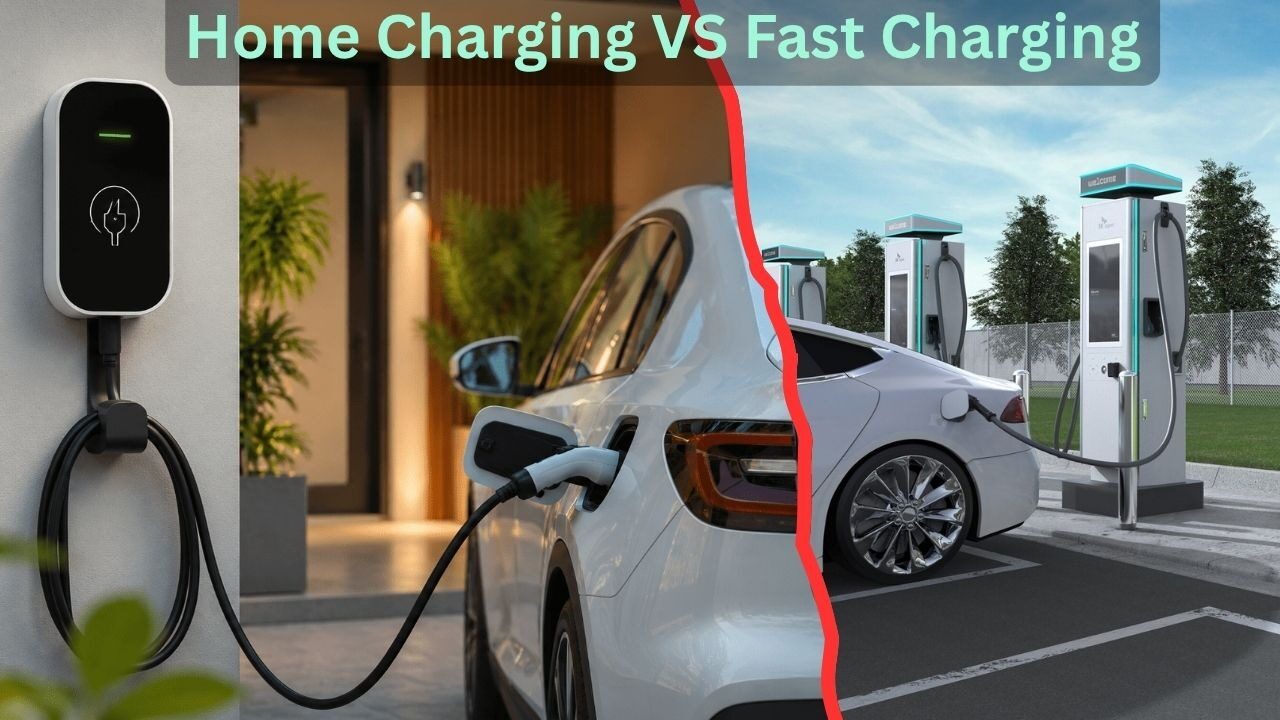
Fast Charging vs Home Charging

Buying an EV is not as hard as choosing a charging method that matches with your lifestyle, expense, and daily convenience. Fast Charging vs Home Charging is not a debate in which one can win, there are different answers from EV car owners themselves. But if you are going to buy an EV car and are confused about the charging method then this blog will make you understand how these two charging methods work.

1. Home Charging: The Reliable Anchor

Home charging usually means an AC charger — either the basic 15A plug that comes with most EVs or a dedicated wall box installed by the manufacturer or a third-party installer. It’s slow by design. A typical home setup adds roughly 8 to 15 km of range per hour, depending on your car’s onboard charger and your home’s power supply. 

For most owners, this means plugging in overnight and waking up to a full battery, every single day, without ever visiting a charging station.

The Advantages

  • Massive Cost Savings: Home electricity tariffs—especially off-peak or night-rate smart tariffs are incredibly cheap. You’re paying your domestic electricity tariff, not a premium station rate. 
  • Increases Battery Lifeline: Slow AC charging produces less heat and stress on lithium-ion cells which increase the battery health. It means your EVs battery won’t be damaged in early years as they experience low average battery degradation of only 1.5% per year, according to large-scale telematics data. 
  • Convenient for City commuters: You don’t have to stand in the line for hours at the station so this home charging method becomes handy. Once you plug in at night, you will get a fully charged vehicle in the morning. 

The Disadvantages

  • Slow Speed: If you need range back in an hour, home charging won’t deliver it since it almost takes from 6 to 12 hours to fully charge a depleted battery.
  • Installation cost and Wiring Upgrades: You have to purchase and install a proper wall box plus wiring upgrade as recent data highlights that nearly 45% of older residential homes or apartment blocks require a minor electrical grid to handle the load that costs you real money.
  • The Apartment or Rentals problem: If you live in an apartment without assigned parking or society approval for a wall box then home charging isn’t an option for you. Even renters and people in shared housing are cut off from this option as they don’t own the parking.

Who It Fits Best

It fits if you live in an independent house or an apartment with assigned covered parking, your daily driving is mostly within city limits, and you can plug in every night without a second thought. This covers a large chunk of EV buyers in Tier 1 and Tier 2 Indian cities who bought an EV specifically to cut down on daily commute costs. 

Cars That Require It Most

Compact or Mid-size EVs and Plug-in Hybrid are required for home charging most. Some reliable EVs such as MG Comet, Tata Tiago EV don’t need high-powered DC fast charging as their batteries are small. If you can afford overnight charging at home then these cars are the best options to buy. And home charging is the cheapest and most convenient way to keep them running.

2. DC Fast Charging: The Road Trip Fuel

Fast charging refers to DC charging stations — the ones you find at highway plazas, malls, and dedicated charging hubs from networks like Tata Power, Statiq, or ChargeZone. These can take a battery from near-empty to 80% in anywhere from 20 minutes to an hour, depending on the car’s charging capability and the station’s output.

The Advantages

  • Incredible Speed: Fast charging can boost the battery from 20 to 80 percent in as little as 20 to 40 minutes. 
  • Enables Long-Distance Travel: That’s the only practical choice for highway travel, it effectively erases range anxiety on highways, making hundred-mile cross-country road trips feasible. 
  • Growing Network: Car manufacturers and the government are working to increase the charging stations. They are rapidly growing as car owners are shifting from petrol to EV cars. 
  • People who don’t own parking spots: Perfect for apartment dwellers, renters now buy an EV for city commute. Similar to a fuel station visit.

The Disadvantages

  • Premium Pricing: Public fast chargers are businesses with high operational overhead. You will pay 2 to 3 times more per kilowatt-hour (kWh) here than you would on your home utility bill.
  • Slightly Higher Battery Wear: Pushing massive amounts of current creates internal heat. Fleet tracking data shows that vehicles relying exclusively on high-power DC fast charging experience an average annual degradation of up to 3.0%.
  • The Taper Effect: Fast chargers slow down significantly after hitting 80% to protect the battery cells from overheating, meaning the final 20% takes frustratingly long.

Who It Fits Best

If you live in a rented flat or a society without charging approval, you regularly drive between cities, or your job involves long daily distances that a single overnight charge can’t cover. It also fits anyone whose EV is a second car used mainly for longer, less predictable trips rather than a fixed daily commute. 

Cars That Require It Most

In Premium & high-range EVs, the advanced 800V battery is fixed to run the engine for many kilometers. Big range EVs like Hyundai Ioniq 5, Kia EV6, or Porsche Taycan are equipped with this battery. These vehicles are specifically engineered to gulp down 250+ kW of power, allowing them to extract maximum utility from ultra-fast public networks.

Read More :- Mercedes Benz CLA 250+ Real-World Range Tested

The Fair Comparison of Fast Charging vs Home Charging

Factor Home Charging Fast Charging
Speed 8–15 km/hour (slow, overnight) 0–80% in 20–60 minutes
Cost per charge Lowest — domestic tariff Higher — commercial station rate
Battery health impact Minimal stress, better long-term health More heat, faster degradation if overused
Convenience High, if you own your parking High, but requires a trip to a station
Upfront cost Wall box + installation charges None — pay per use
Best for Daily commuting, city driving Highway travel, no home parking, urgent top-ups
Availability Depends on your housing situation Depends on your city/route infrastructure

The Car Matters More Than People Admit 

A city-focused compact EV with a smaller battery — the kind bought mainly for daily office commutes leans almost entirely on home charging, since the battery is rarely drained enough to need a fast-charge stop. Premium EVs built on big batteries to give longer range are particularly bought for highway trips. They depend on a strong fast-charging network, because home charging alone can’t refill a large battery overnight for back-to-back long drives. 

In short: Compact everyday EVs are designed to run on home charging, meanwhile long-range and luxury EVs are designed to run highways with fast-charging availability.  

Your Car’s Battery Chemistry (LFP vs. NMC) That EV Buyers Often Forget

Lithium Iron Phosphate (LFP) — The LFP battery is known for being long lasting. They handle aggressive fast charging with close to zero additional degradation, and they can be charged to 100% every day, safely. 

Nickel Manganese Cobalt (NMC) — NMC batteries are more susceptible to heat and high voltage. If you’ve got a vehicle with an NMC battery, it thrives on slow charging at home, and you’d best think of DC fast chargers as something you need just for occasional road trips. 

Read More :- Best Automatic Cars in India Under 10 Lakhs – Easy Driving Options

Why This Comparison Actually Matters for EV Buyers

Most people cross-shop EVs by comparing range and price, and treat charging as an afterthought they’ll figure out later. That’s backwards. Your charging setup determines your real-world cost of ownership, how fast your battery degrades over five to eight years, and whether owning an EV is even convenient for your specific living situation. 

Two people can buy the identical car and have completely different ownership experiences — one because they have a private garage and never touch a public charger, the other because they’re queuing at a mall charger three times a week. The charging question isn’t a footnote. It’s arguably more important than the range number on the brochure.

Why Buyers Should Plan for Both

The most realistic approach isn’t picking one — it’s building a routine where home charging handles 80-90% of your needs, and fast charging exists as a backup for the days that don’t fit the routine: a road trip, a forgotten overnight charge, an unexpectedly long day of driving. 

Buyers who plan around both, rather than betting on one exclusively, tend to get the best of both worlds — low daily running costs from home charging, and the flexibility to never be stranded, thanks to fast charging when it’s genuinely needed.

Crucial Factors EV Buyers Often Forget

  • Check your onboard charger’s AC limit before buying a wall box. Some EVs cap AC charging speed regardless of how powerful your home charger is — paying for a high-output wall box in that case is wasted money.
  • Society approval can take longer than expected. If you live in an apartment, start the RWA approval process for a charging point well before your car is delivered.
  • Fast charging isn’t available at the same speed everywhere. Not all “fast chargers” are equal — output varies station to station, so your actual charging time on the road can differ a lot from the advertised number.
  • Battery warranties usually still apply regardless of charging method, but manufacturers often quietly recommend limiting fast charging to occasional use rather than a daily habit, for exactly the degradation reasons mentioned above.

Read More :-  The Future of Electric Vehicles: What Drivers Need to Know

Conclusion

Home charging wins on cost and battery health. Fast charging wins on speed and flexibility. Neither one replaces the other — they solve different problems. The right question isn’t “which is better in Fast Charging vs Home Charging,” it’s “how much of my driving is predictable daily commuting versus unpredictable long-distance travel,” because that answer decides how much you’ll actually lean on each option. 

0

Zero Depreciation Car Insurance: Benefits, Coverage & Cost

Published Jul 28, 2026, 12:26 PM
Last Updated Jul 28, 2026, 12:28 PM

Zero Depreciation Car Insurance

You back into a pole at 5 kmph. Bumper’s cracked, headlight’s gone. The garage quotes ₹50,000. Then your insurer settles the claim and pays out closer to ₹37,000. The other ₹13,000? Depreciation. So you must understand where Zero Depreciation Car Insurance will help. Your bumper and headlight are made of plastic and rubber, and every standard comprehensive policy in India applies a flat 50% cut to those parts, no matter how new the car is.

This is the exact gap that Zero Depreciation Car Insurance is built to close. It’s an add-on, not a separate policy that sits on top of your comprehensive cover and tells the insurer: don’t deduct depreciation on the parts you’re replacing, just pay the real repair bill, minus the deductible. For a car that’s still within its first few years, that difference in payout can run into thousands of rupees on a single claim.

Why Depreciation Reduces Your Insurance Claim 

The Insurance Regulatory and Development Authority of India (IRDAI) sets a standard age-based depreciation schedule that every insurer follows for a regular comprehensive claim. It looks like this:

Age of vehicle Depreciation on parts
Up to 6 months Nil
6 months – 1 year 5%
1 – 2 years 10%
2 – 3 years 15%
3 – 4 years 25%
4 – 5 years 35%
5 – 10 years 40%
Above 10 years 50%

On top of that age-based table, a few part categories get a fixed rate regardless of how old the car is: rubber, nylon and plastic parts, tyres, tubes and batteries are depreciated at a flat 50%, fibreglass components at 30%, and glass at 0% (glass is the one thing you always get paid for in full). 

Zero Depreciation Car Insurance

Bumpers, dashboards, trims, wiper blades, headlight housings — the parts that actually get damaged in a fender-bender mostly fall into that 50% bucket. That’s why even a fairly minor accident on a fairly new car can leave you covering a surprising chunk of the bill yourself.

Zero Depreciation Car Insurance cover essentially waives that deduction, so the claim tracks the garage invoice far more closely.

Coverage and Limits of Zero Depreciation Car Insurance 

It’s worth being precise here, because “zero depreciation car insurance” doesn’t mean zero deductions of any kind.

  • Metal, plastic, rubber and fibreglass parts replaced during an accident repair are paid in full (subject to your deductible), instead of at the depreciated rate.
  • Tyres and tubes are a common exception: even with zero depreciation, insurers typically still apply the standard 50% cut on tyres and tubes unless you’ve separately added a “Tyre Protect” cover. It’s an easy detail to miss when you’re comparing quotes.
  • Mechanical or electrical breakdown, and damage from regular wear and tear rather than an accident, still isn’t covered — Zero Depreciation Car Insurance only changes how accidental-damage claims are calculated, not what counts as a valid claim.
  • Most insurers cap how many zero-dep claims you can make in a policy year — some restrict it to two, while a handful of newer-generation plans from insurers like ICICI Lombard and Tata AIG are now marketing unlimited zero-dep claims. This varies enough between insurers and even between plans from the same insurer that it’s genuinely worth reading the policy wording rather than assuming.

Read More:-  How to Save Money on Car Insurance?

How Zero Depreciation Insurance Reduces Repair Costs

Go back to that ₹50,000 repair bill. Without Zero Depreciation Car Insurance, a 2-year-old car loses ₹13,000 to depreciation on that claim alone (50% off the plastic/rubber components, 10% off everything else). With Zero Depreciation Car Insurance, most of that comes back to you. Multiply that across the accidental fender-benders, chipped bumpers and cracked tail-lamps most cars pick up in city driving, and the add-on pays for itself fairly quickly on a newer vehicle.

Zero Depreciation Car Insurance

There’s a second, quieter benefit too: because you’re not fighting over depreciated part values, claims tend to settle with less back-and-forth with the surveyor. And if you eventually sell the car, having a clean repair history with OEM-grade parts (rather than a patchwork of cost-cut replacements) tends to help at resale.

Zero Depreciation Car Insurance Cost

Zero dep isn’t free — it adds roughly 10-25% to your own-damage premium, since it’s calculated as a percentage loading rather than a flat fee. For a 2025 Tata Nexon insured at an IDV of around ₹12 lakh, a standard comprehensive premium of about ₹7,800 rose to roughly ₹9,500 with Zero Depreciation Car Insurance added — an extra ₹1,700 for the year. 

That’s one illustrative example rather than a universal figure; your actual loading will depend on the car’s make, model, city (Delhi and Mumbai typically load higher than smaller towns), and the insurer’s own pricing, so treat it as a ballpark and get an actual quote before renewal.

Eligibility is the other cost-adjacent factor: most insurers restrict Zero Depreciation Car Insurance to vehicles up to 5 years old, though the exact cutoff varies by company — some extend it a year or two further for an additional loading.

Who Should Consider Zero Depreciation Cover? 

For a new car, or one still in its first three to five years, yes — this is close to a default recommendation. That window is when a car both depreciates fastest and gets into the most fender-benders, so the add-on is doing real work every time you make a claim. 

It’s an easy call for anyone on a car loan too, since lenders often prefer the vehicle stays fully protected until the EMIs are cleared, and for owners of premium or luxury cars, where part costs run high enough that even a 15-20% depreciation cut is a meaningful sum.

Zero Depreciation Car Insurance

Past the five-to-seven-year mark, the math flips. The car’s IDV has dropped enough that claim sizes shrink, the depreciation percentage is already near its ceiling anyway, and the extra premium starts looking like money spent on a cover you’re unlikely to use fully. 

At that stage, most owners are better off putting that premium toward a straightforward comprehensive policy and, if anything, an engine-protector or return-to-invoice add-on instead.

A Quick Checklist Before You Buy 

Don’t just add Zero Depreciation Car Insurance because the salesperson recommends it — actually check three things on the quote: how many zero-dep claims the policy allows per year, whether tyres and tubes are excluded from the waiver, and how much your own-damage premium actually rises with it added versus without. 

A ₹1,500-2,000 annual increase on a 2-year-old car is an easy yes. The same increase on a 6-year-old hatchback is worth doing the arithmetic on first.

Read More:- How to Renewal Car Insurance: Step-by-Step Guide (2026)

Conclusion

Zero Depreciation Car Insurance is among the few addons that actually come handy at the time of making a claim. For cars that are new or less than five years old, the higher premium often makes sense because it can greatly reduce your repair costs.  

Coverage limits, claim caps and exclusions differ between insurers, so it’s worth comparing the policy wording rather than assuming all zero-dep plans are created equal in terms of benefits. A couple of minutes checking the small print today could save you thousands on your next repair bill.