
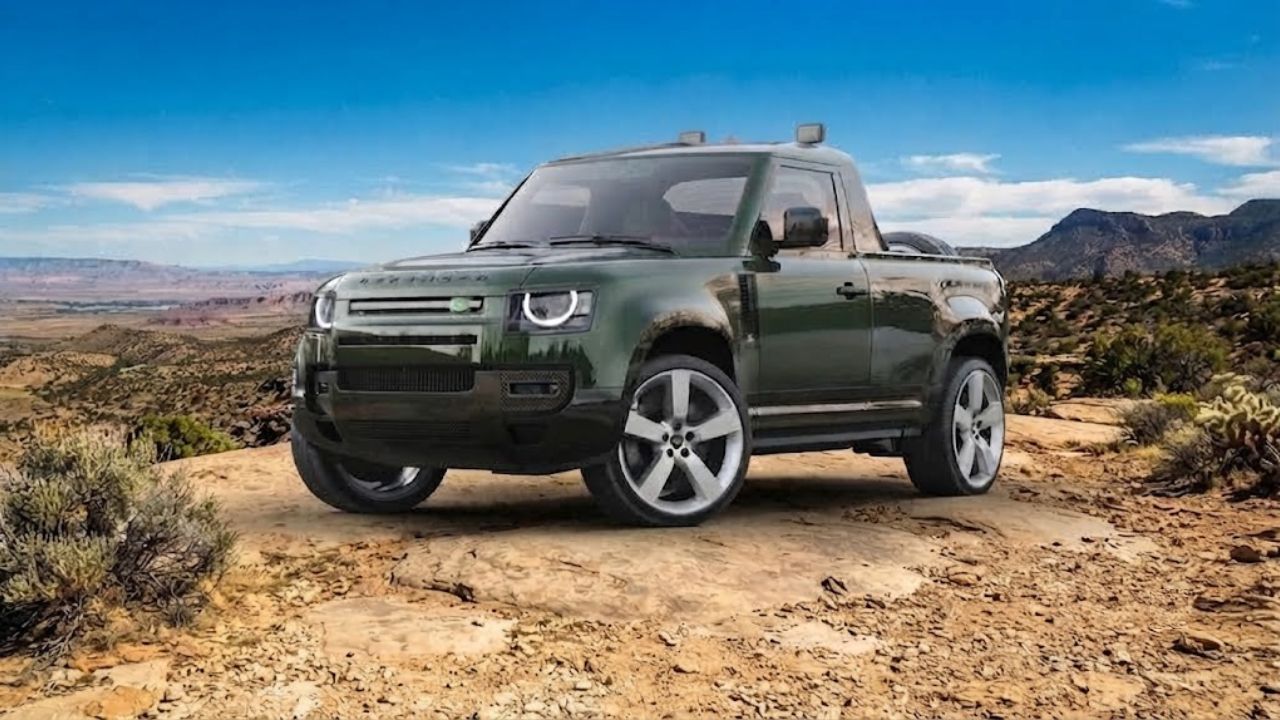
For years, Defender fans have asked why Land Rover keeps teasing a pickup version and never builds one. Now, Jaguar Land Rover (JLR) is working with Stellantis to build a Land Rover Defender pickup truck in the United States — and the reason has less to do with off-road capability and more to do with import tariffs.
The specifications are still not confirmed. This is the first product of collaboration so expecting great tech and reliability of a pickup truck is the first thing to think about.
The Official Agreement Between JLR and Stellantis on Product Development
Back in May 2026, JLR and Stellantis signed a non-binding memorandum of understanding (MoU) to “explore opportunities to collaborate on product development” in the US, along with shared manufacturing capacity. At the time, neither company named a specific vehicle.
That changed in September 2026, when Automotive News reported that the first product out of this alliance would be a Land Rover Defender pickup truck built for the US market. JLR’s Chief Financial Officer, Richard Molyneux, confirmed on an earnings call that the two companies intend to finalize the broader agreement by the end of 2026. JLR’s CEO, PB Balaji, has separately said the goal is to grow JLR’s US business to eventually match the size of its entire global business — a genuinely ambitious target.
Stellantis has acknowledged joint discussions are underway, but neither company has publicly confirmed “pickup truck” as the specific output.
Why Land Rover Defender Pickup Truck Has to Be Built in America
This is really a tariff story wearing a product story’s clothes.
Every Defender sold in the US today — the 90, 110, and 130 — ships in from JLR’s plant in Nitra, Slovakia. Passenger vehicles built in the UK and EU already face added US import tariffs. But trucks get hit worse: American light trucks and pickups imported from abroad face the 25% “Chicken Tax,” a tariff that’s been on the books since the 1960s and makes shipping a European-built truck to the US financially unworkable.
Building the pickup on US soil with Stellantis sidesteps that tariff entirely. North America now accounts for roughly 30% of JLR’s global sales, while China — once its biggest market — has fallen to under 7%. A pickup built for Americans, by an American-based partner, is JLR reading the room.
If it happens, it would also mark JLR’s first vehicle assembly in the US, and the first Land Rover-badged pickup sold there since British Leyland shipped over Series I and Series II trucks in the 1960s and early ’70s.
Read More 👉 This Used Luxury Car Costs the Same as a Top-Spec Maruti Fronx
The Engineering Behind Defender
The current Defender is a unibody vehicle. Stellantis’s American trucks — the Ram 1500, Ram Heavy Duty, and Jeep Gladiator — are body-on-frame. Those are different structural philosophies, and no one has said which way a Defender pickup would go.
Stellantis does have unibody experience through the Jeep Grand Cherokee and Dodge Durango, so a unibody truck isn’t off the table, but it’s not confirmed either.
Powertrain is just as open. Shipping Defender’s European engines to the US would trigger its own tariffs, but slotting in an off-the-shelf Stellantis engine might not fit a vehicle Land Rover wants to sell at premium prices.
Size, trim strategy, launch year, and pricing haven’t been disclosed by either company. Any number you see for engine output, mileage, or price right now is a guess dressed up as a leak.
Land Rover Defender Pickup Truck Rivals Already In The Market
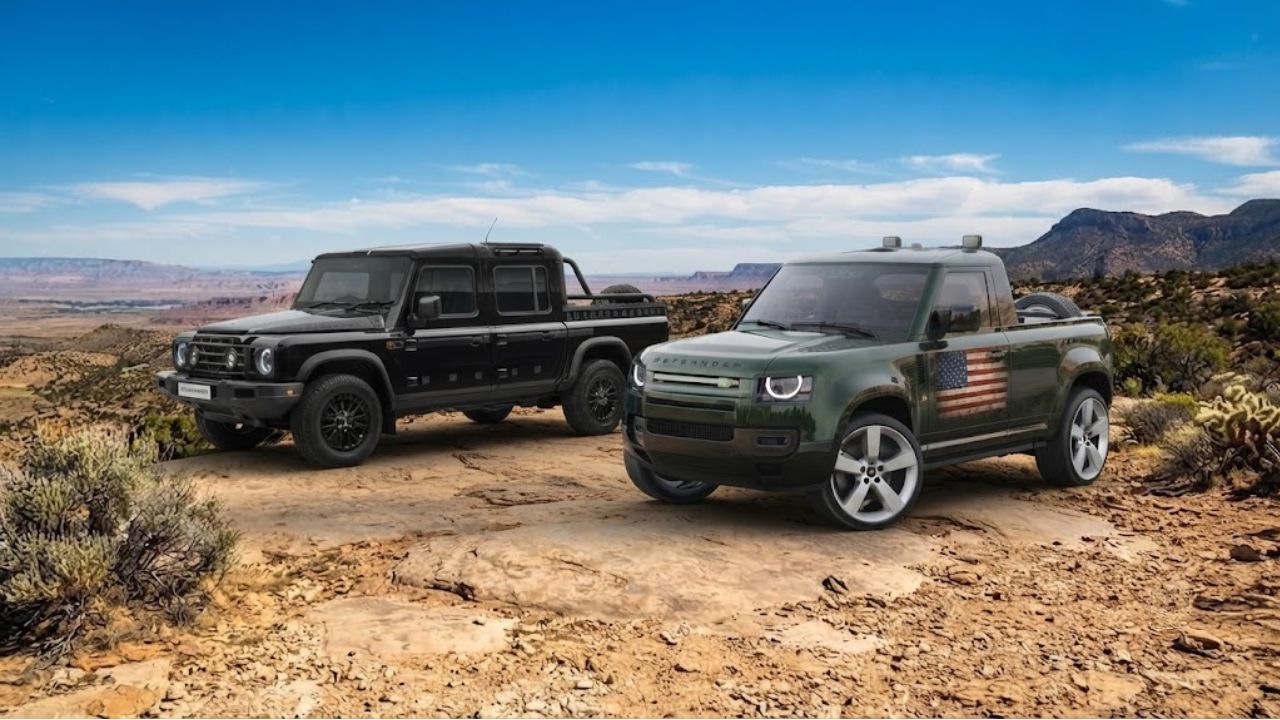
The Ineos Grenadier Quartermaster as the closest natural rival — a body-on-frame, old-school off-roader with genuine pickup credibility and a similar niche, premium-utility positioning. The Jeep Gladiator gets the hook too, though as a lower-priced, less luxury-focused alternative rather than a direct match.
Beyond that, a Defender pickup would land in the same rarefied air as loaded trim levels of the Ford F-150 Platinum and GMC Sierra Denali — trucks that compete less on payload bragging rights and more on cabin quality and brand cachet. If JLR positions this as a genuine luxury pickup rather than a rebadged Stellantis product, that’s the shelf it’s aiming for.
Read More 👉 Get New Maruti Premium Hatchback at Lower Price
Expected Specification and Size of Land Rover Defender Pickup Truck
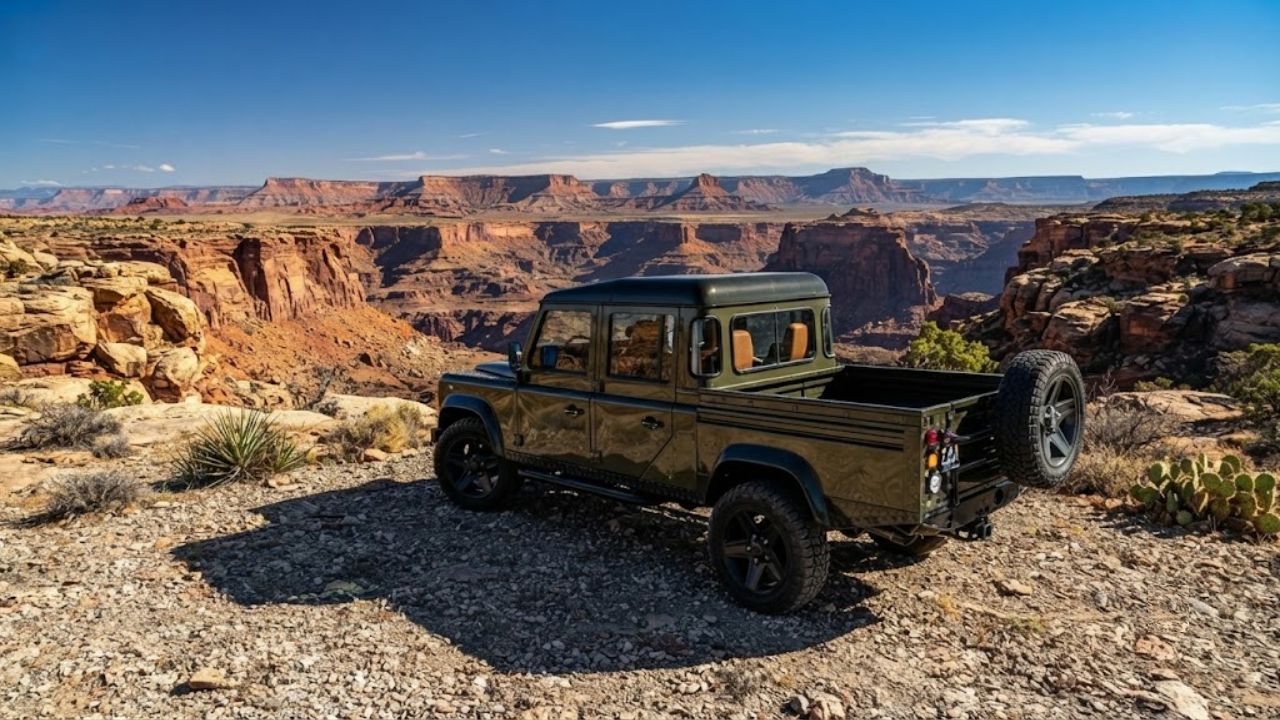
Land Rover Defender Pickup are using the Defender 110 as the donor vehicle since it’s the volume model closest to a crew-cab truck’s proportions. The current Defender 110 measures around 5,018mm in length including the rear-mounted spare wheel and uses a 3,022mm wheelbase. The most-floated build approach isn’t a clean-sheet truck at all — it would keep the 110’s front section, four doors and five-seat cabin, and simply replace the rear luggage compartment with an open load bed.
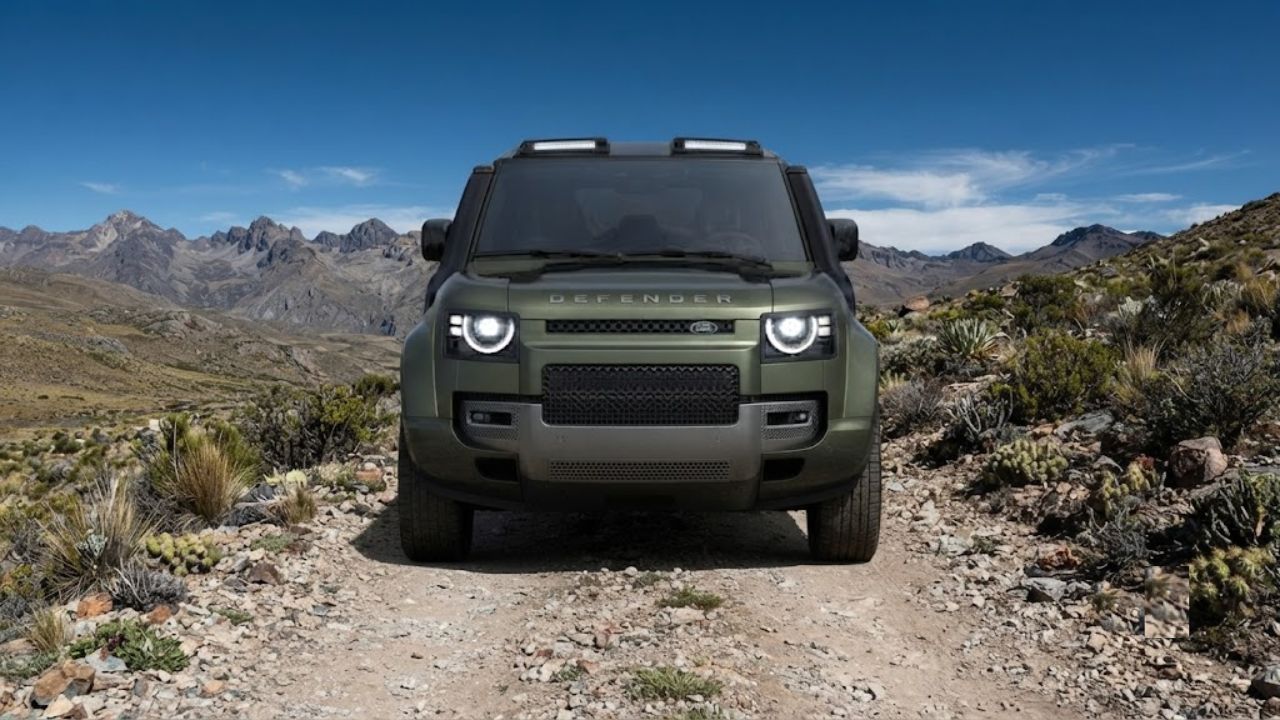
Unlike traditional pickups, the Defender uses JLR’s aluminium D7x monocoque architecture rather than a separate ladder-frame chassis. Stellantis’s US trucks (Ram 1500, Ram HD, Gladiator) are body-on-frame. But still it’s unconfirmed.
The current lineup runs from a 296-hp turbocharged four-cylinder to a 626-hp twin-turbo V8, but European-built JLR engines would face import tariffs if shipped over for US assembly. An off-the-shelf Stellantis engine dodges that, but risks feeling wrong in a truck JLR wants to price at a premium.
Read More 👉 BMW i5 LWB On Road Price Is Lower Than What Buyers Expected
Conclusion
If the deal is finalized by the end of 2026 as JLR’s CFO suggested, the realistic next milestone to watch for is an official confirmation of the vehicle itself. Concept reveals, platform confirmations, and pricing typically trail an MoU finalization by a year or more in projects like this.
For now, JLR wants an American-built Land Rover Defender Pickup Truck badly enough to partner with a rival automaker to get around a 60-year-old tariff law. Everything past that — what it looks like, what it costs, whether it ever reaches a market outside the US is still an open question.
